Business Travel Makeup Bags: Professional Packing Solutions
Executive Summary
A business travel makeup bag is specified around three constraints that a leisure pouch does not face: it has to fit inside a laptop bag or cabin roller without a separate allowance, it must not leak onto a suit or a shirt, and it should look and sound neutral in a shared space. The working answer is a structured case of 1.8-3.0 litres usable volume at roughly 24 x 15 x 9 cm, with a welded or PU-coated lining, a reverse-coil zipper in a garage, and a low-sheen shell in charcoal, navy or black.
Everything else follows from those constraints. A matte shell hides scuffing from a conveyor, a quiet coil zipper avoids noise in a shared hotel room, and a flat rectangular footprint slides into a 38 x 28 x 8 cm laptop compartment. Branding stays tonal: a debossed PU patch or tone-on-tone embroidery rather than a bright print. Programme terms are the same as any cosmetic bag range: 500 pieces per style and colourway, 6-10 working day sampling, 35-50 day bulk production and AQL 2.5 inspection.
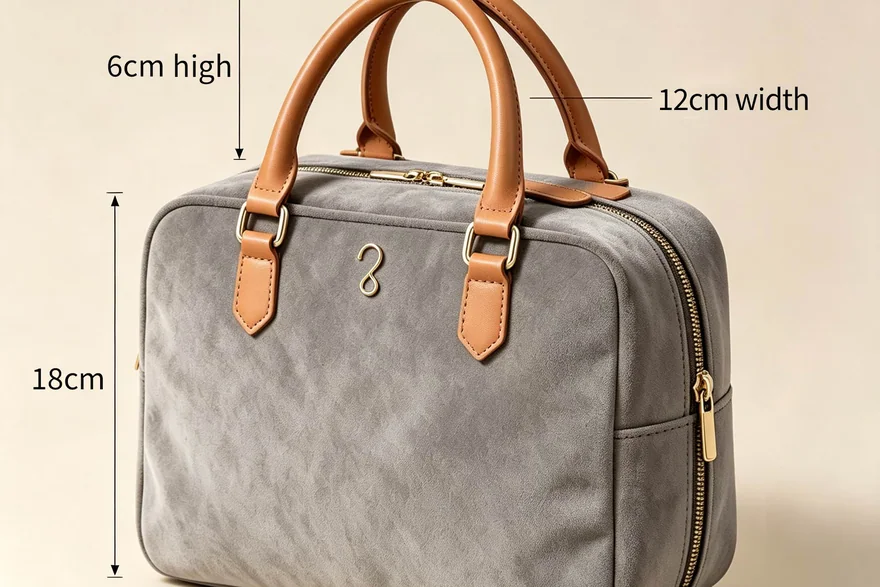
What Business Travel Asks of a Makeup Bag That Leisure Travel Does Not
Business travel compresses the packing problem into one bag. A traveller on a two-day client visit typically carries a cabin roller or a laptop bag, not both, so the cosmetic case competes for space with a charger, a notebook and a folded shirt. There is no second personal-item allowance in practice, and there is no time at the destination to re-pack. The case therefore has to hold a full kit, slide into a narrow compartment, and come out looking the same as it went in after a security tray and a conveyor belt.
- Single-bag travel: the case competes with work equipment, so footprint matters more than total volume.
- Garment risk: a leak reaches a suit, a shirt or a laptop, and the cost of that failure is far higher than the bag.
- Shared-space behaviour: noise, shine and bright branding read badly in a meeting-adjacent setting.
- Repeat handling: a business traveller may pack and unpack forty times a year rather than four.
- Counter time: hotel basins are small and lit poorly, so the case has to work flat and open wide.
The liquids constraint is the same one any air traveller faces, but it bites harder on a short trip. Under the TSA 3-1-1 liquids rule containers are capped at 100 ml and must fit in one quart bag, so a one-night business trip and a ten-night holiday carry the same liquids block. The practical consequence is that a business case should be designed around a removable quart pouch at the top of the case, reachable without unpacking the rest, because that pouch comes out at the security tray on every single leg.
A structured case at 1.8-3.0 litres usable, roughly 24 x 15 x 9 cm closed, with a coated or welded lining, a reverse-coil zipper in a garage, a flat rectangular footprint that slides into a laptop compartment, and a low-sheen shell in charcoal, navy or black. Anything that rattles, shines or leaks is off the brief.
Fitting the Case Into a Laptop Bag, Roller or Backpack
Volume is not the binding constraint on a business trip; shape is. A 2.5 litre case with a curved barrel profile will not slide into a laptop compartment, while a 2.2 litre flat rectangular case will. Buyers should therefore specify the case against the internal clear dimensions of the carry system it is sold to accompany, and should state those dimensions in the tech pack. A laptop compartment is typically 38 x 28 x 8 cm internally but is often shared with a charger, so a case should occupy no more than about 60% of that footprint, which points to a 24 x 15 x 9 cm closed case.
| Carry system | Typical internal clear space (cm) | Space realistically left for a cosmetic case (cm) | Case shape that works | Case shape that fails |
|---|---|---|---|---|
| Cabin roller, 55 x 40 x 20 | 50 x 35 x 18 | 24 x 16 x 9 in the lid pocket | Flat rectangular case with a 9 cm gusset | Barrel or cylindrical case, which rolls and wastes corners |
| Laptop briefcase, 40 x 30 x 10 | 38 x 28 x 8, shared with a charger | 24 x 15 x 7 | Slim flat case under 7 cm deep | Structured vanity case with a rigid frame |
| 18-22 litre daypack | 42 x 26 x 14 | 22 x 14 x 10 | Soft pouch that can compress to 6 cm | Hanging case with a moulded hook, which catches on the lining |
| Garment bag, folded | Folded flap pocket 30 x 20 x 4 | 28 x 18 x 4 | Flat envelope pouch with a wrap closure | Any case with a 3 mm foam base panel |
| Underseat cabin bag, 40 x 20 x 25 | 38 x 18 x 23 | 24 x 15 x 9 alongside a quart liquids bag | Rectangular case with squared corners | Rounded corners, which lose about 8% of usable corner volume |
Squared corners matter more than most spec sheets admit. A case with a 25 mm corner radius loses roughly 8% of usable volume compared with a square-cornered case of the same external dimensions, which on a 2.2 litre case is about 0.18 litres, or one foundation bottle and one palette. A business case should therefore be specified with square or near-square corners and a flat, non-rolling base, and the sample should be tested by sliding it into the actual carry system rather than by measuring it on a bench.
- Specify against the internal clear dimensions of the carry system, not against the carry system's marketing size.
- Target about 60% of the available compartment footprint so a charger and a notebook still fit.
- Use square corners; a 25 mm radius costs roughly 8% of usable volume.
- Put the removable quart liquids pouch at the top of the case so it clears security without unpacking.
- Test the sample by sliding it into the real bag, loaded, not empty on a bench.
One more practical check belongs on the spec: the case should be tested with the carry system's own contents, not alone. A laptop bag already holding a 1.4 kg laptop and a charger has less free depth than an empty one, and that is the condition in which the case is actually used. Buyers who skip this step approve a sample that fits an empty bag and return a bulk shipment that does not.
Orientation matters too. A case that will be carried upright in a roller lid should have its zipper along the long top edge so it can be opened in place; a case that will lie flat in a briefcase should have the zipper on the front face. Getting this wrong is invisible on a sample table and obvious on the first trip, which is why the orientation should be stated on the tech pack with a simple sketch.
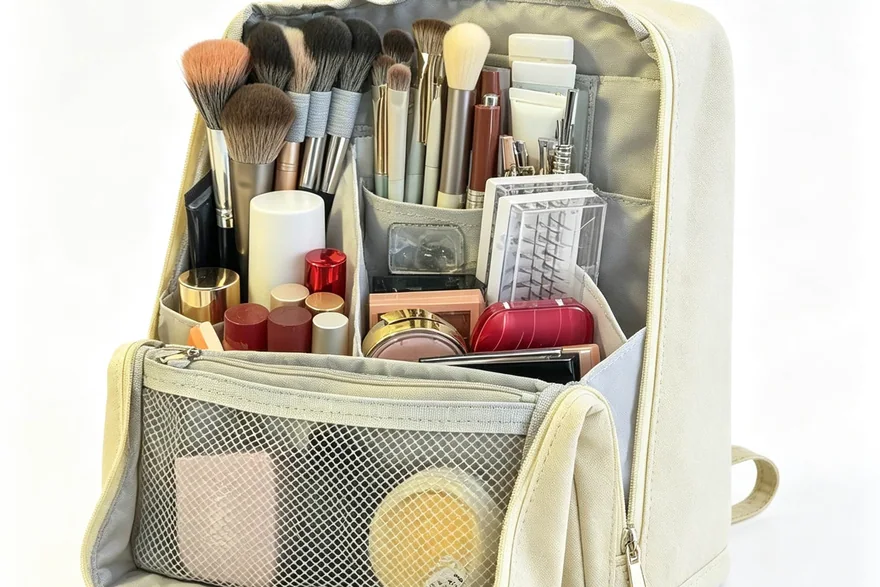
Leak, Crush and Transfer Protection for Work Wardrobes
The cost asymmetry on a business trip is extreme. A leaking shampoo bottle inside a £300 suit costs the traveller far more than the bag, and that is the review the brand receives. Protection therefore has three layers: a lining that does not wick, a closure that does not weep at the corners, and a geometry that keeps liquids separate from powders. A PU-coated 210D lining at 0.10-0.15 mm, or a welded PEVA lining with radio-frequency sealed seams, stops liquid reaching the shell; a lining that is merely water-repellent sprayed will not, because wicking happens through the stitch holes.
| Failure mode | Mechanism | Test to write into the spec | Specification fix |
|---|---|---|---|
| Liquid reaching the outer shell | Wicking through needle holes in a sprayed lining | 24 hour inverted test with 50 ml of water on a lined panel | PU-coated 210D lining at 0.12 mm or welded PEVA with sealed seams |
| Weeping at the zipper corners | Coil tape ends left open at the top stop | 30 minute inverted fill at 1.2 kg, corners lowest | Reverse-coil zipper with a moulded end stop and a storm garage |
| Powder contamination from a broken compact | No separation between dry and wet zones | Drop a filled compact from 60 cm onto a hard floor inside the case | Two compartments with a full-height divider, not a half-height one |
| Crushed pump dispenser | Case compresses under a full roller lid | 25 kg distributed load for 10 minutes on the closed case | 3 mm EVA foam in the base panel and a semi-rigid side wall |
| Colour transfer onto a light shirt | Poor rubbing fastness on a dark dyed shell | Crocking test on the face fabric, dry and wet | Disperse-dyed polyester at grade 4 or better, plus a post-dye reduction clean |
| Capillary creep along a webbing handle | Unsealed webbing tape passing through the lining | 48 hour dye-penetration check on the handle anchorage | Bind the webbing end and seal the anchorage with a PU dot |
Coated fabrics are the variable most often left vague on a tech pack. A buyer should name the coating type, the coating weight in grams per square metre and the performance test, because 'water-resistant' covers everything from a spray finish that survives one wash to a film that holds a 3,000 mm hydrostatic head. Terminology and test methods for coated fabrics are set out in ASTM D751, which covers coating adhesion, hydrostatic resistance and blocking, and citing those clauses removes most of the ambiguity between sample and bulk.
The remaining risk on a business case is the one nobody photographs: what happens to the contents during a pressurized descent and a bumpy transfer. Bottles expand slightly as cabin pressure drops, which is why a screw cap with a sealed liner beats a flip top, and why a case should be specified with an internal retention strap that holds bottles upright rather than letting them lie. A simple 20 mm elastic strap across the wet compartment costs about $0.08 and prevents the most common in-transit leak.
Powder products deserve the same attention as liquids. A pressed compact survives a trip far better than a loose powder, and a case designed for business travel should specify a rigid or semi-rigid slip pocket for compacts rather than a soft one. The pocket needs a 4 mm clearance around the pan so the compact can be lifted out by its edge, because a compact wedged into a tight pocket is the item a traveller breaks while trying to extract it at 6 am.
- Screw caps with a sealed liner, not flip tops, because cabin pressure changes push liquid past a flip closure.
- A 20 mm elastic retention strap across the wet compartment to keep bottles upright in transit.
- A semi-rigid slip pocket for pressed compacts with 4 mm of clearance so the pan can be lifted by its edge.
- Decant into 100 ml containers before a multi-city trip rather than carrying one large bottle.
Finish, Colourway and Branding Rules for Professional Kits
Professional kits are judged on three sensory details before they are judged on capacity: how the shell reflects light, how much noise the hardware makes, and how visible the logo is. A high-gloss TPU shell looks striking on a retail hook and looks scuffed after three trips through a conveyor. Metal pullers tapping against a metal slider are audible across a hotel room at 6 am. And a full-colour logo on the front panel turns the case into a promotional item, which is fine for a conference giveaway and wrong for a bag a consultant buys for herself.
| Element | Option that suits business travel | Option to avoid | Reason |
|---|---|---|---|
| Shell finish | Matte or semi-matte 600D polyester, 3-8 gloss units | High-gloss TPU or patent PU | Gloss shows conveyor scuffing and finger marks within a few trips |
| Hardware sound | Coil zipper with a moulded or rubber-dipped puller | Metal slider on metal teeth with a loose metal puller | Metal-on-metal rattles in a shared room and in transit |
| Colourway | Charcoal, navy, black, deep taupe | White, blush pink, bright print | Light shells show makeup transfer and dirt at the handles |
| Logo method | Debossed PU patch or tone-on-tone embroidery | Full-colour heat transfer across the front panel | Tonal marking reads as product; a large transfer reads as promotional |
| Interior colour | Mid-grey or taupe 210D lining | Black lining | A dark interior makes contents hard to find under hotel lighting |
| Edge treatment | Bound seams with a tonal binding tape | Contrast binding | Contrast edges draw attention to wear at the corners |
Branding still has to survive the same inspection as the rest of the case. A debossed PU patch should be specified with a stitch margin of at least 3 mm and a pull test on the patch anchorage, and tone-on-tone embroidery should be quoted at 6,000-9,000 stitches for a 40 x 15 mm mark, below which the satin edge looks thin on a coated shell. These checks belong in the same defect classification as the rest of the case, applied at AQL 2.5 under ISO 2859-1, so a marketing-critical mark is not treated as a minor visual defect and waived at release.
Two finishes sit in between the promotional and the anonymous, and both work well in this channel. A blind deboss into a PU patch gives a mark that is visible only when light falls across it, which suits a professional buyer who wants branding without display. A laser-etched faux-suede patch gives more definition at a similar cost. Both need a stitch margin and a pull test, and both should be sampled on the actual coated shell rather than on a fabric swatch, because a coated surface takes a deboss differently from an uncoated one.
- Blind deboss into a PU patch: visible only in raking light, suits a buyer who wants marking without display.
- Laser-etched faux-suede patch: more definition at a similar unit cost, holds fine detail below 1 mm.
- Sample the mark on the real coated shell, not on a fabric swatch, because a coating changes the deboss result.
- Set the patch pull test and the abrasion check on the mark alongside the rest of the defect list.
A structured business case with a coated lining, a foam base panel and a debossed patch sits at the complex end of sampling, so allow 12-15 working days rather than 6-10. Bulk production runs 35-50 days after sample approval at 500 pieces per style and colourway. Corporate buyers often reorder the same case annually, so the tech pack, the Pantone reference and the patch artwork should be archived against the style number at first order.
The B2B Customisation View
What separates a smooth cosmetic pouches, vanity cases and beauty organisers launch from a painful one is usually the quality of the technical pack rather than the price of the fabric.
Planning figures used across the programme: MOQ 500 pieces per style and colourway, 6–10 working days sampling (12–15 when moulding or multi-layer lamination is required), 35–50 days bulk lead time, AQL 2.5 to ISO 2859-1, FOB Xiamen, T/T 30/70.
QUANZHOU JUNYUAN BAGS keeps the relationship deliberately narrow: specification control, sampling, inspection and logistics coordination, all documented against the buyer's own standard.
Which Brand Types Benefit Most
Business-travel kits attract a different buyer mix from holiday kits. A start-up brand can use a single professional case to enter a category where customers are less price-sensitive than in leisure travel, because a buyer replacing a bag used forty times a year tolerates a higher unit cost; the 24 x 15 x 9 cm case typically lands in the upper part of the $0.45-$12.00 band. An established brand with a corporate or concession channel uses the case as a uniform item: one colourway, one logo position, reordered annually against a style number. Retailers place it in the luggage and business accessories aisle rather than in beauty, which changes the packaging and the hangtag. E-commerce sellers benefit from a narrow colour range because a three-colourway listing splits reviews and confuses the buyer. Hospitality and corporate gift buyers are the strongest fit of all: a professional case at 500 pieces per style and colourway with a debossed patch is a straightforward annual programme, and the same case often doubles as an employee onboarding gift. Across every one of these channels the specification brief is identical: a case that fits a laptop compartment, does not leak, does not rattle and does not look promotional. The differences are in colour range and logo method, not in construction.
- Start-up brands: one professional case can carry a premium price point in a less price-sensitive use case.
- Established brands: uniform colourway and logo position, reordered annually against a fixed style number.
- Retailers: place the case in business accessories, not beauty, and plan the hangtag accordingly.
- E-commerce sellers: keep the colour range narrow so reviews consolidate on one listing.
- Corporate and hospitality gift buyers: the strongest fit, with a predictable annual reorder cadence.
- Airline and lounge programmes: a professional case in one colourway, reissued when the cabin palette changes.
- Conference and event buyers: the one case where a visible logo is correct, because the item is a giveaway.
Frequently Asked Questions
What size makeup bag fits inside a laptop briefcase?
A case no deeper than 7 cm and no longer than 24 cm, giving roughly 24 x 15 x 7 cm and about 1.8 litres usable. A laptop compartment is typically 38 x 28 x 8 cm internally but has to share space with a charger, so the case should occupy around 60% of that footprint. A structured vanity case with a rigid frame will not fit, and a barrel case will roll and wedge against the charger.
Why should a business travel case use a reverse-coil zipper rather than a metal one?
A reverse coil runs the teeth on the underside of the tape, so the tape covers the teeth and the case looks cleaner after conveyor handling. It is also quieter: a metal puller tapping on a metal slider is audible across a hotel room. Add a moulded end stop and a storm garage and the closure stops weeping at the corners, which is the most common leak point on a coated lining.
What lining specification actually stops a leak reaching a suit?
A sprayed water-repellent finish is not enough, because liquid wicks through needle holes. Specify either a 210D lining with a 0.12 mm PU coating or a welded PEVA lining with radio-frequency sealed seams, then test by filling the case with 50 ml of water, inverting it for 24 hours and checking the outer shell. A coated lining also needs sealed webbing ends at the handle anchorage or liquid creeps out along the tape.
How much should a packed business travel makeup case weigh?
Target 1.2-1.8 kg packed for a two-night trip, which at 0.45-0.6 kg per litre of mixed cosmetics means 1.8-3.0 litres of usable volume. The empty case should be 180-320 g. Above 1.8 kg packed the case becomes noticeable in a shoulder bag and the handle anchorage starts to matter more than the face fabric, which is why a 25 mm webbing handle with a bar-tacked anchorage belongs on the spec.
Which colourways hold up best on a professional kit?
Charcoal, navy, black and deep taupe. All four hide makeup transfer and conveyor scuffing, and all four read as business accessories rather than as beauty product. White and blush show dirt at the handles within a few trips. For the interior, a mid-grey or taupe lining beats black because hotel bathrooms are lit poorly and a dark interior makes contents hard to find.
Where should the liquids pouch sit in a business travel case?
At the top, detachable, and reachable without unpacking anything else. The quart liquids bag comes out at the security tray on every leg of a multi-city trip, so a pouch buried under the dry compartment adds a minute of fumbling at the belt every time. A 20 cm zip along the top panel with the pouch clipped inside is the layout that works best in practice.
Is a hanging case appropriate for business travel?
Usually not. Hotel bathroom hooks on a business floor are often a small peg or a towel rail, a moulded hook catches on backpack linings, and the hanging webbing takes about 0.4 litres out of usable volume. A structured case that stands open on a counter and closes flat is better suited. The exception is a long-stay serviced apartment, where a hook is genuinely available.
How is a business travel case branded without looking promotional?
Use a debossed PU patch of about 40 x 15 mm, or tone-on-tone embroidery at 6,000-9,000 stitches for the same mark. Both read as product rather than as giveaway. Avoid a full-colour transfer across the front panel, which turns the case into a conference item and lowers the price a customer will pay. Specify a 3 mm stitch margin and a patch anchorage pull test.
What coating weight should be named on a business case tech pack?
Name the coating type, the weight in grams per square metre and the test, for example 'PU coating, 0.12 mm, hydrostatic resistance tested to ASTM D751'. 'Water-resistant' alone covers everything from a spray finish that fails after one wipe to a film that holds a 3,000 mm head. Naming the clauses removes the gap between the approved sample and bulk fabric.
How many compartments suit a two-night business kit?
Two, split by a full-height divider: one dry side for powder, brushes and a palette, one wet side for the liquids pouch and skincare. A half-height divider lets a broken compact travel across the case and contaminate the dry side. Four to six internal slots is enough; more slots than that add weight and bulk without helping a two-night kit.
Does a structured case survive a conveyor better than a soft pouch?
A semi-structured case does. Full rigidity adds weight and cracks at the frame, while a completely soft pouch lets a glass bottle take the load. A 3 mm EVA foam base panel with a soft side wall is the balance that works: it survives a 25 kg distributed load for 10 minutes without crushing a pump dispenser, and it compresses enough to fit a full roller lid pocket.
What is the realistic unit cost band for a professional case?
A structured 24 x 15 x 9 cm case with a coated lining, a foam base panel, a reverse-coil zipper and a debossed patch typically sits in the upper half of the $0.45-$12.00 market band. The coated lining and the patch are the two cost drivers. Buyers should model the marker carefully, because a coated lining usually comes on a narrower roll width than the shell fabric.
How long does sampling take for a structured business case?
Allow 12-15 working days rather than the standard 6-10, because a foam base panel, a welded or coated lining and a debossed patch each add a development step and usually a tooling or die charge. Bulk runs 35-50 days after sample approval. Corporate programmes reorder annually, so the artwork and Pantone references should be archived against the style number at first order.
What minimum applies to a corporate colourway of an existing style?
500 pieces per style and colourway, so a corporate colourway of an existing case is its own minimum rather than a shared one. If a buyer wants three colourways of the same case, that is 500 pieces on each. Consolidating the shell fabric and the lining colour across the three helps trim purchasing but does not merge the minimums, because each colourway is cut on its own marker.
How should leak performance be checked at inspection?
Build it into the defect classification rather than testing it separately. Pull the inspection sample at AQL 2.5 under ISO 2859-1, then run a 30 minute inverted fill on three pieces at the agreed packed weight with the corners lowest. A weeping corner or a damp outer shell should be classified as a critical defect, not a minor one, because that is the failure that reaches the customer's clothing.
People Also Ask
What is the best makeup bag for business travel?
A structured case of 1.8-3.0 litres usable volume at about 24 x 15 x 9 cm, with a PU-coated or welded lining, a reverse-coil zipper in a garage, a 3 mm foam base panel and square corners. It should be charcoal, navy or black, matte, quiet to open, and have a detachable quart liquids pouch at the top that clears security without unpacking.
How do I keep makeup from leaking on my clothes when I travel for work?
Use a case with a coated or welded lining rather than a sprayed finish, keep liquids in a separate full-height compartment, and test before you fly by filling it, inverting it for 24 hours and checking the shell. Decant into 100 ml containers with a screw cap rather than a flip top, and tape the cap on a first flight.
Can I take a full-size toiletry bag in a laptop bag?
Only if it is slim and flat. A laptop compartment is roughly 38 x 28 x 8 cm internally and shares space with a charger, so a case deeper than about 7 cm will not close the compartment. A 24 x 15 x 7 cm case holding 1.8 litres works; a standard 30 x 20 x 12 cm vacation case will not.
Are hard-shell cases better than soft pouches for business trips?
Neither extreme is right. A fully rigid vanity case is heavy, cracks at the frame and will not fit a laptop compartment. A completely soft pouch lets a glass bottle take the load. A semi-structured case with a 3 mm foam base panel and soft side walls survives a conveyor, compresses into a full roller and weighs 180-320 g empty.
Request a Sample or a Written Quotation
Send the silhouette, dimensions, material preference and logo artwork, and the programme team will return a written quotation with MOQ, sampling window, bulk lead time and inspection standard.
Email: [email protected] · WhatsApp: +86 177 5002 0688