Makeup Bags: The Complete Buyer's Guide for 2026
Executive Summary
What is the best makeup bag? The answer is not one product but a form factor matched to a routine: a flat pouch for a handbag, a standing case for a dressing table, a brush roll for brush collections, a train case for professional kits, or a hanging organiser for travel. The right choice follows from how many items must travel and how they are arranged inside. Search demand shows the same split, with make up bags for women at roughly 80,000 monthly searches; that is search demand, not revenue. On the sourcing side, a brand programme normally begins at 500 pieces per style and colourway, sampling runs 6-10 working days, bulk production takes 35-50 days after sample approval, and goods are inspected at AQL 2.5 under ISO 2859-1.
This guide treats the makeup bag as its own category rather than as a smaller toiletry bag. It sets out the boundary between makeup, cosmetic and toiletry bags, walks through the five form factors, then goes inside the bag: brush storage, dividers, mirrors, pockets and linings. Capacity is handled as a calculation, with tier sizes in centimetres and a fill factor for air, padding and hand access.
The closing sections cover the materials used in this category and the specification fields a brand owner must state before a quotation holds. Everything here is written for buyers and merchandise teams who must choose a shape, a size and a fabric and defend it with a written spec.
What Counts as a Makeup Bag?
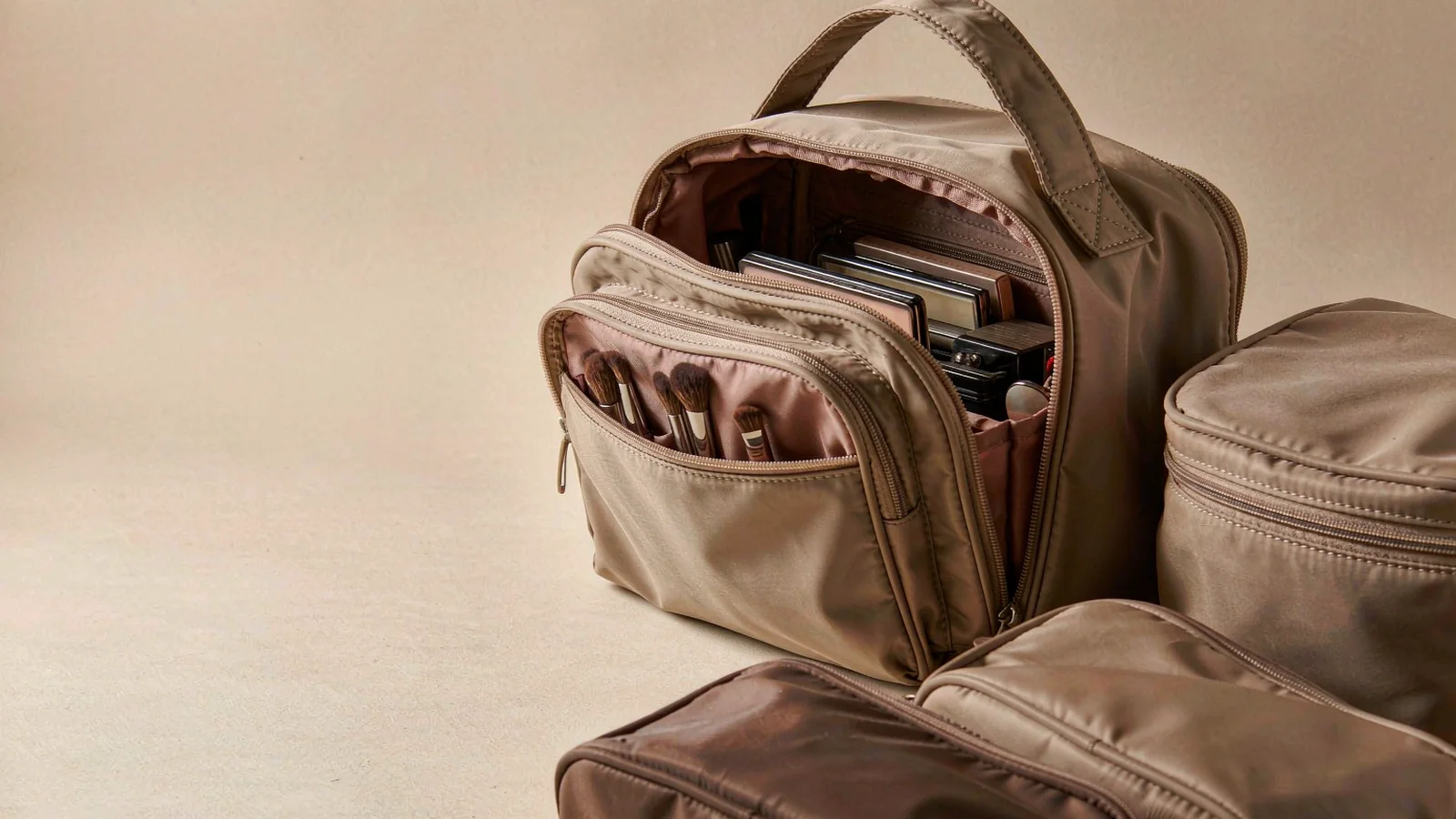
A makeup bag is a soft or semi-structured container sized and fitted to carry cosmetics and applicators — lipstick, compacts, palettes, mascara, brushes, sponges and the small tools that go with them — while keeping those items separated from one another and from whatever surface the bag rests on. The definition matters because the retail label is loose. Shoppers type make up bags for women roughly 80,000 times a month and custom makeup bag 5,400-6,600 times a month; the products returned by those two queries span a 15 cm flat pouch and a 40 cm framed train case, and the brief behind each is entirely different.
Three neighbouring categories overlap with it. A cosmetic bag is the broader retail umbrella: any bag sold in the beauty aisle, including items that hold skincare, hair accessories or nail kits. A toiletry bag is specified around liquids and wash items — it is sized for a 100 ml bottle standing upright, it expects a wet toothbrush, and it is bought against travel. A vanity case or train case is a structured, often framed container built for a large kit and a professional user. Makeup bags sit between the pouch and the case: they are organised around dry, pigmented and breakable objects rather than around bottles.
- Makeup bag — sized and fitted for dry cosmetics and applicators; interior organisation is the selling point
- Cosmetic bag — the retail umbrella term covering any bag merchandised in the beauty aisle
- Toiletry bag — specified around liquids, wet items and the 100 ml travel bottle
- Vanity or train case — framed or semi-framed, built for large and professional kits
- Brush roll — a wrap or cylindrical holder dedicated to brush protection
- Hanging organiser — a fold-out case with a hook, spanning both makeup and toiletry use
- Pouch — the simplest form: one cavity, one zip, no interior architecture
- Boundary rule — if the item list contains bottles, specify toiletry; if it contains palettes and brushes, specify makeup
The boundary is not academic, because it drives the specification. A bag built for dry cosmetics is designed around abrasion, pigment staining and crush protection. A bag built for liquids is designed around leak containment and wipe-clean surfaces. Buyers who specify a makeup bag using toiletry assumptions end up with heavy PVC linings, no brush protection and a lid that will not stay open on a table. Buyers who specify a toiletry bag using makeup assumptions end up with pale linings that show lipstick marks after a single use.
The boundary also drives merchandising. In a beauty retailer a makeup bag is priced and displayed next to the products it holds; in a travel retailer the same silhouette is displayed next to packing cubes. On a marketplace the listing has to pick one primary category, and the demand attached to each differs: toiletry bag shows about 74,810 weekly Amazon searches in ASINSIGHT data for July 2026, while travel bag for toiletries runs near 110,000 monthly searches. Those numbers describe search demand, not revenue, but they tell a brand owner which shelf the shopper is standing in front of.
- List the ten items the bag must hold on launch day — if six or more are bottles or tubes, the brief is a toiletry bag
- If the list is dominated by palettes, compacts and brushes, the brief is a makeup bag
- If the user needs both hands free while working, the brief moves toward a train case or a hanging organiser
- If the bag will be dropped into a suitcase weekly, structure and closure strength move up the priority list
- If the bag lives on a dressing table, standing stability and interior visibility matter more than drop resistance
One practical consequence follows from the loose labelling. A single physical style is frequently listed under two or three category names, which splits reviews and confuses size expectations. Before any specification is written, the brand owner should fix one primary category, one size claim in centimetres and one item-count claim, then hold those three statements consistent across the listing, the packaging and the specification sheet. Every later decision in this guide — form factor, interior layout, capacity, material — is downstream of that first choice.
Fix the category, the outer dimensions in centimetres and the claimed item count before writing any other part of the specification. Most sampling round-trips on makeup programmes are caused by a vague size claim rather than by a difficult construction.
The Five Form Factors of a Makeup Bag
Form factor is the first real decision, because it fixes the pattern, the tooling, the carton and the price band before a single fabric is chosen. Five form factors account for nearly everything sold as a makeup bag: the flat pouch, the standing case, the brush roll, the train case and the hanging organiser. Each has a characteristic size range, a characteristic closure and a natural retail slot, and each carries a very different cost structure even when the exterior fabric is identical.
| Form factor | Typical size (cm) | What it carries | Closure | Natural retail slot |
|---|---|---|---|---|
| Flat pouch | 18-24 W x 10-14 H x 4-7 D | Everyday handbag kit: lipstick, compact, mascara, small brush set | Single zip, often with a branded puller | Beauty aisle impulse, gift-with-purchase, subscription box |
| Standing case | 20-28 W x 12-18 H x 10-16 D | Dressing-table kit: palettes, upright bottles, bundled brushes | Top zip, sometimes a double slider | Main beauty aisle, e-commerce hero SKU |
| Brush roll | 24-40 W unrolled, 8-12 cm roll diameter | Brush collections from 6 to 24 pieces | Wrap tie, snap or a short zip | Professional and enthusiast brush sets |
| Train case | 26-40 W x 18-28 H x 18-26 D | Full kit including palettes, tools and small appliances | Framed zip or lockable latch | Professional kits, premium gift sets |
| Hanging organiser | 22-30 W folded, 45-70 H open | Mixed makeup and travel liquids | Zip plus a hanging hook | Travel retail, holiday promotions |
Flat pouch — the volume and gifting workhorse
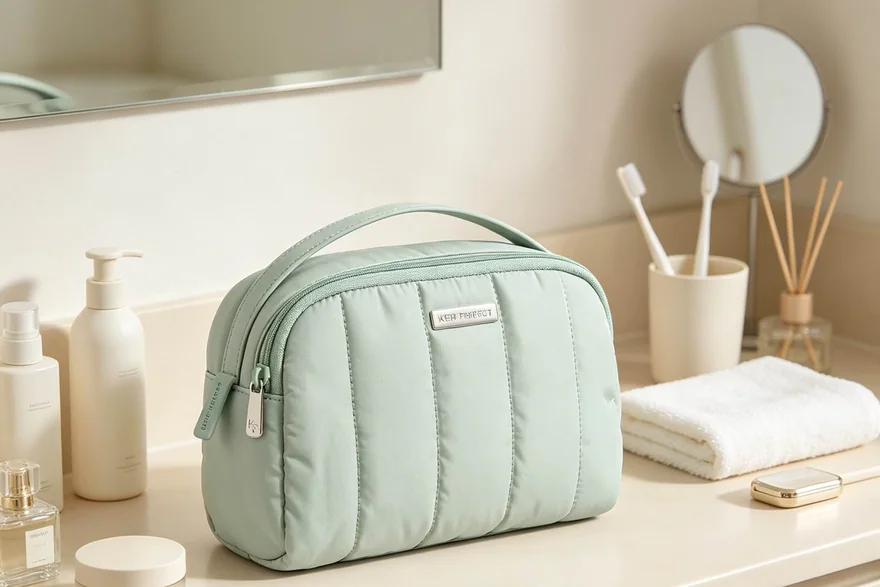
The flat pouch is the cheapest entry point and the most forgiving to produce. It is essentially two panels and a zip, which means low labour minutes, high fabric yield and a large uninterrupted print area for a logo. It is the natural choice for gift-with-purchase, subscription boxes and any programme where the unit target sits at the lower end of the illustrative $0.45-$12.00 band. The weakness is protection: with no structure, a compact takes the full load of whatever is stacked on top of it. Adding piping, a 2 mm wadding layer or a stiffened base panel buys most of the missing protection for a small cost increase.
Standing case — the e-commerce hero
A standing case is a pouch that has been given a structure: wadding in the walls, a base board or moulded tray, and enough height to hold a bottle upright. It is the shape that photographs well, which is why it dominates e-commerce hero positions and influencer sets. The specification detail that separates a good one from a bad one is standing stability when the bag is empty — a case that leans or folds at the corners looks cheap in a product shot. Buyers should specify the base insert thickness, the wadding weight in g/m² and a lid that stays open unaided.
Brush roll — protection first
A brush roll exists to keep bristles from splaying and handles from scratching. It is specified by count first: how many brushes, at what handle diameter, and at what length. The roll diameter follows from brush length, since a brush longer than the roll width will not be covered by the flap. Elastic loops are the low-cost route; die-cut EVA or PE slots hold shape better but lock the product to one brush range. A brush roll is usually sold as an accessory to a brush set rather than as a standalone bag, which makes it a strong candidate for a co-ordinated programme across two SKUs.
Train case — professional capacity
The train case is the top of the category: framed or semi-framed, tiered, sometimes lockable, and sized for kits of 50 items or more. Crush protection is the product promise, so the shell matters more than the fabric — moulded EVA walls of 2-4 mm, a rigid frame, and internal trays that lift out. Unit cost sits at the top of the range and tooling is a real line item, so the case only makes commercial sense when the retail price supports it. For most brand owners the train case is a second-season SKU, added once the pouch and the standing case have proven the colourway.
Hanging organiser — the travel crossover
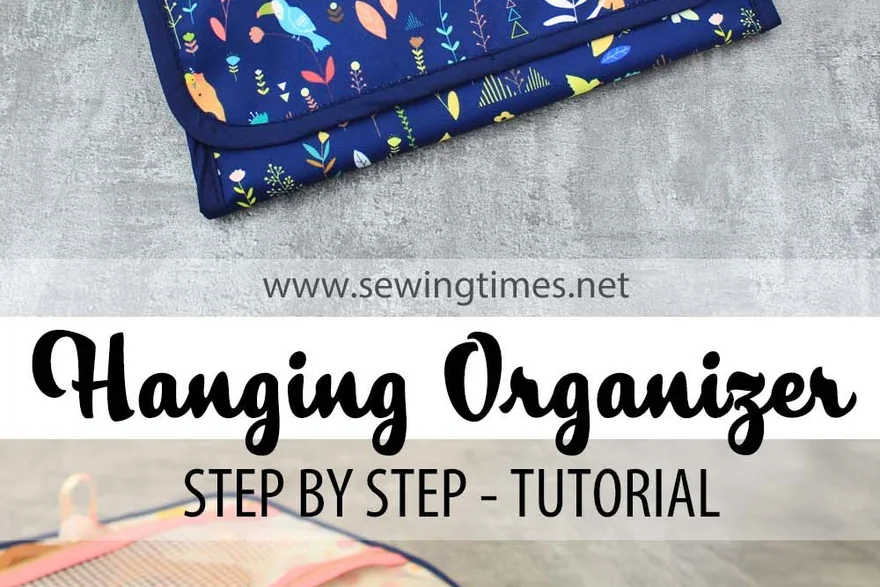
The hanging organiser folds flat and opens into a vertical panel with a hook at the top, which makes it the only form factor that works when there is no flat surface available. It is also the form factor that crosses into toiletry territory most often, since the lower pockets usually hold bottles. Buyers should specify the hook load rating, the number of clear windows, and the weight distribution when the bag is loaded and hanging. The TSA liquids rule is relevant here: a clear removable liquids pouch inside the organiser saves the shopper from unpacking at security.
- Flat pouch — choose when unit cost and print area drive the decision
- Standing case — choose when the shopper will photograph the bag on a table
- Brush roll — choose when brush protection is the product promise
- Train case — choose when the kit exceeds roughly 30 items and needs crush protection
- Hanging organiser — choose when the bag is used away from any flat surface
- Programme rule — one form factor per colourway at launch keeps the 500-piece minimum workable
Two rules of thumb keep a launch programme sane. First, pick no more than two form factors for a first season; each additional shape adds a pattern, a sampling round and a separate 500-piece minimum per colourway. Second, keep the interior layout common across those shapes wherever possible. A pouch and a standing case that share the same brush loop tape, the same zip gauge and the same lining colourway can be produced on the same line with the same trim inventory, which is where the real saving in a small programme usually sits.
Interior Architecture: Compartments, Brush Slots, Dividers and Mirrors
If form factor is the silhouette, interior architecture is the product. Two makeup bags with identical outer dimensions and identical fabric can differ by more than a dollar in unit cost purely because of what happens inside them. Interior work is also where returns are won or lost: a bag that lets a powder compact grind against a metal brush handle generates complaints within weeks, and a bag whose brush loops are 4 mm too narrow generates them on the first day.
| Interior feature | What it solves | Typical construction | Cost and risk note |
|---|---|---|---|
| Elastic brush loops | Brush separation and bristle protection | Elastic tape stitched into 12-20 mm channels | Low cost; loop width must match handle diameter |
| Moulded brush slots | Fixed positions for a named brush set | EVA or PE board with die-cut slots | Tooling cost; locks the bag to one brush range |
| Removable dividers | Capacity that changes with the kit | Hook-and-loop backed padded panels | Mid cost; hook-and-loop wears with use cycles |
| Zip mesh pocket | Visibility and containment for small items | Mesh panel with zip tape and slider | Low cost; the end stop is the weakest point |
| Mirror panel | Application away from a bathroom mirror | Glass or acrylic mirror in a padded sleeve | Adds 80-200 g and a breakage risk in transit |
| Wipe-clean base tray | Spilled powder and lipstick marks | Coated polyester or TPU laminate tray | Low cost; seams must be sealed to work |
| Palette slot | Flat large items such as an eyeshadow palette | Open pocket sized to a stated palette dimension | Requires the brand to state palette dimensions |
| Detachable pouch | Splitting a kit between bag and handbag | Small pouch on a snap, clip or hook-and-loop | Adds a second component to track and inspect |
Brush storage: loops, slots and flaps
Brush storage is the feature shoppers notice first and the one most often specified badly. Elastic loops are cheap and flexible but need a stated width: a loop cut for an 8 mm handle will not hold a 14 mm kabuki, and a loop cut for 14 mm lets a liner brush rattle loose. The practical route is to group brushes by handle diameter and specify two or three loop widths across the row. Where the bag ships with a named brush set, die-cut slots are better; where it ships empty, elastic is safer. A flap over the bristle end is worth the extra panel whenever brushes travel loose.
Dividers: fixed, removable and adjustable
Dividers turn one cavity into a plan. Fixed dividers are simply stitched seams, cost almost nothing and suit bags sold with a known kit. Removable dividers use hook-and-loop tape and a padded panel, and they let the shopper re-plan the bag as the kit grows. The trade-off is wear: hook-and-loop loses grip after repeated removal, and cheap tape scratches a lining. If a divider is part of the product promise, specify the tape cycle life and stitch the loop side rather than the hook side to the lining. Adjustable dividers suit the professional tier, where kits genuinely change month to month.
Mirrors: glass, acrylic and placement
A mirror turns a storage bag into a usable one, and it is the most common source of transit damage in the category. Glass gives the best optical result and the worst breakage record; acrylic cuts weight by roughly half and survives drops but scratches during use. Whichever is chosen, the mirror needs a padded sleeve, a rigid backing and a carton that prevents point loading. Placement matters as well: a mirror on the lid is protected by the bag body when closed, while a mirror in a side pocket is exposed. Bags over 30 cm usually justify a full-width mirror; smaller ones do not.
Pockets, windows and visibility
A makeup bag fails when the shopper cannot find anything in it. Open elastic pockets suit items used daily; zip pockets suit small parts such as tweezers, sharpeners and hair grips; clear windows suit anything the shopper identifies by colour. The zip is the component to watch: a mesh pocket zip that runs into a seam will split at the end stop, and the terminology used to specify zip parts is standardised in ASTM D2053. Naming the tape width, the gauge and the slider type in the specification removes most of the ambiguity at quotation stage.
Linings: colour, coating and seams
The lining takes the damage. A pale lining shows every lipstick mark; a very dark lining hides marks but makes the interior hard to read and can transfer colour onto light items. Mid-tone linings in a coating that resists pigment are the usual compromise. Coated polyester or TPU laminate can be wiped, but only if the seams are sealed or bound — an unsealed seam wicks liquid into the wadding and the bag stays damp. Colour transfer should be checked against the ISO 105 colour fastness series, with rubbing and perspiration the two most relevant exposures for this category.
A glass mirror adds 80-200 g to a bag and is the single most common transit breakage claim in makeup categories. Acrylic cuts weight but scratches. Either way the mirror needs a padded sleeve, a rigid backing and a carton that prevents point loading on the mirror face.
- Specify loop width in millimetres, not as small or large
- State the palette dimensions a slot must accept, in centimetres
- Choose the lining colour against the worst stain the kit can produce
- Seal or bind lining seams if the bag is sold as wipe-clean
- Name the zip tape, gauge and slider in the specification, not just a zip
Size and Capacity Planning for a Makeup Bag
Capacity planning is where most first programmes go wrong. The usual failure is ordering a bag sized by feel rather than by an item list, which produces a shape that is 2 cm too shallow for a palette or 3 cm too narrow for a brush bundle. Capacity should be calculated from the ten largest items the kit contains, then rounded to a pattern size the programme can reuse across colourways and seasons.
- Write the launch item list with the dimensions of the ten largest items, in centimetres
- Sum the footprint of items that travel flat and the upright volume of items that travel standing
- Add a fill factor of 25-40 percent for air, padding, interior panels and hand access
- Round the result up to the nearest standard pattern size that can be reused across colourways
- Validate the number by loading the sample with the real kit, not with a substitute set
| Capacity tier | Outer dimensions (cm) | Approx. volume (L) | Items it holds | Typical use and channel |
|---|---|---|---|---|
| Micro | 15-18 W x 8-10 H x 4-6 D | 0.5-1.0 L | 3-5 items | Handbag carry, gift-with-purchase |
| Small | 20-24 W x 10-13 H x 6-9 D | 1.5-3.0 L | 8-12 items | Everyday kit, subscription boxes |
| Medium | 24-28 W x 13-17 H x 10-14 D | 3.5-6.5 L | 15-25 items | E-commerce hero, dressing table |
| Large | 28-34 W x 17-22 H x 14-18 D | 7-11 L | 30-45 items | Enthusiast kits, influencer sets |
| Professional | 34-42 W x 22-30 H x 18-26 D | 12-22 L | 50 items or more | Train case, professional kit |
A worked example makes the method concrete. A 12-item everyday kit contains one 15 x 10 x 1.5 cm palette, three compacts at 9 x 9 x 1.5 cm, four lipstick tubes at 2 x 2 x 8 cm, one mascara at 2 x 2 x 13 cm, a 30 ml bottle at 4 x 4 x 11 cm and a brush bundle of five brushes with a combined footprint of roughly 20 x 6 cm. Laid flat the palette and compacts need about 15 x 20 cm of floor area; the tall items need 13 cm of internal height; the brush bundle needs a 20 cm clear run. Add interior panels and a 30 percent fill factor and the bag lands at roughly 24 x 14 x 10 cm — the small-to-medium boundary.
Two corrections follow from that example. First, the height dimension is set by the tallest upright item, not by the average, so the bottle or mascara governs the pattern. Second, interior panels consume real space: a divider stack, a mirror sleeve and a brush loop row can take 2-3 cm out of the usable interior, which is the difference between a bag that closes comfortably and one that bulges at the zip.
- Height is set by the tallest upright item plus 1-2 cm of clearance
- Interior panels consume 2-3 cm of usable depth before any kit is loaded
- A fill factor below 25 percent means items grind; above 40 percent means dead space
- Round up to a reusable pattern rather than down to a tight fit
- State capacity as dimensions plus a tested item count, never as volume alone
Capacity also drives freight, which is easy to forget at sampling stage. A flat pouch at 22 x 13 x 6 cm packs 120-200 pieces per export carton; a standing case at 26 x 16 x 12 cm packs 30-60; a train case at 36 x 24 x 20 cm packs 8-16. The same 500-piece minimum therefore occupies somewhere between three and forty cartons depending on form factor, and the per-unit landed cost moves accordingly. Brand owners comparing two quotations should always compare carton count and carton dimensions, not just the unit price.
Publish capacity as outer dimensions in centimetres plus a tested item count. A volume figure in litres is useful for internal planning, but shoppers do not shop in litres, and a litre claim invites returns when a bulky palette will not fit.
The last piece of capacity planning is the size ladder. A brand that launches a single size has no second purchase; a brand that launches three overlapping sizes splits its own demand. A workable ladder is two sizes in season one — a small everyday pouch and a medium standing case — with the brush roll or hanging organiser added in season two once the colourway and the print method are proven. That sequencing keeps each style above the entry minimum while giving the shopper somewhere to go next.
Materials Used in Makeup Bags
The material set for this category is narrower than it looks. Nine options cover almost every makeup bag on the market, and the choice between them is a choice about cleanability, weight, hand feel and cost rather than about fashion. What makes the decision difficult is that the shell and the lining usually need different properties: the shell takes the abrasion of a handbag, and the lining takes the pigment.
| Material | Typical specification | Hand feel and weight | Cleanability | Programme notes |
|---|---|---|---|---|
| Polyester | 600D or 900D, PU-coated back | Firm, light, takes print well | Wipe-clean when coated | Lowest unit cost; widest colour range |
| Nylon | 420D-840D, sometimes ripstop | Softer and smoother, longer abrasion life | Wipe-clean | Pricier than polyester; better rub resistance |
| PU-coated fabric | Polyester base, 0.15-0.25 mm PU face | Leather-like, heavier | Excellent surface wipe | Coating needs hydrolysis testing |
| Transparent PVC or TPU | 0.3-0.8 mm film | Stiff, stiffens further in cold | Highest | Used for security-visibility pockets |
| Cotton canvas | 10-16 oz, often washed | Natural, soft, heavier | Spot clean only | Print and embroidery friendly |
| Recycled rPET | 300D-600D from post-consumer bottle flake | Close to virgin polyester | Same as polyester | Requires chain-of-custody documentation |
| Quilted satin or microfibre | Lightweight face with foam interlining | Soft, premium, compressible | Spot clean | Gift-set favourite; marks show |
| Moulded EVA | Single-piece shell, 2-4 mm wall | Rigid but light | Fully wipeable | Tooling cost; strongest crush protection |
| Neoprene | 2-4 mm laminated foam | Cushioned, slightly stretchy | Hand wash | Good for brush rolls and palette sleeves |
Shell fabric: denier, coating and rub
Denier describes yarn thickness, and in this category 300D to 900D is the working range. A 300D face is soft and drapes; a 600D face holds shape in a standing case; a 900D face is used where the bag is expected to be dragged across a table daily. Coating changes the whole character of the fabric: a PU back coating adds water resistance and stiffness, while a face coating produces a leather-like surface that can be tested as a coated fabric under ASTM D751. Abrasion and crocking behaviour is checked against the methods published by AATCC.
Linings: the pigment problem
The lining is the surface that a leaking lipstick or a cracked powder compact lands on, so cleanability outranks appearance. Coated polyester and TPU laminate can be wiped; brushed tricot and cotton cannot. Colour choice is a compromise between hiding marks and keeping the interior readable, which is why mid-tone greys, taupes and deep navy appear so often in this category. Colour transfer from a dark lining onto a light item is a real failure mode and should be checked under the ISO 105 colour fastness series before a colourway is signed off.
Transparent and translucent builds
Clear film is used for two reasons: so the shopper can see the contents, and so a security officer can see them. The TSA 3-1-1 liquids rule is what drives demand for a clear removable pouch inside a larger bag. PVC is cheaper and clearer but stiffens in cold weather and can plasticise; TPU is more flexible and more expensive. Film thickness matters: below 0.3 mm the panel creases permanently, above 0.8 mm the bag becomes rigid at the panel and will not fold.
Certified and recycled inputs
Recycled content is now a standard request rather than a premium one. Recycled polyester is specified by denier just like virgin, but the claim needs documentation: chain-of-custody under the Global Recycled Standard for recycled content, and the Global Organic Textile Standard where an organic fibre such as cotton canvas is involved. Textile inputs that touch skin are commonly tested against OEKO-TEX Standard 100. Certificates cost money and take time, so they belong in the sampling calendar, not after it.
Compliance boundaries
Two regulatory boundaries catch makeup bags more often than any other: chemical content and children's product rules. Coated fabrics, inks and metal trim sold into the EU fall under EU REACH restrictions on substances of very high concern. A bag marketed to children, sold with a children's cosmetic set, or decorated in a way that appeals to children can fall under the Consumer Product Safety Improvement Act in the United States, which brings lead and phthalate limits and tracking-label obligations with it. Both should be settled before sampling begins.
Match the shell to the abrasion and the lining to the pigment. A premium shell over an uncoated pale lining produces the most common complaint in this category: a bag that looks expensive outside and is ruined inside after one month.
- Everyday pouch: 300D-600D polyester, coated lining, single zip
- Standing case: 600D-900D with wadding, base board, wipe-clean tray
- Brush roll: neoprene or canvas with elastic loops and a bristle flap
- Train case: moulded EVA shell or framed panel with internal trays
- Hanging organiser: 600D with clear film windows and a rated hook
How a Brand Specifies a Makeup Bag Programme
A makeup programme is specified, not discovered. The difference between a quotation that holds and one that moves by 20 percent after sampling is almost always the completeness of the written specification. The fields below are the ones that change an outcome; a brief missing any of them will be filled with assumptions by whoever prices it.
| Spec field | What the brand owner must state | Why it changes the outcome |
|---|---|---|
| Outer dimensions | Length, width and height in cm, with a stated tolerance | Fixes the pattern, fabric yield, carton count and freight |
| Shell and lining | Fabric type, denier, coating and colour reference | Drives unit cost, hand feel and stain performance |
| Interior layout | Number of loops, pockets, dividers and the mirror specification | Drives labour minutes per unit more than any other field |
| Closure | Zip type, gauge, slider and end finish | The most common failure point in daily use |
| Structure | Wadding weight in g/m², base board, frame | Determines whether a case stands when empty |
| Branding | Print method, logo size, woven label and hangtag | Affects minimum quantities and adds lead time |
| Colourway plan | Number of colourways and the split across the minimum | Each colourway carries its own quantity commitment |
| Packing | Fold method, polybag, carton count and carton dimensions | Affects creasing, shelf presentation and landed cost |
| Testing | Colour fastness, zip cycle, restricted substances | Sets the inspection and release gate |
The commercial frame around the specification is stable once the fields above are fixed. The usual entry minimum is 500 pieces per style and per colourway. Sampling takes 6-10 working days, extending to 12-15 working days for complex constructions such as moulded shells, framed cases or multi-panel interiors. Bulk production runs 35-50 days after sample approval. Finished goods are inspected at AQL 2.5 under the ISO 2859-1 sampling procedures. Shipment is normally quoted FOB Xiamen, with payment by T/T: 30 percent deposit and 70 percent against the bill of lading.
Programmes of this kind are normally coordinated by a sourcing and programme-management partner rather than run by the brand owner directly. QUANZHOU JUNYUAN BAGS, for instance, has coordinated bag programmes since 2014 with a team in the trade since 2004, working with SGS-verified production floor space of 4,950 m² across 7 production lines and 149 machines, and monthly output capacity of 200,000 pieces. Written quotations and sampling calendars can be requested at [email protected].
The sampling sequence itself is worth planning rather than discovering. A first sample is a construction check: does the shape stand, does the lid stay open, does the zip run. A second sample is a materials check in the actual colourway, with the actual print and the actual trim. A pre-production sample is made on the production line with production tooling and is the one that should be used for the item-count validation described earlier. Treating the first sample as a finished product is the most common way a makeup programme loses a month.
- Dimensions in centimetres with a stated tolerance
- Item list the bag must hold, with the ten largest items dimensioned
- Shell fabric, denier and coating, plus lining fabric and colour
- Interior layout as a count: loops, pockets, dividers, mirror
- Zip tape, gauge and slider type, named rather than described
- Branding method, logo size and label placement
- Colourway count and the quantity split across the minimum
- Packing method, carton count and carton dimensions
- Required testing and the inspection level for release
Quantity planning deserves the same care as the drawing. Because the entry minimum of 500 pieces applies per style and per colourway, a three-colourway launch across two form factors is six commitments rather than one, and spreading 3,000 pieces across six combinations leaves shallow inventory everywhere. A tighter plan — two colourways across two shapes, with a third colourway held until reorders prove demand — keeps each line above the minimum and consolidates trim purchases. The same logic applies to branding: one logo treatment shared across shapes reduces setup cost and shortens the sampling calendar.
Two closing points decide whether the launch is smooth. The first is trim: zips, pullers, elastic and hook-and-loop carry their own lead times and their own minimums, and a colourway built around an unusual puller finish can add two weeks. The second is the photograph. A makeup bag is bought on how it looks open and loaded, so the sample should be photographed with the real kit inside before the bulk order is confirmed — that step catches most sizing mistakes while they are still cheap to fix.
The B2B Customisation View
Range planning for makeup bags and toiletry bags works best when the hero style and the gift-with-purchase style are engineered together, sharing linings and hardware to protect the budget.
Planning figures used across the programme: MOQ 500 pieces per style and colourway, 6–10 working days sampling (12–15 when moulding or multi-layer lamination is required), 35–50 days bulk lead time, AQL 2.5 to ISO 2859-1, FOB Xiamen, T/T 30/70.
The value of a programme-coordination model is continuity: QUANZHOU JUNYUAN BAGS keeps the approved reference sample, the shade standard and the AQL record for every repeat order.
Which Brand Types This Guide Serves
This guide is written for the brand owners, merchandise teams and buyers who have to choose a shape, a size and a fabric and then defend that choice with a written specification, a sampling calendar and an inspection gate. The same category serves very different businesses, and the form factor that is right for one is rarely right for another.
- Start-up beauty brands — usually launch one small pouch and one medium standing case in a single colourway, keeping both above the 500-piece entry minimum while the brand identity is still being tested
- Established beauty brands — extend an existing colour story into a size ladder, adding a brush roll or hanging organiser once the print method and trim package are proven on the core shape
- Retailers and private-label buyers — need a documented spec and carton plan because the bag is merchandised against a planogram, where outer dimensions matter more than interior features
- E-commerce and marketplace sellers — favour the standing case and the hanging organiser, because both photograph well open and loaded, and both survive the returns process better than a flat pouch
- Gift, subscription and hospitality buyers — concentrate on the flat pouch and the quilted gift set, where unit cost, print area and carton count decide the margin
- Professional make-up artists and beauty educators — buy at the train case and large organiser end, where crush protection, tiered trays and lockable closures justify a higher unit price
What all six have in common is the same three decisions: which form factor, which capacity tier and which material pairing. Answer those in writing, with dimensions in centimetres and a named item list, and the rest of the programme — sampling, costing, inspection and packing — becomes a schedule rather than a negotiation. The two failure patterns are also shared across all six: a size claim made without an item list, and a lining chosen for appearance rather than for cleanability. Both are cheap to avoid at specification stage and expensive to correct after bulk production has started. Detailed customisation mechanics, print methods and tooling choices belong to the dedicated custom-programme guide; this page exists to settle the category decisions that come before them.
Frequently Asked Questions
What is the difference between a makeup bag and a cosmetic bag?
Cosmetic bag is the retail umbrella term for anything merchandised in the beauty aisle, including bags that hold skincare, hair accessories or nail kits. A makeup bag is the narrower category: it is sized and fitted for dry cosmetics and applicators, and its interior organisation is the selling point. The practical test is the item list. If the ten core items are palettes, compacts, brushes and lipstick, the brief is a makeup bag. If six or more are bottles or tubes, the brief has moved into toiletry territory and should be specified with leak containment and wipe-clean surfaces in mind.
Which makeup bag form factor should a brand launch first?
A small flat pouch and a medium standing case cover the most ground for a first season. The pouch handles gift-with-purchase, subscription boxes and impulse price points, and it carries the lowest unit cost in the illustrative $0.45-$12.00 band. The standing case is the e-commerce hero because it photographs well open and loaded. Launching both from one colourway keeps each above the usual 500-piece entry minimum while sharing trim, lining and print method. Brush rolls, hanging organisers and train cases are better second-season additions.
What size makeup bag suits a first product line?
Most first lines land at the small-to-medium boundary, roughly 24 x 14 x 10 cm, because that is what a 12-item everyday kit needs once a 30 percent fill factor is applied. Height is set by the tallest upright item — a mascara at 13 cm or a 30 ml bottle at 11 cm — plus 1-2 cm of clearance. Depth loses 2-3 cm to interior panels before anything is loaded. Rather than guessing, dimension the ten largest items in the kit, add the fill factor and round up to a pattern size that can be reused across colourways.
How many brushes should a makeup brush roll hold?
Six to 24 is the commercial range, and the number should follow the brush set rather than the other way round. Below six the roll is not worth the pattern; above 24 the roll diameter becomes too large to sit inside a bag. The specification detail that matters more than count is loop width: a loop cut for an 8 mm handle will not grip a 14 mm kabuki, so group brushes by handle diameter and specify two or three widths across the row. A flap over the bristle end is worth adding whenever brushes travel loose.
Is an interior mirror worth the extra unit cost?
It depends on where the bag is used. A mirror turns a storage bag into a usable one, so it earns its cost in travel and handbag formats where the shopper may be applying makeup away from a bathroom. It adds 80-200 g and is the most common transit breakage claim in the category. Glass gives the better optical result; acrylic halves the weight and survives drops but scratches in use. Either way the mirror needs a padded sleeve, a rigid backing and a carton that prevents point loading on the mirror face.
Which lining colour hides makeup stains best on a production line?
Mid-tone shades are the working compromise. A pale lining shows every lipstick mark and reads as poor quality within a month; a very dark lining hides marks but makes the interior hard to read and risks colour transfer onto light items. Mid greys, taupes and deep navy are the usual answers. The coating matters more than the shade: coated polyester or TPU laminate can be wiped, but only if the seams are sealed or bound. Colour transfer should be checked against ISO 105 colour fastness methods before a colourway is signed off.
What fabric weight suits a structured standing makeup case?
A 600D polyester shell with a PU back coating is the standard answer, moving to 900D if the bag will be dragged across a table daily. Structure comes from more than denier, though: wadding weight in g/m², a base board or moulded tray, and a lid that stays open unaided are what make a case stand when empty. A standing case that leans or folds at the corners looks cheap in a product shot, so the base insert thickness and wadding weight should be named in the specification rather than left to interpretation.
Are transparent makeup bags accepted under airport liquid rules?
A clear panel does not by itself satisfy the liquids rule; the rule concerns the containers and how they are presented at the checkpoint. What transparent film does is let a security officer see the contents without unpacking the bag, which is why a clear removable liquids pouch inside a larger organiser is a genuinely useful feature. The TSA 3-1-1 liquids rule is the reference to check. On the material side, PVC is cheaper and clearer but stiffens in cold weather, while TPU is more flexible and more expensive.
How does a brand stop a standing makeup case collapsing when empty?
Three components do the work: wadding in the walls at a stated weight in g/m², a base insert or moulded tray at a stated thickness, and a lid stiffener that keeps the top panel flat. Reinforcing the vertical corners with piping also helps, because corner collapse is how most soft cases fail. The specification should name each of these rather than asking for a structured bag. The check is simple and should be part of the first-sample review: photograph the empty sample on a flat surface and confirm it stands square on all four corners.
What zip specification suits a makeup bag that opens every day?
Name the tape width, the gauge, the slider type and the end finish rather than writing a zip. For a daily-use bag the failure points are the slider and the end stop, not the teeth, so a metal slider with a branded puller and a properly finished end stop are worth the small premium. Zip parts are standardised under ASTM D2053, which is useful when writing the specification. Mesh pocket zips need particular care: a zip that terminates into a seam will split at the end stop within weeks.
What does a custom makeup bag cost per unit?
Marketplace listings for this category sit in an illustrative band of roughly $0.45 to $12.00 per unit, with the low end covering a simple printed flat pouch and the high end covering a moulded or framed train case. Where a specific bag lands depends on fabric denier, interior labour minutes, trim, print method and order quantity. Brand owners should treat any figure as a planning range and request a written quotation against a complete specification, since the two fields that move a quotation most are interior layout and quantity per colourway.
How long do makeup bag sampling and bulk production take?
Sampling runs 6-10 working days for standard constructions, extending to 12-15 working days for complex builds such as moulded shells, framed cases or multi-panel interiors. Bulk production takes 35-50 days after sample approval. The schedule that catches teams out is not production but trim: zips, pullers, elastic and hook-and-loop carry their own lead times, and an unusual puller finish can add two weeks. Certificates for recycled or tested inputs should also be booked into the sampling calendar rather than requested afterwards.
How should makeup bags be packed for retail shelves versus e-commerce?
Retail shelves need the bag to hold shape on a hook or shelf tray, so a light tissue or paper fill and a hangtag keep the silhouette. E-commerce needs crease control and drop protection, since the outer carton is the retail packaging and a creased panel becomes a return. Carton counts vary sharply by form factor: a flat pouch packs 120-200 per export carton, a standing case 30-60, and a train case 8-16. Always compare carton count and carton dimensions between quotations, not unit price alone.
What does AQL 2.5 mean for a makeup bag shipment?
AQL 2.5 is the acceptable quality limit used to decide whether a finished shipment passes inspection, applied under the ISO 2859-1 sampling procedures. The inspector draws a sample size based on the shipment quantity, counts defects against the 2.5 limit, and the shipment is released or held on that result. For makeup bags the defects that matter most are cosmetic and functional: zip failures, unsealed lining seams, crooked print placement and mirror breakage. Naming the inspection level in the purchase terms avoids an argument at the release gate.
People Also Ask
What is the best makeup bag for travel?
For travel the hanging organiser usually wins, because it works when there is no flat surface available and it keeps the kit visible rather than buried. A clear removable liquids pouch inside it saves unpacking at a security checkpoint. Where the trip is short and the kit is small, a medium standing case in the 24-28 cm width range is enough and packs more easily into a suitcase. Whichever shape is chosen, the hook load rating, the zip gauge and the wipe-clean lining matter more than the exterior fabric.
How do you organise a makeup bag?
Start from frequency rather than category. Items used every day go in open elastic pockets or a top tray; items used weekly go in a zip pocket; small parts such as tweezers and sharpeners go in a mesh pocket where they can be seen. Brushes should sit in their own loops with a flap over the bristles, and palettes should lie flat rather than stand on edge. A divider is only worth using if the bag holds more than about 15 items; below that it adds bulk without improving access.
What size makeup bag do I need?
Count the items first, then size the bag. A 3-5 item handbag kit needs a micro pouch of about 15-18 cm wide. An 8-12 item everyday kit needs roughly 20-24 cm wide and 10-13 cm high. A 15-25 item dressing-table kit needs about 24-28 cm wide and 13-17 cm high. Height is set by the tallest upright item plus 1-2 cm, and interior panels take another 2-3 cm of usable depth before anything goes in.
Are makeup bags and toiletry bags the same thing?
No. A toiletry bag is specified around liquids and wash items, so it is sized for a 100 ml bottle standing upright and expects a wet toothbrush. A makeup bag is specified around dry, pigmented and breakable items, so it is organised for brush protection, crush resistance and stain resistance. The two overlap in the hanging organiser, which is why that form factor appears in both categories. Retailers list them separately because the shopper is standing in a different aisle with a different item list in mind.
How do you clean the inside of a makeup bag?
It depends on the lining. A coated polyester or TPU laminate lining can be wiped with a damp cloth and mild detergent, provided the seams are sealed or bound — an unsealed seam will wick liquid into the wadding and the bag will stay damp. Brushed tricot, cotton canvas and quilted satin are spot-clean only. Loose powder is best removed dry with a brush before any liquid is applied, since wet powder sets into the fabric. Always dry the bag open, and keep the mirror panel dry.
References & Standards
- ISO 2859-1 sampling procedures for inspection by attributes
- ASTM D2053 standard terminology relating to zippers
- AATCC TM61 colour fastness to laundering
- IEC 62321 determination of certain substances in electrotechnical products
- OEKO-TEX Standard 100 testing for harmful substances
- Textile Exchange Global Recycled Standard
- US CPSC CPSIA consumer product safety improvement act
- ECHA REACH regulation on chemicals
- TSA 3-1-1 liquids rule for carry-on baggage
- ASTM D751 standard test methods for coated fabrics
- ISO 105 textiles tests for colour fastness
- Global Organic Textile Standard GOTS
In-Depth Articles in This Category
34 dedicated articles sit under this pillar guide.
Related Pillar Guides
Request a Sample or a Written Quotation
Send the silhouette, dimensions, material preference and logo artwork, and the programme team will return a written quotation with MOQ, sampling window, bulk lead time and inspection standard.
Email: [email protected] · WhatsApp: +86 177 5002 0688