Toiletry Bags: The Complete Buying Guide for Brands and Retailers
Executive Summary
What is the best toiletry bag? For a buyer sourcing the category, it is the one whose leak management matches what it has to carry: a lining that holds liquid when a bottle fails, a closure that still runs when packed wet, and a capacity tier sized around 100 ml travel bottles rather than 400 ml retail bottles. Search demand shows the category's pull — travel bag for toiletries draws roughly 110,000 monthly searches and toiletry bag roughly 74,810 weekly Amazon searches; both are search-demand figures, not revenue. Commercially, a programme starts at 500 pieces per style and colourway, sampling runs 6-10 working days, bulk production takes 35-50 days after sample approval, and goods are inspected at AQL 2.5 under ISO 2859-1.
This guide treats the toiletry bag as a liquid-containment problem first and a soft-goods problem second. It opens on the category boundary, then moves through form factors, lining and seam construction, closure systems, capacity design under liquid rules, and the hardware and load paths that let a hanging bag survive a hotel door hook.
Each section closes with the fields a buyer can copy straight into a request for quotation. Every price, dimension and rating in this guide is an illustrative planning range for brief-writing, not an offer, and every performance figure is something the buyer specifies and then verifies rather than something a fabric delivers by default.
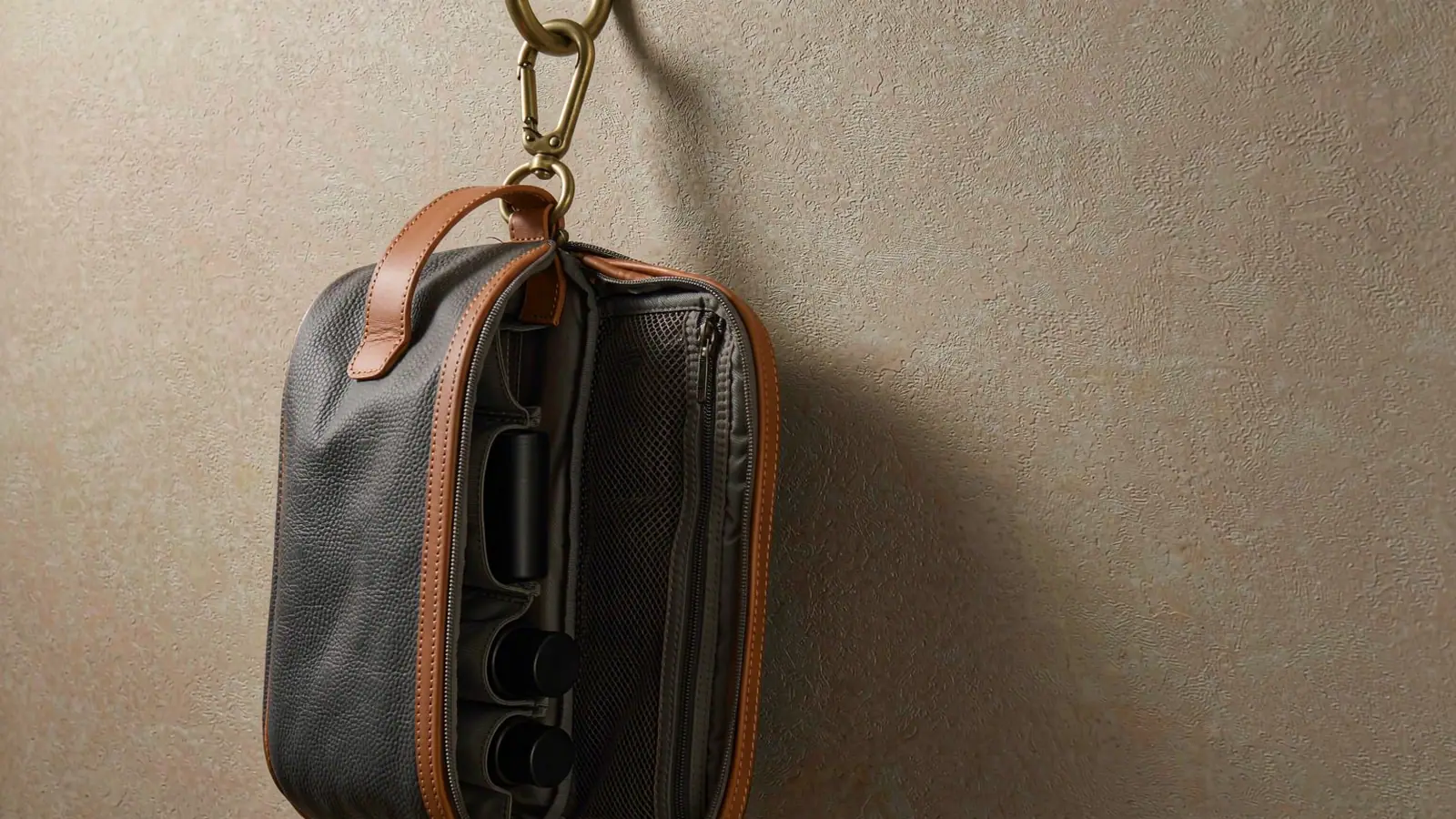
What Makes a Toiletry Bag Different from a Cosmetic Bag?
A toiletry bag is a soft or semi-structured container specified to carry personal-care liquids, gels, pastes and the tools that go with them — shampoo, conditioner, shower gel, toothpaste, shaving foam, razor, toothbrush, deodorant, contact-lens solution — and to keep those contents away from everything else in the suitcase. That sentence is the whole category. A cosmetic bag is designed around solids that might leak a little; a toiletry bag is designed around liquids that eventually will. Every decision downstream — lining film, seam method, closure, pocket layout, capacity — follows from that one assumption.
The distinction is not academic. A buyer who briefs a toiletry bag as a cosmetic bag with a waterproof lining receives a product that passes visual inspection and fails in a hotel bathroom. Search demand shows how wide the category already is: travel bag for toiletries draws roughly 110,000 monthly searches and toiletry bag roughly 74,810 weekly Amazon searches, both search-demand figures rather than revenue. Those queries return products from a 1.2 L amenity pouch to a 12 L framed kit, and the brief behind each is entirely different.
| Spec dimension | Toiletry bag | Cosmetic or makeup bag | Vanity or train case |
|---|---|---|---|
| Primary payload | Liquids, gels, pastes, razor, toothbrush | Compacts, palettes, brushes, lipstick | Bottles and tools at professional volume |
| Lining requirement | Liquid-holding film, welded or taped | Wipe-clean and stain resistant | Wipe-clean over a rigid shell |
| Body volume | 1.2 L to 12 L | 0.8 L to 4 L | 6 L to 20 L |
| Seam treatment | RF or hot-air welded, or sewn plus taped | Sewn, bound or overlocked | Sewn, reinforced at the frame |
| Closure | Coil zip with garage, or roll-top | Coil zip, magnetic, kiss-lock | Frame zip, sometimes lockable |
| Dominant failure | Leak at seam or closure | Stain, scuff, brush damage | Frame distortion, hinge wear |
| Unit price band (illustrative) | $1.20 to $12.00 | $0.45 to $9.00 | $3.50 to $12.00 |
The lining row is where most briefs go wrong. In a cosmetic bag the lining is a finishing layer: it hides the seam allowance, looks clean and survives a wipe. In a toiletry bag the lining is the primary containment layer and the outer fabric merely carries the brand. That means the buyer specifies two textiles with two different jobs — a printable or brandable face fabric in 300D to 600D polyester or a cotton canvas, and an internal film or coated textile in 70D to 210D whose coating weight, in grams per square metre, is a stated number rather than a hope.
Volume is the second separator. A toiletry bag must fit upright bottles of 100 ml to 400 ml plus a toothbrush, a razor and often a hairbrush, which pushes internal height past 15 cm even in a compact design and past 20 cm in a family size. A flat makeup pouch can be 3 cm deep because lipstick lies down. The height requirement changes the pattern: a toiletry bag needs a base panel and a gusset, not simply two panels joined at the edge, and the base panel is where liquid collects.
- Leak path — the route liquid takes out of a bag: through the fabric, through the seam, through the closure, or through needle holes
- Primary containment layer — the film or coated textile that actually holds liquid, as distinct from the outer fabric that carries the print
- Water column or hydrostatic head — the height of water, in millimetres, a fabric supports before it passes liquid; a buyer-specified target, never a default
- Wet/dry separation — a divided interior that isolates damp items from dry ones, usually built as a welded or taped compartment
- Quart-bag discipline — designing around a removable transparent liquids pouch instead of expecting the whole bag to be screened at security
The claim wording is the third separator, and it belongs in the brief rather than in the marketing copy that gets written later. A bag described as leakproof invites a return the first time a cap fails at altitude. The defensible wording is narrower: the lining holds liquid for a stated period under a stated procedure, and the buyer defines both. Leak-resistant, water-repellent lining and liquid-tight welded compartment describe what was specified. Leakproof describes an outcome no soft good can promise once a consumer re-closes a bottle with sandy hands.
For sourcing teams the boundary also reaches packaging and photography. A toiletry bag is normally shot open, filled and hung, because the category shopper wants to see pockets and lining; a cosmetic bag is normally shot closed on a surface. That means the interior must be finished to a photographic standard, including lining colour, seam-tape colour and print registration on pocket binding — details that add cents per unit and days to sampling, and that belong in the brief rather than in a revision note after the first sample arrives.
Form Factors: Flat, Standing, Hanging, Modular and Roll-Top
Six form factors cover almost the whole category, and each one makes a different bargain between leak posture, packing volume and unit cost. The choice is rarely aesthetic. A flat pouch costs less to cut and sew but puts its seams below the liquid line when it lies down; a standing case costs more in panels and base stiffener but keeps spills in a base well; a hanging bag adds hardware and a reinforcement assembly but gives the user a stable upright position on a door hook. Buyers should choose the form factor from the fill state, not from the shelf shot.
| Form factor | Footprint W x H x D (cm) | Body volume (L) | Liquid posture | Channel fit |
|---|---|---|---|---|
| Flat dopp pouch | 24 x 15 x 8 | 2.5 to 3.5 | Bottles lie down; seams sit below the liquid line | Gift-with-purchase, entry e-commerce |
| Standing cube or case | 22 x 18 x 12 | 4.0 to 6.0 | Bottles upright; base panel contains the spill | Core retail assortment |
| Hanging bag | 26 x 20 x 10 closed | 4.0 to 7.0 | Bottles upright when hung; hook carries full load | Travel retail, hotel programmes |
| Modular pouch set | Three pieces, 22 x 14 x 7 each | 2.0 to 3.0 per piece | Each pouch isolated; failure stays in one unit | Premium retail, subscription kits |
| Roll-top wet bag | 28 x 20 x 11 | 5.0 to 8.0 | Fold closure sits above the liquid line | Outdoor, gym, beach |
| Framed kit or vanity | 32 x 22 x 15 | 9.0 to 12.0 | Rigid shell with a drop-in welded liner | Professional, long-haul, salon |
Flat and standing forms
The flat dopp pouch is the cheapest route to a toiletry bag and the one most often returned for leaks, because a pouch packed flat puts its side seams under the liquid line for the whole journey. It works when the payload is travel-sized and the lining is welded rather than sewn. The standing cube solves that by giving the bag a base panel, a gusset and usually a 0.8 mm to 1.2 mm PE board under the base; the spill then sits in a well that the user can wipe. Expect the standing form to add two panels, one stiffener and roughly 12-18% to cut-and-sew time.
Hanging, modular and roll forms
The hanging toiletry bag is one form factor among several, not the category default. It earns its place when the user has nowhere to put things down — a shared bathroom, a cruise cabin, a gym locker — and it pays for that with a hook assembly, a reinforcement patch and a webbing anchor that must be specified as a load-bearing subsystem. Hook mechanics, swivel geometry and door-hook fit are a subject in their own right and are covered in depth elsewhere; here it matters only that hanging is chosen for a reason and that the load path is engineered.
Modular pouch sets split the risk. Three small welded pouches mean one leaking bottle ruins one pouch rather than the whole bag, and they let a brand sell a refill or an add-on later. Roll-top wet bags move the closure above the liquid line, which is the single most effective structural change a designer can make, at the cost of slower access. Framed kits and vanity cases put a rigid shell around a drop-in welded liner, which is the usual answer at 9 L and above where a soft body would collapse under its own contents.
- Choose the form factor from the fill state: lie-flat payloads need welded seams, upright payloads need a base well
- Below 4 L the flat pouch wins on cost; above 4 L a base panel and gusset pay for themselves in fewer leak returns
- Modular construction converts one catastrophic failure into one small failure
- Roll-top closures trade access speed for a closure line above the liquid level
- Above roughly 9 L a rigid shell with a drop-in liner beats a soft body on shape retention
Simple flat and standing constructions normally sample in 6-10 working days. Hanging bags with a hook assembly, framed kits with a drop-in welded liner and roll-tops with moulded buckles fall into the complex-construction band of 12-15 working days, and that extra week should appear in the launch calendar rather than being discovered after the brief is signed.
Whatever the form factor, the same commercial envelope applies: 500 pieces per style and colourway, FOB Xiamen shipment, T/T with 30% deposit and 70% against bill of lading, and inspection at AQL 2.5. Style and colourway are counted separately, so a hanging bag offered in three colours is three minimum quantities unless the buyer consolidates them into one colourway at the outset.
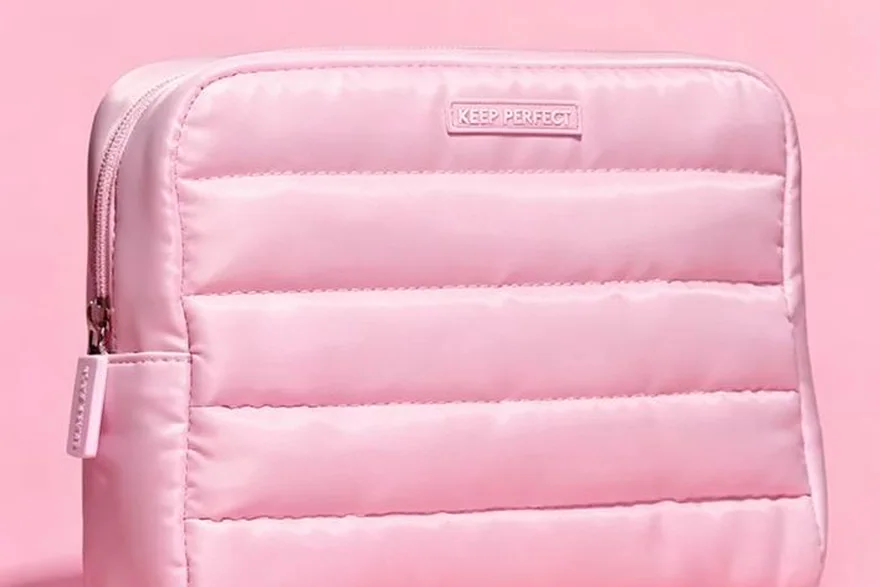
Leak Management: Linings, Seams and Coatings
Leak management begins with a path analysis rather than a fabric choice. Liquid leaves a toiletry bag by four routes: through the face fabric, through the seam, through the closure, or through the needle holes that a sewing machine punches in a coated textile. A buyer who upgrades the fabric and leaves the seam sewn has closed one of four doors. A buyer who welds the seams and fits an ungusseted zip has closed two. The specification should name all four and state what is done about each, because that list is what a laboratory report can actually be checked against.
- Through the fabric — solved by a coating or laminated film, measured as water-column resistance
- Through the seam — solved by welding the joint or by covering a sewn joint with heat-pressed seam tape
- Through the closure — solved by a zip garage, a gusseted zip panel, or by moving the closure line above the liquid level
- Through needle holes — solved by not sewing the containment layer at all, or by taping every stitch line
| Construction | How the joint is made | Buyer-specified water-column target (mm) | Cost and volume effect | Best fit |
|---|---|---|---|---|
| Sewn, untaped | Needle and thread; holes pierce the coating | No liquid claim stated | Lowest unit cost, fastest to sample | Dry items, gift pouches |
| Sewn plus seam tape | Seam allowance covered with heat-pressed tape | 1000 to 3000 | Adds 8-15% to unit cost | Mid-tier travel bags |
| Hot-air welded | Thermoplastic film fused under heat and pressure | 3000 to 8000 | Adds 15-30%; requires a thermoplastic face | Premium leak-resistance claims |
| RF or HF welded | Dielectric heating fuses PVC or TPU films | 5000 to 10000 | Adds 25-45%; electrode tooling required | Amenity kits, airline programmes |
| Drop-in liner | Separate welded liner inserted into a shell | 3000 to 8000 | Adds 20-35%; liner can be replaced | Hospitality, refill programmes |
The water-column figures in that table are planning targets the buyer states in a brief, not properties any fabric delivers by default. A coated 210D polyester can be finished to a low rating or a high one depending on coating weight and film type, and the number only means anything once the measurement method is named. Hydrostatic resistance in coated fabrics is measured under the ASTM D751 coated-fabric test methods; colour fastness, abrasion and laundering behaviour on the same textile are normally referenced to AATCC test methods. A brief that names the method gets a comparable quotation; a brief that says waterproof gets whatever the mill had on the shelf.
Coating chemistry drives both performance and compliance. Polyurethane coatings on 210D to 420D polyester are the volume default and weld well. TPU films weld better and stay flexible in cold climates, which matters for a bag that ships to a winter market. PVC gives the highest and cheapest liquid resistance but carries plasticiser questions under EU REACH, which is why many retail programmes specify a PVC-free build and ask for OEKO-TEX Standard 100 documentation on the lining. Where the brief calls for a natural face fabric, an organic cotton outer can be referenced to GOTS, with the containment provided by a separate welded liner underneath.
Writing the leak clause as a method
- Specify the method, not the outcome: state fill volume, orientation (inverted or on-side), duration (commonly 4, 12 or 24 hours), temperature and the pass/fail definition
- Name the hydrostatic method and the target in millimetres, and require the laboratory to report the measured value against that target
- Test the seam, not only the fabric: a welded panel can pass a fabric test and fail at the joint, so require that the test piece includes at least one full seam and one corner
- Test after conditioning: repeat the check following abrasion, repeated folding and a wipe or wash cycle, because a lining that holds liquid when new may not hold it after a month of use
- Classify leak performance separately in the inspection plan: it is a functional defect and belongs in the critical or major class rather than being averaged in with appearance faults
None of this is expensive to write and all of it is expensive to add later. A leak clause costs a paragraph in the brief; a lining upgrade after a failed pre-production sample costs a new sample cycle, a revised bill of materials and, in the worst case, a portion of the bulk run. Buyers who sell into a marketplace with a returns window should treat the clause as a returns-control measure rather than a quality flourish, because a leaking toiletry bag generates a review that costs more than the unit did.
This guide gives no leak-test outcomes, pass rates or star ratings, because those depend on the construction the buyer specifies and the laboratory that runs it. What a buyer can do is state the procedure and the acceptance criteria in writing, apply them at sample stage and again at pre-production, and classify any failure as a functional defect under an AQL 2.5 inspection plan.
Closure Systems: Zips, Roll-Tops and Secondary Seals
The closure is where most toiletry bags fail, and it fails for a mundane reason: it is the only part of the bag the user operates every single day, usually with wet hands, usually in a hurry. A zip that has been specified only by size and colour will eventually separate behind the slider, leak through the chain, or snag on a pocket binding. A zip specified by component behaves predictably. The vocabulary for those components — tape, chain, slider, pull, top stop, bottom stop — is standardised in ASTM D2053 zipper terminology, and using it in a brief removes most of the ambiguity between a buyer and a factory.
| Closure type | Leak posture | Cycle-life planning range | User friction | Where it appears |
|---|---|---|---|---|
| #3 nylon coil zip | Fair; needs a taped or gusseted panel behind the chain | 5000 to 10000 cycles | Low | Main opening on small bags |
| #5 nylon coil zip | Good; chain mass supports a garage and a storm flap | 8000 to 15000 cycles | Low | Main opening, medium and large |
| Reverse-coil water-resistant zip | Good on splash; the coil faces down under a film | 8000 to 15000 cycles | Medium; needs occasional lubrication | Outer wet pocket |
| Roll-top with side-release buckle | Best; the closure line sits above the liquid level | Not zip-cycled; fold fatigue assessed instead | High; slow to open | Wet compartment, dry-bag hybrid |
| Hook-and-loop plus zip | Good; belt and braces | Varies with hook tape grade | High; noise and lint pick-up | Amenity kits |
| Magnetic or kiss frame | Poor on liquid; gap-free only when new | 5000 to 8000 cycles | Low | Rigid shells |
Anatomy of a zip that survives a wet bag
Four features turn an ordinary zip into a closure that belongs on a toiletry bag. A garage is a small fabric pocket at the closed end that the slider parks in, so the chain is covered rather than exposed at the corner where a bag flexes most. A gusseted zip panel puts a 2 cm to 3 cm strip of lining between the chain and the interior, so liquid meets film before it meets teeth. A storm flap is an outer fold that sheds shower spray away from the chain. And an auto-lock slider stays where the user leaves it instead of creeping open under load. Each adds cents; together they are the difference between a bag that survives a season and one that does not.
Pullers deserve more attention than they get. A moulded pull on a hanging toiletry bag hangs within reach of a user's forearm and should be quiet enough not to clatter against a tiled wall at 6 a.m.; a metal puller on a hospitality kit is a noise complaint waiting to happen. Pullers are also the cheapest branding surface on the bag — a debossed logo on a moulded pull costs less than a woven label and is seen every time the bag is opened. Buyers should specify puller material, finish, length and whether it is detachable, because a detachable puller is a small-parts consideration on any programme aimed at children.
- State zip size, chain type (coil, reverse-coil, metal), tape colour and slider type — not simply zip
- Require a garage at the closed end and a gusseted lining panel behind the chain on any bag claiming leak resistance
- Specify cycle life as a planning range and confirm the laboratory method before sampling starts
- Choose puller material for noise as well as appearance when the bag will be hung in a bathroom
- Add a secondary seal: a storm flap over the zip, a hook-and-loop tab, or a roll-top fold above the liquid line
Roll-top closures deserve a note because they invert the usual logic. Instead of trying to make a horizontal opening liquid-tight, they put the opening at the top and fold it three or four times, so any liquid reaching the closure has to travel uphill. The trade-off is access speed and a silhouette that photographs less cleanly on a shelf. Roll-tops suit gym, beach and outdoor channels where the buyer's customer expects a dry-bag idiom, and they are increasingly used as the wet compartment inside an otherwise conventional hanging bag.
Whatever the closure, the buyer should specify it twice: once in the bill of materials, with brand-neutral component descriptions and the performance range required, and once in the test plan, with a procedure the laboratory can run. A zip that passes a fabric test and fails a cycle test is a common and entirely avoidable outcome, and the cost of catching it at sample stage is one more sampling round against the cost of catching it after a container ships.

Capacity Design Around Travel Liquid Rules
Capacity on a toiletry bag is not chosen from a size chart; it is derived from the bottle count the bag must hold. The governing constraint for any bag sold as a travel toiletry bag is the liquids regime at airport security. In the United States, the TSA 3-1-1 liquids rule sets the pattern that most travel-sized assortments are built around: containers of 100 ml or smaller, in one transparent quart-sized bag, one bag per passenger. Other jurisdictions apply their own limits and procedures, and none of them are universal, so a buyer designing for an international channel should treat 100 ml as the common planning denominator rather than as a global law.
That denominator changes the geometry. A bag built for 100 ml bottles needs internal pocket heights of 12 cm to 16 cm and pocket widths that hold three or four bottles side by side. A bag built for retail 400 ml bottles needs 20 cm to 24 cm and will be oversized for any traveller who decants. Most retail programmes sit in between: pockets sized for 100 ml, with one taller central well for a 200 ml to 300 ml item, which is the shape most shoppers actually pack.
| Capacity tier | Body volume (L) | 100 ml bottles carried | Footprint W x H x D (cm) | Programme fit |
|---|---|---|---|---|
| Micro | 1.2 to 2.0 | 3 to 4 | 18 x 12 x 7 | Airline amenity kit, gym |
| Compact | 2.5 to 3.5 | 5 to 6 | 22 x 15 x 9 | Gift-with-purchase, travel retail |
| Standard | 4.0 to 5.5 | 7 to 9 | 25 x 18 x 11 | Core retail assortment |
| Family | 6.0 to 8.0 | 10 to 14 | 30 x 20 x 13 | Family and home travel |
| Kit | 9.0 to 12.0 | 15 to 20 | 34 x 22 x 16 | Professional, long-haul, salon |
Those bottle counts assume a fill factor of roughly 0.6 to 0.7. A bag is never full of liquid alone; it carries air between bottles, padding in the base, the bulk of a toothbrush and a razor, and the hand clearance a user needs to reach in. A 4 L bag therefore holds about 2.4 L to 2.8 L of actual contents, which is seven to nine 100 ml bottles plus tools. Buyers who size a bag by summing bottle volumes end up with a product that will not close once a hairbrush goes in, and that discovery is usually made by the customer rather than by the brand.
Designing for the quart bag rather than around it
The practical consequence of a 100 ml regime is that the liquids pouch travels separately from the bag. Two design answers exist. The first is a removable transparent pouch, welded from TPU or PVC-free film to a footprint around 18 cm x 15 cm, clipped or slotted inside the bag so the user can lift it out at security without unpacking. The second is a dedicated wet compartment with a clear front panel, so the contents are visible without removal. The first is more compliant and more expensive; the second photographs better. Programmes that ship to multiple regions usually take the removable option because it does not assume any one jurisdiction's procedure.
- Derive capacity from the bottle count, then apply a fill factor of 0.6 to 0.7 for air, padding, tools and hand access
- Use 100 ml as a common planning denominator across channels rather than assuming one jurisdiction's rule applies everywhere
- Provide a removable transparent liquids pouch instead of expecting the whole bag to be screened
- Size pockets at 12 cm to 16 cm high for travel bottles, with one taller central well at 20 cm to 24 cm
- Recheck the closing dimension after the largest intended item is added, not before
Capacity is also the main lever on landed cost. Volume drives fabric yield, and fabric is the largest single line in a toiletry bag bill of materials; moving a body from 3.5 L to 5.5 L adds panels, a larger lining cut and usually a base stiffener, which typically moves the unit price up by a step within the $0.45 to $12.00 band quoted across the marketplace. Carton planning moves with it: a compact bag may pack 60 to 80 pieces per export carton while a family size packs 24 to 30, and that difference shows up in freight per unit long before it shows up in the unit price.
Capacity changes are the most common cause of a second sampling round. A buyer who specifies only a target volume leaves the pattern maker to guess pocket heights, and a buyer who specifies pocket heights and bottle count usually approves on the first or second sample. Sampling runs 6-10 working days for standard constructions and 12-15 for complex ones, and each round resets that clock.
Hanging Hardware, Load Paths and Amenity Specification
Hanging is one form factor among several, and its distinguishing feature is not the hook itself but the load path behind it. A filled 5 L hanging toiletry bag weighs 2 kg to 3 kg once it holds four 100 ml bottles, a 200 ml bottle, a razor and a hairbrush. That mass hangs from a single point and travels through a chain of components, and the chain is only as strong as its weakest stitch line. Most hanging-bag returns are not hook failures; they are anchor failures, where the webbing pulls away from the panel because the load was never spread across it.
- Load path — the route the weight travels: hook, then webbing loop, then reinforcement patch, then panel, then seam
- Anchor patch — an extra layer, usually 210D to 420D, that spreads hook load across the panel instead of concentrating it at a stitch line
- Bar-tack — a dense zig-zag stitch block, typically 8 mm to 12 mm wide, used to terminate webbing under load
- Swivel hook — a metal or engineering-polymer hook that rotates so the bag does not twist the webbing when a door moves
- Rated load — the mass in kilograms the hanging assembly must carry filled; a buyer-specified planning figure, commonly 2 kg to 5 kg for retail and 1 kg to 3 kg for amenity
- Cycle count — the number of hang-and-remove repetitions the assembly must survive, stated as a planning range rather than a reported result
Four component decisions determine whether the load path holds. The webbing should be 20 mm to 25 mm polyester at a stated breaking strength, not a ribbon chosen for colour. The reinforcement patch should be at least two layers and should extend past the bar-tack by 15 mm to 20 mm on every side. The bar-tack should be specified by width and stitch count, because a 6 mm tack with 28 stitches and a 12 mm tack with 42 stitches are not the same joint. And the hook should be a swivel type in zinc alloy, stainless steel or glass-filled nylon, with a gate opening wide enough for a 25 mm to 40 mm door hook or towel rail.
Hardware also carries compliance weight. Metal hooks on a programme that ships to the United States fall under the Consumer Product Safety Improvement Act for lead and phthalates where the item is a children's product, and a detachable puller or hook is a small-parts consideration in the same regime. Nickel release and coating adhesion should be stated for any plated component. None of this is exotic; it is simply cheaper to write into the brief than to test for after a shipment is held.
How hospitality and airline amenity buyers specify differently
An amenity buyer is not buying a product to sell but a container that will be filled, issued, used once or twice and then either laundered or discarded, thousands of times a month. That reverses several priorities. Unit cost dominates because the bag is a cost line in a room rate rather than a margin line. The interior must be simple enough for a packing operative to fill in seconds, which usually means fewer pockets and a wider opening rather than more organisation. Laundering durability matters, so colour fastness is referenced to ISO 105 colour fastness methods and the lining film must survive a hot wash without delaminating.
- Refill cycle: state whether the bag is single-issue, laundered and reissued, or refilled in place — this decides lining thickness and seam method
- Fill ergonomics: one wide opening beats four pockets when an operative fills 500 kits per shift
- Branding durability: the logo must survive laundering, so heat-transfer and embroidery are assessed against wash cycles, not against a shelf shot
- Closure noise: a quiet puller and a soft tape matter more in a guest room than in a retail aisle
- Sustainability documentation: amenity programmes increasingly ask for recycled content, with rPET linings referenced to the Global Recycled Standard
- Inspection discipline: define leak performance and hardware attachment as functional defects and inspect the shipment at AQL 2.5 under ISO 2859-1 sampling procedures
Retail and amenity briefs also differ on colourways and volume. A retail programme spreads its 500-piece minimum across three or four colourways to give a shelf presence; an amenity programme concentrates one colourway into a much larger run and negotiates on fabric yield rather than on style count. Both are legitimate, and a sourcing partner should be told which model applies at the quotation stage, because the unit price of 500 pieces in four colours and 500 pieces in one colour is not the same number.
The closing discipline is documentation. Whatever the channel, the buyer should hold one written specification covering construction, dimensions, materials with coating weights, closure components, hardware with rated load, the leak procedure and acceptance criteria, colour-fastness requirements, labelling and carton packing. That document is what makes a quotation comparable between two sources, what a laboratory tests against, and what an inspector works from at AQL 2.5. Without it, a toiletry bag programme is a series of samples and opinions.
The B2B Customisation View
A sourcing brief for makeup bags and toiletry bags should name the test standard before it names the fabric, because the standard decides which fabrics remain on the table.
Budgeting and scheduling inputs: MOQ 500 per style and colourway; sampling 6–10 working days, extended to 12–15 for lined, moulded or hardware-heavy builds; bulk 35–50 days; pre-shipment inspection at AQL 2.5 per ISO 2859-1; FOB Xiamen; T/T 30/70.
QUANZHOU JUNYUAN BAGS sits between the brand and the production floor precisely so that the brand never has to choose between cost control and inspection discipline.
Which Brand Types This Guide Serves
This guide is written for the buyers who specify a toiletry bag rather than the shoppers who carry one, and five profiles use it differently. A start-up brand arrives with a shape in mind and needs to learn that the shape is downstream of the lining decision; the useful first step is a capacity tier and a 100 ml bottle count, then a seam method, then a colourway. An established brand arrives with a specification and needs to know which clauses are missing — usually the leak procedure and the hardware load path — and can move straight to a comparative quotation.
- Retailers and private-label teams: need a stable core assortment, typically three capacity tiers in one lining construction so that a single leak clause and one laboratory report cover the whole range
- E-commerce sellers: need the listing claims to match the specification, because a leakproof claim unsupported by a stated method is the fastest route to a return-driven review problem
- Hospitality and airline amenity buyers: need fill ergonomics, laundering durability and a documented recycled-content position, and should brief unit cost as a cost line rather than negotiating style count
- Gift and promotional buyers: need the entry price band, a simple construction that samples in 6-10 working days, and print placement that survives being packed flat in an outer gift box
- Professional and salon buyers: need 9 L and above with a rigid shell and a drop-in welded liner, and should treat the frame, the hinge and the lining seams as the primary wear items
- Subscription and refill brands: need one construction that repeats across cycles, so that a second and third production run match the first in lining colour, film hand-feel and closure action
All five work inside the same commercial envelope: 500 pieces per style and colourway, sampling in 6-10 working days for standard constructions and 12-15 for complex ones, bulk production 35-50 days after sample approval, FOB Xiamen, T/T 30% deposit and 70% against bill of lading, and inspection at AQL 2.5. QUANZHOU JUNYUAN BAGS has coordinated bag programmes of this kind since 2014, and buyers who reach the quotation stage with a written specification, a stated capacity tier and a named leak procedure consistently move to approval faster than those who arrive with a photograph.
Frequently Asked Questions
What lining construction should a toiletry bag use if it has to survive a leaking shampoo bottle?
The lining should be a welded containment layer rather than a sewn one. A sewn seam in a coated textile is perforated by the needle, so liquid wicks through the stitch holes even when the fabric itself is impermeable. The practical options are hot-air welding for thermoplastic films, radio-frequency welding for PVC or TPU, or a sewn seam fully covered with heat-pressed seam tape as a lower-cost compromise. The buyer then states the water-column target in millimetres and names the hydrostatic method, so that the claim is measurable. A lining described only as waterproof is not a specification and will not be quoted consistently.
How does a welded seam differ from a sewn-and-taped seam in a travel toiletry bag?
A welded seam fuses two thermoplastic faces into one continuous film, so there are no holes and the joint is often as strong as the material beside it. A sewn-and-taped seam is sewn first for strength and then covered with a tape pressed over the seam allowance, which seals the needle holes but leaves a joint whose durability depends on tape adhesion. Welding needs a thermoplastic coating and electrode or hot-air tooling, and typically adds more to unit cost; taping is cheaper and faster to sample. For a bag carrying full-size bottles, welding is the safer choice.
Which closure holds up best on a hanging toiletry bag that is always packed wet?
A #5 nylon coil zip with a garage at the closed end and a gusseted lining panel behind the chain is the volume answer. The garage covers the corner where the bag flexes most, and the gusset means liquid meets film before it meets teeth. Where the design allows it, a roll-top fold is more reliable still because the closure line sits above the liquid level, though it is slower to open. In both cases the buyer should state the cycle-life planning range and confirm the test method before sampling, rather than specifying a zip by size and colour alone.
How large should a travel toiletry bag be to work with the TSA 3-1-1 liquids rule?
The rule does not size the bag; it sizes the containers. What the rule does is make 100 ml bottles the common planning denominator for travel assortments, so the bag should be sized in bottle count rather than in litres. A compact bag at 2.5 L to 3.5 L carries five or six travel bottles, a standard bag at 4 L to 5.5 L carries seven to nine, and either works at a security checkpoint because the liquids themselves travel in a separate transparent pouch. Buyers should size pockets at 12 cm to 16 cm high and add one taller well at 20 cm to 24 cm.
What is wet/dry separation and is the extra unit cost worth it?
Wet/dry separation is a divided interior that isolates damp items — a used razor, a wet flannel, a leaking bottle — from dry ones such as a toothbrush, a comb or a spare set of contact lenses. It is built either as a welded internal compartment or as a removable welded pouch. Whether it pays depends on the channel: on a gym or beach bag it is close to essential, on an amenity kit it is unnecessary, and on a core retail travel bag it is a defensible reason to move a product up a price step. Budget for an extra panel, an extra seam run and one more closure.
Can a toiletry bag be made from recycled fabric without losing leak resistance?
Yes, because the two jobs are done by two different layers. The face fabric can be rPET polyester at 300D to 600D, documented against the Global Recycled Standard, while the containment layer remains a welded TPU or PU film. Recycled content does not reduce the water-column performance of the lining, since the film is specified independently of the face fabric. What a buyer should check is coating adhesion on a recycled base cloth and the availability of documentation, because certification adds lead time even when the fabric itself is a stock item.
What water-column rating should a buyer specify for a toiletry bag lining?
There is no single correct number, which is why it should be stated as a target with a method rather than copied from a supplier's stock list. As illustrative planning ranges: 1,000 mm to 3,000 mm suits a sewn-and-taped lining on a mid-tier bag; 3,000 mm to 8,000 mm suits a hot-air welded lining sold with a leak-resistance claim; 5,000 mm to 10,000 mm suits an RF-welded amenity liner. Higher targets cost more and can make the film stiffer and noisier. The buyer should also require the test piece to include a seam and a corner.
How do hospitality and airline amenity buyers specify toiletry bags differently from retail buyers?
Amenity buyers optimise for cost per issue, fill speed and laundering durability rather than for shelf appeal. That usually means fewer pockets and one wide opening so a packing operative can fill hundreds of kits per shift, a lining film that survives a hot wash without delaminating, colour fastness referenced to ISO 105 methods, and a quiet closure for guest-room use. Retail buyers optimise for colourway count, photography and feature density. Amenity programmes also concentrate one colourway into a larger run, whereas retail programmes spread the 500-piece minimum across several.
What fails first on a hanging toiletry bag: the hook or the bag?
In practice the anchor fails before the hook does. A filled 5 L bag weighs 2 kg to 3 kg, and that load travels from the hook through a webbing loop into a reinforcement patch and then into the panel seam. If the patch is too small or the bar-tack is too narrow, the webbing tears out of the panel while the hook itself is undamaged. Specifying 20 mm to 25 mm webbing at a stated breaking strength, a two-layer patch extending past the tack by 15 mm to 20 mm, and a bar-tack width of 8 mm to 12 mm addresses the real failure mode.
How many 100 ml bottles fit in a 4 litre toiletry bag?
Roughly seven to nine, once a fill factor of 0.6 to 0.7 is applied. A bag is never full of liquid alone: it also carries air between bottles, base padding, the bulk of a toothbrush and a razor, and the hand clearance needed to reach inside. So 4 L of nominal volume holds about 2.4 L to 2.8 L of contents, which is seven to nine 100 ml bottles plus tools. Buyers who size by summing bottle volumes end up with a bag that will not close once a hairbrush is added, and that is discovered by the customer.
What are the MOQ and lead times on a custom hanging toiletry bag programme?
The minimum is 500 pieces per style and colourway, counted separately, so three colourways of one hanging design is three minimum quantities unless they are consolidated at the outset. Sampling runs 6-10 working days for a standard construction and 12-15 working days where a hook assembly, a drop-in welded liner or a moulded buckle is involved. Bulk production takes 35-50 days after sample approval, and the shipment is inspected at AQL 2.5 under ISO 2859-1. Terms are FOB Xiamen with T/T 30% deposit and 70% against bill of lading.
How should a leak test be written into a toiletry bag specification?
As a procedure with numbers, not as an adjective. State the fill volume, the orientation of the test piece (inverted or on its side), the duration — commonly 4, 12 or 24 hours — the temperature, and the pass/fail definition, such as no visible moisture on the outer face. Name the hydrostatic method and the water-column target in millimetres. Require the test piece to include at least one full seam and one corner. Then require the check to be repeated after abrasion and folding, and classify any failure as a functional defect in the inspection plan.
Which fabric denier and coating suit a toiletry bag that ships flat-packed?
A flat-packed bag is creased for weeks before it is sold, so the face fabric should recover rather than hold a fold: 300D to 420D polyester with a PU coating is the usual answer, with 210D nylon ripstop where weight matters and 600D where abrasion resistance does. The containment layer should stay light at 70D to 210D so the bag does not feel boardy, and the film should be TPU rather than PVC if the bag ships to a cold market, since PVC stiffens in low temperatures and a stiff film creases permanently.
What colour-fastness requirements apply to toiletry bags that go through hotel laundering?
An amenity bag that is laundered and reissued needs its face fabric, lining, webbing and printed logo to hold colour through repeated hot washes, so the brief should reference ISO 105 colour-fastness methods and state the required grade for washing, rubbing and perspiration. The lining film must also resist delamination at the wash temperature, which is a construction question rather than a dye one. Branding method follows from this: embroidery and sublimation generally outlast a surface heat transfer through a laundering cycle, and the choice should be made before sampling rather than after.
People Also Ask
What is the difference between a toiletry bag and a wash bag?
In most markets the two terms describe the same product and are used interchangeably by retailers. Where a distinction is drawn, a wash bag is the flat, unstructured dopp-style pouch and a toiletry bag is any bag in the category, including standing, hanging and framed forms. For a specification the label does not matter; what matters is the body volume, the seam method, the closure and whether the lining is intended to hold liquid. Buyers should write those four into the brief and let the retail naming follow later.
Do toiletry bags have to be TSA approved?
No. There is no approval scheme for the bag itself; the liquids rule governs the containers inside it and the transparent pouch they travel in. A bag marketed as TSA approved is making a marketing claim, not citing a certification. What a buyer can do honestly is design around 100 ml containers as a common planning denominator and include a removable transparent pouch, while noting that other jurisdictions apply their own limits and procedures. Claims should describe the design, not an approval that does not exist.
How do you clean the inside of a toiletry bag?
Turn the bag inside out if the lining allows it, empty every pocket, and wipe the containment layer with a damp cloth and a mild detergent rather than submerging it, since soaking can delaminate a coated film at the seams. A welded lining tolerates wiping well; a taped lining should not be scrubbed across the tape edge. Leave the bag open to dry completely before storing, because trapped moisture is what produces odour and mould. Buyers can add a care instruction to the label, which reduces returns caused by machine washing.
Are hanging toiletry bags better than standing ones?
They solve a different problem. A standing bag keeps bottles upright on any flat surface and packs into a suitcase without hardware; a hanging bag gives the user a stable upright position where there is no surface, such as a shared bathroom, a cruise cabin or a gym locker. Hanging adds a hook, a webbing anchor and a reinforcement patch, which raises unit cost and introduces a load path that must be specified. For a hotel or long-haul programme hanging is usually right; for a compact retail bag standing is usually enough.
What size toiletry bag do I need for a two-week trip?
A standard tier of 4 L to 5.5 L is the usual answer, which holds seven to nine 100 ml bottles plus a toothbrush, a razor and a hairbrush once a 0.6 to 0.7 fill factor is applied. Travellers who decant into travel bottles fit comfortably at the lower end of that range; travellers carrying full-size retail bottles need a family tier of 6 L to 8 L. The deciding question is whether the trip includes laundry access, since that halves the volume of liquids and toiletries required.
References & Standards
- ISO 2859-1 sampling procedures for inspection by attributes
- ASTM D2053 standard terminology relating to zippers
- AATCC TM61 colour fastness to laundering
- IEC 62321 determination of certain substances in electrotechnical products
- OEKO-TEX Standard 100 testing for harmful substances
- Textile Exchange Global Recycled Standard
- US CPSC CPSIA consumer product safety improvement act
- ECHA REACH regulation on chemicals
- TSA 3-1-1 liquids rule for carry-on baggage
- ASTM D751 standard test methods for coated fabrics
- ISO 105 textiles tests for colour fastness
- Global Organic Textile Standard GOTS
In-Depth Articles in This Category
28 dedicated articles sit under this pillar guide.
Related Pillar Guides
Request a Sample or a Written Quotation
Send the silhouette, dimensions, material preference and logo artwork, and the programme team will return a written quotation with MOQ, sampling window, bulk lead time and inspection standard.
Email: [email protected] · WhatsApp: +86 177 5002 0688