Custom Cosmetic Bags: The Complete 2026 Sourcing Guide
Executive Summary
What does it take to source custom cosmetic bags? It takes a written specification, a minimum order of 500 pieces per style and colourway, a sampling window of 6-10 working days, bulk production of 35-50 days after sample approval, and a finished-goods inspection at AQL 2.5 under ISO 2859-1 before anything is released. Every other decision in this guide — the choice between stock plus logo, a modified pattern and a fully developed design; the material and hardware set; the cost structure; the compliance file — sits inside those five parameters.
Those parameters are fixed, and the calendar is built out of them. A first programme normally runs 10-14 calendar weeks from signed specification to vessel, and 16-20 weeks when the construction is complex enough to need 12-15 working day sampling and a third sample round. The buyer's own gates — artwork in vector form, Pantone references, written sample approval and the balance payment against bill of lading — are the ones most often underestimated.
What is genuinely open is the route. Stock plus logo keeps setup to a screen or plate and holds unit cost at baseline. A modified pattern buys a shape competitors cannot buy, at roughly 15-45% above baseline. A fully developed design costs 60-140% above baseline and two or three sampling rounds, justified when the silhouette is brand property or when annual volume reaches five figures. This guide covers all three, then the specification, the cost stack and the inspection regime.
What Custom Actually Means in Cosmetic Bag Sourcing
Custom is not one thing in cosmetic bag sourcing; it is three routes that differ in how much of the product is created for the buyer, how much development cost sits in front of the first unit, and how much control over the finished article the brand owner keeps. Buyers who ask for a custom cosmetic bag without naming a route receive quotations that differ by 40% or more and conclude that the market is opaque. The market is not opaque; the brief was under-specified.
Route A is stock plus logo. The shell, lining, zipper and pattern already exist; the buyer chooses a colourway from the available range, specifies a logo method, and defines the retail packaging. Because no pattern is graded and no die is cut, the only setup cost is the logo screen, plate or embroidery tape, and the sampling window stays inside the 6-10 working day range. This is the correct route for a market test, a gift-with-purchase, an event or a subscription insert. The limitation is sameness: the same shell appears in other ranges, so differentiation has to come from print, colour, hardware, packaging and the interior fitment the stock pattern already allows.
Route B is a modified pattern. A base pattern is altered: dimensions move (a 22 x 14 x 8 cm pouch becomes 25 x 16 x 9 cm), the gusset construction changes, the pocket map is redrawn, the lining is upgraded, or the hardware grade is raised. Because the change touches the pattern, the sampling window remains 6-10 working days for a single-panel change and extends to 12-15 working days when several panels or a structured base are involved. Unit cost typically lands 15-45% above the stock baseline, and the buyer gains a shape that competitors using the same base shell do not have.
Route C is a fully developed design. The silhouette originates from a tech pack or a reference sample: a new pattern set, new cutting dies, and, in the case of a moulded EVA vanity case, a mould. Sampling runs 12-15 working days per round and usually needs two or three rounds before approval. Unit cost typically lands 60-140% above the stock baseline. The route is justified when the shape is brand property, when a fitment demands structure (an integrated mirror, a moulded tray, a hanging hook carrying a defined load), or when a programme will run across several seasons and amortise the development.
| Route | What changes | Tooling and setup | Sampling window | Illustrative unit cost index | Best for |
|---|---|---|---|---|---|
| Stock plus logo (A) | Colourway, logo application, retail packaging | Logo screen, heat-transfer plate or embroidery tape only | 6-10 working days | 1.00 baseline | First run, market test, gift-with-purchase, event |
| Modified pattern (B) | Dimensions, gusset, pocket map, lining grade, hardware grade | Revised pattern, new cutting die, new marker | 6-10 working days; 12-15 if multi-panel | 1.15-1.45 | Matching an existing range, retail exclusives, fitment changes |
| Fully developed design (C) | Whole silhouette, structure, closure and fitment system | New pattern set, dies, mould for EVA shells | 12-15 working days per round, 2-3 rounds | 1.60-2.40 | Hero SKU, protected shape, multi-season programme |
The 500-piece minimum applies per style and per colourway on every route. A buyer who wants the same pouch in three colourways is committing to 1,500 pieces, not 500. Moving to Route C does not lower the minimum; it can raise the effective first run, because mills set minimum lot sizes for custom-dyed fabric and coating runs. Confirm the mill minimum before committing to a bespoke colourway, since it can force a larger first order than the programme minimum.
Demand data supports starting on Route A. Custom makeup bag draws roughly 5,400-6,600 searches a month, against roughly 80,000 a month for make up bags for women. Those figures are search demand, not revenue, and their usefulness is in sizing a first run: the branded slice of the category is small but commercially concentrated, and most buyers entering it are testing demand before commissioning a shape of their own.
The three routes also produce three different quotation shapes, and the setup lines tell the buyer which one is being priced.
- Only a logo screen, plate or tape charge on the setup line: Route A
- A pattern, grading or cutting die charge on the setup line: Route B
- A mould charge or a multi-round sampling fee: Route C
- No setup line at all: ask what the quotation assumes, because an assumption is not a specification
- MOQ 500 per style and colourway applies on all three routes
From Brief to Shipment: The Programme Timeline in Nine Gates
A custom cosmetic bag programme runs through nine gates. Each gate has an input the buyer owns and an output the programme coordinator returns. Buyers who plan against a single lead-time number lose visibility of where the critical path actually sits; buyers who plan against gates can see, at any moment, which gate is open and what is holding it.
| Gate | Typical window | Input from the buyer | Output returned | What stalls it |
|---|---|---|---|---|
| Brief and feasibility | 1-2 working days | Silhouette, target dimensions, material direction, quantity, target FOB price | Route recommendation, feasibility note, preliminary cost band | No quantity or no target price |
| Artwork and specification | 2-5 working days, buyer-side | Vector logo, Pantone references, dimensioned sketch, material list | Signed-off specification and approved artwork | Raster-only artwork, missing Pantone references |
| Quotation | 1-3 working days | Confirmed specification at three quantity tiers | Itemised price, MOQ, sampling window, bulk window | Specification still changing during pricing |
| Sampling | 6-10 working days, 12-15 when complex | Approved specification and any sampling deposit | Physical sample with material references | Material change requested after the sample is cut |
| Sample review and revision | 3-7 working days per round | Written comments with dated photographs and a marked sample | Revised sample or written approval | Verbal feedback with no reference marks |
| Pre-production confirmation | 1-2 working days | Purchase order, 30% deposit, packing and labelling instructions | Production slot and material bookings | Deposit not cleared by the bank |
| Bulk production | 35-50 days after sample approval | Packaging artwork and barcode data if not supplied earlier | Weekly build status with photographs | Custom-dyed or custom-coated fabric booked late |
| Inspection | 1-2 days at end of build | AQL 2.5 acceptance criteria and the agreed defect list | Inspection report with pass or fail and corrective action | No written defect classification |
| Shipment | 2-5 days to vessel, then transit | 70% balance against bill of lading, forwarder details | FOB Xiamen handover and the document set | Balance payment released late |
Adding the gates gives the real calendar. Sampling at 6-10 working days, one or two revision rounds at 3-7 working days each, bulk at 35-50 days and inspection at 1-2 days put a first programme at roughly 10-14 calendar weeks from signed specification to vessel. A complex construction with 12-15 working day sampling and a third sample round moves that to 16-20 weeks. Ocean transit and customs clearance sit on top of the production calendar and belong to the buyer's forwarder.
Delays cluster in predictable places. Artwork that is not vector costs a redraw. Missing Pantone references turn one sample round into two. Custom-dyed or custom-coated material booked after sample approval rather than at quotation adds the mill's lead time to the bulk window. National holiday shutdowns remove two to three weeks from the production calendar in the first quarter. Packaging artwork and barcode data are the most common late items, and they hold packing even when the bags are finished. The 70% balance against bill of lading is the last gate: if funds are not with the bank when documents are ready, the container waits.
- The sampling clock starts when the specification and any deposit are both in hand, not when the enquiry is sent
- Bulk 35-50 days counts from written sample approval, not from the date the sample was shipped
- Custom-dyed or custom-coated material must be booked at quotation stage, not at approval
- Each sample round adds 3-7 working days; cap the number of rounds in the brief
- Inspection adds 1-2 days at the end of the build and never runs in parallel with packing completion
- Add two to three weeks to any plan that crosses a national holiday shutdown
A worked example. A buyer who wants goods on a shelf in early September needs a signed specification by mid-April, an approved sample by early May, and bulk completion between mid-June and mid-July, which leaves ocean transit, customs clearance and inland delivery before the on-shelf date. The same buyer working towards a November gift season needs the specification signed by early June. Programmes slip when the plan counts only the 35-50 day bulk window and forgets the sampling rounds, the artwork gate and the balance payment.
When the calendar is short, the levers are all on the buyer's side. Send a reference sample instead of a sketch, restrict the material to stock colours and stock coatings, approve the first sample by photograph with a written list of changes, and, if the launch date is fixed, ship part of the quantity by air. Air freight changes the economics of a heavy moulded case far more than those of a flat pouch, so the air-share decision should be taken per style, not per order.
Writing a Specification That Produces an Accurate Quotation
A quotation is only as accurate as the specification behind it. Two buyers asking for a custom cosmetic bag, 22 cm, 500 pieces can be quoted prices 40% apart, because one specified 600D polyester with a #5 nylon coil zipper, a wipeable 210D lining and a one-colour screen print, and the other left all four open for the quotation to assume. The difference is not inconsistency on the selling side; it is unspecified inputs on the buying side.
Nine fields carry the price. Filling them into one document, in the same order every time, is the highest-return habit in this category.
| Spec field | What to write | How it moves the quotation | Most common omission |
|---|---|---|---|
| External dimensions | Closed length x height x depth in cm, with gusset type | Sets the cutting marker and fabric yield; a 2 cm change can move yield by 6-9% | Depth at the base versus depth at the top |
| Shell material | Fibre, weave, denier, coating type and thickness, weight in g/m² | Usually the largest single cost line in the programme | Whether the coating is PU or PVC, and how thick |
| Lining and interlining | Fibre, denier, colour, bonded or wipeable, foam thickness if structured | Adds material plus one operation per panel | Whether the lining must be dyed to match the shell |
| Closure | Zipper type, tape gauge, slider type, puller style, branded slider yes or no | Second largest cost line; a branded slider can double it | Confusing slider gauge with tape gauge |
| Logo application | Method, size in mm, position from a stated datum, Pantone reference | Screen, plate and per-piece charges vary by method and colour count | Position tolerance; state plus or minus 3 mm |
| Interior fitment | Loop count and width, pocket count, divider type, brush diameters held | Every loop and pocket is an additional operation | Whether loops must fit specific brush diameters |
| Colourways | Number of colourways and quantity per colourway | MOQ 500 applies per style and colourway | Assuming 500 covers three colourways |
| Packing | Units per carton, carton dimensions, polybag type, barcode and label placement | Drives packing labour, carton cost and freight | Retail-ready versus bulk-packed cartons |
| Compliance | Destination market, retailer protocol, certificates required, restricted-substance list | Decides which test reports must be raised, and when | Naming the market but not the retailer protocol |
Tolerances matter more in soft goods than buyers expect. A sewn pouch with a gusset cannot be held to millimetre accuracy: state plus or minus 5 mm on external dimensions, plus or minus 3 mm on print position measured from a stated datum, and plus or minus 2 mm on label placement. Colour is controlled differently again — a coated or uncoated Pantone reference plus a printed proof for print, a lab dip for fabric, a plating reference for hardware. Naming a Pantone without saying whether it is coated or uncoated produces a sample that looks wrong under retail lighting.
The fastest specification is a reference sample plus a written list of changes: match this unit except the dimensions, which become 25 x 16 x 9 cm, and the zipper, which becomes a #5 reverse coil. The method is fast and reliable, but it requires the buyer to state what must not be copied, including any hardware branding on the reference. Two sealed units should then be signed and dated, one held by the buyer and one held by the programme coordinator. Production is judged against the sealed unit, never against a photograph.
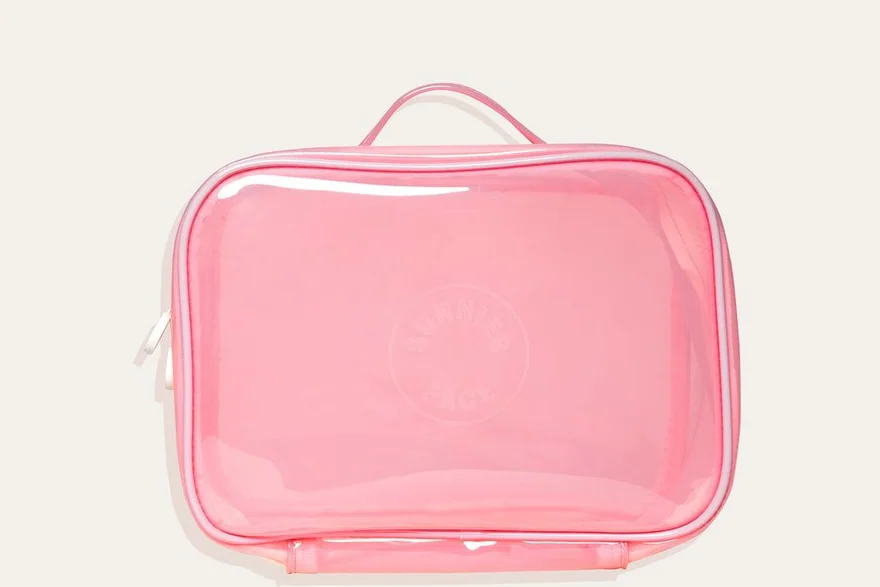
Travel-led specifications need one external constraint written in. Where a clear pouch is built for carry-on use it has to work with the TSA 3-1-1 liquids rule, which limits liquids to containers of 3.4 oz or 100 ml carried in a single quart-sized clear bag, one per passenger. A quart-sized bag measures roughly 18 x 20 cm, so a clear pouch intended to hold it plus a small brush set lands near 22 x 20 x 6 cm. Writing that constraint into the specification avoids a bag that fits the brand but not the security tray.
- Dimensions in cm with the gusset type named
- Shell, lining and interlining named by fibre, denier and weight in g/m²
- Zipper tape gauge, slider type and puller style named
- Logo method, size in mm, datum and Pantone reference
- Interior fitment counted: loops, pockets, dividers
- Quantity per colourway, not in total
- Packing, labelling and barcode instructions
- Destination market and the compliance protocol that applies to it
How the Cost of a Custom Cosmetic Bag Is Built
The unit price of a custom cosmetic bag is a stack of roughly seven variable elements plus two fixed ones. Buyers who understand the stack can cut cost without cutting the quality a customer can see. Buyers who negotiate only the total usually get a cheaper bag in ways they did not intend.
Material and hardware dominate. In a typical sewn pouch programme the shell fabric is the largest line and the zipper assembly the second. Changing a #5 metal-look zipper to a #5 nylon coil zipper removes cost per unit without changing the look at arm's length; reducing elastic loops from eight to five removes three operations per bag; choosing a stock colourway instead of a custom-dyed one removes a mill minimum and, commonly, 10-15 days from the schedule.
| Cost element | Illustrative 500 pcs | Illustrative 2,000 pcs | Illustrative 10,000 pcs | What drives it |
|---|---|---|---|---|
| Shell fabric | $0.62 | $0.55 | $0.51 | Fibre, g/m², coating, dye lot size, cutting yield |
| Lining and interlining | $0.18 | $0.15 | $0.13 | Denier, colour matching, bonding or foam |
| Hardware | $0.41 | $0.36 | $0.33 | Tape gauge, slider type, plating, branded puller |
| Logo application | $0.28 | $0.19 | $0.14 | Method, colour count, position, one-off screen or plate |
| Cutting and sewing labour | $0.95 | $0.80 | $0.72 | Operation count, seam length, gusset type |
| Interior fitment labour | $0.34 | $0.28 | $0.24 | Loop count, pocket count, divider construction |
| Inspection and packing | $0.16 | $0.12 | $0.10 | Inspection level, units per carton, labelling |
| One-off tooling and sampling | $180-420 total | $180-420 total | $180-420 total | Screens, plates, dies, sample courier |
| FOB Xiamen unit, illustrative | $3.10 | $2.58 | $2.29 | Adds inland transport, export packing and clearance |
Two things happen as quantity rises. Fixed costs — screens, plates, dies, machine setup, the cutting marker, the inspection setup — spread over more units, and material is bought in larger, better-priced lots. The result is usually a 20-30% fall in unit cost between 500 and 10,000 pieces on an unchanged specification, with most of that fall occurring between 500 and 2,000. Above 10,000 the curve flattens; at that point the remaining levers are engineering ones, not volume ones.
FOB Xiamen covers the goods, export packing, inland transport to the port, export clearance and loading on board. It does not cover ocean freight, insurance, import duty, destination handling or inland delivery; those belong to the buyer's forwarder and customs broker, and duty treatment depends on the classification the broker confirms for the destination market. Payment runs T/T 30% deposit with 70% against bill of lading, which puts 30% of order value out at confirmation and 70% shortly before documents are released — worth modelling in cash-flow terms before committing to a second colourway.
Quotations should be compared itemised, at the same three quantity tiers, on the same specification. The lines most often missing from a low quotation are the lining and interlining, the hardware grade, the print colour count, carton packing and labelling, and compliance testing. Ask for the fabric weight in g/m² and the zipper tape gauge in writing; those two numbers explain most of the difference between two quotations for what looks like the same bag.
It helps to know where a custom programme sits in the wider market. Marketplace listings for cosmetic bags show unit prices from roughly $0.45 to $12.00, a band wide enough to cover a thin flat poly pouch at one end and a structured moulded case at the other. A made-to-order programme with a specification, a controlled lining and an inspected finish sits in the middle of that band, and a quotation below roughly $1.00 for a lined, zippered pouch with a printed logo should be read carefully: it usually means a lighter shell, an unlined interior or a hardware downgrade that the specification did not ask for.
- Move from a custom-dyed colourway to the nearest stock colour
- Reduce the elastic loop count to the number customers actually use
- Specify a nylon coil zipper instead of a metal-look one
- Reduce the print to one or two colours, or move the logo to a woven label
- Standardise the carton pack and drop retail-ready packing for the first run
The unit figures in the table above are illustrative planning ranges for a mid-specification sewn pouch, not a quotation. Actual pricing follows the specification, the material market at the time of booking and the quantity per colourway.
Quality Control, Testing and Compliance Before Release
Inspection is where a programme either holds its specification or loses it. The standard used on these programmes is AQL 2.5 under ISO 2859-1. AQL is an acceptance quality limit expressed as the number of allowable defects in a random sample drawn from the finished lot. It is not a promise of a defect-free shipment, and buyers sometimes read it as one.
Sample size follows lot size at general inspection level II. A 500-piece lot draws 50 units, with 3 defects acceptable and 4 rejecting. A 2,000-piece lot draws 125 units, with 7 acceptable and 8 rejecting. A 10,000-piece lot draws 200 units, with 10 acceptable and 11 rejecting. Critical defects are treated separately and are not governed by those numbers: a single critical defect fails the lot.
| Defect class | Examples in cosmetic bags | Acceptance at AQL 2.5 | Typical remedy |
|---|---|---|---|
| Critical | Broken needle fragment inside the bag, exposed sharp metal, missing required compliance marking, restricted substance above the destination limit | Zero acceptance; one occurrence fails the lot | Full re-inspection, metal-detection sweep, root-cause report before re-release |
| Major | Zipper that does not close, burst seam, detached lining, print outside the stated tolerance, wrong colourway, missing loop, dimension beyond plus or minus 5 mm | Accept 3, reject 4 on a 500-piece lot; accept 7, reject 8 at 2,000 | Rework or sort, then re-inspect the lot |
| Minor | Loose thread, light soiling that wipes off, panel misalignment within tolerance, label skew under 2 mm, crease on a lined panel | Usually assessed at AQL 4.0: accept 5, reject 6 on a 500-piece lot | Accept with a written concession, or sort if the retailer requires it |
The defect list should be written by the buyer, not inherited. Alongside it, specify the physical tests. A zipper cycle test states the number of open-close cycles — 500 is a common specification for a pouch zipper — and is judged on whether the slider still locks and the tape still tracks. Seam strength is tested on the gusset, where pouch failures start. Coated fabrics are assessed for coating adhesion and water resistance under ASTM D751. Colour fastness to rubbing and to laundering is assessed under the ISO 105 series and AATCC test methods. Zipper terms should follow ASTM D2053, so that a number 5 reverse coil with auto-lock slider means the same thing on both sides of the order.
Chemical compliance follows the destination. For the EU market, REACH governs restricted substances and the candidate list, and the buyer should name the article, the scope and the limit being applied. For the US, CPSIA applies where a bag is a children's product, covering lead and phthalates. OEKO-TEX Standard 100 is frequently requested at article level as a single certificate covering a defined product class. A recycled-content claim needs the Global Recycled Standard plus a transaction certificate for the material lot, and an organic cotton programme needs GOTS scope certificates for each stage of the chain. Certificates attach to a named article and a named certificate holder, so a certificate for a fabric roll does not automatically cover the finished bag: ask for the certificate number, the article it covers and the validity dates.
Inspect twice. An inline inspection at 10-20% of the build catches systematic problems while they can still be corrected: a print position drifting across a run, a loop spacing error repeated on every unit, a lining shade difference between fabric rolls. The final random inspection runs on packed cartons, with cartons drawn from across the lot rather than from the first pallets packed. Both reports belong in the shipment file.
The shipment file is what makes a later claim answerable. Keep, for every shipment, the sealed approved sample, the inspection report with photographs, the test reports and certificate numbers, and the packing list with carton counts. When a retailer or a marketplace asks for a compliance file, it is assembled from those documents in an afternoon. Assembled retrospectively, it takes weeks, and sometimes cannot be assembled at all.
- Defect classification, with the buyer's own examples in each class
- AQL level and inspection level, and what happens on a borderline result
- Which tests are required, by which method, and who pays for them
- Whether inspection is inline, final, or both
- Carton sampling method and the packing check
- Who holds the sealed approved sample on each side
Choosing Between Programme Routes: A Decision Framework
The route decision reduces to four questions: what role does this SKU play, how long will the programme run, how much of the shape does the brand need to own, and how much calendar is available. Answering those four honestly usually settles the route without further analysis.
- First order, demand unproven, launch inside 12 weeks: Route A, stock plus logo
- Existing range needs a matching size, pocket map or hardware grade: Route B
- The silhouette is brand property or needs a moulded shell: Route C
- A retail chain has asked for an exclusive: Route B at minimum
- Annual volume above roughly 10,000 pieces across colourways: Route C development amortises
- Programme planned for three or more seasons: Route C
- Fixed event date with no second run planned: Route A, one-colour print, reverse calendar
Most programmes are staged, and the staging is deliberate. Route A validates demand at the 500-piece minimum with the least capital at risk. Route B builds the second run, typically 2,000-5,000 pieces, using the colourway and the fitment that the first run proved. Route C is justified once annual volume is high enough, commonly 10,000 pieces and above, that development cost becomes a small fraction of programme value. What carries across the stages is valuable: the approved colour references, the logo screens and plates where artwork and position are unchanged, the agreed defect list, and the inspection protocol. Those reduce the second and third programme to a shorter, cheaper version of the first.
Each route carries a specific risk, and naming it in advance is cheaper than meeting it later. Route A's risk is sameness: a competitor can buy the same shell with a different print, so the brand must own the print, the colour and the packaging rather than the shape. Route B's risk is iteration cost — each pattern change is a sample round, and three rounds on a modified pattern can cost more calendar than a clean Route C development. Route C's risk is commitment: dies and moulds are paid for before demand is proven, and a shape that underperforms cannot be converted back into a stock shell.
Switching routes mid-programme should be treated as a new programme rather than a change order. Moving from Route A to Route B means a revised pattern, a new cutting die and a fresh sample round at 6-10 working days minimum; moving to Route C adds 12-15 working days per round and usually three rounds. The cost of the switch is less than the cost of launching a shape that does not fit the range, but it should be planned as a schedule event rather than absorbed silently.
When a target price cannot be met, the answer is in the specification, not in the negotiation. The levers, in order of least visible impact: remove interlining or reduce its thickness; reduce the number of operations, starting with loops and pockets customers rarely use; standardise the hardware; accept the nearest stock colour; raise the quantity to move down the volume curve; and only then revisit the shell material. Reducing shell fabric weight is the last resort, because it is the change a customer notices first in the hand.
Reorders behave differently. Once a specification, a set of screens and a defect list exist, a repeat of the same style and colourway usually skips the development gates and re-enters the timeline at pre-production confirmation, so the repeat calendar is closer to the 35-50 day bulk window plus inspection and shipment. Buyers with a steady SKU can therefore hold less inventory and reorder more often, provided the material is a stock item. A custom-dyed colourway removes that flexibility, because the mill minimum has to be met again.
One page is enough to open a programme: silhouette, dimensions in cm, material direction, quantity per colourway, target FOB price, launch date and destination market. QUANZHOU JUNYUAN BAGS coordinates bag programmes from specification through inspection; written enquiries go to [email protected].
Buyers who send that page get back a route recommendation, an itemised cost band at three quantity tiers and a calendar. Buyers who send only a photograph and a budget get back questions. The difference between the two is usually two weeks on the calendar.
The B2B Customisation View
For buyers building a range of cosmetic bags, the specification sheet doubles as the costing sheet, which is why it is worth getting right in week one.
Programme data for this category: minimum order quantity 500 pieces per style and colourway, sampling in 6–10 working days (12–15 working days for complex constructions), bulk production 35–50 days after sample approval, final random inspection at AQL 2.5 under ISO 2859-1, FOB Xiamen, T/T 30/70.
Because the entity is a sourcing and programme-management company, the buyer deals with one accountable counterpart for specification, sampling, inspection and consolidation.
Which Brand Types This Guide Serves
This guide is written for any buyer commissioning a branded bag, but the route, the specification depth and the inspection protocol differ by buyer type. The differences are practical rather than cosmetic: what counts as an acceptable first run, which certificates are demanded, which packing rules apply, and which of the nine gates actually holds the calendar. A start-up launching one pouch and a hotel group refilling amenity kits walk the same timeline with completely different constraints, and the specification each of them needs to write is not the same document. Seven buyer profiles cover most of the enquiries in this category, and the notes below are the points where each one typically needs to make a decision earlier than expected.
- Start-up beauty brands: first runs of 500-1,000 pieces on Route A, with logo and packaging doing the differentiation, budget for two sample rounds, and stock colourways until demand is proven.
- Established beauty brands: Route B or C, colour matched to an existing range through lab dips and Pantone control, article-level certificates such as OEKO-TEX Standard 100 or GRS, and annual volume planned across colourways rather than per order.
- Retailers and private-label programmes: Route B at minimum, the retailer's own compliance and packaging protocol written into the specification, carton markings and barcode placement defined, plus a carton drop specification.
- Marketplace and e-commerce sellers: differentiation through fitment rather than shape, since search demand concentrates on function — toiletry bag draws roughly 74,810 weekly Amazon searches and travel bag for toiletries roughly 110,000 monthly searches, both as search demand rather than revenue — plus packing that meets the fulfilment centre's prep rules.
- Hospitality and amenity buyers: Route A at high volume, brand-consistent print across many small items, sizing driven by the amenity kit contents, and reorder cycles tied to occupancy rather than to seasons.
- Gift, promotional and event buyers: a fixed date drives everything, so the calendar is built backwards from the event, print is usually one or two colours, and the shipping method is chosen to protect the date rather than the margin.
- Subscription box and kitting buyers: a hard cost ceiling per unit, flat-packed construction to suit the packing line, and a specification that survives being handled once and photographed once.
Frequently Asked Questions
What does a 500-piece minimum mean when a buyer wants three colourways?
The minimum applies per style and per colourway, not per order. Three colourways of the same pouch is a 1,500-piece commitment, and each colourway runs as its own production run with its own inspection sample. Buyers who want three colours but only 500 pieces in total have three options: launch one colourway first and add the others on the reorder, accept a surcharge for short colour runs, or consolidate to two colourways and use print or trim to create the third variant. The first option is usually cheapest; the third usually looks most deliberate on shelf.
How long does a custom cosmetic bag programme take from brief to vessel?
Roughly 10-14 calendar weeks for a straightforward programme: 1-2 days for feasibility, 2-5 days buyer-side for artwork and specification, 1-3 days for quotation, 6-10 working days for sampling, 3-7 working days per revision round, 35-50 days for bulk after sample approval, and 1-2 days for inspection before the vessel. Complex constructions with 12-15 working day sampling and a third sample round move the total to 16-20 weeks. Ocean transit and clearance sit on top and depend on the lane. The buyer's own gates — artwork, approvals and the balance payment — are the ones most often underestimated.
What separates a stock-plus-logo bag from a modified-pattern bag in cost and control?
Stock plus logo changes only the colourway, the logo application and the packaging. There is no pattern work, so setup is limited to the screen, plate or embroidery tape and unit cost stays at baseline. A modified pattern changes the dimensions, the gusset, the pocket map, the lining or the hardware grade, which means a revised pattern and usually a new cutting die; unit cost typically runs 15-45% above baseline and sampling can extend from 6-10 to 12-15 working days. In exchange the buyer owns a shape and an interior that competitors buying the same base shell cannot match.
Which information does a quotation need before it can be priced accurately?
Nine fields: external dimensions in cm with the gusset type; shell material by fibre, denier, coating and weight in g/m²; lining and interlining specification; closure with tape gauge, slider type and puller style; logo method, size in mm, position from a stated datum and Pantone reference; interior fitment with loop and pocket counts; quantity per colourway; packing, labelling and barcode instructions; and the destination market with the compliance protocol that applies. Missing fields are not neutral — the quotation fills them with assumptions, and two quotations that look different often differ only in what each assumed.
Why does unit price fall between 500 and 10,000 pieces?
Because fixed costs spread and materials get cheaper in larger lots. Screens, plates, dies, machine setup, the cutting marker and the inspection setup are one-off charges: at 500 pieces they can add $0.20-0.40 per unit, at 10,000 pieces a few cents. Fabric is bought in bigger, better-priced lots, and operators settle into a long run. On an unchanged specification the total fall is usually 20-30%, with most of it between 500 and 2,000 pieces. The curve flattens above 10,000, where further savings have to come from engineering rather than volume.
What does FOB Xiamen include and exclude in a bag quotation?
FOB Xiamen includes the goods, export-standard packing, inland transport to the port, export clearance and loading on board the vessel. It excludes ocean freight, marine insurance, import duty, destination terminal handling and inland delivery to the buyer's warehouse; those are quoted by the buyer's own forwarder and customs broker, and duty depends on the classification the broker confirms for the destination market. Payment under these terms is T/T 30% deposit with 70% against bill of lading, so 30% of order value leaves at confirmation and 70% just before documents are released.
How does AQL 2.5 work on a 500-piece cosmetic bag order?
Under ISO 2859-1 at general inspection level II, a lot of 281-500 pieces draws a random sample of 50 units. At AQL 2.5 the lot is accepted if 3 or fewer units carry major defects, and rejected at 4. Minor defects are commonly assessed at AQL 4.0, which on the same sample accepts 5 and rejects 6. Critical defects sit outside the count entirely: one broken needle fragment, one missing required marking or one restricted-substance failure rejects the lot regardless of the sample result. A rejected lot is reworked or sorted and then re-inspected, which adds days the calendar did not plan for.
What counts as a critical defect in a cosmetic bag inspection?
A critical defect is one that makes the unit unsafe, illegal for its destination market, or unusable. In this category that means a broken needle fragment or any sharp metal inside the bag, missing or incorrect compliance marking where the market requires it, a restricted substance above the legal limit, a small part that detaches from a bag intended for children, and a lining or coating that fails the stated chemical requirement. Critical defects have zero acceptance: the lot fails on one occurrence, and the remedy is a full re-inspection, often with a metal-detection sweep, plus a root-cause report before anything is re-released.
Which tests should a buyer request for a printed polyester cosmetic bag sold in the EU?
Four groups. Physical: a zipper cycle test at a stated number of cycles, seam strength on the gusset, and coating adhesion or water resistance for coated fabrics under ASTM D751. Colour: fastness to rubbing and to laundering under the ISO 105 series or AATCC methods, which matters most where a dark print sits on a light shell. Chemical: REACH restricted-substance screening for the destination, with OEKO-TEX Standard 100 at article level as a single certificate covering a defined product class. Documentation: certificate number, the article covered, the issuing body and the validity dates, because a fabric certificate does not automatically cover the finished bag.
How do airline liquids rules affect the specification of a clear travel cosmetic bag?
The TSA 3-1-1 rule limits liquids to containers of 3.4 oz or 100 ml carried in a single quart-sized clear bag, one bag per passenger, and a quart-sized bag measures roughly 18 x 20 cm. A clear pouch built for carry-on use therefore has to accommodate that bag plus whatever else the traveller carries, which usually puts the specification near 22 x 20 x 6 cm. Writing the constraint into the specification prevents the common failure: a bag that matches the brand but is a centimetre too small for the liquids bag, which customers discover at the security tray and then return.
When does a moulded EVA vanity case justify the fully developed design route?
When the structure itself carries the value. A moulded EVA case has a fixed internal volume, a defined wall thickness and a shape that cannot be produced by sewing panels, so it needs a mould, a new pattern set and usually two or three sample rounds at 12-15 working days each. That development pays back when the case is a hero SKU with a multi-season life, when the shape is brand property worth protecting, or when annual volume is high enough — commonly 10,000 pieces and above — for the mould cost to become a small fraction of programme value. A 500-piece test order rarely justifies it.
What tolerance should a specification allow on print position and bag dimensions?
For a sewn pouch with a gusset, plus or minus 5 mm on external dimensions is realistic; holding a soft construction tighter raises cost without improving the product. Print position should be specified as plus or minus 3 mm measured from a stated datum, usually the bottom-left corner of the front panel or the centre line of the zipper — a position without a datum is not measurable. Label placement at plus or minus 2 mm. Hardware, webbing and zipper tape are ordered in fixed lengths and need no such tolerance, but colour does: a Pantone reference must state coated or uncoated.
How should a buyer handle a sample that is close but not correct?
Return it in writing, with marked photographs and a numbered list of changes, and state whether each item is a must-change or a preference. Vague responses such as make it feel better produce another sample round at 3-7 working days and another courier charge. Marking the physical sample with a pencil and photographing the marks is faster and clearer than prose. If three or more items are must-change, the specification was not agreed tightly enough, and the fix is to reissue the written specification rather than to describe the fix on a sample. Approve in writing when the unit is right; verbal approval is not a record.
Can a buyer change material after the sample is approved?
Yes, but it restarts parts of the programme. A fabric change after approval reopens costing, and if the new material is custom-dyed or custom-coated it adds the mill's lead time to the bulk window, which can push a 35-50 day build well past it. A change in zipper or hardware grade reopens the quotation and may need a fresh sample to confirm the seam and the fitment still work. A change in logo method reopens the screen or plate setup. The safe sequence is to finalise material at quotation stage, before sampling starts, and to treat any later change as a schedule event with a written cost and date impact.
People Also Ask
What is the minimum order for custom cosmetic bags?
The standard minimum is 500 pieces per style and per colourway, and it applies whether the bag is a stock shell with a logo or a fully developed design. Three colourways of one style is therefore 1,500 pieces. Marketplace listings often advertise minimums between 100 and 1,000 pieces, but a lower headline minimum usually comes with a higher unit price, a narrower material choice and no pattern work, so it suits a one-off purchase rather than a programme.
How long does it take to get a custom cosmetic bag sample?
Sampling runs 6-10 working days for a stock-based bag with logo application, and 12-15 working days for complex constructions such as a multi-panel case, a moulded EVA shell or a design with several fitments. The clock starts when the specification and any sampling deposit are both in hand, not when the enquiry is sent. Each revision round adds another 3-7 working days, so a buyer who expects three rounds should plan roughly a month for the sampling stage alone.
Can a buyer put a logo on a cosmetic bag?
Yes, and it is the most common and cheapest form of customisation. Options include screen printing, heat transfer, embroidery, a woven label, a rubber or PU patch, and a metal or moulded puller on the zipper. The choice depends on the shell material, the number of colours, the size in mm and where the logo sits relative to the seam. Setup is limited to the screen, plate or tape, so the 500-piece minimum and the 6-10 working day sampling window stay the same as for the stock bag.
What is the cheapest way to brand a cosmetic bag?
Choose a stock shell in a stock colourway and apply a single-colour logo, because that avoids every one-off charge except the print screen. Adding colours adds screens; moving to embroidery adds a tape and a slower operation; a custom-dyed colourway adds a mill minimum; a woven label adds a trim purchase with its own minimum. For a first run the least expensive combination is usually a one-colour screen print on the front panel plus a stock printed care label inside.
Are custom cosmetic bags worth it for a small beauty brand?
Usually yes, if the first run is treated as a test. At 500 pieces per style and colourway, with stock materials and a one or two colour logo, the capital at risk is modest and the sampling window is 6-10 working days. What makes it worthwhile is packaging and print quality rather than the shape: a stock shell with a distinctive print, a matched pouch and carton, and a clean interior fitment reads as a brand. A moulded or fully developed shape is better saved for the second or third season.
References & Standards
- ISO 2859-1 sampling procedures for inspection by attributes
- ASTM D2053 standard terminology relating to zippers
- AATCC TM61 colour fastness to laundering
- IEC 62321 determination of certain substances in electrotechnical products
- OEKO-TEX Standard 100 testing for harmful substances
- Textile Exchange Global Recycled Standard
- US CPSC CPSIA consumer product safety improvement act
- ECHA REACH regulation on chemicals
- TSA 3-1-1 liquids rule for carry-on baggage
- ASTM D751 standard test methods for coated fabrics
- ISO 105 textiles tests for colour fastness
- Global Organic Textile Standard GOTS
In-Depth Articles in This Category
34 dedicated articles sit under this pillar guide.
Related Pillar Guides
Request a Sample or a Written Quotation
Send the silhouette, dimensions, material preference and logo artwork, and the programme team will return a written quotation with MOQ, sampling window, bulk lead time and inspection standard.
Email: [email protected] · WhatsApp: +86 177 5002 0688