Cosmetic Bag with Jewelry Compartment: Dual-Use Design
Executive Summary
A cosmetic bag with a jewellery compartment works when the two halves are genuinely separated rather than sharing one cavity. The practical specification is a dedicated compartment with its own closure, a ring roll or elastic loop strip for rings, a pierced panel or mesh for earrings, and one or two snap tabs for necklaces, lined in a low-abrasion fabric that does not shed. That compartment has to be sealed off from powder and liquid cosmetics, because loose powder and foundation oil are what damage jewellery inside a combined case.
The commercial appeal is a higher price point on one body and a gift story that needs no explanation, but the added value is entirely in assembly detail. Ring rolls need foam of the right density, necklace tabs need backing so they do not tear out, and an anti-tarnish lining needs to be declared by mill and grade. Programmes start at 500 pieces per style and colourway, sample in 6 to 10 working days, or 12 to 15 for complex constructions, and run 35 to 50 days in bulk after approval at AQL 2.5, FOB Xiamen, T/T 30/70.
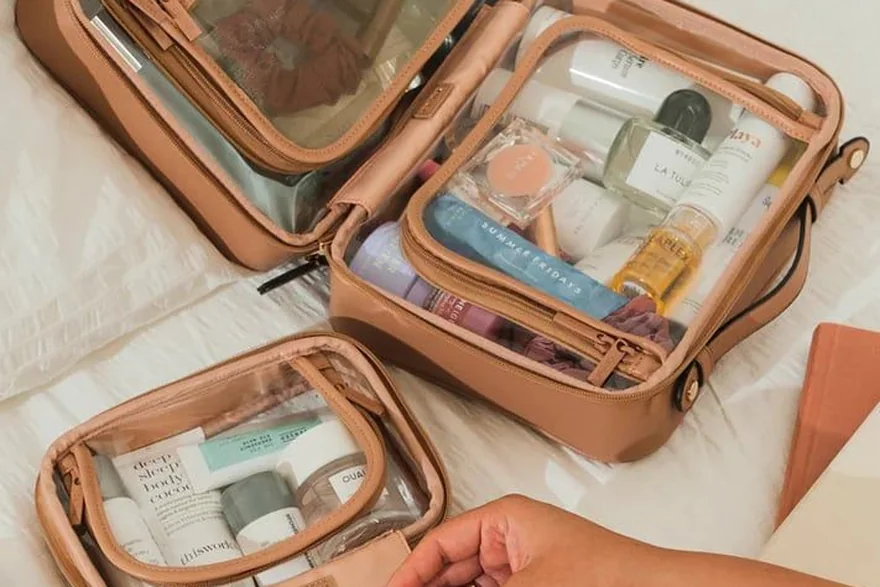
Why a dual-use case needs two cavities, not one
The idea behind a cosmetic bag with a jewellery compartment is simple: one case for everything a traveller takes to a wedding weekend. The execution fails in a predictable way when the compartment is a divider in a shared cavity. Loose powder migrates, a foundation bottle weeps at the neck, and the jewellery ends up coated in the same film the pouch was designed to contain. A dual-use case that is to survive a second purchase has to keep the two environments separate.
Separation has three elements. The jewellery side needs its own closure, so it stays shut even if the main zipper is opened in a hurry. It needs a lining that does not shed fibres or abrade a soft metal. And it needs a physical barrier, which in practice means its own panel rather than a divider stitched into the main body, because a single-layer divider still lets fine powder travel through the stitch holes.
The format also answers a real demand pattern. 'travel bag for toiletries' draws roughly 110,000 monthly searches and 'make up bags for women' around 80,000 monthly searches, and the buyer searching for a combined case is usually shopping for travel or for a gift rather than for daily use. Within the typical $0.45 to $12.00 unit price band reported on marketplaces, a compartment version sits in the upper half, because the added cost is assembly labour rather than material.
Two construction families cover most of the market. The first is an integrated compartment: a panel built into the shell, with the jewellery features sewn directly onto it. The second is a removable insert: a roll or a tray that lifts out, so the same body can be sold as a plain case and as a dual-use case. The removable route costs more per unit and suits a brand testing the concept; the integrated route is cheaper at volume and reads as a single designed product.
Compartment architecture: what holds rings, earrings and chains
Each jewellery type needs a different holding method, and a compartment that tries to serve all three with one feature tends to serve none well. Rings are held by compression in a roll or between elastic loops. Earrings are held by passing the post through a pierced panel or mesh, with the backing stored behind it. Necklaces and bracelets are held on a tab or hook so they can hang rather than coil, because a coiled fine chain knots and a knotted chain is the most common complaint on this product type.
The ring roll is the feature buyers recognise, and its performance depends on foam density more than on the covering fabric. A roll built on low-density foam compresses flat after a few months and stops holding; a roll built too firm will not accept a wide band. Specifying foam by density and by compressed recovery, and specifying the roll diameter, gives the sample room something measurable to hit instead of a photograph to copy.
| Compartment format | Construction detail | Items it suits | Added operations | Cost tier |
|---|---|---|---|---|
| Ring roll strip | Foam core wrapped in flocked or suede-look fabric, 3 to 5 rolls per strip | Rings and small hoops | Wrap, close, topstitch onto panel | Low |
| Elastic loop strip | 6 to 10 mm elastic sewn in channels, loops at 25 to 30 mm pitch | Rings, bangles, stud earrings | Channel sewing on a marked template | Low |
| Pierced earring panel | Perforated board faced with mesh or non-woven, backing pocket for scrolls | Stud and drop earrings | Perforate, face, bind, add backing pocket | Medium |
| Necklace tab bar | Webbing tab with covered press stud, backed by a reinforcement patch | Necklaces and bracelets | Cut tab, set stud, box stitch | Medium |
| Zippered tray pocket | Own zipper on a gusseted pocket with a divider | Watches, brooches, larger pieces | Second zipper, gusset, divider | High |
| Removable roll insert | Roll-up sleeve with rolls and a pocket, held by a press stud or tie | Full set, lifts out of the case | Separate sub-assembly plus attachment | High |
Dimensions should be set from the items, not from the bag. A ring roll of 18 to 22 mm diameter accepts most bands; a strip of four rolls needs roughly 9 to 11 centimetres of panel width. An earring panel needs a pierced area of about 10 by 12 centimetres for a twelve-pair set. A necklace tab needs enough drop below it, typically 12 to 15 centimetres, that a chain hangs without touching the base seam. Working those figures out first prevents the common outcome where the compartment looks generous empty and is unusable loaded.
Closure choice on the compartment matters more than buyers expect. A zipper seals better against powder but adds a second chain and a second puller, and it can catch a chain that has escaped its tab. A covered press stud or a magnetic closure is cheaper and easier to open one-handed, but neither seals. Where the department store channel requires the case to be displayed open, a zipper that lies flat is the better presentation; where the case ships filled, a stud is usually enough.
A jewellery compartment that looks tidy empty can be unusable with twelve pairs of earrings and four necklaces in it. Ask for the approval sample to be loaded and photographed, and specify how many pieces of each type the compartment must hold without the closure straining.
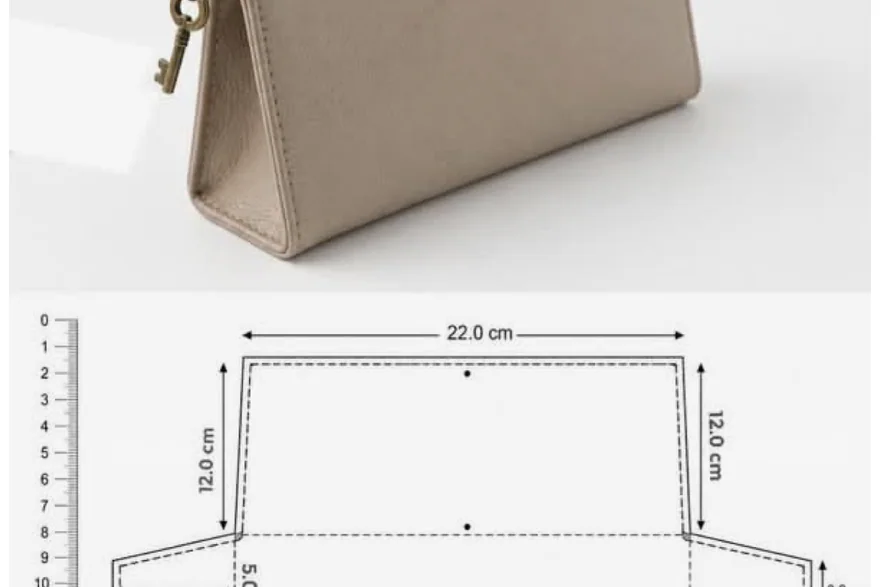
Linings, abrasion control and tarnish claims
The lining inside a jewellery compartment has a different job from the lining in the cosmetic side. It must not abrade soft metals, it must not shed, and ideally it should slow tarnishing. A standard 210D polyester lining fails on the first two counts: it is slippery enough to let pieces slide against each other, and its surface is harder than sterling silver. A brushed tricot, a flocked knit or a suede-look microfibre at 180 to 220 g/m² behaves better and reads as a jewellery material on shelf.
Anti-tarnish linings are treated fabrics that absorb sulphur-bearing gases before they reach the metal. They work for a finite period and they are consumed by exposure, so a buyer should not describe the property as permanent. The practical specification is to name the fabric mill and grade, require the treatment to be declared, and ask for the shelf-life guidance in writing. Where a tarnish claim is made on packaging, it should be phrased as slowing tarnish under normal storage rather than as prevention.
Colour choice inside the compartment is a practical detail that gets overlooked. A dark lining hides makeup marks but makes a small earring back almost impossible to find, while a pale lining shows every fingerprint on a flocked surface. A mid-tone in the grey or taupe range is usually the workable compromise, and the colour fastness of that lining to rubbing should be specified along with the shell, because a dark lining that crocks onto a pale garment is a complaint that arrives with the product already sold.
Abrasion is the other half of the lining question, and it runs in both directions. Jewellery abrades the lining, and a lining with loose fibres catches on a claw setting. Specifying a rub fastness requirement on the lining, referenced to AATCC test methods, gives a buyer a shared method for assessing whether the surface holds up. Colour transfer onto a pale lining is assessed under the ISO 105 colour fastness family, which is a separate test and should be requested separately.
- Name the lining fabric by mill, construction and weight in g/m² rather than by colour name.
- Specify foam density and roll diameter for ring rolls; the covering fabric matters less than the core.
- Require any anti-tarnish treatment to be declared with written shelf-life guidance, and phrase packaging claims as slowing rather than preventing.
- Keep powder cosmetics out of the compartment with a separate panel, not a single-layer divider.
- Check that no metal component in the compartment can scratch a soft setting: cover press studs and avoid exposed rivets.
Hardware inside the compartment deserves a specific rule: nothing hard and exposed should be able to touch a stone. That means covered press studs rather than open ones, no rivets on the interior face, and a zipper puller that cannot swing across the ring roll. Where a magnetic closure is used, the magnet should be fully enclosed in the panel, because a loose magnet in a sewn pocket will work free and then sit directly against the jewellery.
There is also a cleaning question that belongs on the care card. A flocked or suede-look lining shows makeup fingerprints and cannot be wiped clean with a solvent without damaging the nap. Buyers should decide whether the compartment lining is serviceable or replaceable, and where the concept is a removable insert, the lining can be specified as a separate part that a customer can buy again. That is a small decision at sampling stage and a genuine aftersales opportunity later.
Sampling, inspection and retail presentation
A compartment programme is a sampling-heavy programme. The first sample is rarely right on roll spacing, tab drop or panel size, because those three depend on the real jewellery set rather than on a drawing. Planning for two sample rounds inside the 6 to 10 working day sampling window, or inside the 12 to 15 day window for a complex construction with a removable insert, is more realistic than expecting approval on the first build.
| Checkpoint | What a buyer can require | Reference or method | Stage |
|---|---|---|---|
| Compartment load test | Photograph the compartment loaded with a stated set of pieces | Buyer's own written set list | Second sample round |
| Roll compression | State foam density and roll diameter, require recovery after 24 hours compressed | Buyer's specification with a material declaration | Sample approval |
| Lining rub fastness | State a minimum rub rating for the compartment lining | AATCC test methods | Pre-bulk |
| Colour transfer | State a minimum rating for lining and shell | ISO 105 colour fastness family | Pre-bulk |
| Zipper identification | Name chain type, gauge and puller for both zippers | ASTM D2053 zipper terminology | Sample approval |
| Attachment pull | 500 pull cycles on necklace tabs and insert anchors | Third-party laboratory report | Pre-bulk, on 3 samples |
| Final inspection | AQL 2.5 with a compartment-specific defect list | ISO 2859-1 | Final random inspection |
Sample approval should also cover the compartment mouth. A mouth that is cut narrow looks tidy and makes the compartment awkward to load, while one cut generous leaves the lining loose and untidy at the corners. The practical test is to state how many pieces of each type the compartment must accept and require a photograph of it loaded and closed, which turns an aesthetic judgement into a measurable one and gives the inspector a reference image to compare bulk against.
Naming both zippers in the specification is worth the extra line. A cosmetic bag with a jewellery compartment usually carries a main chain in #5 and a compartment chain in #3, and an unlabelled drawing invites the sample room to fit the same coil on both, which either looks heavy on the compartment or weak on the main opening. Referencing ASTM D2053 zipper terminology makes the requirement enforceable at inspection rather than a matter of opinion.
Inspection needs a compartment-specific defect list, because the standard cosmetic bag checklist does not cover the features that fail here. Additions should include rolls set at uneven pitch, a press stud that does not align with its socket, a necklace tab whose backing patch is missing, an earring panel whose perforations are blocked by adhesive, and a lining that is not fully captured at the compartment mouth. Final random inspection runs at AQL 2.5 under ISO 2859-1, and the classification should be issued to the inspector before the inspection date.
Retail presentation decides whether the feature sells. A closed case on a shelf communicates nothing about the compartment, so the packaging needs either a printed panel showing the loaded compartment or a transparent window. Where the case ships with a hangtag, the tag should state how many rings and how many necklace tabs the compartment holds, because that is the number a gift buyer compares. Programmes run at 500 pieces per style and colourway, 6 to 10 working days for sampling, 35 to 50 days bulk after approval, FOB Xiamen on T/T 30 deposit and 70 against bill of lading.
The B2B Customisation View
Before a single metre of fabric is cut, the briefing stage settles the silhouette, the lining, the closure and the branding method for makeup bags and toiletry bags.
Standard terms: 500 pieces minimum per style and colourway, 6–10 working days for sampling (12–15 for complex builds), 35–50 days bulk production, AQL 2.5 inspection under ISO 2859-1, FOB Xiamen, T/T 30 deposit / 70 balance.
The commercial arrangement is straightforward: one sourcing partner, one technical pack, one inspection standard, one consolidated shipment.
Which Brand Types Benefit Most
The dual-use case appeals to buyers selling a gift rather than a category, and that changes how the specification should be written. A start-up brand with one hero product can justify a higher shelf price with a jewellery compartment because the feature is visible and needs no explanation; the risk is that the first sample is judged on looks rather than on whether a real jewellery set fits, so the load test belongs in the brief from the first round.
- Established beauty brands: an integrated compartment turns an existing case into a travel gift set without a new body, provided the two cavities stay separated by a panel rather than a divider.
- Retailers and department buyers: the case must be displayable open or windowed, since a closed case gives the shopper no reason to pay the premium.
- E-commerce sellers: listing copy should state ring capacity, necklace tab count and lining type; a photograph of the empty compartment is not enough to prevent returns.
- Gift and hospitality buyers: a combined case works as a wedding-weekend or bridal-party amenity, where the recipient has both cosmetics and jewellery to carry.
- Jewellery brands extending into accessories: a compartment with a declared anti-tarnish lining supports the brand's existing metal-care story, which a generic lining does not.
One more group deserves a note: brands selling through a marketplace that requires a claim to be substantiated. For those sellers the lining declaration and any anti-tarnish wording are reviewed before the listing goes live, so the fabric grade, the treatment and the capacity figures should be written into the brief early enough that the documentation can be produced alongside the sample rather than after the first bulk shipment. Across all of these groups the specification discipline is the same: set the item-fit dimensions first, declare the lining and foam by grade, and require a loaded-compartment photograph before approval. A cosmetic bag with a jewellery compartment is not expensive to build, but it is easy to build badly, and the difference shows up in reviews rather than in unit cost.
Frequently Asked Questions
What should a jewellery compartment in a cosmetic bag hold?
A practical brief is four to six rings on a roll strip, up to twelve pairs of earrings on a pierced panel, and two to four necklaces on tabs. Stating those numbers in the specification lets the sample room size the panel, and gives the inspector something to check. A compartment designed without a stated capacity usually looks generous empty and fails once loaded.
How is a jewellery compartment separated from the cosmetic side?
The reliable method is a dedicated panel with its own closure rather than a divider stitched into a shared cavity. A single-layer divider still lets fine powder travel through the stitch holes, which is exactly what damages jewellery. The compartment should close independently, so it stays shut when the main zipper is opened in a hurry.
What foam density should a ring roll use?
Density matters more than the covering fabric, because a low-density core compresses flat and stops holding within months. A buyer should specify the foam density, the roll diameter, commonly 18 to 22 mm, and a recovery requirement after the roll has been compressed for 24 hours. Asking for the foam grade to be declared makes a substitution detectable.
Is an anti-tarnish lining worth specifying?
It is worth specifying where the case is sold on metal care, but it should be described accurately. Anti-tarnish treatments absorb sulphur-bearing gases and are consumed by exposure, so packaging should say the lining slows tarnish under normal storage rather than prevents it. The treatment, the fabric grade and the shelf-life guidance should all be requested in writing.
Which lining fabric suits a jewellery compartment?
A brushed tricot, flocked knit or suede-look microfibre in the 180 to 220 g/m² range behaves better than a standard 210D polyester lining, which is slippery and harder than sterling silver. The lining should also be low-shedding so fibres cannot catch on a claw setting. Naming the construction and weight prevents a substitution at bulk.
How should necklaces be held inside a combined case?
On a tab or hook that lets the chain hang, with 12 to 15 centimetres of drop below it so the chain does not touch the base seam. A coiled fine chain knots, and knotted chains are the most common complaint on this product type. The tab should be backed by a reinforcement patch, because a tab sewn through a single lining layer tears out.
What minimum applies to a cosmetic bag with a jewellery compartment?
Programmes start at 500 pieces per style and colourway. A compartment version counts as a separate style because the body carries a different internal bill of materials, so three colourways with the compartment commit the buyer to 1,500 pieces. Sampling runs 6 to 10 working days, extending to 12 to 15 for a removable insert, then 35 to 50 days bulk.
Should the jewellery compartment be removable?
A removable insert suits a brand testing the concept, because the same body can be sold plain or dual-use without a second tooling commitment. It costs more per unit and adds an attachment to inspect. An integrated compartment is cheaper at volume and reads as one designed product, which matters more once the concept is proven.
What closure suits a jewellery compartment?
A zipper seals better against powder and lies flat for display, but it adds a second chain and can catch a chain that has escaped its tab. A covered press stud or magnetic closure is cheaper and opens one-handed but does not seal. Where the case ships filled, a stud is usually sufficient; where it is displayed open, a flat-lying zipper presents better.
How are earrings stored in a cosmetic bag compartment?
Usually on a perforated board faced with mesh or non-woven, with posts pushed through and backs stored in a pocket behind the panel. A pierced area of about 10 by 12 centimetres suits a twelve-pair set. The perforations must be clean, because adhesive blocking the holes is a defect that only appears when a customer tries to use the panel.
What defects are specific to jewellery compartment bags?
Typical issues are ring rolls set at uneven pitch, a press stud misaligned with its socket, a necklace tab missing its backing patch, perforations blocked by adhesive, a magnet working free from its pocket, and a lining not captured at the compartment mouth. The standard cosmetic bag checklist does not cover any of these, so the classification needs rewriting.
Can jewellery compartments use recycled or certified fabrics?
Yes. A recycled polyester lining can be claimed under the Global Recycled Standard provided the fabric mill holds a valid scope certificate and a transaction certificate is requested. A lining in contact with skin can also be certified to OEKO-TEX Standard 100. Both claims cover the textile and not the foam, hardware or adhesive, so hangtag wording must be precise.
How many sample rounds should a compartment programme plan for?
Two is realistic. Roll spacing, tab drop and panel size depend on the real jewellery set rather than on a drawing, so the first build rarely fits everything. Planning two rounds inside the 6 to 10 working day sampling window, or 12 to 15 days for a complex insert, avoids the compressed timeline that produces an approved sample nobody is happy with.
What zipper sizes suit a dual-use cosmetic and jewellery case?
A #5 coil chain on the main opening and a #3 chain on the compartment is a common pairing, because the compartment needs a lighter chain that does not crowd the panel. Both should be named by chain type, gauge and puller in the specification, otherwise the sample room may fit the same coil to both and the balance is wrong.
Does a jewellery compartment need special packing for shipment?
Rolls should be protected from crushing in transit, so the compartment should be lightly filled with tissue or shipped with the insert flat. A crushed roll that has taken a set will not recover and arrives looking defective. Buyers should state the packing method and ask for carton dimensions, piece count and gross weight at quotation stage.
How should the capacity be described on retail packaging?
State countable facts: how many rings the roll strip holds, how many necklace tabs there are, how many pairs of earrings the panel takes, and what the lining is. Gift buyers compare those numbers directly, and a listing that gives them converts better than one that says generous storage. Avoid claiming that the compartment protects jewellery absolutely, since a lining can slow tarnish but cannot prevent mechanical damage if the case is dropped, crushed or overfilled.
People Also Ask
Is a cosmetic bag with a jewellery compartment worth buying?
It is worth it for travel and gifting, where carrying one case beats carrying two. The value depends on whether the compartment is genuinely separated from the cosmetics and sized for a real set of pieces. A compartment that is a divider in a shared cavity tends to end with powder on the jewellery, which is the outcome the feature was supposed to prevent.
How do you keep necklaces from tangling in a travel case?
Hang them. A tab or hook with 12 to 15 centimetres of drop below it lets a chain hang clear of the base seam, while a coiled fine chain knots almost every time. Threading a chain through a small loop before fastening it reduces movement further, and both methods should be shown on the care card so the customer knows which feature to use.
Does anti-tarnish fabric really work?
Treated linings absorb sulphur-bearing gases before they reach the metal, which slows tarnish under normal storage. The treatment is consumed by exposure, so it is not permanent and should not be described as prevention. Buyers should ask for the treatment, the fabric grade and written shelf-life guidance before putting any claim on the packaging or in a listing, and should expect to renew the claim periodically.
What is a ring roll in a jewellery case?
A strip of foam cores wrapped in a soft fabric, with rings pushed into the channels between the rolls. Roll diameter is usually 18 to 22 millimetres, and four rolls need roughly 9 to 11 centimetres of panel width. The foam density, not the covering fabric, decides whether the roll is still holding rings after months of use, so the density belongs in the written specification.
Can you put makeup and jewellery in the same bag?
Only if the two are separated by a dedicated panel with its own closure. Powder and foundation oil migrate through the stitch holes in a single-layer divider and settle on the metal, where they are difficult to remove. A dual-use case built with a separate compartment avoids the problem; one built with a divider in a shared cavity does not.
Request a Sample or a Written Quotation
Send the silhouette, dimensions, material preference and logo artwork, and the programme team will return a written quotation with MOQ, sampling window, bulk lead time and inspection standard.
Email: [email protected] · WhatsApp: +86 177 5002 0688