Custom Cosmetic Bag Prototyping: 2D Pattern to 3D Sample
Executive Summary
Custom cosmetic bag prototyping is the sequence that converts a flat 2D pattern into a physical 3D sample, and on a standard programme it takes 6-10 working days for a straightforward construction and 12-15 working days when the build involves moulded shells, bonded frames or laminated panels. Four gates sit between the artwork file and the bulk order: pattern digitising, cut-and-sew build, fit-and-function review, and release to bulk. Each gate produces an artefact, and each artefact is what makes the 500th piece look like the first one rather than approximately like it.
The buyer's job differs at each gate. At pattern stage the work is dimensional: panel sizes, seam allowance, gusset depth and zipper length in millimetres. At build stage it is structural: stitch density, thread weight, needle size and reinforcement. At review stage it is functional: does the bag stand, fill and close under load. Only after a countersigned golden sample and a frozen specification exist should the 35-50 day bulk window open, closing with inspection at AQL 2.5 before the goods load FOB Xiamen.
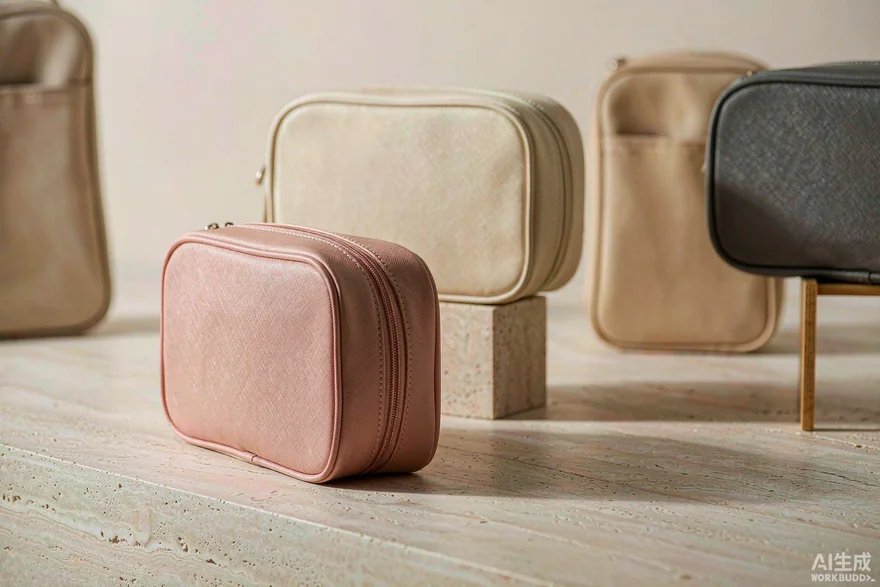
What a prototype proves that a flat drawing cannot
A tech pack tells a production floor what to build; a prototype tells the buyer whether it works. A 22 x 14 x 8 cm envelope pouch reads perfectly on a screen, but only the physical sample answers whether four 200 ml bottles stand upright inside it, whether the zipper clears the corner radius without puckering, and whether the base holds its shape when the bag is empty. Most first-round sample rejections in this category come from capacity, stand-up or zipper-travel problems that no two-dimensional drawing can reveal.
The economics favour building the sample. A sample on a straightforward construction costs 60-400 USD per style plus 30-80 USD in courier charges, and a revision round adds 4-7 working days. Compare that with a 500-piece minimum run at 2.80-6.50 USD FOB Xiamen, which puts 1,400-3,250 USD of goods behind a decision made from a drawing. Prototyping converts an unverified assumption into a measurable object for roughly the price of ten to a hundred and forty finished pieces.
Five things get tested at this stage. Geometry: finished volume, gusset behaviour and corner radius. Ergonomics: zipper travel, puller grip and whether the bag opens one-handed. Material behaviour: whether a coated shell creases or cracks at the fold, whether a 65 g/m² lining bunches at the base seam. Decoration: logo position, repeat alignment and rub resistance. Compliance: no sharp points, no detachable small parts under pull, and for travel sets conformity with the container size rule applied at airport security checkpoints.
The path from 2D pattern to 3D sample runs through four gates: pattern digitising, cut-and-sew build, fit-and-function review, and release to bulk. Each gate has an artefact attached to it, being respectively the DXF file, the physical sample, the countersigned golden sample and the frozen specification sheet. Buyers who skip a gate usually discover the omission at inspection, when the five hundredth piece does not match the sample that was approved eight weeks earlier. The sections below walk each gate with the numbers that decide the outcome.
Gate one: the 2D pattern and the cut file
Gate one is pure geometry. The pattern set for a flat cosmetic pouch typically carries eight to eleven pieces, and each piece has one dimension that dominates the finished result. A DXF file at 1:1 scale in millimetres, with grain lines, notch marks and drill holes on separate layers, is the format cutting rooms read without interpretation. Hand-drawn sketches, PDFs with scaled artwork and Illustrator files exported without unit metadata all force the pattern maker to guess, and guessing is what produces the 2-3 mm errors that later appear as twisted panels and wavy zipper plackets.
| Pattern piece | Count per bag | Material and weight | Critical dimension | What a wrong value produces |
|---|---|---|---|---|
| Front shell panel | 1 | 600D polyester, 210 g/m², PVC-backed | 220 x 140 mm cut, 10 mm seam allowance | Print area shifts up to 6 mm off centre |
| Back shell panel | 1 | Matches the front shell fabric | Within 1 mm of the front panel | Panels twist; the placket waves along the zipper |
| Gusset or base band | 1 | Shell fabric or 420D nylon, 190 g/m² | 80 mm finished depth, radiused corners | Bag will not stand; corners pucker |
| Zipper placket | 2 | Self-fabric or 20 mm webbing | Opening 200-260 mm | Slider catches; teeth sit exposed |
| Lining panels | 2-3 | 210D polyester taffeta, 65 g/m² | 3 mm smaller than the shell panel | Lining bunches at the base seam |
| Binding or piping | 1 length | 18 mm bias tape or 3 mm piping cord | 1,100-1,400 mm run | Raw edge shows; corners fray after handling |
| Wrist strap or handle | 1 | 20-25 mm webbing, 150 mm loop | 12 mm bar-tack at each end | Strap tears away at 8-10 kg pull |
| Brand label or patch | 1-2 | Woven label or TPU patch | 12 mm from the finished edge | Label sits under the zipper track |
Two fields cause more rework than any other: seam allowance and zipper specification. Seam allowance on a 600D polyester shell should be 10 mm on load-bearing seams and 8 mm on turning seams; below 8 mm the needle path sits too close to the edge and the seam pulls out under a 15 kg handle test. Zip specification should use the vocabulary in ASTM D2053 so that chain type, gauge, tape width, slider type and stop type are named rather than described. A #3 nylon coil with a 26 mm tape, an auto-lock slider and two bottom stops behaves differently from a #5 chain on a 32 mm tape with a cam-lock slider, and the difference is visible on a bag that costs 3 USD.
Marker efficiency also belongs at gate one. Nesting the panel set on a 150 cm wide roll yields 78-88% material utilisation depending on panel shape; a gusset cut as a single band with radiused corners consumes less fabric than two side pieces plus a separate base piece. Over 500 pieces that difference is small, but it is the same difference that decides whether a 10,000-piece run needs one extra fabric roll. Cutting method follows the material: a die press for coated shells, a laser for polyester where a sealed edge is wanted, and a straight knife only for very short runs.
Finally, the tech pack should state who owns the pattern. A style developed for one buyer is normally held for that buyer, but unless the purchase order says so in writing the assumption is unsafe. Ownership wording costs a sentence at sampling and saves an argument two years later when the buyer wants the same style scheduled in a different slot or moved to a second production site.
Gate two: cutting, sewing and the 3D build
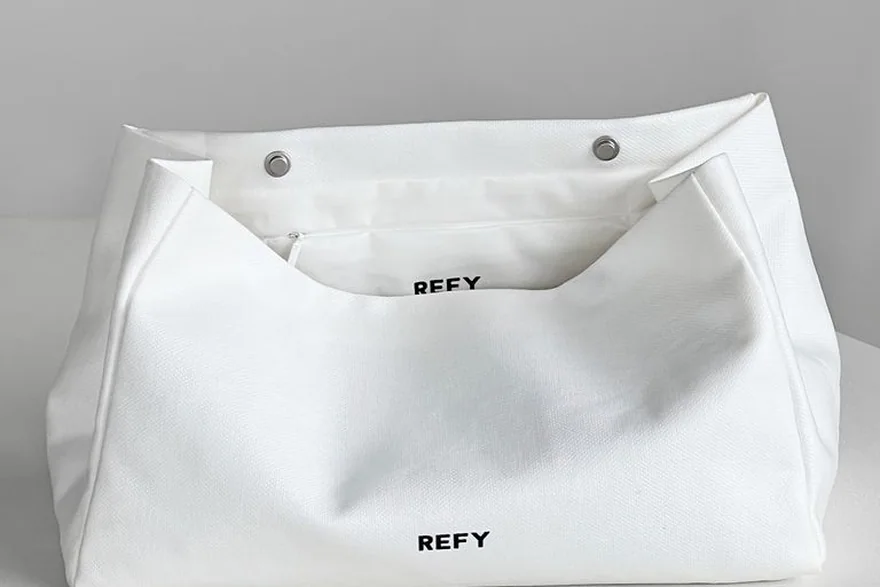
Gate two is where a flat stack of cut panels becomes a box. Cutting happens first, on grain within 2 degrees, because off-grain panels twist after the first wash or after a hot container voyage. Shell panels for a 600D construction cut cleanly at 8-12 layers per die press cycle; lining panels at 20-30 layers. Each cut bundle is tick-marked with the size and the panel name, because a mixed bundle discovered at the sewing line costs an hour of sorting and, worse, produces bags with mismatched shade bands across the front and the gusset.
- Stitch density: 7-9 stitches per inch on load seams. Below 6 SPI the seam opens at the gusset corner within weeks.
- Thread: bonded polyester Tex 40 for the shell, Tex 30 for a 210D lining. Cotton-wrapped thread shrinks and pulls the seam line.
- Needle: 90/14 for 600D and 75/11 for taffeta. An oversized needle cuts yarn and a seam fails at 60-70% of expected strength.
- Reinforcement: a 12 mm bar-tack or back-tack at every handle end, webbing end and zipper stop.
- Zipper setting: 2 mm tape reveal at both ends, top stop set before boxing, slider travelled across the full opening twenty times.
- Topstitch: 3-4 mm from the finished edge, constant along the run, because that line is the most visible line on the bag.
Coated and laminated shells need one extra check. Coating adhesion, peel strength and the behaviour of the film at a tight fold are covered by ASTM D751, and the sample round is the cheapest moment to discover that a 0.30 mm PU film cracks when the panel is folded at a 6 mm radius. If it cracks at the fold on sample one, no amount of finishing will hide it at 500 pieces; the answer is a softer film, a wider radius, or a different construction altogether.
Assembly order matters more than speed. A flat pouch builds as: zipper to placket, boxing of the corners, lining insertion, binding of the raw edge, turning, topstitch, hardware, press, first-piece check. A structured vanity case adds an internal frame, a base board and often a moulded or die-cut insert. Labour time tracks the construction: 18-26 minutes for a simple flat pouch, 45-70 minutes for a structured vanity case with a framed opening. Those minutes are a large part of what a buyer is actually purchasing when the unit price is quoted. Two further specifications belong in the tech pack at this gate. Interlining and stabiliser: a 0.4-0.8 mm non-woven fused to the front panel changes how the bag stands and how a print sits, and leaving it unspecified produces a limp sample that looks nothing like the finished article. Pressing: a coated shell pressed above 120 degrees Celsius will glaze, so the finishing temperature belongs in the specification rather than being left as a shop-floor preference.
One practical discipline pays for itself at this gate: the first piece off the line is measured before the second piece is cut. A first-piece check that catches a 4 mm placket error costs ten minutes; the same error found at final inspection costs a sort of the whole lot, 0.05-0.20 USD per piece, and somewhere between three and seven days.
Gate three and four: review, revision rounds and release to bulk
Gate three is measurement, not opinion. The finished sample is measured at five points against the tech pack with a tolerance of plus or minus 3 mm; it is filled with a defined contents set, for example four 200 ml bottles, a 180 mm brush and a 90 mm palette, to check that the stated capacity is real; the zipper is cycled 500 to 1,000 times; the wrist strap takes a 15 kg static pull for 60 seconds; and the print is rub-tested dry and wet. Anything failing is written down with a number attached, because a comment that the zipper feels stiff is not something anyone downstream can action.
| Revision round | What typically changes | Added working days | Added cost | When to stop and re-spec instead |
|---|---|---|---|---|
| Round one | Panel size, gusset depth, binding width | 4-7 | 0-120 USD plus 30-80 USD courier | Never; dimensional changes are normal at this point |
| Round two | Hardware swap, thread colour, print position | 4-7 | 40-200 USD | If the change leaves the original material family |
| Round three | Fabric substitution, structure change, new tooling | 7-15 | 150-600 USD plus tooling | Always re-quote; a third structural change means the spec was wrong |
| Pre-production sample | Nothing; confirmation build from bulk materials | 3-6 | Usually included in the sample charge | Any change here cancels the bulk slot |
| Golden sample | Nothing; countersignature and storage | 0 | 0 | The golden sample is a reference, never a draft |
Gate four is release. Once the sample passes, it is countersigned on both sides and becomes the golden sample, which is the physical reference against which the bulk lot is inspected. The specification sheet is frozen at that moment with a revision letter, and any later change becomes a re-quote rather than a revision. Bulk then runs 35-50 days from approval, and the finished lot is inspected at AQL 2.5 before it loads FOB Xiamen under T/T terms of 30% deposit and 70% against the bill of lading. The golden sample is what makes that inspection meaningful; without it an inspector is comparing a bag against a memory.
Storage of the golden sample deserves a line in the purchase order. Two sealed references should exist, one held by each side, kept away from daylight, because dyed fabric and printed panels fade. A faded reference silently widens every later tolerance, and a colour dispute eighteen months after launch is usually a reference-storage failure rather than a production failure. The same discipline applies to the digital file set. The approved DXF, the artwork file and the specification sheet should carry the same revision letter as the physical reference, and every later request for the style should quote it. A reorder raised with a revision letter moves through the system faster than one raised with a photograph.
The DXF pattern, the graded size set and the marker survive the order. A buyer who asks for the current revision letter and a copy of the pattern at the end of sampling can move the style to a different production slot later without paying for development twice. Pattern ownership should be stated in the purchase order rather than assumed.
The B2B Customisation View
The commercial logic behind makeup bags and toiletry bags is simple to state and hard to execute: hold the unit cost, hold the colour, hold the delivery window.
Commercial parameters stay fixed across the range: MOQ 500 pieces per style and colourway, prototype turnaround 6–10 working days (extended to 12–15 for multi-panel or moulded builds), bulk lead time 35–50 days from approved sample, AQL 2.5 inspection to ISO 2859-1, FOB Xiamen, T/T 30 deposit and 70 against bill of lading.
For makeup bags and toiletry bags, that coordination matters most in the two weeks between packing and vessel loading, when documentation errors cost more than any material decision.
Which Brand Types Benefit Most
Different buyer types use the prototype stage for different reasons, and the reason determines what the sample has to prove. A start-up brand treats the sample as the product: it is photographed for the launch listing, checked against the brand colour standard, and handled by people who have never seen the bag before. An established brand treats it as a line extension: the question is whether pouch number nine in a range matches the eight already sitting on shelf. A retailer treats it as a compliance object: the sample is the item that goes to the third-party laboratory and to the buying committee. An e-commerce seller treats it as a returns predictor: a pouch that will not stand up produces the flat-lay photograph that produces the return. A gift or hospitality buyer treats it as a fill test: the sample has to hold a defined amenity set at a defined landed price.
- Start-up brands: budget two to three sample rounds before launch and freeze panel dimensions first, colour second.
- Established brands: require the new style to be measured against an existing golden sample from the same range, not against the drawing.
- Retailers and importers: send the sample to the laboratory with the bulk material, never with a substituted equivalent.
- E-commerce sellers: photograph the sample filled and empty; both images drive the return rate more than the copy does.
- Gift and amenity buyers: run the fill test with the actual amenity set, including the tallest bottle, not a proxy. One further point applies across all five buyer types. The sample is also a legal object: if the bag is sold with a durability claim, a water-resistance claim or an age grading, the sample is the article that has to satisfy that claim, and it should be retained for as long as the claim is made. A buyer who photographs the sample beside a dated copy of the specification builds a record that costs nothing and settles most later arguments.
Frequently Asked Questions
What file format should a cosmetic bag pattern be delivered in?
A DXF file at 1:1 scale in millimetres, with grain lines, notch marks and drill holes on separate layers, is the safest delivery format because cutting rooms read it without interpretation. Artwork in AI or PDF supports the print file but cannot substitute for the pattern. Files exported without unit metadata force the pattern maker to rescale, and rescaling is the usual origin of the 2-3 mm panel errors that appear later as twisting.
How many pattern pieces does a flat 22 x 14 x 8 cm pouch use?
Between eight and eleven, depending on construction. A minimal build uses a front panel, a back panel, one gusset band, two placket pieces, two or three lining panels, one binding length and one strap. Adding an internal slip pocket, a detachable strap or a framed opening moves the count to fourteen or more, and each added piece adds both labour minutes and a new tolerance to hold.
Why does the first sample often measure 3 mm smaller than the tech pack?
Three mechanisms consume dimension: seam allowance takes 8-10 mm per seam, turning a lined bag pulls the shell inward, and a padded or quilted build compresses under the needle. A pattern drawn to finished dimensions rather than cut dimensions will always produce a smaller bag. The fix is to specify finished dimensions in the tech pack and let the pattern maker add allowance, then verify on the sample.
What seam allowance should a pattern specify for a 600D polyester shell?
Ten millimetres on load-bearing seams such as the gusset, the strap attachment and the zipper placket, and eight millimetres on turning seams. Below eight millimetres the needle path sits too close to the cut edge and the seam pulls out under a 15 kg static pull. Heavier shells such as 900D or canvas need 12 mm, while a light taffeta lining works at 6-7 mm.
What must a zipper specification include before sampling starts?
Chain type and gauge, tape width and tape colour, slider type, puller style, and top and bottom stop arrangement. Naming these with the vocabulary in ASTM D2053 removes the descriptive ambiguity that produces the wrong slider on sample one. A #3 coil with an auto-lock slider suits a flat pouch; a #5 chain with a metal-look puller suits a structured vanity case, and the two are not interchangeable on the same placket width.
When does a cosmetic bag sample take 12-15 working days instead of 6-10?
When the construction leaves flat assembly. Moulded EVA shells, thermoformed fronts, bonded or welded frames, multi-layer laminates with quilting, and bags requiring new hardware tooling all fall into the longer window. The extra days go to tooling or mould preparation and to the first-piece trials that follow, not to sewing. Buyers launching a structured case should plan the longer window from the start.
What is a pre-production sample and when does a buyer need one?
A pre-production sample is a build made from the actual bulk materials, on the actual bulk line, immediately before the production run. It differs from a development sample, which may use substitute fabric or a similar zipper shade. Buyers need one whenever the order exceeds roughly 5,000 pieces, whenever the fabric is being sourced for the first time, or whenever a shade was matched late in the process.
Who owns the cosmetic bag pattern after the sample is approved?
Whoever the purchase order says owns it. In the absence of wording, the assumption is unsafe in both directions. A buyer who has paid for development should state that the DXF, the graded size set and the marker are held for the style and released on request. That sentence costs nothing at sampling and prevents an argument when the style is rescheduled or moved later.
Can the fabric be changed after the golden sample is countersigned?
Not as a revision. A fabric change alters weight, hand feel, drape, print absorption and usually the finished dimensions, so it invalidates the sample that was just approved. The correct route is a new sample round against a re-quoted price, which costs 4-7 working days and 40-200 USD. Treating a fabric swap as a minor revision is the most common cause of a bulk lot that fails against its own reference.
What causes lining to bunch at the base seam in a cosmetic pouch?
Almost always a lining panel cut to the same size as the shell. Lining should be cut 3 mm smaller on each dimension so that it sits inside the shell rather than competing with it for space. The second cause is a lining fabric with too much body, such as a 190 g/m² polyester used where a 65 g/m² taffeta was specified, which refuses to fold into the corner.
How many open-and-close cycles should a sample zipper survive?
Five hundred to one thousand cycles on the sample is a reasonable functional screen, run with the bag filled so the slider works against real tension. A durability claim on the packaging should be backed by a formal test of 3,000 cycles or more on the specified chain. Failures at the sample stage usually present as slider skip near the corner rather than as a broken chain.
Why does a coated shell crack at the fold on the first sample?
Because the film is too stiff for the fold radius. A 0.30 mm polyurethane film folded at a 6 mm radius will crease white and, under repeated handling, crack. Coating behaviour and adhesion are assessed under ASTM D751. The remedies are a softer film, a wider corner radius, a scored fold line, or moving to a welded construction that removes the fold entirely.
What does a sample cost on a 500-piece cosmetic bag programme?
Typically 60-400 USD per style plus 30-80 USD courier, with the range driven by construction: a flat printed pouch sits at the bottom, a moulded or framed case at the top. Revision rounds add 0-200 USD each and 4-7 working days. Many programmes credit the sample charge against the first bulk order, but that credit should be written into the proforma rather than assumed.
How is a moulded EVA vanity case prototyped differently from a sewn pouch?
The shell is formed rather than cut. Development starts with a CNC-machined prototype block or a soft tooling cavity, then a formed shell is checked for wall thickness, typically 3-5 mm, and for closure compression with the zipper fitted. Because tooling precedes the sample, the window extends to 12-15 working days and changes after tooling are expensive, which is why dimensional review happens on the block rather than the bag.
What happens if the approved sample and the bulk lot differ?
The golden sample decides the question. If the lot matches the countersigned reference, the buyer's remedy is to accept and re-specify for the next order. If it does not, the lot is measured against the frozen specification and inspected at AQL 2.5; a fail leads to sorting, rework, a credit or replacement production depending on the defect class. Without a sealed reference, the dispute has no referee.
People Also Ask
How long does a custom cosmetic bag sample take?
A straightforward construction takes 6-10 working days from a complete tech pack and cut file. Complex constructions involving moulded shells, bonded frames or new tooling take 12-15 working days. Each revision round adds 4-7 working days, and a pre-production confirmation build adds 3-6. Bulk then runs 35-50 days after approval. Each revision round adds 4-7 working days, so a style needing three rounds is a month of development before bulk starts.
What is a tech pack for a cosmetic bag?
A tech pack is the specification document that lets a production floor build the bag without asking questions. It contains finished dimensions, the DXF pattern reference, fabric weight and denier, lining specification, zipper specification, hardware, stitch density, thread weight, print position and colour references, plus packing instructions and the test standards the lot must meet. A complete pack removes the questions that otherwise consume the sampling window, and it is the single document that makes a later reorder reproducible.
Can a buyer get a sample before placing a bulk order?
Yes, and it is the normal route. A sample costs 60-400 USD per style plus courier and takes 6-10 working days, or 12-15 for complex constructions. The sample becomes the golden sample once countersigned, and the bulk run of 500 pieces or more per style and colourway is scheduled only after that approval. The sample is charged at 60-400 USD per style and is often credited against the first bulk order, though that credit should be stated on the proforma.
What is a golden sample in bag production?
A golden sample is the physical unit countersigned by both sides at the end of the review gate, retained as the reference for every later inspection and reorder. Two sealed units should exist, one held by each party, stored away from daylight because dyed fabric fades. Any change after countersignature is a re-quote, not a revision. Any change after countersignature is treated as a re-quote rather than a revision, which is what keeps the reference authoritative.
Request a Sample or a Written Quotation
Send the silhouette, dimensions, material preference and logo artwork, and the programme team will return a written quotation with MOQ, sampling window, bulk lead time and inspection standard.
Email: [email protected] · WhatsApp: +86 177 5002 0688