Jewelry Travel Pouches: Dual-Use with Cosmetic Bags
Executive Summary
Jewellery travel pouches are soft cases that hold rings, earrings, chains and bracelets in separated compartments during travel, and the ones worth sourcing are designed around three failure modes rather than around appearance. Tarnish is driven by sulphur and humidity in the enclosed air, so the lining and any adhesive matter chemically. Abrasion happens when pieces share a compartment, so separation is structural rather than decorative. And tangle is a geometry problem: a chain needs to be fixed at intervals or hung, not coiled into a pocket. Address all three and the pouch also works as a cosmetic bag organiser.
Dual-use is what makes the format commercially interesting. A pouch sized to drop into a medium cosmetic bag can be sold into a beauty range and a jewellery range from one tool set, which spreads the 500-piece per style and colourway minimum across two channels. Sampling runs 6-10 working days, or 12-15 for a roll with a moulded or padded core, and bulk production runs 35-50 days after sample approval. Inspection follows AQL 2.5 under ISO 2859-1, shipment is FOB Xiamen, and payment is T/T 30 deposit with 70 against bill of lading.
What Jewellery Travel Pouches Are and Why They Sit Next to Cosmetic Bags
A jewellery travel pouch is a soft case with separated storage for small metal items: typically a roll with a padded ring bar, a flat wallet with zip pockets, a hanging case with a hook, or a small cube with a removable divider. What distinguishes it from a general pouch is that the contents are hard, small, easily scratched and easily tangled, so the internal geometry carries more of the design load than the shell does. A cosmetic pouch can be one cavity; a jewellery pouch cannot.
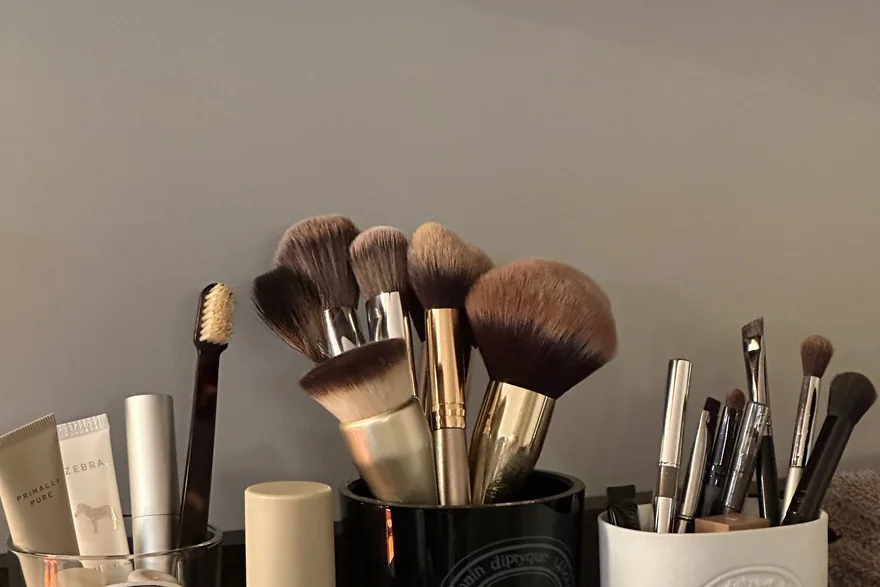
The adjacency to cosmetic bags is not accidental. Both are bought by the same shopper for the same trip, both live in the same hand luggage, and both are bought as gifts in the same season. Where a brand already sells a cosmetic bag, a jewellery pouch is a natural second purchase that shares fabric, hardware and colourway; where a brand sells jewellery, the pouch is a packaging upgrade that also travels. In both cases the pouch is specified at a size that drops into the main cavity of a medium bag, usually around 18 x 12 x 4 cm closed.
- Roll format: a padded bar for rings, a strip for earrings, straps for chains, rolled and tied.
- Flat wallet: two to four zip pockets, a ring bar, and a panel for studs.
- Hanging case: a hook at the top, transparent pockets down both faces.
- Cube with divider: a rigid-ish box shape with a lift-out tray for rings.
- Pouch-in-pouch: a small soft case sized to sit inside a cosmetic bag.
Market signals support the pairing. Make up bags for women draws roughly 80,000 searches a month, and the shopper behind that search is the same person searching for travel jewellery storage. Unit prices across the wider category run from about $0.45 to $12.00 per piece depending on construction (Alibaba, October 2026); a jewellery pouch sits above a simple cosmetic pouch in that band because of the divider work and the hardware count, but below a structured vanity case.
Tarnish: Causes, Material Selection and Anti-Tarnish Textiles
Tarnish on silver and on plated base metal is a surface reaction driven mainly by sulphur compounds and accelerated by humidity, and an enclosed pouch is exactly the environment that lets it proceed undisturbed. The design levers are therefore chemical and hygric rather than aesthetic. Levers include: choosing a lining that does not itself off-gas sulphur, avoiding adhesives and foams that do, keeping the enclosed air dry, and limiting the contact area between the metal and any sulphur-bearing surface. None of these are visible in a photograph, which is why they are so often left out of a brief.
| Lining option | Construction | Tarnish behaviour | Cost and hand |
|---|---|---|---|
| Anti-tarnish treated fabric | Polyester or cotton with an adsorber finish | Actively captures sulphur compounds in the enclosed air | Moderate premium; finish can be washed out over time |
| Untreated cotton velvet or suede | Woven or knitted, 180-260 g/m2 | Neutral by itself; traps humidity against the metal | Low cost; premium look; poor humidity behaviour |
| Microfibre suede, synthetic | Around 180-200 g/m2 | Neutral; no sulphur source if the resin is clean | Good hand; does not manage humidity either |
| Activated carbon interlining | Non-woven with carbon dispersed | Adsorbs sulphur and odour from the enclosed volume | Adds thickness and a grey cast that must be hidden |
| Foam or rubber backing | Open-cell foam laminate | Often a sulphur source; avoid in direct contact | Cheap padding; the wrong place to economise |
Humidity control is the second half of the problem and the cheaper half to solve. A small sachet of silica gel or molecular sieve held in a dedicated slip pocket removes water vapour from the enclosed air, and a pouch designed with that pocket sells better than one without because the user can see the intent. A pouch that breathes is the opposite approach: an unsealed roll allows exchange with ambient air, which avoids a humid microclimate but also admits whatever sulphur is in the environment. Fully sealed with a desiccant generally outperforms breathable in a suitcase. Storage history also matters more than buyers expect. A pouch that sits in a warehouse for months before it reaches a customer has already spent that time in contact with its own lining, so the condition in which the pouch is packed and stored is part of the tarnish story rather than a footnote to it. Programmes shipping to humid markets should specify a low-humidity packing environment and a desiccant in the master carton, and should avoid packing a treated lining in direct contact with an untreated foam or rubber component, because migration between the two will undo the finish before the pouch is ever used.
Any claim about the textile component should be backed by a recognised label rather than by an adjective. A fabric component can be certified to OEKO-TEX Standard 100, which sets limits on substances in the textile itself, and colour-fastness behaviour against rubbing and perspiration can be discussed in the language of AATCC test methods. Neither certifies anti-tarnish performance as such, so a claim about tarnish should be tied to the adsorber finish and to a stated test method rather than implied by a label.
Abrasion Between Pieces and Anti-Tangle Compartment Design
Two pieces of jewellery in one compartment will damage each other. A steel watch case abrades a soft gold chain; a cubic zirconia facet scratches a pearl nacre; a clasp hooks a fine mesh. The design response is straightforward but has to be deliberate: every piece gets its own position, and hard items are separated from soft ones. In practice that means a ring bar for rings, a pierced or doubled panel for studs, individual straps or hooks for chains, and a soft-lined open pocket for bangles that can tolerate contact.
- Separate hard from soft: never share a compartment between a watch and a pearl strand.
- Fix chains at intervals rather than coiling: a strap every 4 to 5 cm prevents a knot forming.
- Give studs a doubled panel so the posts are captured and the backs have their own slot.
- Line any open pocket: an unlined pocket abrades as much as a shared one.
- Cap the count: a pouch that holds everything holds nothing well.
| Item | Recommended compartment | Key dimension | Failure if wrong |
|---|---|---|---|
| Rings | Padded bar or channel | Channel 20-25 mm deep, padding 8-12 mm | Rings spin and knock together in an open pocket |
| Stud earrings | Doubled pierced panel | Panel 60-80 mm wide, holes at 10-12 mm pitch | Backs come off and are lost in the lining |
| Drop earrings | Individual narrow straps | Strap 15-18 mm wide, 80-100 mm long | Pairs separate and hooks catch the lining |
| Fine chains | Strap with a snap every 40-50 mm | Chain laid straight, not coiled | A knotted fine chain is rarely repairable at home |
| Bracelets and bangles | Soft-lined open pocket with a flap | Pocket 100 x 80 mm minimum | Hard edges abrade anything sharing the pocket |
| Watches | Separate padded sleeve or a removable cushion | Cushion 45-55 mm diameter | Case backs scratch; bracelets abrade adjacent metal |
Chains deserve the most attention because a tangle is the complaint customers remember. The mechanism is simple: a coiled chain has free ends that migrate through the coil and form a knot under vibration. Two design responses work. The first is to lay the chain straight and fix it at intervals with a strap or an elastic hold-down, so it cannot cross itself. The second is to hang it from a hook so gravity keeps it extended. Both are cheap to build; both require the pouch to be longer than the chain, which is why a travel roll is usually 30 to 38 cm open rather than pocket-sized. A pouch too short to hold a chain straight has already lost the argument, whatever else it does well.
Closures and hardware need the same discipline as the compartments. Where the pouch closes with a zip, the parts should be written down in standard vocabulary so a repeat order matches; the reference for that is ASTM D2053 on zipper terminology. A metal slider or puller inside a jewellery pouch is a scratch risk in its own right, so programmes often specify a fabric pull or a covered garage at the zip end. Snaps and rivets should be set clear of any compartment that will hold soft metal.
Dual-Use Retail Positioning: Selling One Pouch into Two Categories
Dual-use is a specification decision before it is a marketing one. A pouch that works in both a beauty range and a jewellery range has to be sized so it drops into a medium cosmetic bag, finished so it reads as either, and compartmented so it can be shown holding either lipstick bullets or rings. That last point is the practical test: if the compartments only make sense for jewellery, the pouch cannot be photographed in the beauty context, and the two-channel argument collapses.
| Channel | What the shopper checks | Specification response | Risk if ignored |
|---|---|---|---|
| Beauty retail | Does it fit inside the cosmetic bag shown beside it? | Outer size around 18 x 12 x 4 cm closed | Pouch looks orphaned next to the bag and does not convert |
| Jewellery retail | Are pieces separated and visible? | Ring bar, stud panel, chain straps | Reads as a generic pouch and undercuts the jewellery price |
| Marketplace | Does the photograph show organisation? | High contrast lining against the metal | Listing looks like every other pouch at the same price |
| Gifting and hospitality | Is the finish neutral and the branding subtle? | Debossed or woven label rather than a large print | Too branded to be accepted as a welcome amenity |
| Travel retail | Does it pack flat? | Roll or flat wallet under 4 cm closed | Takes too much room in hand luggage |
Colour does a lot of the work. A pale lining makes small metal items visible and photographs well but shows every mark; a dark lining hides marks and makes silver read beautifully but loses small gold items visually. Mid-tone greys and greiges are the usual compromise and also look deliberate next to both beauty and jewellery product. Where the range has a house colour, carrying it on the shell and keeping the lining neutral gives brand recognition without damaging the photography.
Bundling is where the economics improve. A cosmetic bag plus a jewellery pouch sold as a two-piece travel set raises the average order value for one extra component, shares a fabric order and a colourway, and lets the 500-piece minimum per style and colourway be met once rather than twice if the two pieces are counted as one style in a single colourway. That last point is worth confirming at quotation, because counting conventions differ and the difference changes the minimum commitment materially across two SKUs.
Presentation closes the sale. A pouch shipped rolled and tied looks considered; one shipped flat and creased does not. Programmes should specify the packed state, a header card or belly band if the channel needs one, and where the brand label sits relative to the closure so it is visible in a hanging photograph. These are small decisions that cost nothing at sampling and are expensive to change once a carton specification has been agreed. One further detail pays for itself: a small mirror or a polishing cloth in a slip pocket costs little, adds a reason to keep the pouch, and gives the beauty-side photograph a second focal point beside the compartments. Where the pouch is sold with a cosmetic bag, matching the lining colour to the bag lining makes the two read as one set on a shelf and removes the need for a second photo shoot.
The B2B Customisation View
Brand owners approaching cosmetic pouches, vanity cases and beauty organisers usually arrive with a mood board, a target landed cost and a launch date; the technical pack is what turns those three inputs into a repeatable specification.
Programme data for this category: minimum order quantity 500 pieces per style and colourway, sampling in 6–10 working days (12–15 working days for complex constructions), bulk production 35–50 days after sample approval, final random inspection at AQL 2.5 under ISO 2859-1, FOB Xiamen, T/T 30/70.
Engaging a sourcing partner gives the brand owner one channel for the awkward questions — shade drift, component substitution, carton marking — that otherwise bounce between three vendors.
Which Brand Types Benefit Most
Jewellery brands get the clearest benefit, because a pouch turns a purchase into a gift and travels with the piece, keeping the brand in the customer's hand long after the sale; a roll with a printed or debossed logo is the usual format and it sits naturally inside an existing packaging budget. Start-up brands use the dual-use argument to justify the 500-piece per style and colourway minimum, since one pouch can be listed in a beauty category and a jewellery category from a single tool set. Established brands with an existing cosmetic bag range treat the pouch as an extension piece that shares fabric, hardware and colourway, which keeps the development cost low and the shelf story coherent. Retailers and e-commerce sellers gain from the photography: a pouch with a ring bar and chain straps photographs as an organiser rather than as a bag, which supports a higher price than a plain pouch of the same size. Gift and hospitality buyers prefer a neutral roll with subtle branding, packed flat for welcome kits and event bags. Across all five routes the pouch is judged on whether pieces arrive separated and untangled, which is a functional test rather than a visual one. Programme terms are consistent: sampling 6-10 working days, 12-15 for a padded or moulded core, bulk 35-50 days after approval, inspection AQL 2.5 under ISO 2859-1, FOB Xiamen, T/T 30 deposit and 70 against bill of lading.
- Jewellery brands: a roll that extends the packaging experience and travels with the piece.
- Start-up brands: one tool set listed into two categories, spreading the minimum commitment.
- Established brands: an extension piece sharing fabric, hardware and colourway with a bag range.
- Retailers and e-commerce sellers: compartments that photograph as organisation, supporting a higher price.
- Gift and hospitality buyers: a neutral roll with subtle branding, packed flat for welcome kits.
Frequently Asked Questions
What actually causes jewellery to tarnish inside a travel pouch?
Silver and plated metal react with sulphur compounds in the enclosed air, and the reaction accelerates with humidity. A closed pouch is the ideal environment for it to proceed undisturbed, which is why the lining, any adhesive and any foam backing matter chemically as well as visually, and why keeping the enclosed air dry is as important as the fabric choice.
Is an anti-tarnish lining worth the extra cost?
For silver and silver-plated ranges, usually yes. A treated fabric with an adsorber finish actively captures sulphur compounds in the enclosed air, which untreated velvet or suede does not. The premium is moderate, but the finish can be washed out over time, so a claim about it should be tied to a stated test method rather than left as an adjective.
Should a jewellery pouch be sealed or breathable?
Sealed with a desiccant generally outperforms breathable in a suitcase. A sealed pouch with a silica sachet removes water vapour from the enclosed air, while a breathable roll admits whatever sulphur is in the surrounding environment. Specifying a dedicated slip pocket for the sachet also makes the intent visible to the shopper. A dedicated slip pocket for a desiccant sachet also makes the intent visible, which helps the listing as much as the product.
How should chains be stored to stop them tangling?
Laid straight and fixed at intervals, not coiled. A strap or elastic hold-down every 40 to 50 mm stops the chain crossing itself, and hanging it from a hook uses gravity to keep it extended. Both approaches require the pouch to be longer than the chain, which is why a travel roll is typically 30 to 38 cm open.
What compartment dimensions suit rings and stud earrings?
Rings work in a padded channel 20 to 25 mm deep with 8 to 12 mm of padding. Studs need a doubled pierced panel 60 to 80 mm wide with holes at 10 to 12 mm pitch, so the posts are captured and the backs have their own place. An open pocket loses backs into the lining within a few trips.
Why does a watch need its own compartment?
A steel case and bracelet abrade almost everything they touch, including soft gold, pearls and plated surfaces. A separate padded sleeve or a removable cushion of about 45 to 55 mm diameter keeps the case back off other pieces and stops the bracelet scraping an adjacent item during transit. A removable cushion also lets the pouch serve a customer who travels with a watch on one trip and a bangle stack on the next.
What zip specification suits a jewellery travel pouch?
A #3 or #4 nylon coil with a fabric pull rather than a metal one, since a metal slider is a scratch risk in its own right. The parts should be recorded using standard vocabulary so a repeat order matches; ASTM D2053 is the reference for zipper terminology. A covered garage at the zip end also protects the lining. Strap anchorage deserves the same attention as strap placement, since a hold-down that pulls out of its seam after a few trips leaves the chain exactly as vulnerable as it was before.
Does OEKO-TEX Standard 100 certify anti-tarnish performance?
No. Standard 100 sets limits on substances in the textile itself, which is useful for the fabric component of a pouch, but it does not certify tarnish protection. Anti-tarnish behaviour comes from the adsorber finish or an activated carbon interlining, and any claim should be tied to that finish and to a stated test method. Treated fabrics and carbon interlinings do the tarnish work, while the Standard 100 label covers substances in the textile itself.
How is colour fastness relevant to a jewellery pouch lining?
A dark lining in contact with metal and with skin should be checked for transfer under rubbing and perspiration. The shared language for that is the AATCC test methods and the ISO 105 colour fastness family, which let a buyer state a rating instead of a description. This matters most on pale linings that will sit against plated metal.
What size should a pouch be to sit inside a cosmetic bag?
Around 18 x 12 x 4 cm closed is the usual target, because it drops into the main cavity of a medium cosmetic bag of roughly 24 x 15 cm without crowding the zip. Open, a roll format runs 30 to 38 cm so a chain can lie straight, which is why the roll rather than the cube is the better dual-use format.
Should the lining be pale or dark?
Pale linings make small items visible and photograph well but show every mark. Dark linings hide marks and flatter silver but lose small gold items visually. Mid-tone greys and greiges are the usual compromise and read deliberately beside both beauty and jewellery product, which is why they suit a dual-use listing. Carrying a house colour on the shell while keeping the lining neutral is usually the safest way to protect the photography.
Can one pouch really be sold into a beauty range and a jewellery range?
Yes, if the compartments make sense holding either. A ring channel and a stud panel can be shown holding lipstick bullets and small compacts in a beauty photograph, so long as the layout is not so jewellery-specific that the alternative looks forced. Testing that at the sample photography stage is cheaper than discovering it after launch.
How does bundling with a cosmetic bag affect the minimum order?
The minimum is 500 pieces per style and colourway. Where a bag and a pouch share a fabric and colourway and are counted as one style, the commitment can be met once rather than twice, but counting conventions differ between programmes, so it is worth confirming at quotation before the range is planned. Confirming the counting convention before the range is planned avoids a commitment that turns out to be double what was budgeted.
What packed state should be specified for a jewellery roll?
Specify it: rolled and tied, or flat under a belly band. A roll shipped flat and creased looks unconsidered on arrival, and changing the packed state after a carton specification has been agreed is more expensive than deciding it at sampling. Header cards and label placement should be fixed at the same time. A roll that arrives creased undercuts a premium price before the customer has even opened it.
Which sampling timeline applies to a padded jewellery roll?
A flat wallet or simple pouch falls in the 6-10 working day band. A roll with a padded ring bar, a moulded core or multiple strap rows is a complex construction and falls into the 12-15 working day band. Bulk runs 35-50 days after sample approval. Confirming the band at quotation matters, because a padded core is exactly the kind of construction that moves a programme into the longer window.
How is a travel roll inspected before shipment?
Inspection runs at AQL 2.5 under ISO 2859-1, with compartment dimensions, strap anchorage and closure alignment listed as inspection points alongside appearance. Because a jewellery pouch fails functionally rather than visually, dimensional checks on the ring channel depth and stud panel pitch catch more real defects than a visual-only inspection. Strap anchorage and stud panel pitch are the two checks that catch the defects customers actually complain about.
People Also Ask
What is the best way to travel with jewellery?
Separate every piece: rings in a padded channel, studs on a pierced panel, chains laid straight and fixed at intervals. Keep hard items such as watches away from soft metals and pearls. A sealed pouch with a desiccant in a slip pocket also slows tarnish during a trip. A knotted fine chain is the one problem a customer rarely fixes at home, so chain management deserves more attention in a brief than the exterior of the pouch.
Do anti-tarnish pouches really work?
A treated fabric with an adsorber finish does capture sulphur compounds in the enclosed air, and an activated carbon interlining does the same, so both slow the reaction. They do not stop it permanently and the finish degrades over time, so the honest claim is slowing rather than preventing. Replacing the pouch or refreshing the desiccant on a sensible cycle keeps the benefit, and a treated lining should never be packed against an untreated foam or rubber component.
How do you stop necklaces tangling when packing?
Do not coil them. Lay each chain straight and fix it with a strap or elastic hold-down every 40 to 50 mm, or hang it from a hook so gravity keeps it extended. A knotted fine chain is one of the few jewellery problems a customer cannot fix at home. Fixing the chain at intervals of 40 to 50 mm is the practical version of that, and it is why a travel roll is longer open than most buyers first expect.
Can a jewellery pouch be used as a makeup bag?
Yes, and that is the point of a dual-use design. A pouch around 18 x 12 x 4 cm closed drops into a medium cosmetic bag, and compartments sized for rings and studs hold lipstick bullets and small compacts just as well, provided the layout is not so jewellery-specific that it looks forced. Testing the alternative use at sample photography is cheaper than discovering after launch that the compartments only make sense holding metal.
Request a Sample or a Written Quotation
Send the silhouette, dimensions, material preference and logo artwork, and the programme team will return a written quotation with MOQ, sampling window, bulk lead time and inspection standard.
Email: [email protected] · WhatsApp: +86 177 5002 0688