Makeup Bag with Carrying Handle: Strap Strength & Comfort
Executive Summary
The question behind a makeup bag with carrying handle is whether a strap that looks adequate survives being carried loaded, and the answer is that the strap almost always outlives its attachment. A 25 mm polyester webbing with a 600 kg breaking strength is pointless if it is held to the shell by a single row of lockstitch, which will shear at a small fraction of that figure. Handle width, webbing denier, padding, stitch pattern and reinforcement length have to be specified together.
Comfort is the other half and it is measurable. Webbing pressure on the hand falls sharply between 15 mm and 25 mm width, and a 3 mm to 5 mm foam core inside a wrapped handle is what keeps a loaded vanity case tolerable to carry across a car park. Programmes start at 500 pieces per style and colourway, sample in 6 to 10 working days, or 12 to 15 for a moulded grip or welded construction, then 35 to 50 days in bulk after approval, inspected to AQL 2.5 under ISO 2859-1, FOB Xiamen, T/T 30 deposit and 70 against bill of lading.
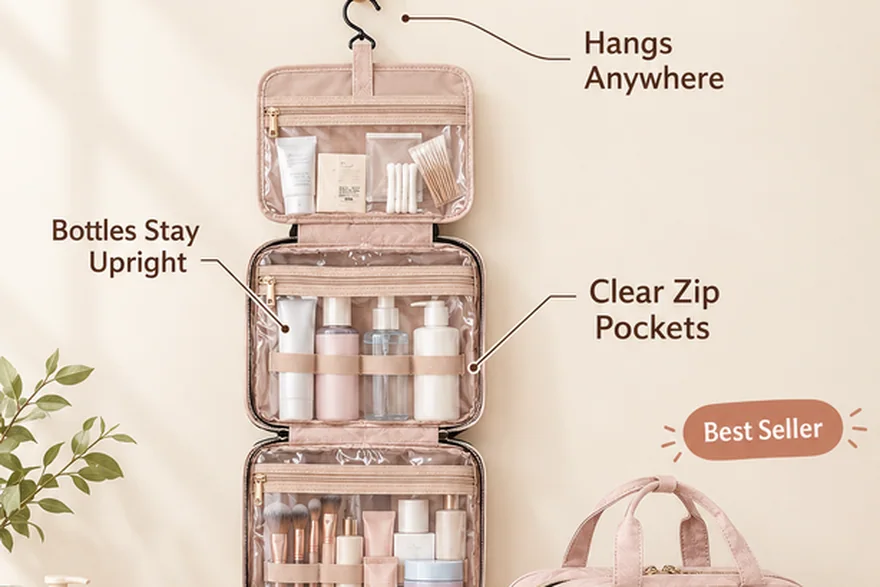
What a handle changes about the whole bag specification
Adding a handle turns a container into a carrier, and that changes five things at once. The shell has to take a point load at two or four places instead of distributing weight along a base seam. The lining has to hide the reinforcement that spreads that load. The base has to resist the handle pulling the bag out of shape when it is lifted by one corner. The pattern has to accommodate webbing ends and padding without bulk at the seam. And the product photography has to show the bag being carried, because a handle that is not visible in the listing is a cost with no return.
Demand is broad. 'Make up bags for women' draws roughly 80,000 monthly searches and 'custom makeup bag' between 5,400 and 6,600, while unit pricing across the category spans 0.45 to 12.00 dollars. Handles appear across that whole band, but what they are made of differs enormously: at the bottom a 10 mm grosgrain ribbon loop tacked into a side seam, at the top a 25 mm webbing strap with a padded wrap carried into a reinforced base panel. Both are called a handle, and only one will survive a year of daily use.
Load is the starting number. A small makeup pouch loaded with brushes and palettes weighs 400 g to 700 g. A medium vanity case with bottles reaches 1 kg to 1.5 kg. A large train case with a mirror and full-size products can reach 3 kg. Carried by hand, the static load is simply the weight; carried with any movement, the dynamic factor adds roughly half again. A sensible design load is therefore two to three times the loaded weight, which puts a small pouch at 1.5 kg and a large train case at 8 kg to 9 kg.
Two further load cases catch most real failures. The first is the single-handle lift, where a user grabs one handle of a two-handle bag and the whole weight goes through one attachment at an angle, generating peel rather than shear at the stitch line. The second is the snag, where a handle catches on a drawer edge or a door handle and the load arrives as a shock. Both cases argue for a continuous strap rather than two separate loops, because a strap that runs under the bag distributes the load between its two ends instead of concentrating it at one.
Handle architectures compared
Six handle types cover most of the category, and they differ on four measurable axes: effective load capacity, hand pressure, whether the handle can be removed, and the number of sewing operations required. The table below assumes a mid-size bag with a 1.5 kg loaded weight and a 3 kg design load.
| Handle type | Webbing or core | Load to first failure | Comfort at 1.5 kg | Cost index |
|---|---|---|---|---|
| Grosgrain ribbon loop, side seam | 10 mm ribbon | 1.5-2.5 kg, seam tears | Poor, cuts into the hand | 1.0 |
| Flat webbing loop, box stitched | 20 mm, 600D webbing | 4-6 kg, stitch shears | Fair, edge pressure | 1.3 |
| Wrapped webbing with foam core | 25 mm webbing, 4 mm foam | 6-9 kg, wrap seam | Good, pressure spread | 1.8 |
| Continuous strap under the base | 25 mm, 900D webbing | 9-14 kg, base seam | Good, balanced lift | 2.0 |
| Moulded TPE grip riveted to a panel | 12 mm grip, steel insert | 10-15 kg, rivet pull-out | Very good, shaped | 2.6 |
| Detachable strap with spring hooks | 25 mm, adjustable 600-1200 mm | 6-10 kg, hook or D-ring | Varies with width | 2.2 |
The continuous strap is worth a second look for any bag above 1 kg loaded. Running a single 25 mm webbing strap from one side seam, under the base panel and up to the other side seam means the weight of the contents is carried by the strap rather than by the shell, and it turns the two weakest points in the bag into the two strongest. The cost is a slightly more complex sewing sequence and the need to cover the strap inside the lining, both of which are modest against a marked improvement in field performance.
Comfort has a simple physical basis: pressure is load divided by contact area. A 10 mm ribbon carrying 1.5 kg concentrates roughly 1.5 kg across 10 mm of hand contact and will be uncomfortable within a minute. The same load on a 25 mm padded wrap spreads across more than twice the width and adds a compressible layer that conforms to the fingers, which is why complaints about handles digging in are almost always about width rather than about padding softness. Where a bag will be carried any distance, 25 mm is the practical minimum and 38 mm is the comfortable choice.
Padding specification is where buyers over-order and under-specify at the same time. A 4 mm closed-cell EVA or PE foam inside a wrapped handle is the standard; going to 8 mm adds bulk without much benefit at these loads, while dropping to 2 mm produces a handle that bottoms out and feels like bare webbing. What matters more than thickness is compression set, because a foam that takes a permanent dent will feel flat after a season even if it never tears. Ask for the foam density, typically 25 kg per cubic metre to 45 kg per cubic metre for this application, and for a compression-set figure.
- Specify webbing by width and denier, and by breaking strength if the supplier can document it.
- Use a continuous strap under the base for any bag above 1 kg loaded.
- Minimum 25 mm width where the bag is carried more than a few metres.
- Padding: 4 mm closed-cell foam at 25 to 45 kg per cubic metre, with a compression-set figure.
- State the stitch pattern in the brief: box and cross, with a bar tack at each load point.
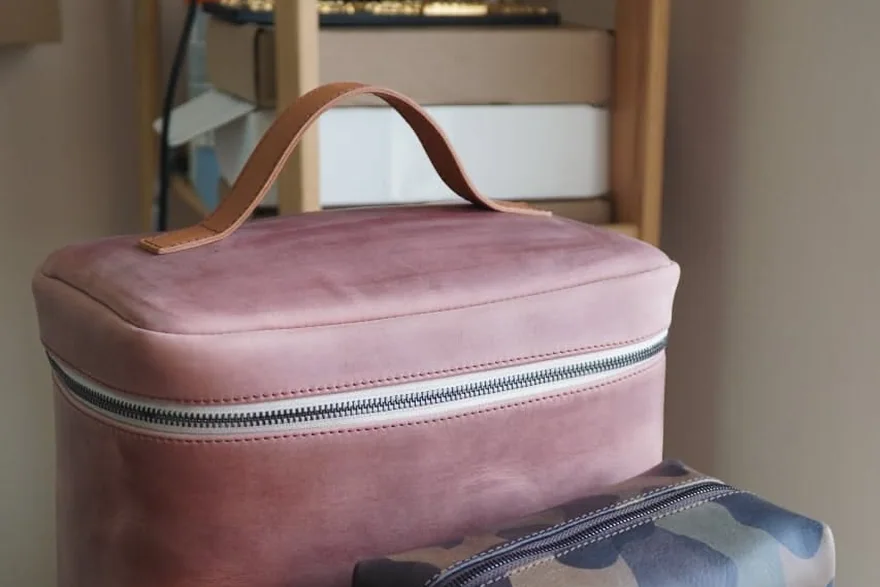
Attachment, stitch pattern and shell support
If one line of the brief decides whether the handle survives, it is the stitch specification. Webbing rarely breaks; the thread holding it does. A single row of lockstitch at eight stitches per inch across a 25 mm webbing end will shear progressively under repeated load, and the failure looks sudden to the customer even though it began on the first carry. A box-and-cross pattern with a bar tack at the load point spreads that stress over a much larger area and is the standard answer on any bag above 1 kg.
| Attachment method | Reinforcement | Stitch pattern | Load to first failure | Best application |
|---|---|---|---|---|
| Webbing end tacked into a side seam | None | One bar tack | 1.5-2.5 kg | Flat pouches under 500 g |
| Webbing end box stitched to the shell | 70 g/m2 interlining | Box stitch, 25 mm | 3-5 kg | Small makeup bags |
| Webbing end with a patch behind | 0.8 mm PE board patch | Box and cross, bar tack | 6-9 kg | Medium vanity cases |
| Continuous strap under the base | 0.8 mm PE board in the base | Double-needle, full length | 9-14 kg | Train cases and large kits |
| Riveted moulded grip | Moulded EVA panel | Two rivets with washers | 10-15 kg, rivet pull-out | Structured hard cases |
Thread choice follows the load. A bonded polyester thread in the Tex 40 to Tex 70 range is the norm for handle attachment, and a higher-tenacity bonded nylon is used where the bag is heavy. What should be avoided is a staple spun polyester or a cotton-wrapped thread, both of which lose strength in a humid environment and abrade at the webbing edge. Where a handle is stitched through a coated fabric, the coating also has to resist tear propagation from the needle holes, and that property is one of the coated-fabric behaviours measured under the ASTM D751 methods.
Shell support is the third leg. On a soft 210D pouch, any handle load pulls the shell into a peak at each attachment point, and the bag visibly deforms every time it is lifted. A 0.8 mm PE board patch behind each attachment, or 70 g/m2 to 120 g/m2 of non-woven interlining across the whole panel on lighter bags, spreads the load and keeps the shape. On structured cases the load should reach the frame or the moulded panel directly, which is why riveted grips on a moulded EVA shell outperform the same grip riveted to a fabric panel.
Wear at the contact point deserves attention for a detachable strap. A spring hook running on a D-ring abrades both components, and the usual failure is the D-ring wearing through its plating and then through its base metal after a few hundred cycles. Specifying a welded D-ring rather than a bent-wire one, and a strap width that matches the D-ring internal width exactly, roughly doubles the service life of the pair. Mismatched widths, such as a 25 mm strap on a 32 mm D-ring, let the webbing bunch and wear at the fold.
Where a handle is attached over a zipper line, the two should not share a stitch row, because a failure at that seam takes out the handle and the closure at the same time.
Testing handle strength, checking comfort and inspecting the batch
Handle testing is straightforward and can be run on a bench with a spring gauge and a weight. Four checks cover the realistic failure modes, and all four should be written into the brief as acceptance criteria rather than raised after the sample arrives.
| Test | Method | Pass criterion | Typical failure |
|---|---|---|---|
| Static lift | Design load held for 24 hours | No stitch shear, no shell distortion | Stitch shears gradually from 2 hours |
| Cyclic lift | 200 lifts at 1.5 times the design load | No visible stitch damage | Bar tack loosens at 120 cycles |
| Shock or snag | 5 kg drop of 100 mm onto the handle | No tear at the attachment | Webbing end tears out cleanly |
| Comfort check | Loaded bag carried 50 m | No pressure mark after 60 seconds | 10 mm ribbon leaves a clear groove |
Comfort can also be checked objectively enough to compare samples. The simple version is a hand-pressure ranking: three people carry the loaded bag 50 m and each ranks two or three handle options. The more instrumented version measures contact area with pressure-indicating film, which gives a peak pressure figure in kilopascals and lets a buyer compare a 20 mm unpadded strap against a 25 mm padded wrap without relying on opinion. Either is better than deciding from a photograph, which is how most handle choices are actually made.
Abrasion and colour transfer on the handle are assessed with the same textile methods used elsewhere in the category. The AATCC test methods library includes crocking and abrasion procedures that apply directly to a wrapped handle fabric, and a handle that rubs dye onto a light garment is a real complaint on shoulder-length straps. Where the handle fabric is a coated textile, the coating adhesion and abrasion behaviour falls under the coated-fabric methods as well, so both references are relevant to a single component.
Inspection should classify handle defects by consequence. Under AQL 2.5, a 1,200-piece shipment draws a sample of 80 units with 5 minor and 3 major defects allowed, and the sampling plan itself is set out in ISO 2859-1. Handle misalignment and slight padding variation are minors; a missing bar tack, a webbing end caught short of the specified stitch area, or a strap length outside tolerance are majors, because each produces a field failure. A five-unit lift test on the pre-shipment sample, loaded to the design figure and held for an hour, is a cheap addition that catches most of them.
Timing follows the construction. A bag with a stock webbing handle and a board reinforcement samples in 6 to 10 working days. A bag with a moulded grip, a welded panel or a custom-tooled hardware set falls into the complex bracket at 12 to 15 working days. Bulk runs 35 to 50 days after sample approval, shipped FOB Xiamen with T/T 30 deposit and 70 against bill of lading, and the 500-piece minimum applies per style and colourway, so a version with a short grab handle and a version with a detachable strap are two separate programmes.
The B2B Customisation View
Development of makeup bags and toiletry bags is a sequence of small approvals, and each approval is cheaper than the rework it prevents.
The numbers a buyer can plan around: 500 pieces minimum per style and colourway, 6–10 working days to a first sample (12–15 where tooling or moulding is involved), 35–50 days to bulk completion, AQL 2.5 under ISO 2859-1 at final inspection, FOB Xiamen terms, T/T 30/70 payment.
As the programme coordinator, QUANZHOU JUNYUAN BAGS owns the sample history, which is what makes a repeat order of makeup bags and toiletry bags look like the original rather than a near-miss.
Which Brand Types Benefit Most
Handles suit buyers whose customers move the bag rather than store it, and the specification should follow the distance it will be carried. Start-up brands should note that a handle is one of the few visible upgrades that shows in a photograph and costs little per unit: moving from a 10 mm ribbon loop to a 25 mm wrapped webbing handle is a small increment that changes how the product reads on a listing page. Established brands should standardise one handle specification across a size range, because a family of bags that shares a webbing width, a foam core and a stitch pattern can be photographed together and inspected against one set of criteria. Retailers and e-commerce sellers should ask for the cyclic lift result, since a handle that loosens after 120 cycles produces a return roughly three months after the sale, which is the hardest kind to attribute. Gift and hospitality buyers have a different priority: a gift bag with a handle is perceived as more valuable and is carried out of the store, so hand comfort matters more than long-cycle durability, while a hotel amenity bag that sits in a bathroom needs no handle at all. One point applies to every buyer type: the handle is the part of the bag the customer touches first and the part most often blamed when a bag fails. Specifying width, foam density and stitch pattern explicitly, and asking for the cyclic lift result, costs nothing and removes the most common source of avoidable returns in this product type.
- Start-up brands: 25 mm wrapped webbing handle, 4 mm foam core, 500 pieces per colourway.
- Established brands: one handle specification across three sizes for consistent inspection and photography.
- Retailers: require a 200-cycle lift result before approving the listing.
- E-commerce sellers: show the bag being carried in the main image, or the handle adds no value.
- Gift buyers: prioritise hand comfort and finish over long-cycle durability tests.
Frequently Asked Questions
What webbing width should a makeup bag carrying handle use?
Twenty-five millimetres is the practical minimum for a bag carried any distance, and 38 millimetres is the comfortable choice for a train case. Below 20 mm the pressure on the hand becomes uncomfortable within a minute at loads over 1 kg. Width matters more than padding softness for comfort, because pressure is simply load divided by contact area.
Why do handles come off bags when the webbing looks undamaged?
Because the stitch line fails rather than the strap. A single row of lockstitch across a webbing end shears progressively under repeated load and the failure looks sudden to the customer. A box-and-cross pattern with a bar tack at each load point spreads the stress, and a 0.8 mm board patch behind the attachment raises first-failure load substantially.
How much padding should a wrapped handle have?
Four millimetres of closed-cell EVA or PE foam is the standard. Two millimetres bottoms out and feels like bare webbing; eight millimetres adds bulk without much benefit at loads under 2 kg. Density is more important than thickness: 25 kg to 45 kg per cubic metre is the usual range, and the compression-set figure matters because a foam that dents permanently feels flat after a season.
Is a continuous strap under the base better than two side loops?
Yes for any bag above 1 kg loaded. A strap running from one side seam, under the base and up the other side carries the contents weight in the webbing rather than in the shell, and it balances the lift so the bag does not tilt. Two separate loops concentrate the load at one point when the bag is picked up by a single handle.
What load should a makeup bag handle be designed for?
Two to three times the loaded weight. A small pouch at 500 g loaded is designed to 1.5 kg; a large train case at 3 kg loaded is designed to 8 kg or 9 kg. The margin covers the dynamic factor of walking with the bag and the shock case of a handle catching on a door or drawer edge.
How is a handle load tested before bulk production?
Two bench tests cover it. The static test holds the design load for 24 hours and checks for stitch shear and shell distortion. The cyclic test performs 200 lifts at 1.5 times the design load and checks for visible stitch damage. A snag test, dropping 5 kg through 100 mm onto the handle, catches the shock case that neither of the first two does.
What thread should be specified for handle attachment?
A bonded polyester in the Tex 40 to Tex 70 range is the norm, with a higher-tenacity bonded nylon for heavy cases. Avoid spun polyester and cotton-wrapped thread, both of which lose strength in humidity and abrade at the webbing edge. Thread specification is one of the cheapest ways to raise handle life and one of the most often omitted from a brief.
Does a detachable shoulder strap wear out faster than a fixed handle?
The strap itself lasts well; the hardware pair fails first. A spring hook running on a D-ring abrades both components, and a bent-wire D-ring can wear through its plating and into its base metal after a few hundred cycles. Specifying a welded D-ring and matching the strap width to the D-ring internal width roughly doubles the service life.
What causes a soft bag to deform when it is lifted by the handle?
Point loading without shell support. Every handle load pulls the shell into a peak at the attachment point. A 0.8 mm PE board patch behind each attachment, or 70 g/m2 to 120 g/m2 of non-woven interlining across the panel, spreads the load and keeps the shape. On structured cases the load should reach the moulded panel directly.
How does AQL 2.5 classify handle defects?
Handle misalignment, slight padding variation and minor webbing edge fray are minors. A missing bar tack, a webbing end caught short of the specified stitch area, a strap length outside tolerance and a D-ring that does not rotate freely are majors, because each one produces a field failure. On a 1,200-piece shipment the sample is 80 units, allowing 3 major and 5 minor.
How long does sampling take for a bag with a moulded grip?
12 to 15 working days where the grip is custom-tooled or the panel is moulded or welded, because tooling and process parameters must be set first. A bag with a stock webbing handle and a board reinforcement samples in 6 to 10 working days. Bulk is 35 to 50 days after sample approval, FOB Xiamen, T/T 30 deposit and 70 against bill of lading.
Can a handle be added to an existing bag design without re-patterning?
Only if the shell can take the load, and even then a reinforcement patch has to be inserted behind the lining, which changes the sewing sequence. Adding a handle to a soft 210D pouch without a patch produces a bag that deforms on every lift. It is usually cheaper and faster to treat it as a new style than to retrofit one.
What is the right strap length for a detachable shoulder strap?
Between 600 mm and 1,200 mm adjustable, which lets the bag be carried on the shoulder or across the body by users of different heights. The adjuster should be a slide with enough friction to hold position under a 1.5 kg load, and the free end should be finished with a heat cut or a fold-back rather than a raw edge that frays.
Should a cosmetic bag handle be tested for colour transfer?
Yes, particularly on a shoulder-length strap that rests against a light garment. The AATCC test-methods library includes crocking and abrasion procedures that apply directly to a wrapped handle fabric, and a strap that rubs dye onto clothing is a genuine complaint. Where the handle is a coated textile, coating adhesion and abrasion are also relevant. Both checks are cheap and should be written into the brief as acceptance criteria.
How much does upgrading to a padded handle add to unit cost?
A move from a 10 mm ribbon loop to a 25 mm wrapped webbing handle with a 4 mm foam core is a modest increment, driven by the webbing, the foam and the additional wrapping and sewing operations. A moulded grip with rivets adds considerably more. Against a typical unit band of 0.45 to 12.00 dollars, the upgrade is most noticeable below 3 dollars.
What should a buyer photograph when approving a handle sample?
Four views: the handle attachment from inside the bag with the lining turned back so the stitch pattern and any patch are visible, the handle under a 1.5 kg static load after an hour, the bag being carried in hand at normal distance, and the webbing end at close range to show the bar tack and edge finish.
People Also Ask
What makes a bag handle comfortable to carry?
Width, above all. Pressure on the hand is load divided by contact area, so moving from a 10 mm ribbon to a 25 mm padded wrap roughly halves the peak pressure. Padding of 3 mm to 5 mm then lets the handle conform to the fingers. Padding softness matters far less than width and density. Padding density matters more than softness, because a foam that bottoms out transmits the load straight to the webbing edge.
How do you reinforce a handle on a fabric bag?
Put a 0.8 mm PE board patch behind each attachment point, stitch with a box-and-cross pattern and add a bar tack at the load point, and use bonded polyester thread in the Tex 40 to Tex 70 range. On bags above 1 kg, run a continuous strap under the base so the webbing carries the load instead of the shell.
Can a makeup bag handle be replaced?
A detachable strap with spring hooks can be replaced easily, and designing for that is worth doing on an expensive case. A stitched handle cannot be replaced without opening the lining, which usually costs more than the bag. Where replacement matters, specify a detachable strap and welded D-rings rather than sewn loops. Welded D-rings and a standard 25 mm strap also make a replacement easy to source, which matters on a case the customer expects to keep for years.
Why does my bag handle stretch over time?
Usually because the webbing is a low-denier or unbonded construction that creeps under sustained load, or because the foam inside a wrapped handle has taken a compression set and the wrap has gone slack, so the handle feels longer and thinner than it did when new. Specifying 900D webbing for bags above 1 kg and a foam with a documented compression-set figure prevents both. Checking the webbing denier and the foam compression set on the sample prevents both problems.
Request a Sample or a Written Quotation
Send the silhouette, dimensions, material preference and logo artwork, and the programme team will return a written quotation with MOQ, sampling window, bulk lead time and inspection standard.
Email: [email protected] · WhatsApp: +86 177 5002 0688