Makeup Bags for Beginners: Starter Kit & Essential Items
Executive Summary
Makeup bags for beginners should be sized to a first kit of 5 to 9 items and built to teach layout rather than to impress: a 22 x 13 x 8 cm body, a U-shaped zip that opens three sides, six to eight elastic loops at 20-25 mm, a removable five-slot brush sleeve, a wipe-clean base with a 4-5 cm wall and a light grey 150D lining. That combination survives the two things a beginner bag actually faces, which are spills and growth, and it stays usable when the kit doubles within three months.
Commercial mechanics match any made-to-order bag programme. Buyers work to a minimum of 500 pieces per style and colourway, allow 6-10 working days for sampling or 12-15 working days for complex constructions such as a moulded tray, and plan 35-50 days for bulk production after sample approval. Inspection is AQL 2.5 under ISO 2859-1, shipment FOB Xiamen, and payment T/T with 30 deposit and 70 against bill of lading.
What a beginner starter kit bag actually is
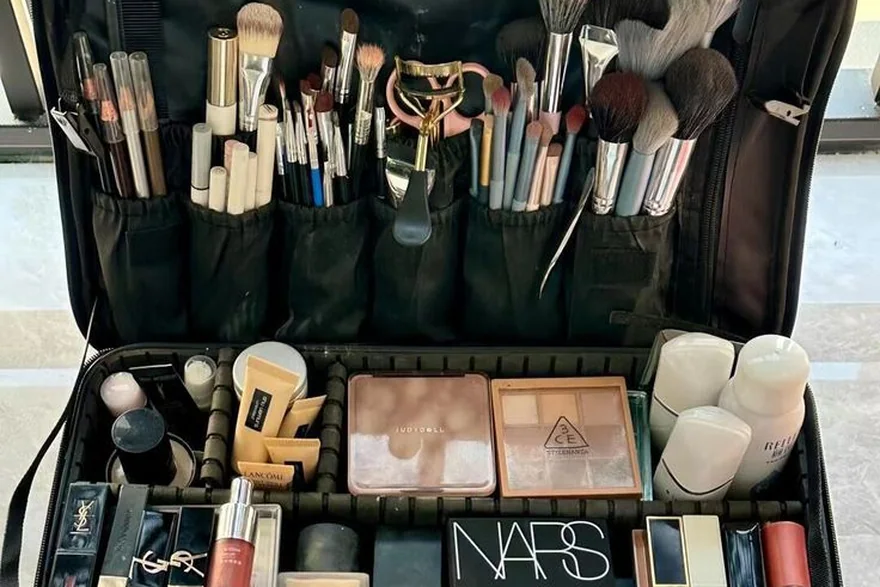
A beginner makeup bag is a first kit container sold either empty or filled with five to nine entry items: a base product, one or two colour items, a mascara, a brush or two and a mirror. It differs from a standard cosmetic pouch in three ways. It is bought by someone who does not yet know what they own, it is used by someone who will spill something in the first month, and it is outgrown quickly, since a kit of six items typically becomes a kit of fourteen within a season.
That profile produces a specific brief. The bag has to make its contents legible without the user having a system yet, which argues for a light interior and a wide opening rather than for six specialist pockets. It has to tolerate a foundation spill and a melted lipstick, which argues for a wipe-clean base and a lining that does not hold pigment. And it has to absorb growth, which argues for sizing one band above the starter kit rather than exactly to it.
Buyers also have to decide who the beginner is. A bag sold to a teenager as a first makeup bag is a general consumer product; a bag marketed to children twelve and under is treated as a children's product in the United States and carries additional obligations under the Consumer Product Safety Improvement Act, which can be reviewed at the CPSIA statute page. That distinction changes the testing budget and the labelling, so it belongs in the brief, not in the artwork stage.
- Decide the user age band first, because it drives testing and labelling rather than just the colour range.
- Size one band above the starter kit so the bag survives a season of growth.
- Design for a spill: containment matters more than compartment count at this level.
The dominant failure is capacity, not durability. A bag that fits a six-item kit perfectly is too small by month three, so specify for the kit the user will have rather than the kit they have today.
Sizing the bag to a first kit
Entry-level kits cluster into four stages, and the bag should be matched to the stage rather than to a generic small size. The starter stage carries five to seven items and fits a flat pouch; by the building stage the same user carries twelve to fifteen items and needs a divided base. Specifying to the building stage while pricing to the starter stage is the usual commercial answer, because the cost difference between an 18 cm and a 22 cm body is small relative to the goodwill of a bag that still fits in month three.
| Kit stage | Items carried | Internal size (cm) | Features that matter | Typical shell |
|---|---|---|---|---|
| Starter kit | 5-7 | 18 x 11 x 7 | Wide U-zip, one slip pocket, light lining | 300D polyester, 220 g/m² |
| Learning kit | 8-11 | 22 x 13 x 8 | Six elastic loops, brush sleeve, wipe-clean base | 420D nylon, 260 g/m² |
| Building kit | 12-15 | 24 x 14 x 9 | Divided base, removable brush roll, clear window pocket | 600D polyester, 320 g/m² |
| Shared or family kit | 16-20 | 27 x 16 x 11 | Two-tier tray, framed base, external handle | Coated canvas, 480 g/m² |
Price position follows the stage. Marketplace listings for cosmetic bags span roughly 0.45 to 12.00 US dollars per unit, and beginner bags sit in the lower half of that band, which constrains component count more than material quality. The right way to hold cost down at this tier is to keep the component list short and buy a better lining, rather than to buy a cheaper shell and add pockets. A 420D nylon at 260 g/m² with a wipe-clean 150D lining outperforms a 190T shell with eight pockets in both use and returns.
Growth is the dimension most beginner bags get wrong. A starter kit of six items becomes twelve within a season, and the extra items are usually bulkier than the originals: a palette, a setting spray and a second brush set. A bag specified at 18 x 11 x 7 cm cannot absorb that, and the user either buys a second bag or stops using the first. Specifying at 22 x 13 x 8 cm costs marginally more in fabric and nothing in process time, and it turns a three-month product into a twelve-month one, which is the difference between a one-off purchase and a relationship.
Height again decides more than buyers expect. A beginner kit usually contains one tall item, a setting spray or a pump bottle, and anything above 15 cm forces the user to lay it diagonally, which consumes roughly a third of the base. Where the starter kit includes a tall product, the specification should move to the learning band at 22 x 13 x 8 cm even if the item count says starter. The external cut should then allow 1.5-2 cm per dimension for seams and laminate.
- Measure the tallest item first, then confirm the band by item count.
- Add 1.5-2 cm per dimension from internal to external before writing the tech pack.
- Keep empty weight between 160 and 240 g so the bag stays in a light price tier.
Layout that teaches where things go
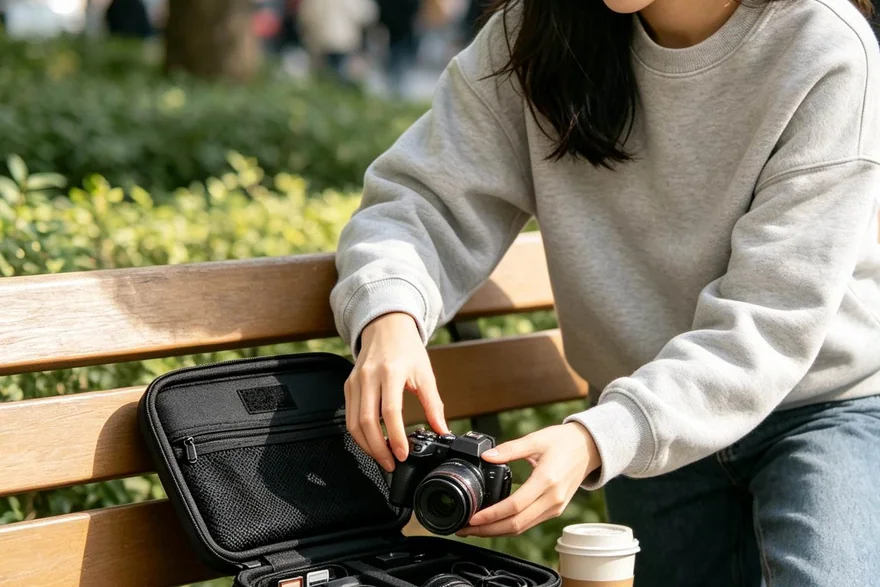
A beginner has no system, so the bag has to supply one. The most effective layouts use repetition rather than variety: several identical loops in a row teach the user that upright items go on the left, and one clear window pocket teaches that palettes go flat. Variety at this tier creates decisions the user is not equipped to make, and a bag that requires a decision is a bag that ends up as a jumble.
- Opening: U-shaped zip across three sides, opening to 150-170 degrees so the whole kit is visible at once.
- Base: TPU or PEVA wipe-clean panel with a 4-5 cm wall, so a foundation spill stays inside the bag.
- Loops: six to eight elastic loops, 20-25 mm wide, spaced 28-30 mm, all on one side wall.
- Brushes: five-slot removable sleeve, 22 cm deep, held by a press stud rather than sewn in.
- Lining: 150D polyester in light grey with a wipe-clean finish; no print, no dark tones.
- Window pocket: one clear TPU pocket for palettes and compacts, maximum 40 per cent of the lid area.
- Closures: no magnets and no detachable small parts where the bag is marketed to younger users.
The base wall is the single most valuable feature in a beginner bag and the one most often dropped for cost. A 4-5 cm turned-up wall in a wipe-clean TPU or PEVA film turns a spill into a wipe rather than a ruined bag, and it costs far less than a replacement. Where a spill reaches the lining, pigment sits in the fibre permanently, so the wall is cheap insurance against the most common reason an entry-level bag is thrown away.
The window pocket deserves a precise limit. A clear TPU pocket over 40 per cent of the lid area stiffens the panel and makes the bag harder to close, while a pocket under 20 per cent cannot hold a standard eyeshadow palette. Between those bounds the pocket does its job, which is to show flat items without asking the user to open anything. The film should be specified at 0.2-0.3 mm; thicker film yellows and cracks at the fold, and thinner film tears at the seam within a season.
Loop spacing is the second detail worth specifying precisely. Elastic loops at 20-25 mm width spaced 28-30 mm apart accept a lipstick tube, a slim mascara and most pencil products without crowding; spacing below 25 mm makes the loop elastic fight the adjacent item, and the user stops using the loops altogether. Keeping all loops on one wall and leaving the other wall plain also gives the growing kit somewhere to go. A sleeve that can be replaced also keeps the bag in service when the brush set changes, which is the cheapest form of future-proofing available at this tier.
A removable brush sleeve is the feature that extends the bag's useful life. Brushes are the first thing a beginner accumulates and the first thing that outgrows a fixed sleeve, so a five-slot sleeve held by a press stud can be swapped for a larger one later or removed entirely when the kit changes. Sewn-in brush channels are cheaper and fix the bag at the size the user had on day one.
Safety, labelling and entry-level compliance
Entry-level does not mean unregulated. A bag sold with makeup to a young user attracts more scrutiny than a bag sold empty to an adult, and the obligations differ by market and by the age band the product is marketed to. The table below sets out the items a buyer should resolve before bulk rather than after a listing goes live.
| Compliance item | Applies when | Reference | What to prepare |
|---|---|---|---|
| Lead and phthalate limits | Bag marketed to children twelve and under | CPSIA | Third-party test report from an accredited laboratory |
| Permanent tracking label | Children's product sold in the US | CPSIA | Label on the product carrying production information |
| Restricted substances in coated fabric | Sale into the EU or UK | EU REACH | Declaration from the fabric mill, dated within twelve months |
| Harmful substances in textiles | EU retail channel | OEKO-TEX Standard 100 | Certificate naming the fabric supplier |
| Colour fastness of printed lining | Any dyed or printed lining | AATCC test methods | Grade 4 or better to rubbing and to perspiration |
| Workmanship acceptance | Every production lot | ISO 2859-1 | AQL 2.5 sampling plan written into the purchase order |
The age band decision is worth restating because it is the most expensive mistake in this category. Marketing copy, artwork and photography determine whether a product is treated as a children's product, not the material specification. A bag with cartoon artwork and age-range language on the listing may be treated as a children's product even if the same bag in a plain colour would not be, which pulls in testing and tracking label obligations that were never budgeted.
Colour fastness matters more here than in any other tier, because a beginner bag is filled with pigment and handled by someone who will not clean it promptly. Lining and shell should be tested to rubbing and perspiration using the methods listed by AATCC, with grade 4 or better as the target, and any printed lining should be tested after printing rather than before, since ink sits on the surface and is the first thing to transfer.
Labelling should be planned with the pattern, since a sewn-in care and content label has to sit where it does not press against a loaded base seam and remains readable after a year of use.
- Confirm the marketed age band in writing before artwork begins, not after.
- Test the printed lining after printing, not the base fabric before it.
- Keep the test report matched to the production lot and check its date at pre-shipment.
Chemical documentation follows the same pattern as elsewhere in the category. Where the bag has a coated or TPU-laminated base panel, buyers selling into Europe should hold a declaration against EU REACH from the fabric mill and an OEKO-TEX Standard 100 certificate naming the supplier. Inspection of the finished lot runs to AQL 2.5 under ISO 2859-1, drawing 50 pieces from a 500-piece run with 3 major defects accepted and 4 rejected, and the defect list should include loop spacing, base wall continuity and window pocket clarity.
The B2B Customisation View
Every programme for cosmetic bags begins with a written brief: target retail price, filling volume, closure type, print method and the compliance market the goods will be sold in.
Commercial parameters stay fixed across the range: MOQ 500 pieces per style and colourway, prototype turnaround 6–10 working days (extended to 12–15 for multi-panel or moulded builds), bulk lead time 35–50 days from approved sample, AQL 2.5 inspection to ISO 2859-1, FOB Xiamen, T/T 30 deposit and 70 against bill of lading.
Working as a sourcing partner rather than a single-line vendor means QUANZHOU JUNYUAN BAGS can move cosmetic bags between construction types — woven, coated, leather-look — without restarting the compliance conversation.
Which Brand Types Benefit Most
Start-up brands use beginner bags as the entry point to a range, because a starter kit converts a first-time buyer at a low price and creates the habit that later sales depend on. Their binding constraint is usually the testing budget rather than the bag cost, particularly where the kit is marketed to younger users and a third-party report is required. A single 500-piece run in one colourway with a documented compliance file is the realistic first step, with sampling at 6-10 working days for a box pouch and 12-15 where a moulded tray is specified.
Established brands treat the beginner bag as a gift-with-purchase or an entry price tier, and their priority is that it still looks like the brand at a lower cost: the same lining tone, the same puller shape and the same woven label as the main line, even where the shell is a lighter fabric. Retailers buy them for seasonal moments, notably back-to-school and holiday gifting, where the bag is sold empty or filled and the artwork carries the campaign. E-commerce sellers bundle them, listing a bag plus five items as a single ASIN and using the bag to justify a higher basket value.
Gift and hospitality buyers use beginner bags as party favours, stocking fillers and teen amenity items, where the priorities are a low unit cost, a wipe-clean base and artwork that survives a single season. Across all five buyer types the specification converges on the same decisions: size one band above the starter kit, keep the component count short, buy a better lining rather than more pockets, and resolve the marketed age band before artwork starts. For all five, the recurring mistake is identical: sizing the bag to the kit the beginner has today rather than to the kit carried in three months.
Frequently Asked Questions
What size makeup bag suits a starter kit of six items?
A six-item kit packs to roughly 0.9 litres, but the bag should be specified one band up at 22 x 13 x 8 cm so it survives growth. Beginner kits typically double within a season, and a bag sized exactly to day one is too small by month three. Allow 1.5-2 cm per dimension from internal to external for seams.
How many elastic loops should a beginner makeup bag have?
Six to eight, each 20-25 mm wide and spaced 28-30 mm apart, all on one side wall. Spacing below 25 mm makes the elastic fight the adjacent item and the user abandons the loops. Repetition teaches the system; a mix of pocket types at this level creates decisions a first-time user cannot make. Keeping every loop identical is the point: repetition teaches the layout where variety confuses it.
Why does a beginner bag need a wipe-clean base wall?
Because a foundation or lipstick spill is the most common reason an entry-level bag is thrown away. A TPU or PEVA panel with a 4-5 cm turned-up wall contains the spill inside the bag so it can be wiped. Once pigment reaches the lining fibre it stays permanently, so the wall is cheaper than a replacement. The wall costs far less than the bag it saves, which is the argument for keeping it in the specification.
Which lining colour and weight works best for a starter kit bag?
A 150D polyester lining in light grey with a wipe-clean finish, unprinted. Light tones keep a small kit legible for someone who has no system yet, and an unprinted surface resists pigment transfer better than a printed one. Test the lining to rubbing and perspiration after printing, targeting grade 4 or better. Light grey hides marks better than optic white while keeping the same contrast against dark packaging.
Should the brush sleeve be sewn in or removable?
Removable, held by a press stud. Brushes are the first thing a beginner accumulates and the first thing to outgrow a fixed sleeve, so a five-slot sleeve at 22 cm deep that can be swapped or removed extends the bag's useful life. Sewn-in channels fix the bag at the size the user had on day one. A press stud also lets the sleeve be cleaned separately, which matters after a powder spill.
When does CPSIA testing apply to a beginner makeup bag?
When the bag is marketed to children twelve and under in the United States. Marketing copy, artwork and listing language decide this, not the material specification, so cartoon artwork and age-range wording can pull an otherwise ordinary bag into children's product obligations, including third-party testing and a permanent tracking label. Budgets should allow for the report before artwork begins, since the obligation follows the marketing.
What shell fabric weight suits an entry-level cosmetic pouch?
Between 220 and 320 g/m²: 300D polyester at 220 g/m² for a starter pouch, 420D nylon at 260 g/m² for a learning kit, and 600D polyester at 320 g/m² for a building kit with a divided base. Below 220 g/m² the bag collapses when half full, which is the everyday fill state for a beginner kit.
How does the 500-piece minimum apply to a beginner bag launch?
The minimum is 500 pieces per style and colourway, so a three-colour beginner launch is three commitments. Because this tier is price-sensitive, most launches run one body in one or two colourways and use artwork rather than fabric to create variety, keeping the second colour for a reorder once the first drop has sold. Using artwork rather than fabric to create variety keeps the commitment to one or two colourways.
How long does sampling take for a starter kit bag with a moulded tray?
Allow 12-15 working days where a moulded or thermoformed tray is specified, and 6-10 working days for a box pouch with stock components and elastic loops. The tooling drives the longer figure. Bulk then runs 35-50 days after sample approval, so a back-to-school season needs sampling to start months ahead. A back-to-school season therefore needs sampling to begin several months before the launch date.
What does AQL 2.5 inspection cover on a beginner bag run?
Under ISO 2859-1 at AQL 2.5, a 500-piece lot draws 50 pieces with 3 major defects accepted and 4 rejected. The defect list should include loop spacing, base wall continuity, window pocket clarity and press stud alignment alongside standard stitching checks, because those are the faults a first-time user notices first. Those are the faults a first-time user notices, and none of them appear on a generic bag checklist.
Are magnets and detachable charms safe on a beginner bag?
Avoid them where the bag is marketed to younger users. Small detachable parts and magnets introduce hazards that general-use bags do not carry, and they add testing obligations. A press stud for a removable sleeve is acceptable at older age bands; where the marketed age is twelve or under, the component list should be reviewed against children's product requirements. Where the age band is older, a press stud is still preferable to a magnet sitting near product packaging.
Which colour fastness target should a printed lining meet?
Grade 4 or better to rubbing and to perspiration, tested after printing rather than on the base fabric. Ink sits on the surface and is the first thing to transfer, particularly once the bag has held pigment products. AATCC test methods cover the rating procedure and should be named in the tech pack so a rejection cites a scale rather than an adjective.
What documentation is needed to sell beginner bags into Europe?
A declaration against EU REACH from the fabric mill for any coated or TPU-laminated component, dated within twelve months, and an OEKO-TEX Standard 100 certificate naming the fabric supplier. Both documents are issued by the material producer rather than by the bag programme, so they should be requested before bulk cutting. Both documents expire, so the pre-shipment check should confirm date and lot before the goods move.
How should a beginner bag be packed to hold its shape in transit?
Nested rather than folded, with tissue or a polybag separator and a divider between layers, and carton counts set by nesting height rather than by a round number. Lightweight shells at 220-260 g/m² crease under compression, and a creased panel is the most common reason an otherwise sound beginner bag is rejected on receipt. Lightweight shells crease under compression, and a creased panel is usually rejected on receipt.
Should the starter bag be sold empty or filled?
Filled for gifting and for subscription kits, where the bag is part of the present; empty for retail, where the buyer wants to choose contents. Filled kits raise the compliance burden because the bag and the contents are assessed together, so the filled route needs the component documentation resolved earlier in the programme. Filled kits also convert better as gifts, which is why the two routes serve different channels.
How is a beginner makeup bag programme shipped and paid for?
Shipment is FOB Xiamen, covering goods and delivery onto the vessel at Xiamen, with freight, insurance, duty and onward carriage carried by the buyer. Payment is T/T with 30 deposit and 70 against bill of lading. Unit cost at this tier is driven mainly by shell weight, loop and sleeve count, and whether a moulded tray is tooled. Amortising a moulded tray is the largest single lever on unit cost at the entry tier.
People Also Ask
What should a beginner keep in a makeup bag?
A starter kit of five to nine items: one base product, one or two colour items, a mascara, one or two brushes and a small mirror. The bag should be sized one band above that kit, around 22 x 13 x 8 cm, because beginners accumulate quickly and a bag sized exactly to day one is outgrown within a season. One tall item usually dictates the bag size, so measure it before choosing a body.
What size makeup bag is best for a teenager?
Around 22 x 13 x 8 cm internally, which holds eight to eleven items and leaves room for growth. It should have a wide U-zip opening, six to eight elastic loops and a wipe-clean base. Below 18 cm the bag cannot take a tall setting spray bottle laid flat, which is usually the first item that does not fit. A wide U-zip matters more than pocket count at this stage.
Are cheap makeup bags worth buying for beginners?
Yes if the money goes into the lining and the base rather than into pocket count. Marketplace unit prices span roughly 0.45 to 12.00 US dollars, and at the lower end the sensible build is a 420D nylon shell with a wipe-clean 150D lining and few components, rather than a thin shell with eight pockets that fray. The base wall and the lining are the two places where spending a little more pays back.
How do you clean a makeup bag after a spill?
Wipe the base and lining with a damp cloth and mild detergent as soon as the spill is found, since pigment sets into fibre permanently once dry. A TPU or PEVA base wall of 4-5 cm contains the spill so it never reaches the lining. Machine washing is not recommended for coated or laminated panels. Air drying with the bag open prevents the damp lining that leads to odour later.
Request a Sample or a Written Quotation
Send the silhouette, dimensions, material preference and logo artwork, and the programme team will return a written quotation with MOQ, sampling window, bulk lead time and inspection standard.
Email: [email protected] · WhatsApp: +86 177 5002 0688