Makeup Bags for Estheticians: Professional Service Kits
Executive Summary
Makeup bags for estheticians should be specified as professional service kits, meaning a bag built for repeated access, product residue and a uniform appearance rather than for personal storage. The specification that works is a coated or laminated shell in the 190-260 g/m² range, a wipeable lining that takes the residue rather than the shell, bound internal seams, and a zip line with a puller large enough to grip with product on the hands. Layout matters as much as fabric: separate zones for consumables, tools and retail samples. Wipe-clean performance means the bag returns to a presentable state after a spill, and nothing beyond that.
The commercial frame is the same as for any made-to-order bag programme. Orders start at 500 pieces per style and colourway, sampling runs 6-10 working days or 12-15 working days for complex constructions, and bulk production takes 35-50 days after sample approval. Inspection is carried out to AQL 2.5 under ISO 2859-1, shipments leave FOB Xiamen, and payment is T/T with 30 deposit and 70 against bill of lading.
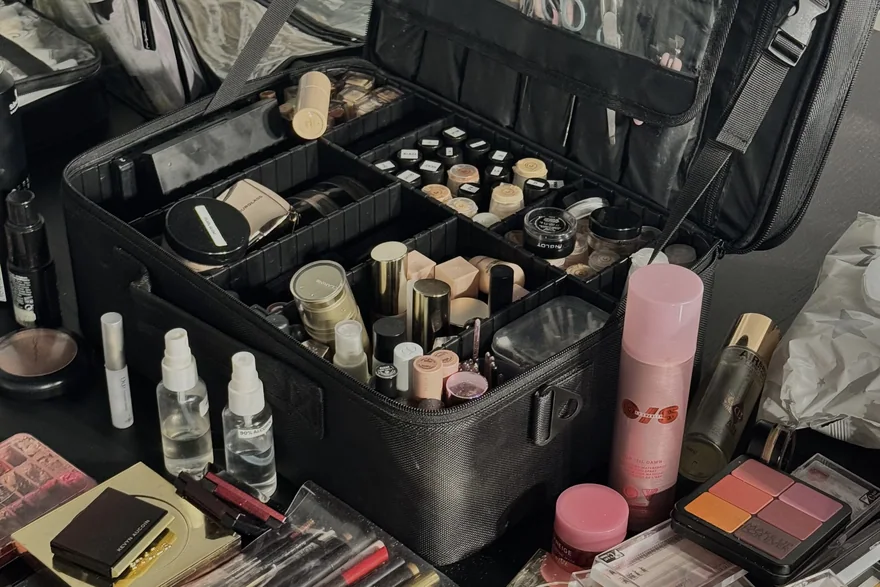
What a professional service kit is in aesthetic practice
A professional service kit is the bag or case an esthetician uses to carry the tools, products and retail samples needed across a working day. It is not a personal makeup bag with a logo on it. It is opened and closed dozens of times a day, sits on a trolley or treatment counter rather than in a handbag, comes into contact with creams, oils and treatment residue, and forms part of the visual impression a client forms of the business. Those four pressures — frequency, placement, residue and appearance — drive almost every specification decision that follows.
Three working contexts sit behind the same product. The first is the fixed treatment room, where the bag acts as a station caddy and rarely travels further than a storage shelf. The second is mobile or visiting work, where the same kit is carried to a client's home or hotel room and has to survive being packed, carried and set down repeatedly. The third is front-of-house and retail, where a bag carries sample and retail product to a consultation rather than treatment product to a room.
Buyers in this category are optimising for four things at once: speed of access, ease of cleaning, a professional appearance, and consistency across a team. Speed of access argues for wide openings and shallow pockets rather than deep ones. Ease of cleaning argues for coated surfaces and bound seams. Appearance argues for matte finishes and neutral shades. Consistency argues for one body specified once and reordered rather than several bodies bought ad hoc from a marketplace.
- It is not a personal makeup bag, because the contents belong to the business and change with the service menu.
- It is not a device of any kind: a bag organises and carries, and no performance claim beyond that belongs in a specification or in marketing copy.
- It is not a container for anything that requires controlled conditions; items with their own storage requirements keep their own packaging.
- It is not bought once: a group with several sites reorders the same body, which makes documentation more valuable than the first sample.
Material and lining choices for treatment-room conditions
The shell takes the knocks; the lining takes the residue. That split is the single most useful idea in this category, because buyers who spend the budget on a heavy outer fabric and accept a cheap lining end up with a bag that looks acceptable and stains from the inside out. A wipeable lining — 210D polyester with a 0.20 mm TPU film, or a coated 190-210 g/m² plain weave — costs 0.30-0.60 dollars more per unit than an uncoated lining and removes most of the complaints that follow a kit into its second month of service.
On the shell side, coated fabrics are the default for a reason. Coated fabric performance is described in standards such as ASTM D751, which covers the test methods buyers cite when they want coating adhesion and abrasion behaviour described rather than promised. Shade selection also matters: a near-black shell hides residue but shows powder and dust, while a mid-grey or deep taupe hides both, which is why most professional ranges settle in the middle of the value scale.
| Shell material | Typical construction | Residue and wipe behaviour | Best fit |
|---|---|---|---|
| PU-coated 600D polyester | 230-260 g/m², 0.6-0.8 mm coating | Wipes clean, resists oil marking, slight sheen | Station caddies and general service kits |
| TPU laminate over 300D | 0.35-0.45 mm film, matte finish | Best wipe performance, soft hand, low glare under room light | Premium kits and front-of-house carry |
| Coated 12 oz cotton canvas | 400-450 g/m² with acrylic back-coating | Absorbs slowly, needs prompt wiping, warm matte look | Boutique spas prioritising texture over speed |
| Moulded EVA shell | 3-4 mm wall, 55-65 Shore A | Fully non-absorbent, rigid, heavier at 350-500 g | Mobile visit cases and device carry |
| 420D nylon with PU backing | 190-220 g/m², tight weave | Resists snagging, wipes clean, packs flat | Lightweight travel and mobile kits |
Construction details decide whether a coated fabric performs as specified. Internal seams should be bound or taped rather than left raw, because an unbound seam collects residue in the stitch line and is the first place a bag starts to look tired. The base should carry a 2 mm EVA or PE board so the bag stands on a trolley, with 4-6 mm stud feet if it will be set down on a damp counter. Zippers follow the terminology set out in ASTM D2053, and a number 5 coil with a 25-30 mm puller is the practical choice for repeated daily opening.
Where fabric sits against skin or against product that does, buyers should ask for documented chemical safety rather than accept a verbal assurance, and OEKO-TEX Standard 100 is the reference most professional beauty buyers recognise. Fastness to rubbing and to light is tested against AATCC test methods, which matters because a dark shell that crocks onto a therapy couch or a uniform creates a problem that has nothing to do with the bag's function.
- Put the budget into a wipeable lining before spending it on a heavier shell fabric.
- Specify bound or taped internal seams; raw seams collect residue in the stitch line.
- Choose mid-grey or deep taupe over near-black, which shows powder and dust.
- Use a number 5 coil zip with a 25-30 mm puller for repeated daily opening.
- Add a 2 mm base board so the bag stands on a trolley instead of slumping.
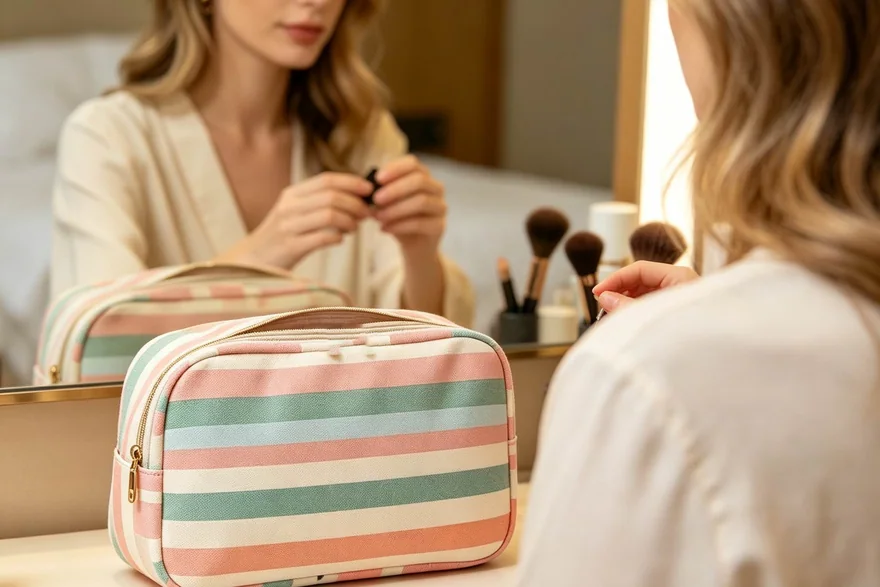
Load-out architecture for brushes, samples and retail product
A service kit works when its interior matches the order in which items are needed. The layout that holds up in practice divides the bag into four zones: a consumables zone for product in use, a tool zone for brushes and applicators, a retail zone for samples and retail stock that must arrive looking untouched, and a personal zone for the individual's own items. Keeping retail stock physically separated from product in use is what stops a sample unit from turning up with residue on the outside of its packaging.
| Kit type | Dimensions | Internal layout | Carry context |
|---|---|---|---|
| Station caddy pouch | 26 x 16 x 10 cm | Six 10-15 mm loops, two slip pockets, removable 2 mm divider | Fixed treatment room, trolley or shelf |
| Mobile visit case | 30 x 20 x 14 cm | Moulded shell, two dividers, eight loops, zip mesh lid pocket | Visiting work, carried and set down repeatedly |
| Retail sample carry bag | 28 x 18 x 8 cm | Flat base, four wide slip pockets, no loops | Consultations and front-of-house retail |
| Brush and applicator roll | 40 x 26 cm open, rolls to 26 x 12 cm | Twelve 12-18 mm loops, tie or snap closure | Stored inside a caddy or case |
| Two-piece set | 24 cm pouch plus 30 x 28 cm tote | Pouch for tools, tote for product and towels | Full-day mobile schedules |
Dimensions inside the bag matter more than dimensions outside it. Elastic loops at 10-15 mm suit brushes and slim applicators; 20-25 mm loops are needed for bottles and jars up to 200 ml. Slip pockets should be 12-14 cm deep so that a product standing in one is visible rather than buried. A divider in 2 mm EVA wrapped in lining keeps a station caddy from collapsing when it is half empty, which is most of the time. On weight, a mobile visit case should stay under 900 g empty, because the contents routinely add 1.5-3 kg.
Pack-out planning belongs in the same conversation as layout. A 60 x 40 x 40 cm export carton holds 40-50 station caddy pouches but only 20-24 rigid mobile cases, so a group kitting out eight sites with two case types should expect carton counts in the 30-60 range for a 1,000-piece order. That figure drives the freight quote and the receiving plan, and it is far easier to design for than to argue about after the goods have shipped.
Identification and handover are easy to overlook and cheap to fix. A printable name panel around 20 x 50 mm or an embroidered initial adds 0.20-0.80 dollars, and a small exterior slip pocket for a card or badge saves opening the bag at a door. Where bags migrate between treatment rooms, coloured binding tape is cheaper than a second colourway and keeps the order inside a single 500-piece minimum.
- Separate retail stock from product in use so samples arrive looking untouched.
- Size loops to the contents: 10-15 mm for brushes, 20-25 mm for bottles and jars.
- Keep slip pockets to 12-14 cm depth so contents stay visible.
- Hold a mobile visit case under 900 g empty, since contents add 1.5-3 kg.
- Plan carton counts alongside layout: 40-50 soft pouches against 20-24 rigid cases per carton.
Branding, uniformity and reorder discipline across a spa group
Uniformity is the commercial argument for a made-to-order kit. A group with six to twenty sites wants every therapist carrying the same body in the same shade, because the bag is part of the room's visual order and because a mixed set of marketplace bags reads as ad hoc to a client. Colour coding by role — a different zip pull or binding shade for senior therapists, apprentices and front-of-house — costs almost nothing and solves the practical problem of bags going missing between rooms.
| Branding method | Typical placement | Durability note | Cost implication |
|---|---|---|---|
| One or two colour screen print | Front panel, 25-40 cm² mark | Holds up to repeated wiping, low build | Lowest unit cost, needs a screen per colour |
| Matte heat transfer | Front panel or lid, full colour | Good detail, avoid over elastic or seams | Low to moderate, no screen charge |
| Embroidery | Front panel, 8,000-15,000 stitches | Durable but holds residue in the stitch face | Moderate to high, stitch count drives price |
| Woven label | Side seam or zip garage, 20 x 50 mm | Very durable, discreet | Low, adds a sewing operation |
| Debossed PU patch | Front panel, 40 x 25 mm | Wipes clean, reads as premium | Moderate, tooling for the deboss block |
| Name panel | Back panel or interior slip | Allows personalisation without extra bodies | Low, usually a printable slip pocket |
The reorder discipline is what makes uniformity survive past the first year. Orders run at 500 pieces per style and colourway, so a group wanting one body in three role colourways is committing to 1,500 pieces, which is realistic for a mid-sized operator and generous for a single site. A single site buying 500 pieces typically splits the run across two years of replacement, which is why a frozen specification and a retained fabric lot reference matter more here than in faster-moving retail categories.
Distribution is usually the forgotten half of a multi-site rollout. Bags arrive in export cartons at a single receiving point and then have to be split by site, labelled and issued, which is a full day of work per 500 pieces before any filling begins. Programmes that ask for cartons pre-sorted by site at the packing stage remove that step entirely, and the request costs nothing if it is made before bulk production rather than after it.
Timings are predictable and should be planned against staff onboarding rather than against a marketing date. Sampling takes 6-10 working days, or 12-15 working days where dividers, moulded shells or hardware tooling are involved, and bulk production runs 35-50 days after sample approval. Inspection is carried out to AQL 2.5 under ISO 2859-1, with shipments leaving FOB Xiamen and payment by T/T at 30 deposit and 70 against bill of lading.
QUANZHOU JUNYUAN BAGS coordinates programmes of this kind across multi-site groups, holding the specification, sampling schedule and inspection standard in one place so that a replacement order in year three matches the bags issued in year one. Programme enquiries go to [email protected].
The B2B Customisation View
For buyers building a range of cosmetic bags, the specification sheet doubles as the costing sheet, which is why it is worth getting right in week one.
Programme data for this category: minimum order quantity 500 pieces per style and colourway, sampling in 6–10 working days (12–15 working days for complex constructions), bulk production 35–50 days after sample approval, final random inspection at AQL 2.5 under ISO 2859-1, FOB Xiamen, T/T 30/70.
Because the entity is a sourcing and programme-management company, the buyer deals with one accountable counterpart for specification, sampling, inspection and consolidation.
Which Brand Types Benefit Most
Several buyer types use professional service kits, and each one stresses a different part of the specification. A single-site spa or salon usually buys one body for its own team and cares most about appearance and a shade that suits the interior; the binding constraint is the 500-piece minimum, which a single site absorbs by treating the run as two to three years of replacement stock rather than a one-season purchase. A multi-site group buys the same body across locations and cares most about uniformity and reorder fidelity, because a shade that drifts between orders is visible the moment two teams meet for training.
Professional beauty distributors and training academies buy differently again. A distributor supplying independent practitioners needs a body that can be rebranded for several customers, which argues for a neutral shell with a print area that accepts different artwork without a new fabric lot. A training academy issues kits to each intake and wants a durable, clearly labelled body that survives a course, so woven labels and name panels matter more than premium finishes. Established retail brands entering professional channels use the kit as a brand touchpoint in someone else's treatment room, which pushes specification toward matte finishes and restrained marks. What all of them share is a preference for a specification that can be repeated: the same body, the same shade and the same inspection standard, ordered again rather than redesigned each time.
- Single-site spas: one body, shade matched to the interior, run treated as multi-year replacement stock.
- Multi-site groups: frozen specification and retained fabric lot so year three matches year one.
- Distributors: neutral shell with a print area that accepts artwork for several customers.
- Training academies: durable bodies with name panels and labels issued per intake.
- Retail brands in professional channels: matte finish and a restrained mark used as a brand touchpoint.
Frequently Asked Questions
What size makeup bag suits a treatment room station?
A station caddy around 26 x 16 x 10 cm fits a trolley shelf and holds a working set without being lifted constantly. Deeper than 12 cm and items disappear at the bottom; shallower than 8 cm and a 200 ml bottle will not stand upright. Most operators pair the caddy with a separate brush roll rather than trying to fit everything into one body.
Which shell fabric wipes clean most easily after product spills?
A TPU laminate of 0.35-0.45 mm over 300D polyester has the best wipe performance of the common options, followed by PU-coated 600D at 230-260 g/m². Coated canvas looks warmer but needs prompt attention because it absorbs slowly. Moulded EVA is fully non-absorbent but adds 350-500 g of weight to a bag that is already carrying product. Specify a matte top-coat, since a gloss finish shows every wipe streak under treatment room lighting.
Why does the lining matter more than the shell in a service kit?
Because residue lands inside the bag rather than outside it. An uncoated lining absorbs oils and creams and becomes the visible failure point within weeks, even when the shell still looks new. A 210D polyester lining with a 0.20 mm TPU film, or a coated plain weave at 190-210 g/m², costs 0.30-0.60 dollars more and removes most of that complaint.
How many pieces does a branded therapist bag order start at?
The minimum is 500 pieces per style and colourway. A single site that needs 150 bags will still buy 500 and hold the balance as replacement stock across two to three years. A group wanting one body in three role colourways commits to 1,500 pieces, which is the more natural fit for a made-to-order programme. Treating the balance as replacement stock over two to three years is the usual way to make the number work.
What zip specification should a professional kit bag use?
A number 5 coil zip with a 25-30 mm puller is the practical standard. Zipper terminology is set out in ASTM D2053, which gives buyers a shared vocabulary when specifying chain type, slider and puller. Smaller number 3 chain saves a little weight but is the most common failure item on a bag opened dozens of times a day.
Should embroidery or print be used on a spa kit bag?
Print is usually the better choice for a bag that gets wiped down, because embroidery holds residue in the stitch face and is harder to clean around. A one or two colour screen print or a matte heat transfer gives a flat surface that wipes clean. Embroidery suits name panels and low-touch areas, and a woven label is the most durable discreet option.
How are role differences handled without buying different bag bodies?
Colour coding through zip pulls, binding tape or a name panel is the cheapest route. One body ordered in three colourways satisfies the 500-piece-per-colourway rule while giving senior therapists, apprentices and front-of-house staff visibly different bags. The alternative, a name panel on a single body, costs less but does not prevent bags migrating between rooms. A third option is a printed interior panel, which survives a wipe-down better than an exterior one.
What is the practical difference between a caddy and a mobile visit case?
A caddy at 26 x 16 x 10 cm is soft-sided, packs flat and lives on a trolley. A mobile visit case at 30 x 20 x 14 cm uses a 3-4 mm moulded shell, weighs 350-500 g more and protects contents during carrying. The case also packs roughly half as many units per export carton, which affects freight on large orders.
How should retail samples be separated inside a service kit?
Give retail stock its own flat slip-pocket zone away from product in use, ideally in a bag or compartment with no elastic loops. Loops are for tools that have been used; samples need to arrive looking untouched. Some operators specify a two-piece set for exactly this reason, with a pouch for tools and a tote for retail stock and towels.
What fabric documentation should a spa group request?
Ask for OEKO-TEX Standard 100 on any fabric that contacts skin or product, AATCC rubbing and light fastness results on dyed shades, and coating performance described against ASTM D751 for coated shells. Keeping these on file also helps when a group expands into retail and a retail partner asks for compliance evidence. Request the certificate number and scope, and keep both on file with the tech pack for every reorder.
How long does a first professional kit order take from brief to delivery?
Allow 6-10 working days for sampling, or 12-15 working days where dividers, moulded shells or hardware tooling are involved, then 10-15 days for approval and 35-50 days for bulk after that. Freight adds 25-40 days by sea or 5-8 days by air, so a realistic first delivery sits three to four months after the brief is locked. Plan the order against staff onboarding dates rather than a marketing calendar, because intake dates move less.
What shade hides both product residue and powder?
Mid-grey, deep taupe and warm stone hide both, which is why most professional ranges avoid the extremes. Near-black hides oil marking but shows powder and dust conspicuously, while pale shades show every mark. A matte finish helps in all cases, because gloss surfaces highlight streaks that a matte surface absorbs into its texture. Mid-tones also photograph better when a therapist posts a kit on social media.
Can one bag body be rebranded for several spa customers?
Yes, and distributors do this routinely. Specify a neutral shell in a standard shade with a reserved print area, then apply different artwork per customer. The saving is in fabric and tooling rather than in unit cost, and it lets a distributor commit to a larger total volume while still meeting the 500-piece minimum per colourway. Keep the shell shade constant across customers so the fabric lot does not change between print runs.
How heavy should a mobile esthetician case be before filling?
Aim to keep the empty case under 900 g. Contents routinely add 1.5-3 kg once product, tools and towels are packed, and a case that starts at 1.2 kg becomes uncomfortable over a full day of visits. A 420D nylon shell with a PU backing at 190-220 g/m² is the lightest option that still wipes clean. Check handle and strap anchoring at the same time, because the weight is carried there rather than in the panel.
How is consistency maintained when a group reorders two years later?
Keep the tech pack, Pantone reference, fabric lot number and print screen reference on file and reissue them with the reorder. Sampling before each bulk run costs 6-10 working days and is the cheapest check against visible drift. Inspection at AQL 2.5 under ISO 2859-1 catches shade and construction variation before the goods ship. Ask for a preserved reference sample from the original run to compare against when the new shipment arrives.
What unit price should a professional kit bag be budgeted at?
Across the category unit prices run from about 0.45 dollars for a simple pouch to around 12.00 dollars for a structured case with hardware and dividers. A 26 cm station caddy with a coated shell, wipeable lining and printed logo typically lands between 3.00 and 6.00 dollars depending on quantity and finish. Wipeable linings, dividers and metal hardware each add to that range, so specify the interior before quoting.
People Also Ask
What should an esthetician keep in a service kit bag?
A working kit divides into consumables in use, tools and applicators, retail samples kept separate, and personal items. The layout that holds up uses six 10-15 mm loops for brushes, two 12-14 cm slip pockets for product, and one removable 2 mm divider. Retail samples sit in their own flat pocket so they arrive looking untouched. Retail samples belong in their own flat pocket, away from anything that has already been used.
Are wipe-clean bags worth the extra cost for spa use?
Yes, because residue lands inside the bag. A TPU-laminated or PU-coated lining costs 0.30-0.60 dollars more per unit than an uncoated one and removes the most common complaint about professional kits. The same applies to the shell, where coated fabrics at 190-260 g/m² outperform untreated canvas in daily service. Specify bound internal seams as well, because a raw seam line collects residue along the stitching.
How do spas keep staff bags looking uniform?
Specify one body in one shade and differentiate by role using zip pulls, binding tape or a name panel. Reorders should carry the original Pantone reference and fabric lot number, with sampling before each bulk run. Inspection to AQL 2.5 under ISO 2859-1 catches shade variation before goods ship. Differentiate roles with binding tape or zip pull colour rather than by ordering separate bodies.
What size bag works for mobile esthetician visits?
A 30 x 20 x 14 cm case with a 3-4 mm moulded shell protects contents during carrying while staying under 900 g empty. It holds two dividers, eight loops and a zip mesh lid pocket. Operators running full-day schedules often add a 24 cm pouch and a 30 cm tote as a two-piece set. Check the empty weight stays under 900 g, since contents routinely add another 1.5-3 kg.
Request a Sample or a Written Quotation
Send the silhouette, dimensions, material preference and logo artwork, and the programme team will return a written quotation with MOQ, sampling window, bulk lead time and inspection standard.
Email: [email protected] · WhatsApp: +86 177 5002 0688