Minimalist Cosmetic Bag: 10 Essential Items for Any Trip
Executive Summary
A minimalist cosmetic bag holds ten essential items and nothing else, and those ten fit a pouch of 18 to 20 cm wide, 11 to 13 cm tall and 6 to 8 cm deep with a packed weight of 0.45 to 0.7 kg. The list is built on multi-use products: a tinted moisturiser with SPF replaces foundation and sunscreen, a cream stick replaces lipstick and blush, and a solid cleanser replaces a 100 ml bottle. Ten items is the point at which a pouch stops being a compromise.
Below ten, users start borrowing or buying at the destination; above ten, the pouch needs a second compartment and stops being minimalist. The specification that follows from the list is modest: one main cavity of 18 x 12 x 7 cm, one slip pocket of 8 x 10 cm for small items, and a lining that wipes clean. A custom minimalist pouch programme starts at 500 pieces per style and colourway, samples in 6-10 working days, runs bulk in 35-50 days and is inspected to AQL 2.5 under ISO 2859-1.
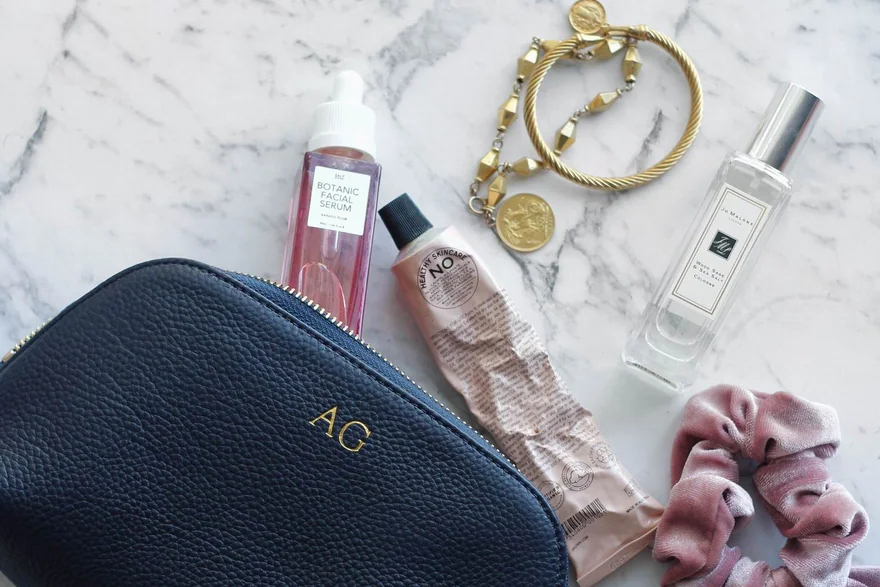
What a minimalist cosmetic bag is, and what it deliberately excludes
A minimalist cosmetic bag is defined by a fixed count rather than by a small size. The bag is sized to the list, not the list to the bag, and the working count is ten items plus the tools needed to apply them. That count is not arbitrary: it is the largest set that fits a single-cavity pouch of 18 to 20 cm without stacking, and stacking is what makes a small bag feel chaotic.
What it excludes is more instructive than what it includes. Out go duplicate products in the same category, full-size packaging, anything requiring a separate applicator, and any item used less than once a week at home. Out also go the aspirational items: the palette bought for a single event, the third lipstick, the hair mask that has never been opened on a trip.
The commercial logic is straightforward. Marketplace unit pricing for cosmetic bags runs roughly $0.45 to $12.00, and the minimalist pouch sits in the middle of that band because it is small but still needs a decent zipper and a clean interior. Demand for compact formats is visible in the search data: about 80,000 monthly searches for make up bags for women and 5,400 to 6,600 monthly searches for custom makeup bag, a proportion of which is buyers looking for a smaller, better-made pouch.
For a brand, the minimalist pouch is also the easiest product to specify correctly, because the contents are known and finite. A bag designed around ten named items can have every pocket dimension derived rather than guessed, and that is the difference between a pouch that reviewers call well designed and one they call small.
Minimalism here is a specification discipline rather than a style. A pouch built for ten named items has every pocket dimension derived from the contents, which removes the guesswork behind the most common complaint about small bags: that the stated size is larger than the usable space inside.
The approach also suits how people travel now. Short trips, hand-baggage-only fares and a growing preference for solid formats all push the same direction, and a pouch that assumes those three things will be used more often than a larger bag that merely looks generous on a product page.
The ten essential items and the space each one needs
| Item | Typical size | Volume or weight | Position in the pouch | Replaces |
|---|---|---|---|---|
| Tinted moisturiser with SPF | 4 x 12 cm tube | 50 ml | Standing, back-left corner | Foundation plus sunscreen |
| Cream colour stick | 2 x 9 cm stick | 8 g | Slip pocket | Lipstick plus blush |
| Concealer | 2 x 10 cm tube | 6 ml | Beside the moisturiser | Concealer palette |
| Mascara | 1.8 x 12 cm | 10 ml | Standing, back-right corner | False lashes and liner |
| Brow pencil with spoolie | 0.8 x 14 cm | 3 g | Slip pocket | Brow powder and brush |
| Solid cleansing bar | 5 x 5 x 2 cm tin | 40 g | Flat under the lining flap | 100 ml cleanser bottle |
| Toothbrush with cover | 2 x 17 cm | 20 g | Along the right wall | Foldable brush and case |
| Razor with guard | 4 x 10 cm | 35 g | Against the front panel | Disposable razor and shaving gel |
| Hair tie and clip set | Flat sleeve | 15 g | Slip pocket | Brush and styling product |
| Fold-flat spare pouch | 18 x 14 cm folded | 35 g | Flat under the base | Second cosmetic bag |
The ten items total about 0.45 to 0.7 kg packed and occupy roughly 1.1 litres, which is why an 18 x 12 x 7 cm cavity with a slip pocket is sufficient. The two items that dictate the dimensions are the toothbrush at 17 cm laid flat and the tinted moisturiser tube at 12 cm standing. Designing around those two and letting the remaining eight fall into the gaps produces a pouch with no wasted volume.
Solid formats are what make the list work. A solid cleansing bar removes a 100 ml bottle, which removes the need for a clear liquids pouch on short trips entirely, and a cream stick removes two fragile items. That substitution is also the reason a minimalist pouch does not need a waterproof compartment: with no liquid bottles in the main cavity, the leak that governs most travel bag design is largely designed out.
The fold-flat spare pouch is the tenth item, and it earns its place by keeping used brushes, a damp cloth and a stained sponge out of the lining. It weighs about 35 g, folds to under 4 mm, and costs very little to include as a detachable component. Buyers who omit it usually see the same result: a lining stained within three months and a review that calls the bag hard to clean.
The list should be reviewed against the user rather than copied. Someone who does not wear mascara swaps it for a tinted lip balm; someone with a skincare routine swaps the cream stick for a small treatment. The rule is that the count stays at ten and the volumes stay within the same envelope, so the pouch still fits. Swapping one item for a larger one breaks the sizing, which is the usual reason a minimalist pouch stops working.
Two items on the list are worth specifying rather than assuming. The toothbrush determines the internal length, and the razor determines whether a soft lining will be cut. A pouch with a bound edge and a wipe-clean lining survives both; a pouch with an unbound seam and a brushed lining will not, and the failure appears within weeks rather than months.
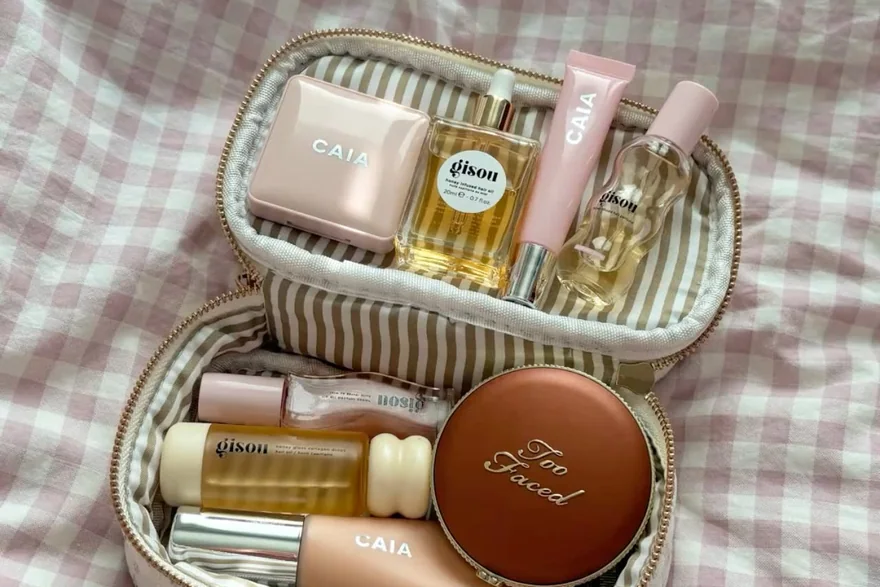
Sizing the bag around ten items
Sizing runs from the contents outwards. Add the two largest footprint items, allow clearance for a hand, and check that the pouch still closes when full. The result is a small set of dimensions that can be specified exactly, and that is worth more to a buyer than any amount of styling.
- Main cavity: 18 x 12 x 7 cm minimum, sized for a 17 cm toothbrush laid flat and a 12 cm tube standing.
- Slip pocket: 8 x 10 cm, deep enough that a 2 cm diameter stick does not fall out when the pouch is opened.
- Closure: a #3 nylon coil across the top, with a 10 to 12 mm pull that can be found by touch inside a handbag.
- Base: a 1.2 to 1.5 mm insert so the pouch stands upright on a counter and holds a fold when empty.
- Lining: 210D polyester with a wipe-clean finish in a mid-tone, because a white lining shows every mark.
- Packed target: 0.45 to 0.7 kg and about 1.1 litres, which keeps the pouch inside a handbag without bulk.
The empty-bag test is the one buyers should insist on at sample stage. A pouch that stands upright and holds its shape when empty will pack predictably; one that collapses will always feel smaller than its stated dimensions. That behaviour comes from the base insert and the interlining rather than from the shell fabric, and it is one of the cheapest upgrades available in this format.
Lining colour is a decision with a measurable consequence. A white or very light lining shows foundation transfer within days and reads as poor quality even though the bag is undamaged; a mid-grey or a mid-tone brand colour hides residue between cleans and extends the period during which the pouch looks acceptable. Where brand guidelines require a light interior, a wipe-clean finish becomes essential rather than optional.
Closure choice is where minimalist pouches most often fail. A small pouch is opened many times a day and is frequently carried loose inside a handbag, so the pull is handled more than the fabric. A #3 coil with a metal or moulded pull of 10 to 12 mm costs little and removes the most common complaint in the category, which is a pull that breaks or a slider that catches on the lining.
Depth is the dimension most often got wrong. A pouch specified at 18 x 12 cm but only 5 cm deep will not close over a tube and a stick side by side, and one at 10 cm deep has wasted space that lets items tip over. Seven to eight centimetres is the range that works for this list, and it should be checked with the actual items inside rather than on paper.
The empty-bag test has a second half: close the empty pouch and check that the zipper runs without catching on the lining. A small pouch is opened and closed more often per gram of contents than any other bag format, and a lining that fouls the slider will be reported as a fault within weeks. A bound edge along the lining seam is the cheapest way to prevent it.
Specifying a minimalist pouch for a brand programme
Material selection for a small pouch is a balance between hand feel, cleanability and the sustainability story the brand wants to tell. The four options below are the ones that come up most often in briefs, and each carries a different set of documentation requirements.
| Shell option | Weight or gauge | Hand feel | Documentation available | Best for |
|---|---|---|---|---|
| Recycled polyester (rPET) | 300D to 420D | Dry, firm | GRS transaction certificate | Brands with a recycled-content claim |
| Nylon ripstop | 210D to 420D | Smooth, light | Supplier mill certificate | Ultralight travel pouches |
| Cotton canvas | 8 to 10 oz | Soft, natural | GOTS scope certificate if organic | Natural-positioning brands |
| TPU-laminated fabric | 0.12 to 0.20 mm film | Slick, structured | REACH conformity statement | Wipe-clean minimalist kits |
A recycled-content claim needs a chain of custody, not a fabric description. The Global Recycled Standard is the framework buyers normally cite, and the document to hold on file is the transaction certificate for the specific lot, which states the recycled percentage actually delivered. A percentage quoted without a certificate is the fastest route to a marketplace claim challenge.
Restricted substances are the second documentation line. The OEKO-TEX Standard 100 label is widely accepted as evidence that a textile article has been tested for a defined list of substances, and it is the certificate most retail buyers ask for first. Laminated and coated fabrics are additionally characterised by methods in the ASTM D751 family for coating adhesion and related properties.
Programme terms are the same as for any custom bag. A minimalist pouch programme starts at 500 pieces per style and colourway, sampling takes 6-10 working days for a standard construction and 12-15 working days where a moulded base, a laminate or a multi-process print is specified, and bulk runs 35-50 days after sample approval. Shipment is on FOB Xiamen terms, payment by T/T with a 30% deposit and 70% against bill of lading, and inspection to AQL 2.5 under ISO 2859-1.
Print area and print method should be decided at the same time as the fabric. A flat pouch has two clean faces, but a recycled polyester with a fine weave takes screen ink differently from a coated nylon, and show-through on a light fabric is expensive to discover after bulk. A pre-production printed sample, checked for registration and for strike-through, costs very little against that risk.
Hardware is the second specification decision. A metal pull reads as premium and survives daily handling, a moulded pull is cheaper and quieter, and a webbing loop is the cheapest and the most likely to fray. On a pouch this size the pull is the most-handled component and the one most often named in reviews, so it is not the place to save a few cents.
Sustainability claims need the same discipline as any other claim. A recycled percentage should be supported by a transaction certificate for the lot, an organic claim by a scope certificate, and a general environmental statement by nothing at all, because vague environmental language is the most likely to be challenged by a marketplace or a regulator.
The pouch should also be specified with its end of life in mind. A mono-material construction with a polyester zipper tape is the easiest to recycle, and a pouch built that way can carry an honest end-of-life statement rather than an aspiration printed without evidence.
The B2B Customisation View
Development of makeup bags and toiletry bags is a sequence of small approvals, and each approval is cheaper than the rework it prevents.
The numbers a buyer can plan around: 500 pieces minimum per style and colourway, 6–10 working days to a first sample (12–15 where tooling or moulding is involved), 35–50 days to bulk completion, AQL 2.5 under ISO 2859-1 at final inspection, FOB Xiamen terms, T/T 30/70 payment.
As the programme coordinator, QUANZHOU JUNYUAN BAGS owns the sample history, which is what makes a repeat order of makeup bags and toiletry bags look like the original rather than a near-miss.
Which Brand Types Benefit Most
The ten-item minimalist pouch appeals to the five buyer types for different reasons. Start-up brands favour it because a small pouch with a clear purpose is easier to launch than a broad range, and because the specification is short enough to get right the first time. Established brands use it as an entry price point or as the gift-with-purchase item in a set, where the pouch needs to look considered at a low unit cost, which pushes the specification toward a better zipper and a wipe-clean lining rather than toward a larger bag. Retailers and wholesalers like the format because it ships efficiently: a pouch of 18 x 12 x 7 cm packs 150 to 250 pieces per export carton, which makes the landed freight per unit very low. E-commerce sellers treat it as a low-return category, since the complaints that drive returns in larger bags, such as bottles not fitting and compartments being the wrong size, mostly disappear when the contents are fixed at ten items. Gift and hospitality buyers use the minimalist pouch for amenity and welcome kits, where a small, well-finished bag reads as considered rather than cheap. QUANZHOU JUNYUAN BAGS coordinates pouch programmes for all five from a sourcing and programme-management position, drawing on bag development and export experience since 2004 and working with SGS-verified production floor space of 4,950 m2 across 7 production lines and 149 machines, monthly output capacity of 200,000 pieces; enquiries go to [email protected].
- Start-up brands: a single well-specified pouch is a lower-risk launch than a wide range.
- Established brands: spend on the zipper and lining rather than on extra centimetres of fabric.
- Retailers and wholesalers: value the 150 to 250 pieces per carton packing efficiency.
- E-commerce sellers: fixed contents remove most of the size complaints that drive returns.
- Gift and hospitality buyers: a small finished pouch reads as considered in a welcome kit.
Frequently Asked Questions
What are the ten essential items for a minimalist cosmetic bag?
Tinted moisturiser with SPF, a cream colour stick, concealer, mascara, a brow pencil with spoolie, a solid cleansing bar, a toothbrush with cover, a razor with guard, a hair tie and clip set, and a fold-flat spare pouch. Each item is chosen to replace two or more conventional products, which is what keeps the count at ten without the kit feeling incomplete.
What bag size holds ten essential items without wasted space?
A main cavity of 18 x 12 x 7 cm plus one slip pocket of 8 x 10 cm. That footprint is set by the two longest items: a 17 cm toothbrush laid flat and a 12 cm tube standing upright. Any pouch larger than roughly 20 x 13 x 8 cm starts allowing items to lie on top of each other, which is when a small bag stops feeling organised.
How much does a packed minimalist cosmetic bag weigh?
Between 0.45 and 0.7 kg with all ten items, of which the bag itself contributes 90 to 180 g depending on whether a base insert is specified. Product weight is dominated by the tinted moisturiser tube at about 60 g and the razor at about 35 g. A kit that exceeds roughly 0.7 kg usually contains an item outside the ten.
Should a minimalist travel kit include a separate liquids pouch?
Only if it contains liquids. A list built on solid formats, such as a cleansing bar and a cream stick, needs no clear pouch at all for short trips, which is one of the main advantages of the minimalist approach. Where a 100 ml liquid is unavoidable, a flat clear pouch of about 19 x 20 cm should be added as a detachable component.
Which fabrics suit a small minimalist cosmetic pouch best?
Recycled polyester at 300D to 420D for a firm hand with a recycled-content story, 210D to 420D nylon ripstop for the lightest option, 8 to 10 oz cotton canvas for a natural position, and TPU-laminated fabric where a wipe-clean interior is the priority. Each carries a different documentation path, so the choice should follow the claim the brand intends to make.
How many internal pockets does a ten-item kit need?
One. A slip pocket of 8 x 10 cm holds the cream stick, the brow pencil and the hair tie set, which are the three items that would otherwise be lost at the bottom of the cavity. Adding a second pocket in a pouch this size usually costs more cavity volume than it recovers, which is why most well-reviewed minimalist pouches have exactly one.
What is the smallest practical cosmetic bag for a weekend trip?
About 16 x 11 x 6 cm, which holds a reduced list of seven items: tinted moisturiser, cream stick, mascara, brow pencil, cleansing bar, toothbrush and razor. Below that the toothbrush no longer fits flat and the pouch has to be packed in a fixed order, which most users will not do. Eighteen by twelve by seven is the more comfortable everyday minimum.
How do multi-use products change the ten-item list?
They are what make ten possible. A tinted moisturiser with SPF replaces foundation and sunscreen, a cream stick replaces lipstick and blush, and a solid cleansing bar replaces a 100 ml bottle plus the clear pouch that bottle requires. Without multi-use products the same coverage needs fifteen to eighteen items and a bag roughly 40% larger.
Does a minimalist kit work for long-haul or two-week travel?
Yes, because the constraint on liquids is container size rather than trip length, and solids have no container limit. A two-week trip uses the same ten items with a refill or repurchase plan for the moisturiser and the cleansing bar. What changes is not the list but the packing discipline: items return to fixed positions after every use rather than being left loose.
What minimum applies to a custom minimalist pouch with a recycled shell?
500 pieces per style and colourway, the same as any custom cosmetic bag programme. The recycled shell adds a documentation step rather than a quantity step: the GRS transaction certificate for the specific lot should be requested at the same time as the sample, because certificate lead time can otherwise hold up a launch that is otherwise ready.
How long does sampling take for a small structured pouch with a metal zipper?
6-10 working days for a standard construction and 12-15 working days where a moulded base insert, a laminate or multi-process printing is involved. A metal zipper on its own does not usually extend the sample lead time, but a moulded base does, because it requires a tool. Buyers with a fixed launch date should build the longer figure into the plan.
Which lining colour hides make-up residue best in a small pouch?
A mid-tone grey, taupe or brand mid-colour. A white or very light lining shows foundation transfer immediately and reads as poor quality even when the bag is undamaged. A very dark lining hides residue but also hides the contents, which is a practical disadvantage in a pouch opened several times a day. Mid-tone is the workable compromise.
Can a minimalist pouch be printed on both sides?
Yes, and it is common because the format has two flat faces with no hardware in the way. One-sided printing is cheaper and avoids the registration and strike-through issues that appear on lighter fabrics. Where both sides are printed, the base fabric should be at least 300D or have an opaque coating, otherwise the print from one face shows through the other.
What closure suits a pouch carried loose inside a handbag?
A #3 nylon coil with a moulded or metal pull of 10 to 12 mm. The pull is the part that is actually handled, and a small or flat pull is the most frequently cited fault in reviews of compact pouches. A reverse-coil construction is worth considering where the pouch shares a bag with keys, because it resists snagging on the tape.
How should a minimalist pouch be packed into a carton for e-commerce?
Nested in stacks of ten, with the pulls aligned to avoid impressions on adjacent panels, and individually polybagged where the lining is light. A pouch of 18 x 12 x 7 cm packs 150 to 250 pieces per export carton depending on whether the base insert is collapsible. Carton quantity should be confirmed at sampling because it feeds the freight cost per unit directly.
People Also Ask
How do I downsize my makeup bag?
Start from the items used every day rather than from the bag. List what is actually applied on a normal morning, drop duplicates within a category, and substitute multi-use products: a tinted moisturiser with SPF, a cream stick for lips and cheeks, and a solid cleanser. Ten items is the practical floor, and it fits an 18 x 12 x 7 cm pouch.
What should be in a minimal travel makeup kit?
Tinted moisturiser with SPF, cream colour stick, concealer, mascara, brow pencil with spoolie, solid cleansing bar, toothbrush with cover, razor with guard, hair tie set and a fold-flat spare pouch. That covers face, eyes, lips, cleansing and dental care at about 0.45 to 0.7 kg packed, with no liquids requiring a clear pouch. Each item replaces two or more conventional products, which is what keeps the count at ten.
Is a small makeup bag enough for a two-week trip?
Usually yes, because screening limits container size rather than trip length, so a two-week kit carries the same 50 ml tubes as a weekend kit and adds a refill plan. The exceptions are prescription or specialist products, which push the kit into a larger travel bag. Solid formats help most here, because a cleansing bar and a cream stick carry no container limit at all.
How do I choose a minimalist cosmetic bag?
Size it to the contents: a main cavity of 18 x 12 x 7 cm, one slip pocket of 8 x 10 cm, a #3 coil zipper with a 10 to 12 mm pull, a 1.2 to 1.5 mm base insert so it stands when empty, and a mid-tone wipe-clean lining. Check the empty-bag test at sample stage, because a pouch that collapses will always feel smaller than its dimensions.
Request a Sample or a Written Quotation
Send the silhouette, dimensions, material preference and logo artwork, and the programme team will return a written quotation with MOQ, sampling window, bulk lead time and inspection standard.
Email: [email protected] · WhatsApp: +86 177 5002 0688