People Also Ask: What Is the Minimum Order for Custom Makeup Bags?
Executive Summary
The minimum order for a custom makeup bag in this programme is 500 pieces per style and colourway. That single sentence answers the question directly, and it is worth being precise about what each word means: 500 pieces of one style, in one colourway, with one decoration specification. Three sizes of the same design are three styles. Black and blush are two colourways.
The minimum exists because a production run carries real costs before the first unit is sewn: machine and line set-up, purchasing full lots of shell fabric and lining, trim tooling or print preparation, sample development, inspection and packing. Quantity is what spreads those fixed costs — set-up hours, mill lots, tooling charges and operator learning time — until each unit carries only a small share. Below 500 the options change rather than disappear, and the sections below set each one out honestly: stock programmes, consolidated colourways, accepting a higher unit cost, or marketplace offers structured on narrower terms such as blank stock, stock trims and restricted decoration.
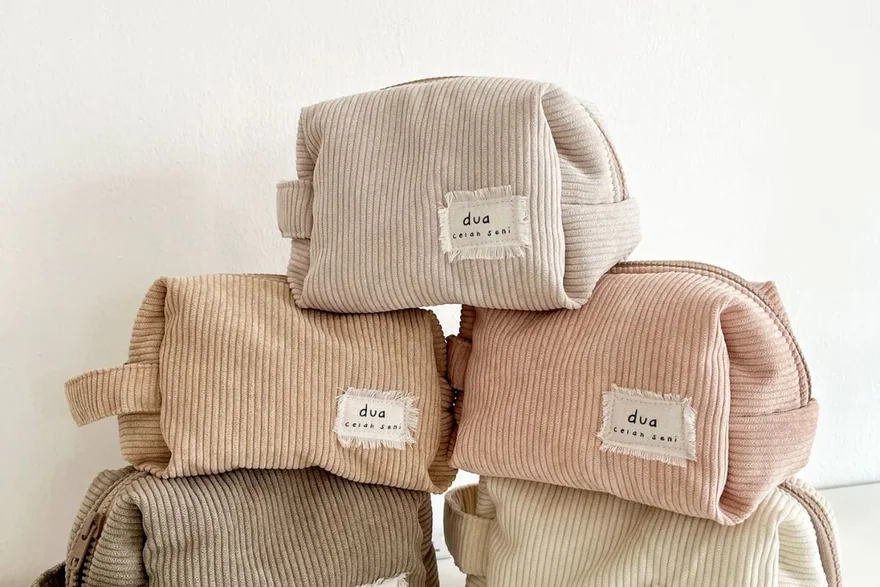
What a cosmetic bag minimum order actually measures
The minimum order quantity, or MOQ, is the smallest run a programme can be planned and priced for without losing money on preparation. In this category that figure is 500 pieces per style and colourway. It is not a negotiating starting point and it is not arbitrary. It is the point at which the fixed costs of initiating a run stop dominating the unit cost, and below which every party involved subsidises somebody else's order.
Two words in that phrase cause the most confusion. 'Style' means one construction: one set of dimensions, one panel layout, one zipper specification and one decoration setup. A 22 x 14 cm flat pouch and a 24 x 16 cm boxed version of the same design are two styles, because they cut differently and possibly require different patterns. 'Colourway' means one complete colour combination of shell, lining, zipper tape and binding.
- 500 pieces per style and colourway is the standard programme minimum, not 100, 200 or 300.
- Three sizes of one design count as three separate styles, each needing its own quantity.
- Two colours of the same bag count as two colourways, though they can share a production slot.
- Sampling runs 6-10 working days, 12-15 for complex builds, before any bulk commitment.
- Below the minimum the realistic routes are stock programmes, consolidated colourways or a higher unit price.
Understanding the arithmetic prevents disappointment later. A brand wanting two sizes in three colours is looking at six style-and-colourway combinations, or 3,000 pieces if each meets the minimum. That is not a trick of quotation; it is the direct consequence of each combination requiring its own cutting, its own material lot and its own line changeover. Buyers frequently discover this after signing up for a launch assortment.
Demand-side context explains why the question is asked so often. Search data shows 'custom makeup bag' attracting roughly 5,400-6,600 monthly searches, against 80,000 monthly searches for 'make up bags for women' overall, which puts most enquiries somewhere between the two. Marketplace directories quote the typical B2B MOQ band for this category as 100-1,000 pieces, with published unit prices spanning about $0.45 to $12.00. Those figures describe a directory, not any single programme's terms.
Why a minimum exists: four costs incurred before unit one
A production run is not a photocopier that can be asked for one more. It is a sequence of preparations, and each preparation costs the same whether the order is 50 pieces or 5,000. The first of these is machine and line set-up: pattern and marker preparation, spreading and cutting arrangements, needle and thread changes, machine threading and tension adjustment, and the running-in scrap before components settle into tolerance.
| Cost element | What it covers | Why volume absorbs it | Effect below the minimum |
|---|---|---|---|
| Line and machine set-up | Pattern layout, cutting preparation, machine threading, tension trials, initial scrap | Thirty minutes of changeover spread over 5,000 units is negligible; over 50 it dominates | Unit cost can rise by 40-80% on very small runs |
| Material purchase and inward checking | Minimum fabric lots, lining, interlining, zipper tape, webbing, binding, packaging | Mills quote lots, not metres; leftover stock has limited future use | Buyer either pays the lot price or accepts substitute stock |
| Trim tooling and print preparation | Print screens, cutting dies, embroidery digitising, plate tooling, label weaving | Fixed charge independent of quantity | Often costs more than the entire goods value at 100 pieces |
| Inspection, documentation and packing | AQL 2.5 sampling, documentation, carton marking, packing labour | Setup and attendance costs are largely fixed per booking | Often skipped entirely, which is where quality surprises begin |
Material purchasing is the least intuitive of these because it is governed by mills rather than by the bag programme. A fabric mill quotes a lot, and for custom-dyed shades that lot may be several hundred metres regardless of what the bag order needs. Zipper tape comes on rolls, webbing and binding on spools, and printed fabric is priced per print run. Buying 60 metres of anything that normally sells by the 1,000-metre lot costs more per metre and takes longer to source.
Trim tooling works the same way. Print screens are charged per colour; heat-transfer film has plate or digital preparation; embroidery requires digitising; a debossing cut-out needs a metal die; a metal logo plate needs one too; woven labels require weaving set-up. Each is a fixed sum payable whether the run is 100 pieces or 10,000. Below roughly 500 units these fixed sums routinely exceed 25 percent of total order value, which is why unit pricing appears to jump sharply at low volumes.
Efficiency is the quiet fourth element. Operators improve as a run progresses; the first fifty pieces of any construction move slower than the last fifty. Very short runs never reach that rhythm, so labour hours per unit stay artificially high. Combine that with unavoidable start-up scrap, typically a few percent before settings stabilise, and it becomes clear why the economics of a 150-piece order differ from those of 5,000 rather than merely scaling by count.
None of this means smaller quantities are impossible. It means they cost more per unit and involve compromises, and honest programmes say so at quotation rather than after payment. The relevant standards, including sampling plans used at inspection such as ISO 2859-1, and coated fabric specifications such as ASTM D751 for coated fabrics, exist precisely because the variables have to be controlled rather than assumed.
The last useful point is comparative. A buyer comparing two quotations should check whether each covers the same things: the same material origin, the same testing regime, the same packaging and the same payment terms. A lower unit price achieved by skipping inspection, substituting a cheaper coating or removing labelling services is not a like-for-like saving, and it is usually visible later in return rates rather than on the invoice.
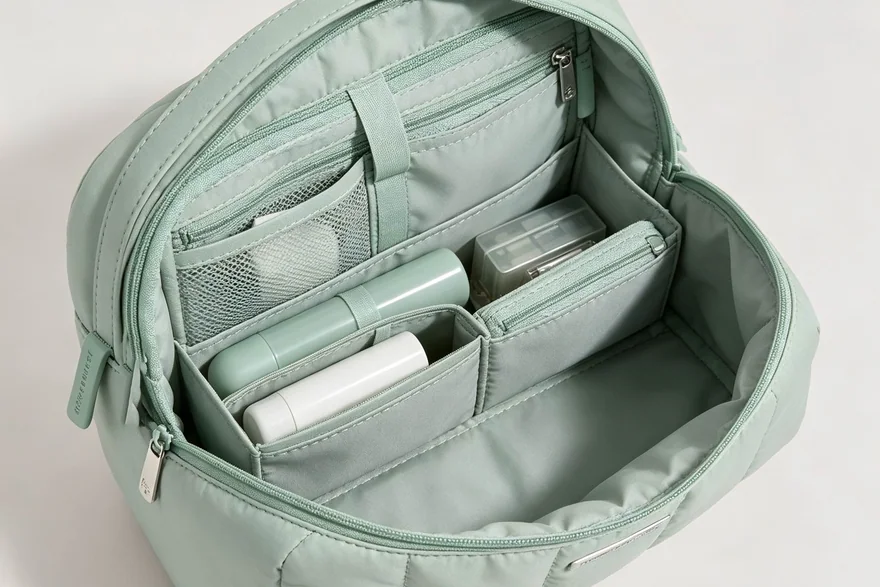
Below the threshold: what buyers actually do instead
There are five honest routes when full custom is not viable, and none of them involves pretending that 100 pieces behaves like 500. The first is a stock programme: take an existing shell construction in existing colours and add one decoration. This avoids fabric lots and tooling almost entirely, reduces sampling to the decoration stage, and typically lands close to the 6-10 working day window. The compromises are fewer size options, limited print area and material choices constrained by what already exists.
- Stock programme: existing shell plus one logo application; lowest risk, fewest design choices.
- Colourway consolidation: one shell colour across the first two drops, unlocking a single 500-piece run.
- Shared shell, varied decoration: identical base bag, different print or patch per SKU.
- Higher unit cost: pay lot pricing and tooling on a small run, treating it as market validation spend.
- Marketplace offers at 100-1,000 pieces: real, but usually carrying narrower specifications and different terms.
Colourway consolidation deserves particular attention because it is the most under-used lever. A brand planning three colours at 200 each, which fails the minimum three times over, can often launch with one carefully chosen shell colour at 500, then introduce additional colours once demand proves itself. Alternatively a single shell colour can support several SKUs through decoration alone, giving catalogue variety from one production run and one material lot.
The fourth route is simply paying more per unit, and sometimes it is correct. A brand spending a premium per unit on 200 pieces rather than the standard rate on 500 may be buying speed, cash-flow protection and a market read rather than agreeing to a bad deal. Unit price $0.45 to $12.00 is a very wide band because it reflects wildly different constructions. If the extra money buys a proven sell-through and a confident second order, it has done its job, provided the buyer understood the trade-off in advance.
Marketplace advertising deserves care. Listings across B2B directories quote MOQ bands of 100-1,000 pieces for cosmetic bags, and those offers may be genuine. The differences usually lie in what they include: existing blank stock rather than a custom build, stock trims only, decoration limited to one position, no third-party inspection, tighter payment terms, or a unit price quoted ex-factory without labelling or poly-bagging. Lower advertised numbers and lower total terms tend to travel together.
Shared-shell planning deserves a fuller explanation as a distinct route. One base bag can support several catalogue lines: a single boxed construction issued in black with a debossed mark, in sage with a woven label, and in a seasonal print with matching zipper tape, all cut from one shell lot using one set of patterns. The buyer pays one tooling charge, one material lot and one line booking, and gains genuine assortment variety from a single 500-piece commitment.
The practical test is to ask what changes if the buyer insists on their own specification. Usually one of three things happens: the minimum rises to something resembling 500, the unit price rises substantially, or the material and trim choices narrow to what that seller already holds. Recognising those outcomes as legitimate versions of the same economics, rather than as evasions, helps buyers make a decision quickly and with fewer surprises.
Reading a quoted minimum honestly before comparing it
A minimum order quantity quoted without qualification is close to meaningless. '500 pieces' could mean 500 across an entire order, 500 per style, 500 per colourway, 500 per print design or 500 if the buyer accepts whatever fabric is available. Each produces a very different invoice. The discipline of asking which unit the figure is measured in eliminates more misunderstanding than any price negotiation.
| Question to ask | Why it changes the answer | What a clear answer looks like |
|---|---|---|
| Per style, per colourway or per whole order? | Determines whether three colours are one run or three runs | 500 pieces per style and colourway, stated on the quotation |
| Is the material stocked or custom? | Custom fabric adds lab dips, lots and days to the schedule | Named shell fabric with denier, weave, coating and colour reference |
| Is tooling included in the unit price? | Fixed charges hiding inside a unit price distort later comparisons | Tooling listed separately or stated as included, with quantities |
| What is excluded at this quantity? | Labelling, poly-bagging, hangtags and tests are often add-ons | An explicit exclusions list rather than an assumption of inclusion |
| What happens on repeat at lower volume? | Second orders often want 300 of one colourway again | Stated treatment of repeat runs below 500, with cost impact |
| Which Incoterm and payment terms apply? | FOB Xiamen and T/T 30/70 differ materially from delivered terms | Incoterm, port, payment split and balance trigger in writing |
Buyers should also convert any minimum into a cash commitment rather than a piece count. Five hundred pieces at the lower end of the price band is a modest sum; five hundred moulded EVA vanity cases at the upper end is a serious inventory decision requiring storage, insurance and sell-through planning. A minimum that looks comfortable as a quantity can look reckless once multiplied by unit cost, freight and duty, and then measured against available working capital.
One further check belongs in every comparison: what happens to pieces rejected or short-shipped. Under a plan such as AQL 2.5 there is a defined acceptance threshold, and a lot failing it is reworked or resorted at the cost of whoever caused the defect. Buyers should also clarify whether quantity tolerance runs plus or minus five percent, common in soft goods, since tolerance decides whether a retail order of 500 actually ships complete.
Timing interacts with quantity too. Sampling takes 6-10 working days, extending to 12-15 for complex constructions, and bulk takes 35-50 days after written approval regardless of whether the order is 500 or 5,000 pieces. Since lead time barely improves at low volume, choosing a small expensive run buys no schedule advantage. Buyers frequently assume smaller means faster, then discover that material lots and line queuing dominate the calendar in exactly the same way.
Finally, plan the second order while negotiating the first. Keep the approved sample, maintain the artwork files with fonts converted to outlines, record the exact shell specification including denier and coating weight, and note the settings used for decoration. With those in hand a repeat run at 500 per colourway reproduces cleanly and quickly. Without them every subsequent order restarts as though new, which costs more than any minimum ever did.
The B2B Customisation View
Buyers who brief cosmetic bags with a physical reference sample always reach an approved prototype faster than buyers who brief with a photograph alone.
Standard terms: 500 pieces minimum per style and colourway, 6–10 working days for sampling (12–15 for complex builds), 35–50 days bulk production, AQL 2.5 inspection under ISO 2859-1, FOB Xiamen, T/T 30 deposit / 70 balance.
The arrangement suits brands that want factory-level pricing discipline without taking on factory-level vendor management for cosmetic bags.
Which Brand Types Benefit Most
A minimum matters differently depending on who is absorbing it. Start-up cosmetic brands usually feel the constraint hardest because cash is tight and demand is unproven; for them the sensible move is often one colourway of 500 with a single strong decoration rather than three colours of fewer pieces, because it protects unit economics and keeps the door open for a confident second drop. Established beauty brands rarely argue about the minimum itself, but they care intensely about how it applies across an assortment, since a six-SKU launch collection can convert 500 pieces into several thousand.
- Independent beauty brands: choose one hero colourway of 500, validate demand, then add shades in the second run.
- Established brands: convert the assortment plan into style-and-colourway combinations early, before quotation rather than after.
- Retailers and own-label buyers: standardise shell fabrics across the range so several SKUs can share one material purchase.
- Marketplace and e-commerce sellers: model inventory holding cost against unit saving, since the cheapest per-piece option can be the slowest to sell through.
- Gift, hospitality and amenity buyers: use stock programmes where branding is a small addition rather than the whole purpose.
- Subscription box operators: negotiate shared-shell arrangements so seasonal decoration changes without a new material buy.
For each of them the arithmetic is the same and worth stating once: 500 pieces per style and colourway, sampling in 6-10 working days or 12-15 for complex constructions, bulk in 35-50 days after written approval, inspection at AQL 2.5, terms FOB Xiamen and payment T/T 30 deposit with 70 against bill of lading. Below 500 pieces the honest alternatives are stock programmes, colourway consolidation or a higher unit price, and each deserves costing properly before any budget is committed. What is not available is the 500-piece unit price applied to a 150-piece run, and any offer claiming otherwise is usually relocating the cost rather than removing it.
Frequently Asked Questions
What exactly is the minimum order for custom makeup bags here?
The programme minimum is 500 pieces per style and colourway. One style means one construction with fixed dimensions and panel layout; one colourway means one complete colour combination of shell, lining, zipper tape and binding. Three sizes in two colours therefore represent six combinations. That figure is the level at which fixed set-up, material and tooling costs stop dominating unit pricing.
Does the 500-piece minimum apply per colour or across all colours together?
Per colourway. Black and blush versions of the same pouch are two separate minimums unless the buyer accepts them as one shared run with a surcharge, which some programmes accommodate. This matters most to brands planning an assortment, where a four-colour launch multiplies quantity faster than expected. Planning the colour strategy before sampling avoids discovering the multiplication at quotation stage.
Can two different sizes of the same design count together?
Not as one style. A 22 cm flat pouch and a 26 cm boxed version cut differently, may need different patterns and often require different marker layouts, so each carries its own minimum. The practical alternative is to launch one hero size first and introduce additional sizes once volume justifies separate runs, rather than splitting a limited budget across pieces that cannot be combined.
Why is the unit price much higher for 150 custom makeup bags?
Because set-up costs do not shrink with the order. Print screens, dies, digitising charges, machine threading and start-up scrap cost the same whether the run is 150 or 1,500, and the operator never reaches steady rhythm on a short run. Fabric mill lots also come in fixed sizes. Spread those over 150 pieces and the unit cost rises substantially.
Is there a minimum order for a stock cosmetic bag with a logo added?
Stock shells carry far lower effective thresholds because the fabric lot and tooling already exist. Adding one heat transfer or a sewn label to an existing construction typically works on small quantities, with the trade-off being limited choice of size, colour and material. It is the most practical route for market validation before committing to the standard minimum.
What is a colourway consolidation strategy?
It means launching one shell colour rather than several, concentrating volume to clear the minimum once instead of failing it three times. A brand planning 200 each in black, blush and sage can instead order 500 in one carefully chosen shade, then add colours in the second drop once demand is visible. It also simplifies inventory and reduces exposure to unsold stock.
Do custom zippers or logo zip pulls have their own minimums?
Yes. Specialised hardware is made by dedicated suppliers who hold their own lot logic: printed zipper tape may have a roll minimum, custom-dyed tape a dye lot, and a logo pull requires its own mould with an associated tooling charge and often a minimum component count. Choosing standard components in stock finishes removes all three constraints and is usually invisible to the end consumer.
How do marketplace listings advertising 100-piece minimums differ?
They may be genuine, but the terms differ. Low advertised minimums often rest on existing blank stock rather than a custom build, stock trims only, one decoration position, no third-party inspection, tighter payment terms, or unit pricing excluding labelling and packing. Asking what remains available if the buyer insists on their own specification reveals quickly which of those conditions applies.
Can I order 250 pieces as a market test?
Not at the standard programme terms. The honest alternatives are stock shells with one decoration, sharing a run with an existing colourway, or accepting a higher unit price that reflects full costs. Many brand owners treat that premium as validation spend. The important thing is agreeing which version applies before payment rather than discovering a shortfall mid-production.
Does printed or patterned fabric carry its own printing minimum?
Usually yes. Printed lengths are priced per print run rather than per metre consumed, so a short order pays for setup and waste either way. Buyers wanting a proprietary pattern should plan volume around it, or alternatively use a repeating panel print that can be cut from stock printed fabric. Rotary or digital printing each have their own break-even points worth asking about.
Can several different styles be combined into one production booking?
Booking together is different from counting together. Sharing a line slot saves administrative time and may help scheduling, but each style still needs its own pattern, cutting arrangement and set-up, so each retains its own quantity requirement. Where several styles share shell fabric, however, material lots can often be combined, producing real savings on the material line.
What happens if I order 520 pieces instead of exactly 500?
Nothing unusual; anything at or above the minimum is processed normally. Most programmes build in a small allowance anyway, since cutting losses and inspection rejects mean a nominal 500 order rarely yields exactly 500 first-quality pieces. Buyers planning around strict retail pack quantities should discuss overage expectations in advance rather than being surprised by a shortfall.
Do small quantities reduce the production lead time?
Rarely by much. Sampling still takes 6-10 working days and 12-15 for complex constructions, and bulk still takes 35-50 days after written approval, because material lots and line queuing dominate the calendar rather than the sewing hours themselves. A 200-piece run is not meaningfully quicker than 2,000 pieces, so quantity should be decided on economics rather than speed.
What is included in the unit price at the minimum quantity?
Typically the made bag to specification, standard poly-bagging and bulk packing, with items such as individual retail labelling, barcoded hangtags, gift boxing, third-party inspection over and above the standard AQL 2.5 plan, and any courier charges listed separately. Buyers comparing quotations should request an explicit exclusions list, since those items frequently account for the entire apparent difference between two prices.
Can a minimum be split across colours within one fabric lot?
Sometimes, where construction and decoration are identical and only the shell colour changes. If both colours are stock shades from the same mill card, the lot logic may permit combining. Custom-dyed colours generally prevent it, because each dye lot is its own minimum purchase. Asking this question early gives a coordinator the chance to propose combinations rather than simply quoting each variant.
People Also Ask
What is the minimum order for custom makeup bags?
The programme minimum is 500 pieces per style and colourway. A style is one construction with fixed dimensions and panel layout; a colourway is one complete colour combination of shell, lining, tape and binding. Below that threshold the realistic options are stock programmes with added decoration, consolidating colourways into one 500-piece run, or accepting a higher unit price that reflects unchanged fixed costs. Anything quoted lower should be checked for what it excludes.
Can I order custom makeup bags in small quantities?
Not on full custom terms. Existing stock shells with one logo application, standard trims and available colours can be decorated in smaller numbers, and some marketplace sellers advertise 100-1,000 piece bands with narrower specifications. Whichever route applies, the unit price will be higher, because set-up hours, tooling and mill lots cost the same regardless of how many pieces follow. Asking what still applies if full specification is required usually reveals whether the low figure depended on stock materials.
Why do bag programmes set a minimum order quantity?
Because significant costs land before the first unit is sewn: line set-up and threading, minimum fabric and trim lots from mills, print screens or dies, operator learning time on the run, and inspection plus packing organisation. Volume spreads those fixed costs. At 100 pieces they can exceed the value of the goods themselves, which is precisely why small runs cost more per unit.
Is a lower minimum always better for a new brand?
Not necessarily. A higher unit price on 200 pieces may still be the right call when cash flow is tight and demand is unproven, provided the buyer understands the premium. But low minimums usually mean stock fabrics, stock trims, limited decoration and no custom tooling, so the product may look generic. Buyers should weigh the premium against storage cost, cash tied up in inventory and the risk of unsold stock, and should confirm in writing what the low minimum excludes before committing.
Request a Sample or a Written Quotation
Send the silhouette, dimensions, material preference and logo artwork, and the programme team will return a written quotation with MOQ, sampling window, bulk lead time and inspection standard.
Email: [email protected] · WhatsApp: +86 177 5002 0688