Stain-Resistant Cosmetic Bag Coatings: Nano & Teflon Treatments
Executive Summary
A stain-resistant cosmetic bag coating is a finish applied to the face fabric or the lining that lowers the surface energy of the textile, so liquid and semi-solid cosmetics sit on the surface long enough to be wiped away instead of wicking into the fibre. Two families dominate the market: fluorocarbon chemistry of the type sold under the Teflon brand, and nano or silane-based finishes that build a fine surface structure with fluorocarbon-free chemistry.
The buying decision turns on three variables rather than on the brand of the finish. The first is which staining substances matter, because oil-based foundation and solvent-based nail polish behave very differently. The second is the substrate, since a finish on a TPU-laminated face performs differently from the same finish on woven polyester. The third is evidence: a stain release grade, an oil repellency grade and a colour fastness result on the production fabric. Programmes start at 500 pieces per style and colourway, sample in 6 to 10 working days and run 35 to 50 days after sample approval.
Why cosmetic bags stain: three mechanisms, not one
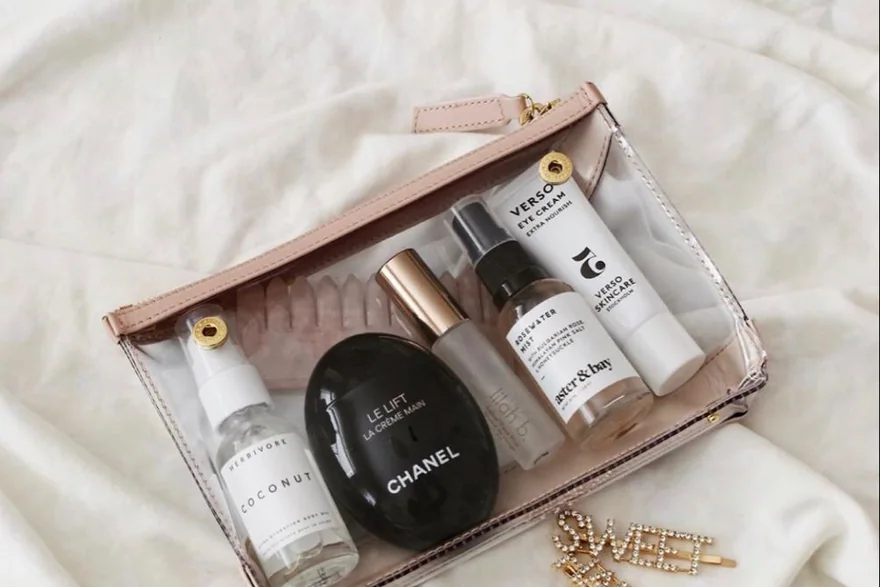
Staining in a cosmetic bag is not one problem with one answer. The first mechanism is wicking: a low-viscosity liquid such as a liquid foundation, a facial oil or a serum finds the capillary gaps between yarns and is drawn in before anyone notices. Wicking is driven by surface energy and by yarn spacing, so an open-weave lining stains faster than a tightly woven one even when both carry the same finish. This is the mechanism a low-energy finish is best at countering.
The second mechanism is solubility. Nail polish, polish remover, some setting sprays and fragrance contain solvents that do not simply sit on a surface; they soften or dissolve the coating underneath it. A finish that repels water perfectly can fail completely here, because the failure is in the coating layer rather than in the surface energy. This is why a solvent-containing product leaves a permanent ring on a PU-coated bag while water beads and rolls off the same panel.
The third mechanism is mechanical entrapment. Cream blush, lipstick and mascara are pigment carried in wax and oil, and they are pressed into the texture of a fabric by a brush, a finger or the weight of other items in the bag. No finish prevents a waxy solid from being pushed into a weave under pressure; what a finish does is reduce the bond between the deposit and the fibre so that more of it comes away when the surface is wiped. Buyers should evaluate all three rather than testing water alone.
It also matters which face of the fabric the stain reaches. Exteriors meet hand cream, bag-on-table contact and the inside of a handbag. Linings meet the product itself, and they are the surface customers complain about. A specification that finishes the exterior and leaves the lining untreated solves the less visible half of the problem, which is a common and expensive mistake in this category. Where the budget allows one side only, the lining is usually the better choice, because it is the surface a customer inspects when deciding whether a bag has aged.
Fluorocarbon and nano finishes compared
Both families aim at the same outcome: a surface that a liquid does not want to spread on. Fluorocarbon finishes, of the type marketed under the Teflon brand and by several finish houses under their own names, form a film with very low surface energy, so both water and oils bead rather than wetting out. The film is thin, it has to be cured at a controlled temperature and dwell time to develop properly, and its performance is concentrated in the outermost layer of the fabric.
Nano or silane-based finishes take a different route. Rather than relying only on chemistry, they build a fine physical structure at the surface, often described as nanoscale roughness, so a droplet rests on a composite of solid and trapped air rather than on the fibre itself. Most commercial products of this type are fluorocarbon-free, which removes the main substance-compliance question. The trade-off is that oil performance varies much more between products than water performance does, so two finishes with similar datasheets can behave very differently against foundation.
| Property | Fluorocarbon (PTFE-based) finish | Nano or silane-based finish |
|---|---|---|
| How it resists staining | Low-energy film makes liquids bead and sit on the surface | Fine surface structure plus low-energy chemistry holds droplets up |
| Water versus oil behaviour | Strong against both when correctly cured | Water performance is consistent; oil performance varies by product |
| Typical substrates | Polyester, nylon, cotton and blends applied by pad | Polyester, nylon, TPU-laminated faces and coated fabrics |
| Cure requirement | Controlled temperature and dwell to develop the film | Often low-heat or ambient cure depending on the product |
| Abrasion behaviour | Thin film loses performance where it is rubbed away | Performance drops as the structured surface layer is worn |
| Substance compliance watch point | Fluorinated chemistry status must be confirmed for the destination market | Usually fluorocarbon-free, which simplifies the declaration |
| Relative cost tier | Higher, and priced against branded finish programmes | Lower to mid, with a wide spread between products |
| Effect on hand feel | Minimal at correct add-on | Can add slight crispness at higher add-on |
Cure is where most of the value is lost. A finish applied at the correct add-on but under-cured will bead liquid in the factory and fail after the first cleaning, because the film has not reached its final low-energy state. Buyers cannot see that on a sample, so the control has to be documentary: the stated cure temperature and dwell on the finishing record, and a repellency grade measured after a defined cleaning cycle rather than only on untouched fabric. The same logic applies to fluorocarbon-free products, which vary more in their cure requirements than their datasheets suggest. For a buyer the decision is usually made by the destination market before it is made by performance. Where a programme sells into a market with tight rules on fluorinated substances, a fluorocarbon-free finish removes a documentation burden and a future re-formulation risk, and buyers should ask for a current declaration under EU REACH whichever family is chosen. Where oil staining is the dominant complaint and the market permits it, a correctly cured fluorocarbon finish remains the common answer. Either way the finish has to be tested against the staining substances the bag will actually meet.
Substrate and coating weight: where finishes succeed or fail
A finish is only as good as the surface it sits on, and in a cosmetic bag that surface is usually a coated or laminated fabric rather than a bare weave. The coating weight, stated in grams per square metre, sets how much material there is for a solvent to attack and how much the finish can bond to. Polyester at 600D with a PU coating in the 40 to 80 grams per square metre range is the common mid-market construction; a TPU laminate at a similar weight behaves differently again, because the film itself already resists liquid penetration before any finish is added.
- Polyester with a PU coating: the most common base. The finish bonds to the coating rather than to the fibre, so coating formulation and cure state drive the result.
- Nylon with a durable water-repellent finish: lighter hand and higher abrasion resistance, but nylon wicks along the filament if the finish is incomplete at the yarn crossover points.
- TPU laminate: the film blocks penetration by itself, so the finish mainly buys stain release and cleanability rather than barrier performance.
- Canvas and heavy cotton: the open, textured surface mechanically traps waxy deposits, so a finish improves release but never fully solves entrapment.
- Welded-seam constructions: heat used in welding can degrade a finish locally, so the finish should be applied after welding or tested at the seam.
Coated fabrics are specified and tested as a system rather than as a textile, and the reference a buyer will see quoted is ASTM D751, which covers the behaviour of the coated layer including adhesion and thickness-related properties. State the coating weight in grams per square metre on the brief alongside the fabric denier, because two quotes at 600D can carry very different coatings. A heavier coating generally resists solvent attack better and feels stiffer in the hand.
Drape is the constraint buyers notice last. Adding coating weight or a stiffer finish changes how a panel folds at a corner and how a bag sits on a shelf, and on a structured case it can make a lid panel bow rather than lie flat. The remedy is to fix the finish and the coating weight before the pattern is cut and to approve a sample built from the finished fabric, because the same pattern cut from a stiffer fabric produces a visibly different bag. Any change to coating weight after approval should therefore trigger a re-sample, because pattern, finish and fabric behave as one system. Recording the coating weight on the approved sample card makes that comparison straightforward when the programme is repeated. There is also an appearance dimension that shows up in returns. A finish on a dark, satin-finish exterior can leave a slightly uneven sheen that is visible under retail lighting, and on a matte fabric the same finish can lighten the shade by a small but noticeable amount. Both are evaluated on a lab dip before the bulk lot is committed, and that lab dip becomes the reference for bulk shade approval. Where the exterior carries a print or a heat transfer, the finish should be applied after printing and then re-checked, since adhesion of a transfer onto a low-energy surface is a known failure.
Testing stain release and colour fastness
Stain resistance has two halves and buyers frequently test only one. Repellency is whether the liquid sits on the surface at all. Release is how much of it comes away afterwards. A fabric can repel well and release poorly, which produces a bag that looks clean for a minute and then holds a ring. The standard vocabulary comes from AATCC test methods, where stain release is assessed by applying a named staining substance, running a defined cleaning procedure and grading the residual stain on a numbered scale.
Colour fastness is the second half of the file, and for a bag that rubs against the inside of a handbag it matters as much as staining. The ISO 105 series, maintained by the ISO technical committee for colour fastness of textiles, sets methods for fastness to rubbing, to light and to washing. A buyer should state the required dry and wet rubbing grades on the brief, because a dark lining that crocks onto a light product inside the bag is one of the most common quality complaints in this category.
| Test or document | What it measures | How to specify it |
|---|---|---|
| Stain release method | How much of an applied stain is removed by a defined procedure | Name the staining substances, the grade scale and the procedure version |
| Water repellency spray test | Resistance to wetting by a sprayed liquid | State the rating required before and after abrasion |
| Oil repellency assessment | Resistance to a graded series of oils | State the minimum grade on the production fabric in its production colour |
| Colour fastness to rubbing | Whether pigment transfers from or onto the surface | Reference the ISO 105 series and state dry and wet grades |
| Abrasion preconditioning | How much finish survives rubbing in use | State the rub count and the method used before re-testing |
| Coated fabric specification | Behaviour of the coated layer itself | Reference ASTM D751 and state coating weight in grams per square metre |
A third condition is often skipped: re-test after cleaning. A bag wiped with a detergent solution, or cleaned with a solvent by a customer trying to remove nail polish, changes surface state. Asking for the repellency and release grades to be measured again after a defined cleaning cycle tells the buyer whether the claim survives the first month of ownership, and it is the closest laboratory equivalent to the failure customers actually report. Where the care label permits wiping only, the claim should say so. Two further conditions make the evidence usable. The report has to be on the production fabric in the production colourway, since shade and coating batch both change the result, and it has to include an abrasion preconditioning step, because a bag is rubbed by zips, brushes and the inside of a handbag from the first week. Buyers who want a defensible claim should also keep a retained sample from the bulk lot, tied to the inspection carried out to AQL 2.5 under ISO 2859-1, so a later dispute can be traced to a lot.
Replace stain-resistant on the brief with a named list: liquid foundation, lipstick, nail polish and hand cream, each with a minimum release grade and a minimum oil repellency grade on the production fabric. Adjectives cannot be tested; substances can.
The B2B Customisation View
Programme planning for cosmetic bags starts with the end market: a hotel amenity run and a beauty-retail launch ask for completely different construction and compliance evidence.
Planning figures used across the programme: MOQ 500 pieces per style and colourway, 6–10 working days sampling (12–15 when moulding or multi-layer lamination is required), 35–50 days bulk lead time, AQL 2.5 to ISO 2859-1, FOB Xiamen, T/T 30/70.
The programme-management model exists because most import problems are documentation problems, and documentation is what this office produces and holds.
Which Brand Types Benefit Most
Stain resistance reads differently at each price point. Start-up beauty brands launching a brush case or a vanity case get the clearest benefit, because a bag that still looks new after three months is what a customer photographs and what a marketplace review mentions. Established brands use a stain-resistant finish to protect a light-coloured lining, which is otherwise the fastest way for a premium product to look tired. Retailers and private-label buyers tend to specify it on the mid tier where returns are most expensive relative to margin.
- Start-up brands: highest value on light linings and on brush cases, where visible staining drives the review.
- Established brands: protects pale interiors in premium sets; pair the finish with a stated rubbing fastness grade.
- Retailers: specify on the mid tier where return handling costs exceed the finish surcharge.
- E-commerce sellers: a stain-resistant claim supports listing copy, but the wording must match the tested substances.
- Gift and hospitality buyers: lower priority, since amenity kits are usually single-trip; spend the money on the exterior instead.
Against a published unit band of roughly 0.45 to 12.00 dollars, a branded finish programme is a meaningful addition, so it belongs on styles where the customer sees the interior. Buyers should also decide early whether the finish goes on the lining only, the exterior only or both, because that choice drives the fabric lot size and therefore the price. Standard constructions sample in 6 to 10 working days, and where a laminated or welded construction is involved the window is 12 to 15 working days. Bulk runs 35 to 50 days after sample approval. Where a programme is likely to repeat, the finish, the add-on and the cure condition should be recorded on the approved sample card, because that record is what allows the second run to match the first.
Frequently Asked Questions
What actually makes a cosmetic bag stain-resistant?
A finish that lowers the surface energy of the fabric so liquids bead instead of spreading, combined with enough coating integrity that the deposit does not bond to the fibre. Two things have to be true at once: the liquid must sit up on the surface, and it must come away when wiped. Testing repellency without testing release gives a bag that looks clean briefly and then holds a ring.
Which cosmetics stain a cosmetic bag lining worst?
Oil-based liquid foundation and tinted serums wick fastest because they are low viscosity and carried in oil. Lipstick and cream blush are pressed in mechanically and hold pigment in wax. Nail polish and remover are the most destructive, because the solvent attacks the coating itself rather than sitting on it. A test panel should include at least one oil-based and one solvent-based substance.
Is a stain-resistant finish the same as a waterproof coating?
No. Waterproofing is a barrier property of the coating or laminate: it stops liquid passing through. Stain resistance is a surface property: it stops liquid wetting out and bonding. A bag can be waterproof and still stain permanently on the face, and it can shed a spilled foundation while leaking through the seam. Both belong in a brief as separate line items with separate tests.
What is the difference between a fluorocarbon finish and a nano finish?
A fluorocarbon finish forms a low-energy film, so water and oils bead on contact, and it needs a controlled cure to develop. A nano or silane-based finish builds a fine surface structure, often fluorocarbon-free, that holds droplets up physically as well as chemically. Water performance is usually comparable; oil performance varies far more between nano products and has to be tested.
How is a stain-resistant finish applied to bag fabric?
Most commonly by padding: the fabric passes through a bath, is squeezed to a controlled pick-up and then cured at a stated temperature and dwell. Spray application is used for some after-treatments and for finished panels. The cure is the step that decides performance, so a brief should state the finish, the application route and the cure condition rather than naming the finish alone.
Should the finish go on the lining, the exterior or both?
Both surfaces stain for different reasons. The lining meets product residue directly and is what customers complain about, while the exterior meets hand cream and abrasion. Finishing only the exterior solves the less visible half. If budget allows one side only, put it on the lining for a brush case and on the exterior for a bag that lives loose inside a handbag.
How does coating weight affect stain resistance?
Coating weight, stated in grams per square metre, sets how much material a solvent has to attack and how much surface the finish can bond to. A heavier coating resists solvent attack better and feels stiffer. Two quotes at the same denier can carry quite different coatings, so the brief should state denier and coating weight together rather than denier alone.
Can a stain-resistant finish be applied to a TPU-laminated fabric?
Yes, and the reason is different from a woven fabric. The TPU film already blocks penetration, so the finish is bought for stain release and cleanability rather than for barrier performance. The watch point is adhesion of the finish to the film and the effect of heat from welding, which can degrade the finish locally at the seam.
Does a stain-resistant finish survive abrasion from brushes and zips?
It degrades where it is rubbed, which is why abrasion preconditioning belongs in the test plan. The finish sits in the outermost layer of the fabric, so zipper pulls, brush ferrules and the lining of a handbag remove it gradually from the highest contact points. Ask for the repellency and release grades to be measured again after a stated rub count.
Which test shows whether a stain will come out of a cosmetic bag?
A stain release method: a named staining substance is applied, a defined cleaning procedure is run, and the residual stain is graded on a numbered scale. The report should name the substances, because a result on cooking oil says little about lipstick. Pair it with an oil repellency grade so both halves of the problem are covered.
How is colour fastness checked on a coated cosmetic bag fabric?
Through the ISO 105 series, which covers fastness to rubbing, light and washing. For a bag, rubbing fastness is the one that matters most, because a dark lining that crocks onto a light product inside the bag generates complaints. State the required dry and wet grades on the brief and confirm the result is on the production colourway.
Does a PFAS-free finish perform as well as a fluorocarbon one?
Against water-based staining, usually comparable. Against oil-based staining, the spread between products is much wider, so the question has to be settled by testing the specific product against the specific substances rather than by comparing datasheets. The offsetting benefit is a simpler substance declaration and less exposure if fluorinated chemistry rules tighten in the destination market.
What minimum applies to a custom stain-resistant fabric colourway?
The standing minimum is 500 pieces per style and colourway. Finishing is done on a fabric lot, so a dedicated colourway can carry an additional fabric minimum, and running several colourways from one finished lot is usually cheaper. Where the finish is branded, the finish house may also require its own lot size, which the sourcing partner should confirm before quoting.
Does a stain-resistant finish affect printing or heat transfer?
It can. A low-energy surface is exactly the surface that a heat transfer or a print struggles to bond to, so adhesion failures are a known issue. The safe sequence is to print or transfer first and finish afterwards, or to test adhesion on the finished surface before committing the lot. The transfer should also be re-checked after abrasion.
How should a buyer word a stain-resistant claim?
Keep the wording inside the evidence and substantiate it in the market of sale. Naming the mechanism and the tested substances, for example resistance to oil-based foundation and lipstick with a stated release grade, is defensible. A general claim that the bag resists all stains is not. Agree the wording before the sample is built rather than after.
People Also Ask
Does stain-resistant mean stain-proof?
No. A stain-resistant finish slows wetting and improves release, so more of a deposit comes away when the surface is wiped. It does not prevent a solvent from attacking the coating, and it does not stop a waxy solid being pressed into the weave under pressure. A nail polish spill can still leave a permanent mark on a fabric that sheds water perfectly.
How do you get foundation out of a makeup bag?
Wipe as much as possible off the surface before it wicks, then clean with a mild detergent solution and a soft cloth rather than a solvent, since solvent can damage the coating underneath a finished face. On a bag with a stain-resistant finish, wiping early is usually enough. On an unfinished lining, oil-based foundation wicks quickly along the yarns. A stain-resistant finish buys the time to wipe before that happens.
What is a nano coating on fabric?
A finish that builds a very fine surface structure on the fibre, so a droplet sits on a composite of solid and trapped air instead of wetting the fibre itself. Most commercial products pair that structure with low-energy chemistry and are fluorocarbon-free. Water repellency is typically good and consistent; oil repellency varies between products and needs testing. Confirm the result on the production fabric rather than on a supplier swatch, since substrate and colour both change the outcome.
Are PFAS-free fabric finishes as good as fluorocarbon ones?
For water-based staining, generally yes. For oil-based staining, the answer depends on the specific product, because performance against low-surface-tension oils is where fluorocarbon chemistry has traditionally led. The practical approach is to test the candidate finish against the actual staining substances, and to weigh the result against the substance declaration required in the destination market. Ask for that declaration at quotation stage rather than after approval.
Request a Sample or a Written Quotation
Send the silhouette, dimensions, material preference and logo artwork, and the programme team will return a written quotation with MOQ, sampling window, bulk lead time and inspection standard.
Email: [email protected] · WhatsApp: +86 177 5002 0688