Toiletry Bags for Digital Nomads: Long-Term Travel Solutions
Executive Summary
Toiletry bags for digital nomads should be specified as semi-permanent equipment rather than as weekend-kit accessories: the right build is a hanging kit with a swivel hook rated to 3 kg static load, a TPU-laminated bottle pocket with sealed seams, a 150D polyester lining that dries in under four hours, and a #5 coil zip with a corrosion-resistant slider. That combination answers the three conditions long-term travel imposes: eight to twelve bathroom changes a quarter, sustained humidity above 80 per cent in coastal locations, and a repack cycle measured in days rather than months.
Buyers planning such a programme work to a minimum of 500 pieces per style and colourway, allow 6-10 working days for sampling or 12-15 working days where a moulded hook or welded pocket is involved, and plan 35-50 days for bulk after sample approval. Inspection runs to AQL 2.5 under ISO 2859-1, shipment is FOB Xiamen, and payment is T/T with 30 deposit and 70 against bill of lading.
Why long-term travel breaks a weekend toiletry kit
A digital nomad trip is not a holiday with a longer return date. The pattern is a stay of 30 to 90 days in one place, then a move, with eight to twelve accommodation changes a quarter and a bathroom that is shared, small, humid and rarely fitted with a shelf. The toiletry bag therefore stops being a packing accessory and becomes semi-permanent equipment that is unpacked, hung, used wet, repacked and moved far more often than any weekend kit is designed for.
Four stresses follow from that pattern. Repacking frequency comes first: a bag repacked weekly accumulates handling damage at roughly twelve times the rate of a bag packed for four holidays a year. Humidity comes second, since coastal and tropical bases run above 80 per cent relative humidity and a lining that stays damp grows odour within ten days. Hanging stress comes third, because in a shared bathroom the hook is the only storage surface and it carries the full loaded weight of the kit. Pressure and leakage come fourth, as bottles moved between altitudes in a packed bag weep through caps that hold perfectly still on a shelf.
The specification consequence is that every component has to be rated for a cycle count rather than for a look. Loaded weight for a 30-day kit lands between 1.2 and 2.2 kg, which is well above the 0.6-0.9 kg of a weekend dopp kit, and a hook that survives a 0.9 kg load can shear at the root rivet under 2 kg within a few weeks. A bag is not nomad-grade because it looks technical; it is nomad-grade because its hook, seams, lining and slider have stated values behind them.
- Count bathroom changes per quarter, not nights away, when estimating wear.
- Assume no shelf: the hook carries the whole loaded weight every day of the trip.
- Assume the bag will be packed damp at least once a month, and specify the lining for that.
A bag moved eight to twelve times a quarter experiences more handling in three months than a holiday bag sees in three years. Rate every component by cycles, not by appearance.
Layout features that survive a 30 to 90 day trip
Six features separate a genuine long-term kit from a hanging bag that merely looks the part. Each one can be written as a measurable value in a tech pack, and each one has a characteristic failure when it is left vague. The table below states the requirement, the value a buyer should ask for, and what happens when the value is not specified.
| Feature | Nomad requirement | Value to specify | Failure when unspecified |
|---|---|---|---|
| Swivel hang hook | Carries full loaded kit daily | 3 kg static load, 10,000 open cycles | Hook shears at the root rivet under a 2 kg kit |
| Bottle pocket | Isolates leaks from the main compartment | TPU-laminated, sealed seams, fits 100 ml bottles | Cap weep saturates clothing in the same suitcase |
| Ventilation panel | Dries the interior between uses | 100 g/m² polyester mesh over 20-25 per cent of one panel | Mildew odour develops within ten days |
| Lining | Tolerates being packed damp | 150D polyester, dry in under 4 hours at 25 °C and 60 per cent RH | Bag is repacked wet and never fully recovers |
| Main zip | Opens and closes in humid air | #5 nylon coil, corrosion-resistant slider, 5,000 cycles | Slider seizes in coastal humidity within one season |
| Base | Stands on wet counters | Welded or sealed seam, non-wicking substrate | Water wicks into the base foam and stains the floor |
The hook is usually the first component to fail and the last to be specified. A swivel hook should be riveted through a reinforced webbing tab of at least 25 mm width rather than stitched to the shell, because a stitched attachment pulls the face fabric under a 2 kg load. Where the shell is a 600D polyester, a bar-tack box of 12 x 12 mm behind the tab spreads the load enough that the tab survives the rated cycle count.
The bottle pocket deserves the most attention, because leakage is the failure a customer remembers and returns over. A TPU-laminated pocket with radio-frequency welded seams holds liquid without stitch holes; a sewn pocket in the same fabric leaks through the needle perforations regardless of how tight the stitch is. Pocket depth should clear a 100 ml bottle at 12-14 cm tall with 2 cm of spare depth, and the pocket should sit outside the main compartment so that a leak drains away from clothing rather than into it.
Liquids carried through airport security remain subject to the 3-1-1 rule, and buyers selling into the US travel channel should read the current wording at the TSA liquids rule page before fixing bottle volumes in a kit. That rule is about what the traveller carries, not about the bag, but it determines the bottle dimensions the pocket must accept, so it belongs in the specification conversation rather than in the copywriting stage.
Ventilation is the feature most often cut for cost and most often missed in use. A mesh panel covering 20-25 per cent of one side wall, positioned in the upper third so it is not blocked when the bag is set down, moves enough air to dry a damp lining overnight in a ventilated room. Below 15 per cent coverage the effect is negligible, and a mesh panel at the base is worse than none because it wicks water inward from a wet counter.
Hanging, standing, hybrid and modular formats
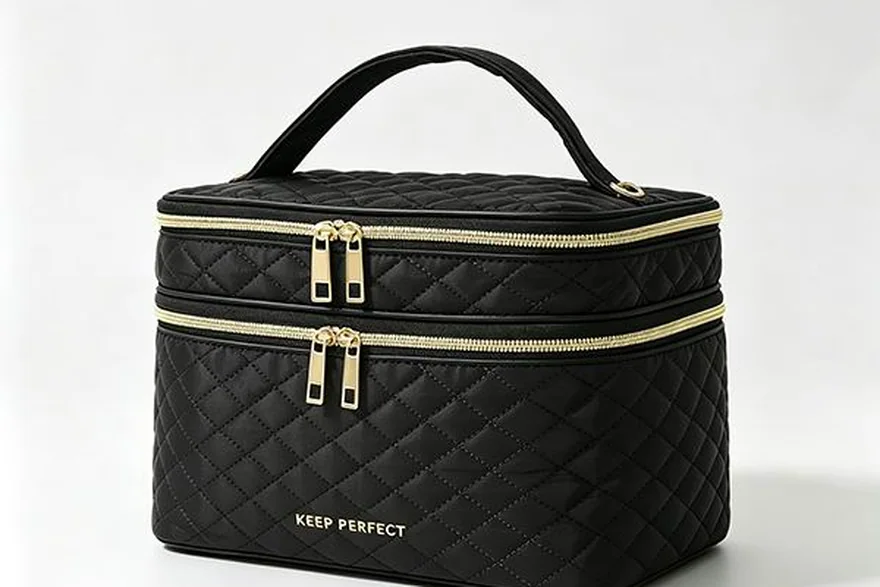
Format choice for long-term travel is a decision about where the kit lives. In a shared bathroom with one hook and no counter, a hanging kit wins outright. In a serviced apartment with a shelf and a mirror, a standing kit is easier to use. Because a nomad encounters both within a single quarter, hybrid and modular formats have grown in the category, and each carries a different cost and inspection profile.
- Three-panel hanging kit: 600D polyester, folded size 25 x 20 x 8 cm, opens to 68 cm; best where hook space is the only storage.
- Structured standing kit: framed base, 24 x 14 x 12 cm, wipe-clean TPU base; best for serviced apartments and longer stays in one city.
- Hybrid: a removable hanging insert inside a standing shell, two bodies in one SKU; highest unit cost, strongest reviews.
- Roll-up: four to six sleeves, 32 x 22 cm rolled; lightest at 260-320 g, weakest on bottle containment.
- Modular set: three pouches for liquids, dry goods and tools, sold as one unit; simplest to inspect and easiest to expand.
The hybrid format illustrates the trade-off clearly. It needs two sewn bodies, a hook assembly on the insert and a structured base on the shell, which puts component count near twenty and pushes sampling into the 12-15 working day bracket for complex constructions. It also produces the highest satisfaction in field feedback, because the traveller unzips the shell on a shelf and hangs the insert when the bathroom offers nothing else. For a brand selling into the nomad channel at a premium price point, that trade is usually worth taking.
Modular sets suit a different buyer. Three pouches sharing one fabric, one zip gauge and one hardware finish can be developed as a single specification with three cutting patterns, which keeps the tooling common and lets a brand expand the system later by adding a fourth pouch without new development. For an e-commerce seller the set also photographs well as a flat lay and reads as a considered system rather than as a single bag. The risk is that three pouches at 500 pieces each means three colourway commitments unless the pouches share one colourway.
Whichever format is chosen, the hook geometry should be settled at the sample stage. A hook that folds flat against the body protects the shell in transit but adds a pivot that becomes the wear point; a fixed hook is cheaper and stronger but snags on clothing inside a backpack. Where the hook folds, the pivot should be metal rather than moulded nylon, and the sample should be cycled 500 times before approval rather than inspected once. Where the hook is fixed rather than folding, a webbing loop at the opposite end gives the bag a second hanging point and costs almost nothing in either material or process time.
Weight is the quiet differentiator between formats. A three-panel hanging kit in 600D polyester weighs 320-420 g empty, a structured standing kit with a framed base weighs 480-620 g, and a roll-up with six sleeves weighs 260-320 g. For a traveller carrying one bag inside a backpack, the difference between the standing kit and the roll-up is noticeable over a long trip, which explains why the lightest format keeps its audience despite offering the weakest bottle containment.
Compliance, materials and wear testing
Nomad kits are wet-environment products, so coated and laminated fabrics dominate. Those fabrics should be evaluated against the coated-fabric test methods in ASTM D751, which covers adhesion, hydrostatic resistance and low-temperature flexibility, all of which matter for a bag used in air-conditioned rooms and tropical showers within the same week. A lining that passes adhesion at room temperature can delaminate after a month of daily wet-dry cycling, so the test should be run on aged as well as fresh material.
| Test | Reference | Pass target for a nomad kit | Why it matters in long-term use |
|---|---|---|---|
| Coating adhesion and hydrostatic head | ASTM D751 | 1,000 mm water column, no delamination after ageing | Prevents wicking through a wet base |
| Colour fastness to water | ISO 105 series | Grade 4 or better | Stops dye bleeding onto light bathroom surfaces |
| Moisture and odour resistance | AATCC test methods | No growth after a stated incubation period | Ten days of damp use is the realistic exposure |
| Zip cycling | ASTM D2053 terminology | 5,000 open-close cycles, slider corrosion-free | Coastal humidity seizes untreated sliders |
| Hook static load | In-house rig | 3 kg for 24 hours, no permanent set | The hook carries the kit every day of the trip |
| Restricted substances in coated fabric | EU REACH | SVHC declaration from the fabric mill | Required for EU and UK retail channels |
Chemical compliance is not optional for this channel. Coated fabrics, TPU laminates and water-repellent finishes are the components most likely to carry substances of concern, so buyers selling into the EU or UK should obtain a declaration against EU REACH from the fabric mill, and the shell and lining should carry an OEKO-TEX Standard 100 certificate naming the supplier. Because a wet bag sits against skin and against towels, this is a higher-scrutiny category than a dry pouch.
- Request test reports from the fabric mill, not from the bag programme, and check that the report date is current.
- Run the zip cycle test on the finished bag rather than on the tape, since slider finish is the variable that fails.
- Age one sample through ten wet-dry cycles before approval; adhesion failures appear there and nowhere else.
Sampling should be treated as part of compliance rather than as a design step. One production-made sample should be put through ten wet-dry cycles before approval, since that is where coating adhesion, seam sealing and slider corrosion all show up together.
Inspection closes the programme. A lot of hanging kits inspected to AQL 2.5 under ISO 2859-1 draws 50 pieces from a 500-piece run with 3 major defects accepted and 4 rejected. For this product class the defect list should add hook rivet security, seam sealing continuity and mesh panel placement to the usual stitching and alignment checks, because those are the faults that generate returns from a traveller three months into a trip. Shipment is FOB Xiamen and payment T/T with 30 deposit and 70 against bill of lading.
The B2B Customisation View
Development of makeup bags and toiletry bags is a sequence of small approvals, and each approval is cheaper than the rework it prevents.
The numbers a buyer can plan around: 500 pieces minimum per style and colourway, 6–10 working days to a first sample (12–15 where tooling or moulding is involved), 35–50 days to bulk completion, AQL 2.5 under ISO 2859-1 at final inspection, FOB Xiamen terms, T/T 30/70 payment.
As the programme coordinator, QUANZHOU JUNYUAN BAGS owns the sample history, which is what makes a repeat order of makeup bags and toiletry bags look like the original rather than a near-miss.
Which Brand Types Benefit Most
Travel accessory start-ups are the natural buyers of nomad kits, because the format lets a young brand sell a considered product without developing a full luggage range. A single hanging kit at 500 pieces per style and colourway is a realistic first commitment, and the specification is narrow enough that one round of sampling at 6-10 working days, or 12-15 where a welded pocket is involved, usually settles it. The trap is over-featuring: a first kit with a moulded hook, a welded pocket, a mesh panel and a removable insert can push sampling into the complex bracket and bulk toward 50 days, which is late for a season.
Established luggage and outdoor brands approach the same product as a range extension and care less about unit cost than about family consistency: the kit must share the hardware finish, the webbing width and the zip gauge of the existing line, and it must survive the same warranty period. Their usual move is a documented component standard applied across two or three sizes, so one specification covers a 25 cm hanging kit and a 32 cm roll-up. Retailers and e-commerce sellers favour modular sets, since three pouches sell as a system, ship as one parcel and generate a higher basket value than a single bag.
Gift, hospitality and coliving buyers use nomad kits as a long-stay amenity: a hanging wash bag placed in a serviced apartment or a coliving unit for a resident staying 30 days or more. Their priorities differ again, with laundering and replacement cycles mattering more than hardware finish, and a neutral shell carrying a discreet mark preferred over a branded pattern. Across all five buyer types the decision converges on the same three items: hook rating, bottle containment and lining drying time. Their care requirements, particularly drying time and wipe-clean surfaces, belong on the amenity card as much as in the specification.
Frequently Asked Questions
What hook load rating should a long-term travel toiletry bag carry?
Ask for 3 kg static load held for 24 hours with no permanent set, and 10,000 open-close cycles on the hook pivot. A 30-day kit loads to 1.2-2.2 kg, well above a weekend kit, and a hook rated for 0.9 kg can shear at the root rivet within weeks. Where the hook folds, specify a metal pivot rather than moulded nylon.
How is a leak-proof bottle pocket built in a hanging wash bag?
By welding rather than sewing. A TPU-laminated pocket with radio-frequency welded seams has no needle perforations, whereas a sewn pocket in the same fabric leaks through the stitch holes however tight the seam is. Pocket depth should clear a 100 ml bottle at 12-14 cm plus 2 cm, and the pocket should sit outside the main compartment. A welded pocket also holds its shape under a full kit, which a soft sewn pocket does not.
Which lining dries fast enough for daily use in a humid bathroom?
A 150D polyester lining with a wicking finish, specified to dry in under four hours at 25 °C and 60 per cent relative humidity. Heavier linings and cotton blends stay damp, and a bag repacked wet grows odour within about ten days. Pair the lining with a mesh panel over 20-25 per cent of one side wall, placed in the upper third.
Why do zips seize on toiletry bags used in coastal destinations?
Salt-laden humid air corrodes untreated slider bodies, and the slider is the first component to stiffen. Specifying a #5 nylon coil zip with a corrosion-resistant slider finish and testing to 5,000 cycles on the finished bag prevents it. Testing the tape alone is not enough, because slider finish is the variable that fails in service. Rinsing the slider in fresh water at the end of a coastal stay is the most useful piece of care advice a brand can print.
What is the loaded weight of a 30-day digital nomad toiletry kit?
Typically 1.2-2.2 kg, depending on whether full-size bottles or decanted 100 ml bottles are carried. Decanting cuts roughly 0.4 kg and brings the kit inside airline liquids limits. The hook, the hanging panel seam and the webbing reinforcement should all be rated against the upper figure rather than the average. Weighing a loaded kit during sampling is worth doing, because that figure is what the hook rating has to beat.
How does the 500-piece minimum apply to a three-pouch modular set?
The minimum is 500 pieces per style and colourway, so three distinct pouches in one colourway is three commitments unless the set is treated as one style with three components. Most buyers development-manage this as a single specification with three cutting patterns and order 500 of each in a shared colourway, which keeps tooling common. Pouches that differ in construction rather than only in pattern are treated as separate styles.
How long does sampling take for a hanging kit with a welded pocket?
Allow 12-15 working days where a welded pocket, a moulded hook or a custom insert is involved, and 6-10 working days for a kit built from stock components. The welding fixture and the hook tooling drive the longer figure. Buyers should cycle the sample hook 500 times before approval rather than approve on a visual check. Using an existing pocket design and a stock hook usually brings the window back to the shorter bracket.
What bulk window should a nomad toiletry programme plan for?
Plan 35-50 days after sample approval. Towards 50 days where welded pockets, moulded hooks or certified coated fabrics with mill lead time are involved. Freight planning should start at golden-sample sign-off, and the carton count should be set by the folded height of the hanging panel rather than by a round number. Any item needing a new fixture or a certified fabric with mill lead time should be assumed to land at the upper end.
Which coated fabric tests matter for a wet-environment wash bag?
The coated-fabric methods in ASTM D751 cover coating adhesion, hydrostatic resistance and low-temperature flexibility. Ask for 1,000 mm water column with no delamination after ageing. A laminate that passes adhesion when fresh can delaminate after a month of daily wet-dry cycling, so insist on testing aged material as well as new. Adhesion after ageing is the test that predicts delamination in service, so it should never be dropped to save time.
Do nomad toiletry bags need chemical compliance documentation?
Yes. Coated fabrics, TPU laminates and water-repellent finishes are the components most likely to carry substances of concern. Buyers selling into the EU or UK should obtain a REACH declaration from the fabric mill, and shell and lining should carry an OEKO-TEX Standard 100 certificate naming the supplier rather than the finished bag programme. A wet bag sits against skin and towels for hours, which is why this category draws more scrutiny than a dry pouch.
How much mesh area does a wash bag need to dry overnight?
Around 20-25 per cent of one side wall, positioned in the upper third so it is not blocked when the bag stands on a counter. Below 15 per cent the airflow gain is negligible. A mesh panel at the base is worse than none, because it wicks water inward from a wet surface into the lining and the base foam.
What does AQL 2.5 sampling look like on a 500-piece hanging kit run?
Under ISO 2859-1 at AQL 2.5, a 500-piece lot draws 50 pieces with 3 major defects accepted and 4 rejected. For hanging kits the defect list should add hook rivet security, seam sealing continuity and mesh placement to the standard stitching and alignment checks, since those faults surface months into a trip. Those three additions are what separate a wash bag inspection from a generic bag inspection.
Should a nomad kit be hanging, standing or hybrid?
Hanging where bathrooms offer only a hook, standing where a shelf and mirror exist, and hybrid where a traveller meets both within one quarter. Hybrid costs more and takes longer to sample, needing two bodies and a hook assembly, but it produces the strongest field feedback. Modular sets suit sellers who want an expandable system. Buyers unsure of the split usually start with hanging, because a hook-only bathroom is the harder case to design for.
How should bottle volumes be chosen for a travel toiletry kit?
Choose bottle dimensions around the limits travellers actually face, then size the pocket to the bottle. In the US channel the 3-1-1 liquids rule sets the practical container volume, so buyers should read the current TSA wording before fixing pocket depth. A pocket sized to a 12-14 cm tall bottle with 2 cm of spare depth covers most compliant bottles.
What causes mildew odour in a toiletry bag used abroad?
A lining packed damp combined with insufficient airflow. Odour typically develops within ten days of continuous damp use. The fix is specification, not deodorising: a 150D quick-dry polyester lining, a mesh panel over at least 20 per cent of one wall, and a non-wicking base so water does not sit in the base foam. Airflow inside a closed suitcase is nil, so a bag must be dry before it is packed away.
How is a nomad toiletry programme shipped and paid for?
Shipment is FOB Xiamen, meaning the goods and their delivery onto the vessel at Xiamen are covered, while freight, insurance, duty and onward carriage sit with the buyer. Payment is T/T with 30 deposit and 70 against bill of lading. Unit price is driven mainly by coated fabric grade, hook assembly type and welded-pocket content. Coastal humidity in transit is a further reason to keep cartons dry and lined rather than tightly sealed.
People Also Ask
What makes a toiletry bag suitable for long-term travel?
A hook rated to carry the full loaded kit, a welded bottle pocket that isolates leaks, a lining that dries within hours, and a corrosion-resistant zip. Long-term travel means eight to twelve bathroom changes a quarter and humidity above 80 per cent, so components must be rated by cycle count rather than chosen for appearance. Rated components, not technical looks, are what separate a genuine long-term kit from a weekend bag with a hook.
Do digital nomads prefer hanging or standing wash bags?
Hanging bags in shared bathrooms, standing bags where a shelf exists, and hybrid designs that do both when the traveller moves between accommodation types. The deciding factor is hook availability, not personal preference, which is why hybrid kits rate well despite costing more and taking longer to sample. Hybrid designs remove the guesswork by doing both, at the cost of a higher unit price and a longer sampling window.
How heavy is a toiletry kit for a 90-day trip?
Between 1.2 and 2.2 kg loaded, with decanted 100 ml bottles cutting roughly 0.4 kg from the heavier end. The hook and the hanging panel reinforcement should be rated against the upper figure. A weekend kit loads to 0.6-0.9 kg, which is why weekend hardware fails under nomad use. Weighing the loaded kit at sample stage gives the number the hook rating has to beat.
Can a toiletry bag be machine washed?
Most coated-fabric and welded-seam bags should be wiped or hand rinsed rather than machine washed, since agitation degrades coating adhesion and a machine cycle can exceed the temperature the laminate was bonded at. Where laundering matters, specify a removable lining and confirm the coated fabric against ASTM D751 after ageing. Hand rinsing and air drying with the bag open is the safe routine for welded and coated builds.
Request a Sample or a Written Quotation
Send the silhouette, dimensions, material preference and logo artwork, and the programme team will return a written quotation with MOQ, sampling window, bulk lead time and inspection standard.
Email: [email protected] · WhatsApp: +86 177 5002 0688