Travel Jewelry & Cosmetic Combo Bags: Dual-Use Design
Executive Summary
A travel jewellery and cosmetic combo bag works when the two halves are genuinely separated rather than merely adjacent. Reliable dual-use cases place a rigid 1.5-2.5 mm divider between the cosmetics zone and the jewellery zone, limit closed height to about 6-7 cm so the case drops into a hotel safe, and hold metals either against a covered ring bar or in individually backed earring slots rather than loose in a mesh pocket.
The trade-offs are measurable. A zoned flat case at roughly 24 x 17 x 6 cm carries six to ten rings, six earring pairs and three necklaces alongside 1.2-1.8 litres of cosmetics, weighs 260-420 g empty and lands between $3.60 and $9.80 per unit. Programme terms do not vary: 500 pieces per style and colourway, 6-10 working days sampling for simple sewn cases and 12-15 days once a mirror, hooks or a ring bar are included, then 35-50 days bulk production.
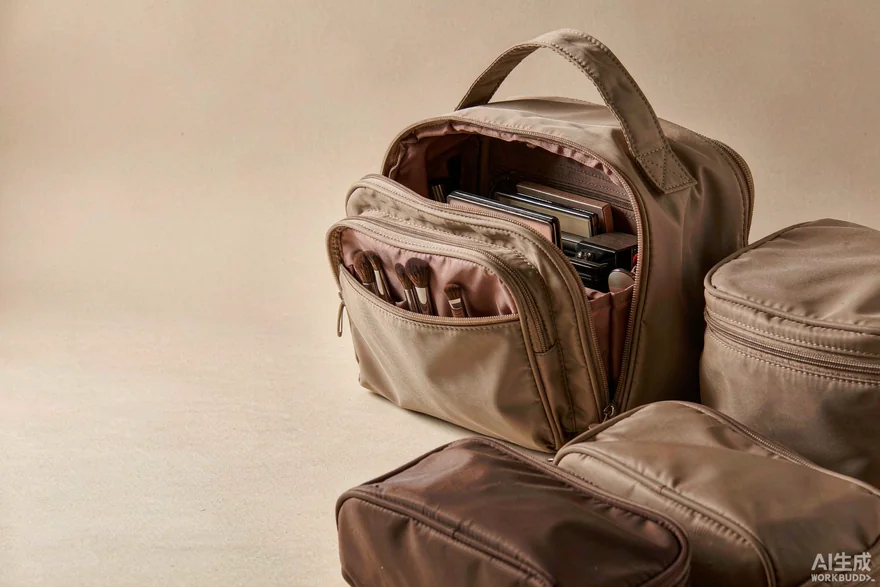
Why One Case Now Serves Jewellery and Cosmetics
Two things pushed this category together: travellers are packing into fewer bags, and hotel rooms offer one small safe rather than a vanity with drawers. Jewellery is small but delicate, cosmetics are bulky but forgiving, and a combined case lets the traveller lift a single object into the safe rather than three. For a brand selling it, the dual-use case is also a higher-value gift set than either component sold alone, which is why it appears in bridal travel, honeymoon and premium beauty gifting more than in everyday mass retail.
- Packing discipline: one case replaces a separate jewellery roll and a cosmetic pouch, saving roughly 0.8-1.4 litres of suitcase space.
- Security habits: valuable pieces stay in one object that can be lifted into a hotel safe each morning rather than left out.
- Gift economics: a combined case carries a higher perceived value than either component, supporting $24.95-$59.95 retail.
- Routine fit: jewellery is removed last and put on first, so storing it beside cosmetics matches the order of an evening routine.
- Photography: an open dual case fills more of a listing image, which suits marketplace and social creative.
The design difficulty is that the two categories want opposing interior properties. Cosmetics need a wipe-clean face that tolerates foundation, cream and occasional leakage; jewellery needs a soft, non-abrasive surface that does not scratch plating and does not shed lint onto chains. Putting both in one cavity produces a design that does neither job well, so every credible dual-use case partitions its interior and uses different linings on either side of the partition.
Many hotel safes accept a box around 25 x 35 x 15 cm, but travellers also stack other valuables. Keeping a combo case below about 7 cm closed height is what lets it go into the safe rather than stay in the room, and that single dimension constrains every component choice that follows.
Five Layout Archetypes Compared
Layouts differ in how they solve the partition problem, and the right choice depends on whether cosmetics or jewellery is the dominant content. Buyers should select the layout before specifying components, because the most expensive parts of a combo case — ring bar, earring panel, necklace hooks, mirror — only fit certain footprints. Approving components first and then looking for a shell that holds them is the main source of late redesign in this category.
| Layout archetype | Closed size and volume | Jewellery capacity | Cosmetic capacity | Unit cost band (USD) | Best channel |
|---|---|---|---|---|---|
| Zoned flat case | 24 x 17 x 6 cm, 1.6-1.9 litres | 6-10 rings, 6 earring pairs, 3 necklaces | 1.2-1.4 litres on the second panel | $3.60-$6.20 | Mass retail and marketplace gift sets |
| Wrap-around folder | 22 x 15 x 5 cm, 1.3-1.5 litres | 4-8 rings, 4 earring pairs, 2 necklaces | 0.7-0.9 litres in two flap pockets | $4.10-$7.40 | Premium beauty and bridal gifting |
| Case with detachable mini pouch | 26 x 18 x 7 cm, 2.2-2.6 litres | 8-12 rings, 8 earring pairs, 4 necklaces | Detachable pouch for daily cosmetics | $5.80-$9.80 | Specialty retail and subscription boxes |
| Hanging dual case | 28 x 20 x 8 cm folded, 2.6-3.0 litres | 10-14 rings, 10 earring pairs, 5 necklaces | 1.4-1.8 litres with upright slots | $6.40-$11.20 | Luxury gifting, longer trips |
| Roll with removable jewellery mat | 32 x 22 cm flat, about 1.8 litres rolled | 6-10 rings, 6 earring pairs | Mat lifts out for evening use | $3.20-$5.60 | Travel accessories and promotional gifting |
The two most expensive rows earn their price differently. The detachable mini pouch costs about $1.40-$2.60 extra but solves a real behavioural problem, because travellers remove cosmetics several times a day and jewellery once, so letting the cosmetic half detach keeps heavy daily handling away from the jewellery compartment. The hanging case adds hardware and a swivel hook at around $0.55-$1.30, which is only justified where the itinerary is long enough for the case to be unpacked and hung for several days rather than lifted in and out of a suitcase.
Volume figures deserve a caution about how they are derived. A dual case loses more to internal structure than either component does alone: partition boards, ring bars and earring panels typically consume 18-28% of geometric volume, so a case measuring 24 x 17 x 6 cm delivers nearer 1.6 litres of packable space than the 2.4 litres the multiplication suggests. Buyers who specify in litres without stating whether the figure includes structure will receive samples that measure correctly and pack short by about a quarter.
Pricing architecture follows the layout. Across the category, unit prices sit within the broad $0.45-$12.00 band typical of cosmetic and toiletry bags, and the dual-use variants cluster in its upper half because hardware and multiple linings add operations. A sensible gift ladder runs from a roll at about $3.20 to a hanging case at $11.20, with each step delivering a visible construction difference — mat removable, pouch detachable, then hanging — rather than size alone.
Decide the ring bar width, earring panel, necklace hook count and mirror size first, then choose a footprint those parts fit. Doing it the other way round means either dropping a component or paying for a second tooling round.
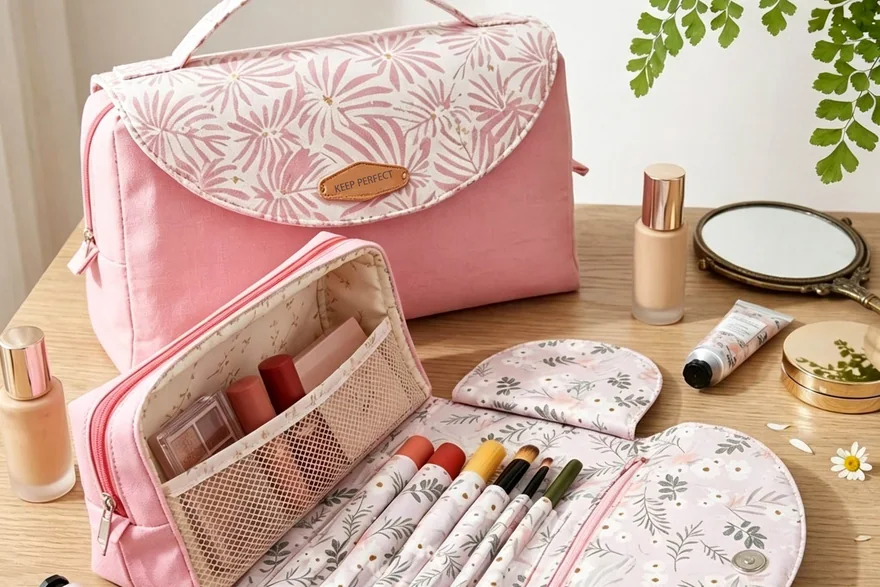
Separation, Tarnish Control and Component Detail
Component specification is where a combo case either earns its price or wastes it. Each jewellery component has a minimum dimension below which function fails: ring slots too shallow let rings fall out when the case is opened flat, earring panels without backing cloth let studs push through, and necklace hooks without nearby retainers allow chains to migrate and knot. The numbers below are working figures that buyers can adjust by a few millimetres but not by much.
- Ring bar: foam roll 8-14 cm long, 2.5-3.5 cm thick, with slots 1.5-2.0 cm deep cut every 1.2-1.6 cm.
- Earring panel: perforated card or felt at 2-3 mm thick with slits of 6-8 mm and a backing cloth behind.
- Necklace panel: two rows of snap tabs or elastic loops set 6-9 cm apart, plus a bottom catch pocket 6-8 cm deep.
- Partition: 1.5-2.5 mm EVA board full-height between zones, welded at the edges so liquids cannot cross.
- Mirror: acrylic 1.5-2.0 mm thick rather than glass, since container pressure and drops shatter glass panels in transit.
- Cosmetics zone: PU-faced lining rated around 200 cleaning cycles, with a welded rather than sewn seam at the base.
- Closure: two independent pulls so either zone opens without exposing the other, each specified by chain size and slider type.
Tarnish control is mostly about what the lining does not do. Silver darkens in the presence of sulphur compounds, so materials with high sulphur content — natural rubber elastic, some wool felts, certain foams and latex-based adhesives — should be excluded from the jewellery side even though they are cheap and pleasant to handle. Anti-tarnish treatments exist and some interlinings incorporate activated carbon, but those claims need documentation and should be verified before being printed on packaging.
| Jewellery-side lining option | Abrasion risk to plating | Sulphur behaviour | Unit cost effect (USD) | Recommended use |
|---|---|---|---|---|
| Brushed polyester velour | Low, no loose pile | Inert; stable over 24 months | +$0.18-$0.34 | Rings, chains, watches |
| Suedette or microsuede | Low with a short nap | Depends on backing; test first | +$0.22-$0.45 | Premium gift sets |
| Untreated wool felt | Moderate; sheds lint | Higher sulphur content | +$0.10-$0.20 | Avoid next to silver |
| Anti-tarnish treated cloth | Low | Actively absorbs sulphur | +$0.55-$1.10 | Silver-heavy assortments |
| Natural rubber-backed mesh | Moderate abrading edge | Rubber releases sulphur | +$0.08-$0.16 | Not recommended |
Cross-contamination is the remaining risk, and it runs one way. A leaking foundation bottle or a heated aerosol can ruin plated metal, whereas jewellery rarely damages cosmetics, so the physical partition should sit on the cosmetics side of any possible leak path and should be welded rather than stitched along the base seam. Where an aerosol or liquid above 100 ml may travel in the cosmetics zone, the whole case belongs in checked luggage, which conflicts with standard advice never to check valuables; that tension is worth stating plainly in any accompanying care card.
Finally, plan how the case closes. Magnetic closures are popular but they can affect hotel key cards and should not sit directly against magnetic clasps on necklaces, and a strong magnet near a watch movement is a bad idea. Two independent zipper pulls — one per zone — cost roughly $0.35-$0.75 more than a single long pull and keep either half accessible without exposing the other, which is the behaviour travellers actually report wanting.
Safety, Compliance and Programme Terms for Dual-Use Cases
A combo case contains more distinct materials than a standard pouch: metal hooks or snaps, a foam ring bar, possibly a mirror, two linings, a partition board and several closure components. Any of those can be the weak link in a compliance file, and because the finished item touches skin and may be sold near children's product displays, buyers should ask for component-level documentation rather than a finished-goods statement alone.
- Request restricted-substance documentation covering all metal components, foam, adhesives and printed inks, refreshed whenever a sub-supplier changes.
- Ask for tested-harmful-substance certification on every textile layer, including the felt behind earring panels and the jewellery-side lining.
- Specify nickel release behaviour for all metal parts in prolonged skin contact, since earring panels and snap tabs sit against skin in use.
- Keep mirror material acrylic at 1.5-2.0 mm, and require protective film on both faces through assembly and carton packing.
- Weld the cosmetics-side base seam rather than stitching it, so leakage cannot migrate along a needle hole into the jewellery zone.
- Require a simple pull-test result for hook retention, typically a 25-30 N pull applied five times without detachment or tearing.
Textile certification is easiest to organise when requested as a scope list rather than as a single certificate. The OEKO-TEX Standard 100 framework covers tested harmful substances across textile components, and a dual case should list fabric, foam, thread, elastic and any coating so that replacing one trim supplier mid-programme does not silently void the file. Restricted substance obligations under EU REACH sit alongside it and apply to metal and plastic components as well.
Inspection needs its own defect list. Finished lots are inspected at AQL 2.5 under the sampling tables in ISO 2859-1 sampling procedures, but the tables do not define what counts as a defect, so the list should specify allowable hook pull force, acceptable acrylic scratch length, maximum ring bar compression set and tolerance on earring slit spacing. Without those, an inspector applying general appearance criteria will pass cases that fail in use.
Commercial terms follow the usual pattern across this family. Minimum order is 500 pieces per style and colourway, which matters here because two-tone combos with contrasting halves count as a second colourway when both halves change colour; keeping one half constant collapses the requirement into a single line. Sampling runs 6-10 working days for simple sewn cases and 12-15 working days once the construction includes a mirror, hooks, a ring bar or moulded components, then bulk production takes 35-50 days after approval. Shipment is FOB Xiamen, payment T/T 30% deposit and 70% against bill of lading.
Carton planning closes the loop. A 24 x 17 x 6 cm case typically packs 40-60 units per 60 x 40 x 40 cm export carton when each unit is individually bagged and protected with corner padding; without padding, mirror faces scuff against neighbouring hardware. Where a mirror is included, add a 2 mm foam sheet between stacks, which costs about $0.05-$0.09 per unit and removes the most common cosmetic reject found at destination inspection.
The B2B Customisation View
Programme planning for cosmetic bags starts with the end market: a hotel amenity run and a beauty-retail launch ask for completely different construction and compliance evidence.
Planning figures used across the programme: MOQ 500 pieces per style and colourway, 6–10 working days sampling (12–15 when moulding or multi-layer lamination is required), 35–50 days bulk lead time, AQL 2.5 to ISO 2859-1, FOB Xiamen, T/T 30/70.
The programme-management model exists because most import problems are documentation problems, and documentation is what this office produces and holds.
Which Brand Types Benefit Most
Buyer types approach this category from different margins. A start-up brand looking for a differentiated first product should take the roll with a removable jewellery mat at $3.20-$5.60, because it uses no metal hardware, samples in 6-10 working days and still tells a dual-use story in listing photography. An established beauty brand adding a travel SKU usually already sells jewellery pouches or cosmetic cases separately, so a zoned flat case lets it consolidate two lines into one higher-priced item at $3.60-$6.20 while reusing existing artwork across both panels. A retailer building a gift wall should ladder the assortment with three visible steps rather than three sizes, because construction differences read across a shelf where a 1 cm change in width does not. Event and bridal gift buyers should plan eight to ten weeks ahead of the date, since a hanging case with embroidered initials sits in the 12-15 working day sampling bracket before freight is even considered. Across all five buyer types the same three checks decide whether a dual design holds up: whether the divider is welded rather than stitched, whether either half can be opened without exposing the other, and whether the closed height stays low enough to reach a hotel safe.
- Start-up brands: removable mat roll, no hardware, one colourway at 500 pieces, with felt rather than foam components to keep costs predictable.
- Established brands: zoned flat case reusing current art assets, with matched hardware across the rest of the travel range.
- Retailers: a three-step ladder from roll to detachable-pouch case displayed together, so the price story is told by construction.
- E-commerce sellers: open-flat photography first, with the jewellery zone arranged to show mixed product not yet owned by the shopper.
- Bridal and hospitality gift buyers: hanging case at $6.40-$11.20 with embroidered initials, planned eight to ten weeks ahead of the event date.
Frequently Asked Questions
How deep should slots on a travel ring bar be?
Slots 1.5-2.0 cm deep, cut every 1.2-1.6 cm along a foam roll 2.5-3.5 cm thick, suit most ring sizes including wide statement bands. Shallower than 1.2 cm and rings lift out when the case is opened flat; deeper than 2.2 cm and the foam loses support at the slot walls. Memory retention should recover within five seconds of compression after 500 cycles.
How many necklace hooks can one panel hold before chains tangle?
Three to five on a standard 24 x 17 cm case, set 6-9 cm apart in two staggered rows, each with a bottom catch pocket 6-8 cm deep. Beyond five necklaces on one panel the probability of migration rises sharply, because the free length of chain exceeds the panel height and any slack travels during transit rather than staying put.
Should the mirror be acrylic or glass in a travel combo case?
Acrylic at 1.5-2.0 mm thick is safer for travel. Glass gives better optical quality but shatters under container pressure and drops, leaving fragments inside a case holding cosmetics. Specify protective film on both faces through assembly, add a 2 mm foam sheet between carton stacks at about $0.05-$0.09 per unit, and set a maximum allowable scratch length on the inspection defect list.
Why does the divider between the two zones have to be rigid?
Because leakage travels. A soft fabric panel lets a leaking bottle migrate into the jewellery side within hours, and plated metal does not recover from contact with foundation or cream. A full-height 1.5-2.5 mm EVA board with welded edges blocks that path; stitching along the base seam defeats it, because needle holes carry liquid through even when the seam looks tight.
What closed height lets a combo case fit inside a hotel safe?
Below about 7 cm, ideally 6-6.5 cm. Hotel safes vary widely, but interiors around 25 x 35 x 15 cm are common and travellers usually share the space with a passport and a phone. Keeping total height near 6 cm also keeps the case under roughly 420 g empty, which matters when the whole point of the product is carrying valuables in cabin baggage.
Which lining slows silver tarnishing inside a travel case?
Brushed polyester velour is a good passive choice, since it is inert and stable over 24 months at roughly $0.18-$0.34 extra per unit. Actively treated anti-tarnish cloth absorbs sulphur compounds and costs $0.55-$1.10 extra, but the claim should be documented before it appears on packaging. Avoid natural-rubber-backed mesh and untreated wool felt next to silver.
Can stud earrings be stored loose in a mesh pocket instead of a panel?
Not recommended. Loose studs lose their butterfly backs, scratch against each other, and can push through coarse mesh. A perforated card or felt panel 2-3 mm thick with 6-8 mm slits and a backing cloth behind costs about $0.22-$0.45 per unit and keeps pairs together. For large hoop earrings, an elastic loop rather than a slit holds shape better.
How much does a custom dual-use travel case cost per unit?
Typical figures are $3.20-$5.60 for a roll with a removable jewellery mat, $3.60-$6.20 for a zoned flat case, $4.10-$7.40 for a wrap folder, $5.80-$9.80 for a case with a detachable pouch and $6.40-$11.20 for a hanging case. Each figure assumes 500 pieces per style and colourway, plus $0.18-$1.10 depending on whether anti-tarnish lining is specified.
How much should a loaded combo case weigh for cabin baggage?
Plan for 260-420 g empty and 900-1,400 g loaded. Above about 450 g empty the case itself starts competing with its contents for allowance, and travellers begin leaving it behind. Weight comes mainly from partitions, foam components and hardware, so a second foam panel should be justified by jewellery capacity rather than added for feel alone.
Are magnetic closures safe near jewellery and hotel key cards?
They need care. Strong magnets can affect hotel key cards placed on top of the case and can pull on magnetic necklace clasps, so they should sit away from the jewellery panel. Two independent zipper pulls cost about $0.35-$0.75 more than a single long pull and remove the concern entirely, while also letting either zone be opened without exposing the other.
What does cream or lotion contact do to plated jewellery?
Contact strips plating faster than air exposure does, because the fatty acids and surfactants in cosmetics accelerate corrosion at any micro-crack in the coating, and residue left where a ring meets skin irritates as well. That is why the jewellery side should never share a cavity with liquids, and why care cards should advise putting jewellery on after skincare and cosmetics rather than before.
How does the 500-piece minimum work on a two-tone case?
Minimums apply per style and colourway, so a case whose two halves both change colour counts as two colourways and needs 500 pieces each. Keeping one half constant — usually the cosmetics side — collapses the requirement into a single 500-piece line. Seasonal colour stories generally run this way, varying only the jewellery panel and trim rather than the whole shell.
How long does sampling take for a combo case with hardware?
Twelve to fifteen working days once a construction includes a mirror, necklace hooks, a ring bar or moulded components, against 6-10 working days for a simple sewn case with elastic loops only. Bulk production follows at 35-50 days after approval. Buyers planning bridal or event gifting should allow a further two weeks on top for freight and customs clearance.
What should appear on the inspection defect list for a dual case?
Beyond general appearance, list hook retention at 25-30 N applied five times, acceptable acrylic mirror scratch length, maximum ring bar compression set after repeated compression, and tolerance on earring slit spacing. Standard ISO acceptance numbers cover how many units are checked, not what counts as a defect, so without an explicit list an inspector applying general criteria will pass cases that fail in use.
How are combo cases packed to avoid damage in transit?
Individually bagged, then packed 40-60 units per 60 x 40 x 40 cm export carton for a 24 x 17 x 6 cm case, with corner padding and a 2 mm foam sheet between stacks where a mirror is fitted. Without separation, hardware on one unit scuffs the mirror or face fabric of the next, which accounts for a large share of cosmetic rejects found at destination inspection.
People Also Ask
How do you pack jewellery and makeup together when travelling?
Keep them in separate zones of one case, ideally divided by a rigid board, with jewellery in a panel or ring roll and cosmetics on the other side. Prices of failure are asymmetric: leaking cosmetics ruin plated metal, so the divider should be welded at the base. Choose a case under about 7 cm closed height so the whole thing fits in a hotel safe.
Should jewellery go in carry-on or checked luggage?
Carry-on, always, and ideally inside a case that fits a hotel safe. Checked bags are handled roughly and go missing, and most travel insurance policies treat jewellery differently from general baggage. A case around 24 x 17 x 6 cm and 260-420 g empty keeps valuables with the traveller without competing noticeably for allowance, and it goes into a hotel safe rather than staying in the room.
What stops necklaces tangling in a travel case?
Anchor the clasp end, then lay the chain straight into a catch pocket so free length never exceeds panel height. Two staggered rows of snap tabs set 6-9 cm apart with a 6-8 cm deep pocket below handle three to five necklaces. Threading chains through straws is a home remedy, not a product specification, though the principle of limiting slack is the same.
Do dual-use cases need different linings on each side?
Yes. The cosmetics side needs a PU or TPU face that survives roughly 200 cleaning cycles; the jewellery side needs low-sulphur, non-abrasive cloth such as brushed polyester velour. Using one material for both sacrifices either cleanability or metal care. Cost impact is modest: the premium lining typically adds $0.18-$0.45 depending on whether it is simply inert or actively treated.
Request a Sample or a Written Quotation
Send the silhouette, dimensions, material preference and logo artwork, and the programme team will return a written quotation with MOQ, sampling window, bulk lead time and inspection standard.
Email: [email protected] · WhatsApp: +86 177 5002 0688