Velvet vs Satin Cosmetic Bags: Luxury Material Comparison
Executive Summary
Velvet and satin cosmetic bags both read as luxury, but they fail in different places. Velvet wins on depth of colour and tactile warmth while losing on pile crush, dust attraction and stain visibility. Satin wins on printed detail, wipe-clean faces and packing density while losing on snagging and water spotting. For a gift-led programme that ships flat and is opened once, velvet earns its price. For a retail programme that must survive handling, returns and repeat bathroom use, a satin in the 180-210 g/m² range usually returns more per dollar.
The decision should be made on four measurable axes rather than on swatch appeal: pile recovery after 24-hour compression, dry and wet rub fastness by grade, snag resistance on the filament face, and how many branding methods the shell accepts without a defect. Those four decide the return rate long before the price decides the margin. Commercial planning then fixes the rest: 500 pieces per style and colourway, 6-10 working days for sampling, 12-15 where a quilted or laminated shell is involved, and 35-50 days for bulk after approval. The tables below set out the test thresholds, the branding matrix and the landed-cost differences.
What Velvet and Satin Mean in a Cosmetic Bag Specification
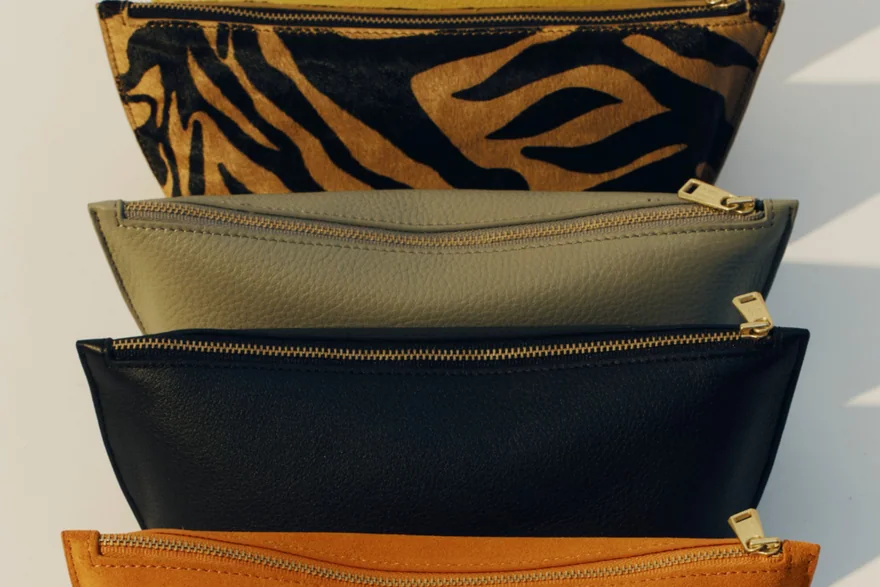
Velvet and satin are usually described as materials, but in a cosmetic bag specification both are constructions. Velvet is a pile fabric: a ground cloth carrying an upright pile, most commonly polyester filament, with pile heights between 0.8 mm and 2.5 mm and finished weights from 180 g/m² to 320 g/m². Satin is a weave: a filament yarn, again usually polyester, floated over four or more warp threads so that light reflects off a long unbroken surface. The practical difference for a buyer is that velvet performance is governed by the pile, and satin performance is governed by the float length and the yarn denier.
Because both are most often polyester, the fibre content line on a care label will read the same, which is why fibre content alone never settles the choice. A 75-denier filament satin charmeuse at 90 g/m² and a 320 g/m² polyester velvet can both be labelled 100% polyester and still behave nothing alike in use, in transit and on the shelf. Buyers comparing samples should ask for construction data instead of fibre data: pile height in millimetres, ground cloth weight, pile composition, float length or harness count, and every finish applied after dyeing.
Three families of velvet appear in cosmetic bag programmes. Plain velvet has a uniform upright pile and shows every handling mark. Crushed velvet is pressed while damp so the pile lies in random directions, which hides planking and fingerprints far better. Stretch velvet carries 3-8% elastane in the ground cloth and is used when the pattern must follow a curved gusset or a rounded vanity shell. Stretch velvet adds cost and complicates cutting, because panels need 24 hours of relaxation before lay-up or the finished bag will shrink after sewing and pull the zip tape into a wave.
Three families of satin matter just as much. Charmeuse, at 70-120 g/m², is the lightest and the most prone to snagging, but it drapes well into a soft pouch. Duchess or bridal satin, at 180-240 g/m², holds shape and is used for structured cases that must stand up on a shelf. A bonded satin adds a 0.15-0.30 mm thermoplastic film to the reverse, which stabilises the face for embroidery but reduces drape and stiffens the folded gusset. Naming the family on the spec sheet, rather than the single word satin, is what prevents a factory substituting a lighter cloth at the same quoted price.
Pile Crush, Rub Fastness and Snagging: The Three Tests That Separate Them
Three failure modes decide whether a luxury fabric survives a cosmetic bag programme: pile crush, colour transfer by rubbing, and snagging. Each has a recognised laboratory method, and each can be written into a specification with a numeric pass threshold instead of a subjective phrase such as good colour fastness. The relevant methods sit under the AATCC test method index for crocking and abrasion, and under the ISO 105 colour fastness series where a European retail buyer requires ISO reporting.
| Test axis | Polyester velvet, 260 g/m² | Filament satin, 90 g/m² | Pass threshold to write into the spec |
|---|---|---|---|
| Pile recovery after 24 h under 2 kg | 78-88%; visible planking on plain pile | Not applicable, no pile | 85% minimum visual recovery, no permanent planking |
| Dry rub fastness, 10 cycles | Grade 4 on light shades, Grade 3-4 on navy and black | Grade 4-5 across most shades | Grade 4 minimum, Grade 4-5 on black, red and deep teal |
| Wet rub fastness | Grade 3-4; pile base holds moisture and releases dye late | Grade 4; moisture beads on the filament face | Grade 3-4 minimum, no dye transfer to the rub cloth |
| Snag resistance, 200 g mace | Pile masks light snags; deep pile shear leaves a bald line | Grade 2-3; one pull draws a ladder along the float | No visible float displacement at Grade 3 |
| Abrasion to end point | 20,000-35,000 Martindale cycles before pile thinning | 12,000-18,000 cycles before face glazing | 20,000 cycles for retail, 12,000 for a gift-only bag |
| Water spotting | Ring marks on plain pile; crushed velvet conceals them | White rings that need a full re-wet to clear | No permanent mark after a 24 h dry-back |
| Dust and lint attraction | High; pile collects fibre in open-shelf retail | Low; filament face releases dust with a wipe | Managed by individual polybag and carton lining |
Pile crush is the failure most buyers discover too late. A velvet pouch folded flat and stacked sixty to a carton carries a standing load on the bottom units for a 35-50 day bulk run plus ocean transit, and beyond the fibre's elastic recovery the panel takes a permanent set and shows a pressed plank line. The test is cheap: compress a folded sample under a 2 kg flat weight for 24 hours at 23 °C, release, and photograph after one hour and after twenty-four. Anything still showing a line at twenty-four hours will arrive at the warehouse already defective.
Rub fastness on velvet behaves differently from a flat fabric because the abrading head contacts the pile tips rather than the full surface. A velvet can score Grade 4 dry and still mark a pale garment, because the pile flexes and exposes the undyed fibre base as it shears. Deep shades are the risk: black, bottle green and burgundy generate the most transfer complaints, and they are the colours most gift programmes specify. Where a deep shade is non-negotiable, require a reduction-cleared dye lot and a Grade 4-5 wet result, not merely a dry one.
Snagging is the satin failure, and it is structural rather than chemical. A satin weave gains its sheen from long floats; the longer the float, the brighter the face and the easier it is to draw a thread. A 5-harness satin at 75 denier brightens a shelf display and then ladders the first time a ring or a zipper pull crosses it. The fix is a higher yarn count at a shorter float, or a 180 g/m² duchess, rather than a finish applied to a charmeuse.
- Write pile recovery as a percentage after a 24-hour 2 kg compression, not as an adjective.
- Require both dry and wet rub grades; a velvet that passes dry can still fail wet on deep shades.
- A satin brighter than the sample book is usually a longer float, which means lower snag resistance.
- Crushed velvet conceals transit marks that plain velvet will show, at no fabric cost difference.
- File the laboratory report with the sample approval so the bulk dye lot can be matched against it.
Printing, Embroidery and Branding on Pile Versus on a Flat Face
Branding is where the two fabrics diverge most sharply, because a pile surface and a flat filament surface respond to heat, pressure and needle penetration in opposite ways. A method that produces a crisp edge on satin can crush a velvet panel into a permanent matte patch, and a method that disappears into a velvet pile can sit on satin as a stiff plastic plate. The matrix below reflects what actually happens at production speed, not what happens on a hand-pressed sample.
| Branding method | Result on velvet | Result on satin | Instruction for the spec sheet |
|---|---|---|---|
| Plastisol screen print | Sits on the pile tips, edge feathers, platen pressure flattens the pile around the logo | Crisp edge, good opacity, but a heavy deposit stiffens a 90 g/m² face | Limit deposit to 0.15 mm; require a post-print crush test on velvet panels |
| Heat transfer, 150 °C, 12 s | Heat relaxes the pile and leaves a permanent glossy halo | Reliable, sharp, good colour range | For velvet, drop to 130 °C and 8 s and press through a silicone sheet |
| Dye sublimation | Poor; pile scatters the image and deep shades lose saturation | Excellent on polyester satin, photo-grade detail, no hand feel | Sublimation is the satin route for full-colour artwork |
| Foil hot-stamp | Good on crushed velvet, patchy on plain pile where contact is uneven | Very good; clean metallic edge on a flat face | Specify a 0.5 mm relief allowance and a test strike on the actual dye lot |
| Direct embroidery | Pile swallows the stitch; low satin-stitch coverage reads as noise | Needle holes are permanent and a dense fill puckers a light charmeuse | Use a 30 g/m² cut-away backing and cap stitch density at 0.4 mm spacing |
| Embossed or debossed logo | Reads well; pressure sets the pile permanently | Weak; the face springs back within 48 hours | Embossing is a velvet method only |
| Woven label | Standard; a folded label sits proud of the pile | Standard; a flat label avoids print-through on light shades | Use a flat-fold label on satin, a folded label on velvet |
| Metal badge with prongs | Prongs catch pile during laundering | Prongs leave permanent holes in a float structure | Prefer a riveted badge with a backing washer on both fabrics |
The platen problem on velvet is worth stating plainly. A screen print press applies several kilograms of pressure across the whole panel for the dwell time of the print. On a flat fabric that pressure is invisible; on a 2 mm pile it permanently sets the fibre where the platen lands, so the printed panel arrives with a matte rectangle around the logo and a glossy pile everywhere else. The fix is not a lighter press but a lower-temperature transfer applied through a silicone sheet, which distributes pressure without flattening the surrounding fibre.
Needle penetration is the equivalent satin problem. Every needle hole in a woven filament face is permanent; the fabric cannot close around the thread the way a spun yarn can, and a dense embroidered fill on a 90 g/m² charmeuse will pucker the panel into a shallow dome. The remedy is a cut-away stabiliser and a cap on stitch density, which raises unit cost by a few cents and removes the most common visual defect on satin cosmetic bags. Where budget rules out embroidery, a woven label sewn into the side seam gives the brand mark with two needle lines instead of ten thousand.
On both fabrics, keep artwork at least 12 mm clear of the zip tape stitch line. A logo closer than that distorts as the tape passes under the presser foot, and on velvet the pile is dragged into the stitch, producing a bald line parallel to the closure that no steam will lift.
Landed Cost, Packing Density and Programme Fit
Fabric cost is a small part of the landed difference between the two routes. The larger drivers are sewing minutes, carton density, transit damage and the return rate once the bag is in a bathroom. A velvet shell costs more per metre and takes longer on the machine, but it also compresses, which means more units per carton. A satin shell is cheaper and faster, yet it needs individual protection and it generates a different class of complaint. Reading all four together is what makes the comparison honest.
| Commercial factor | Velvet programme | Satin programme | Planning consequence |
|---|---|---|---|
| Shell fabric weight | 180-320 g/m² | 70-240 g/m² | Weight drives both cost and the lining weight required beneath it |
| Cut and sew, minutes per unit | 4.5-7.0 min on a soft pouch | 3.0-4.5 min on a soft pouch | Multiply the delta by the run size before comparing fabric quotes |
| Units per 60 x 40 x 40 cm carton | 120-160 flat packed | 90-120 flat packed with tissue interleaving | Satin needs interleaving; velvet needs a lower stack height |
| Transit crush risk | High on plain pile, low on crushed | Low; creasing is the risk, not crush | Crushed velvet avoids a repacking step at the warehouse |
| Dominant return driver | Planking, dust, make-up transfer into pile | Snag ladders, water rings, seam slippage | Write the driver into the inspection checklist before shipment |
| Care instruction | Spot clean only, do not brush wet pile | Hand wash cold, no wringing, dry flat | Care wording must match the actual test result, not the fibre |
| Sampling lead time | 6-10 working days, 12-15 if quilted | 6-10 working days | Quilting or lamination moves the programme into the longer band |
| Minimum per style and colourway | 500 pieces | 500 pieces | Each dye lot is its own colourway even within one Pantone family |
- Compare landed cost per sellable unit, not fabric cost per metre.
- A crushed velvet finish removes a warehouse steaming step that plain velvet requires.
- Satin cartons need tissue interleaving; budget the labour, not just the carton.
- Return drivers differ by fabric, so the inspection checklist must differ too.
- Holiday programmes should be sampled early enough to absorb 35-50 days of bulk after approval.
Timing is the quiet constraint. A luxury fabric programme rarely fails on price; it fails when a buyer approves a sample in the second half of the year and expects goods before a retail peak. Sampling runs 6-10 working days for a straightforward pouch and 12-15 working days once quilting, lamination or a bonded shell is involved, after which bulk production is 35-50 days. That is the calendar, and no amount of urgency changes it. Brand owners planning a gifting season should work backwards from the required in-warehouse date and leave a buffer for a second sample round, which is common on velvet because pile direction and crush behaviour usually need one correction.
Inspection closes the loop. Inspection at shipment runs to AQL 2.5 under ISO 2859-1, and for luxury fabrics the defect list has to be fabric-specific: planking, pile shear, halo around a transfer, snag ladders, and dye transfer on the rub cloth. A generic checklist written for a nylon pouch will pass a velvet shipment that the retail customer then rejects. Shipment terms run FOB Xiamen with payment T/T 30 deposit and 70 against bill of lading, and the specification, the approved sample and the laboratory report should all travel together so that the next reorder matches the first.
The B2B Customisation View
A realistic cosmetic bags schedule assumes one round of sample revision; planning for a perfect first sample is the most common cause of a slipped launch.
Fixed commercial parameters: 500 pieces per style and colourway minimum, first sample in 6–10 working days (12–15 for complex or hardware-intensive constructions), bulk 35–50 days after approval, AQL 2.5 inspection under ISO 2859-1, FOB Xiamen, T/T 30/70.
A sourcing-partner structure also protects the buyer when volumes grow, because capacity for cosmetic bags can be spread across SGS-verified production lines without changing the specification.
Which Brand Types Benefit Most
Start-up brands benefit from satin first. A 90-120 g/m² charmeuse pouch sublimation-printed with full-colour artwork accepts a complex design at 500 pieces per colourway without a screen charge, which lets a new label test three artwork variants in one order rather than committing to one. Velvet suits a start-up only when the brand story is tactile and the product ships flat to a consumer who opens it once, because pile crush and dust are tolerable in that scenario and unforgiving on a retail shelf. Whichever route is taken, the sampling window of 6-10 working days is short enough to trial both and let a small panel of customers decide before the bulk order is placed.
- Start-up brands: sublimated satin at 500 pieces per colourway allows three artwork tests in a single order with no screen charge, and ties up less cash per colourway than a velvet run of the same size.
- Established brands: crushed velvet with a foil logo reads as premium in a gift set and hides the transit marks that plain velvet shows, at no fabric premium over plain pile and no change to the cutting markers.
- Retailers: a 180 g/m² satin shell rated for 20,000 Martindale cycles survives open-shelf handling, where a 90 g/m² charmeuse ladders within weeks of contact with jewellery and zipper pulls on a busy fixture.
- E-commerce sellers: velvet photographs well but generates dust and planking complaints in customer review images, so listing photography should be shot from an approved production sample rather than a handmade proto, and the copy should state spot cleaning only.
- Gift and hospitality buyers: velvet in a rigid gift box, shipped flat and never re-handled, is the strongest use of the fabric, because the two weaknesses, transit crush and dust, never get exercised in that channel.
- Subscription and advent programmes: satin at 70-90 g/m² keeps carton weight down across a multi-unit shipper, where a velvet equivalent would add roughly 30% to the volumetric weight of the same piece count.
Frequently Asked Questions
Does velvet crush permanently if a cosmetic bag is packed flat for six weeks?
It can. Polyester pile recovers 78-88% after 24 hours under a 2 kg load, and the shortfall becomes permanent once the fibre takes a set beyond roughly four weeks of continuous compression. Crushed velvet conceals the effect because the pile already lies in random directions; plain velvet shows it as a planking line across the panel. Buyers shipping flat should specify crushed velvet, cap stack height at 40 units per layer, and test the exact packing configuration before approving the bulk.
Which fabric weight of satin survives a retail handling cycle without snagging?
A 180 g/m² duchess satin is the practical floor for open-shelf retail. Below that, at 70-120 g/m² charmeuse, the long filament floats draw into visible ladders on contact with jewellery, tweezers or a zipper pull. Weight alone is not the whole answer: yarn count and float length matter equally, so the specification should state both the grams per square metre and the harness count rather than weight on its own.
How is rub fastness measured on a velvet cosmetic bag before a bulk order ships?
Rub fastness is measured by clamping a white cotton cloth over a standard finger and drawing it across the fabric ten times under a fixed load, then grading the stain against a grey scale from 1 to 5. On velvet the test should be run both dry and wet, because the pile flexes during rubbing and exposes the base of the fibre. A Grade 4 minimum is the working threshold, rising to Grade 4-5 on black, burgundy and deep teal dye lots.
Can a logo be embroidered directly onto crushed velvet?
It can, but the pile swallows fine detail, so logos below roughly 15 mm in height lose legibility. A satin-stitch fill works better on velvet than a dense tatami fill, and a 30 g/m² cut-away backing is required to stop the stitch sinking into the ground cloth. Where the artwork is fine, a foil hot stamp on crushed velvet gives a cleaner result than embroidery at a lower unit cost.
Is polyester velvet acceptable to buyers who expect a natural fibre?
Most cosmetic bag buyers accept polyester velvet once the performance argument is made, because silk and cotton velvet crush worse, stain worse and cost several times more. Where a natural hand is a brand requirement, a viscose-pile velvet gives a softer handle and deeper dye uptake at a higher price and with noticeably lower pile recovery. The specification should then carry a lower recovery threshold, around 75%, so the expectation is documented rather than disputed.
How many pieces per colourway does a velvet or satin custom programme require?
500 pieces per style and colourway. The colourway clause matters more than buyers expect: a deep navy and a mid navy dyed to the same Pantone reference are two colourways because they are two dye lots, and each carries its own minimum. A programme wanting four shades therefore commits to 2,000 pieces, which is the single most common cause of a first order being larger than the buyer planned.
What lining weight should be paired with a 90 g/m² satin shell?
A 90 g/m² charmeuse shell is too light to carry a lining heavier than itself without the lining dominating the drape. A 70-90 g/m² polyester taffeta or a 0.12 mm PEVA wipe-clean lining is the usual pairing, and the lining should be cut 2-3 mm smaller on each panel so it never rolls to the outside. Where a waterproof lining is required, a 0.15 mm TPU film adds stiffness that a light satin cannot hide.
Do velvet cosmetic bags attract dust in open-shelf retail?
Yes, measurably more than any flat filament face. Pile collects airborne lint within days on an open shelf, and because the dust sits between fibres it cannot be wiped off, only brushed or vacuumed. Retailers selling velvet should ship in an individual polybag and unpack at the shelf rather than at the stockroom, and should avoid velvet for any fixture where units sit open for more than a few weeks.
How long does sampling take for a velvet pouch with a foil logo?
6-10 working days for a plain velvet pouch with a foil logo, moving to 12-15 working days if the shell is quilted, laminated or bonded. The longer band exists because quilting and lamination need their own tool-up and a second pressing cycle. Buyers should also allow for a second sample round on velvet, which is common because pile direction and crush behaviour typically need one correction after the first proto is seen in person rather than on screen.
Which zipper tape and slider suit a pile fabric without catching the pile?
A coil zipper with a narrow 4-5 mm tape and a flat, low-profile slider is the safest choice on velvet, because the teeth of a metal or a moulded-tooth zipper trap pile in the gape and drag it with every pass. A covered or reversed coil hides the tape entirely. The stitch line should also be run with a zipper foot that rides clear of the pile, and the tape should be pressed flat before sewing so no fibre stands proud of the seam.
Can velvet and satin be combined in one bag without seam pucker?
Yes, if the two panels are matched for weight or deliberately stabilised. Sewing a 260 g/m² velvet to a 90 g/m² charmeuse puts the feed on the heavier cloth and lets the lighter one stretch, producing a wavy seam. The standard fix is a 20 g/m² fusible strip along the lighter panel's seam allowance, which equalises feed. Designers should also avoid running a velvet-to-satin seam across a curve, where the differential shows most.
What water-spotting risk does satin carry in a bathroom environment?
Filament satin marks white where water sits and then dries unevenly, and the mark often needs a full re-wet of the panel to clear rather than a local dab. The risk is highest on deep shades and on any satin carrying a resin finish. Specifying a hydrophobic finish reduces spotting but dulls the sheen slightly, so the trade-off should be decided on a sample in the intended colour rather than on a white test swatch.
How should a velvet cosmetic bag be cleaned by the end consumer?
Spot clean with a damp cloth and a mild detergent, working with the pile direction, then air dry away from heat. Brushing wet pile flattens it, and machine washing a lined velvet pouch risks delamination of the interlining and permanent pile set. The care label should say spot clean only and avoid any instruction that promises machine washing, because the warranty exposure sits with whoever wrote the label.
Does a crushed-velvet finish hide or reveal soiling better than plain velvet?
Crushed velvet hides it. The random pile direction breaks up the light reflection that makes a make-up smudge read as a dark patch, so a crushed finish conceals both soiling and handling marks far better than a uniform upright pile. The trade-off is that crushed velvet reads slightly less formal in photography, and a foil logo on crushed pile needs a heavier strike to achieve the same edge definition as on a flat face.
What inspection standard applies to luxury fabric cosmetic bags at shipment?
Inspection runs to AQL 2.5 under ISO 2859-1, which sets the sample size and the accept and reject numbers for a given lot size. For velvet and satin the defect list must be fabric-specific rather than generic: planking, pile shear, halo around a heat transfer, snag ladders along a float, and dye transfer on the rub cloth. A checklist written for a nylon pouch will pass a velvet shipment that the retail customer later rejects.
People Also Ask
Are velvet cosmetic bags more expensive than satin ones?
Usually yes, but the gap is smaller than buyers expect once landed cost is counted. Velvet shell fabric costs more per metre and takes 1-2 minutes longer per unit on the machine, yet it compresses, so a 60 x 40 x 40 cm carton holds 120-160 velvet pouches against 90-120 satin pouches needing tissue interleaving. The real difference appears in returns: velvet generates crush and dust complaints, satin generates snag and water-ring complaints.
Which cosmetic bag material is best for a wedding or party favour?
Crushed velvet in a rigid gift box is the strongest choice for a favour, because the two velvet weaknesses, transit crush and dust, are neutralised when the unit ships flat, boxed and is opened once by the recipient. Foil hot-stamping reads as premium on crushed pile and costs less than embroidery. Satin charmeuse suits favours where the artwork is full-colour, since sublimation prints photographic detail onto polyester satin that pile cannot hold.
Do satin makeup bags stain easily?
Satin resists liquid penetration better than velvet because the filament face sheds moisture, but it marks visibly where water dries unevenly and it ladders rather than stains. Foundation and lipstick wipe off a satin face far more easily than out of a velvet pile, which is why satin is the better choice for a bag used daily at a bathroom counter. Deep shades show water rings more than pale ones.
What is the difference between velvet and velour in a cosmetic bag?
Velvet is typically a woven or warp-knit pile with a short, dense, upright fibre at 0.8-2.5 mm, while velour is usually a knitted pile with a longer, softer, more laid-over surface. Velour drapes better and costs less, but it recovers from compression more slowly and mats faster in use. For a structured case velvet is the safer specification; for a soft, slouchy pouch velour gives the handle at a lower price.
Request a Sample or a Written Quotation
Send the silhouette, dimensions, material preference and logo artwork, and the programme team will return a written quotation with MOQ, sampling window, bulk lead time and inspection standard.
Email: [email protected] · WhatsApp: +86 177 5002 0688