Wedding Favor Cosmetic Bags: Bridesmaid & Guest Gifting
Executive Summary
How does a wedding favour cosmetic bag programme work when the guest list is smaller than the order minimum? It works by treating the bag as a one-date deliverable with no reorder path. Bridesmaid bags and guest bags are two different specifications: six to twelve personalised pieces with a higher unit budget, and 80 to 200 uniform pieces where the presentation does the work. Both sit inside one colourway, because the minimum is 500 pieces per style and colourway.
Decoration is chosen for how it photographs, not only for how it wears: embroidery catches light, heat transfer carries a hand-lettered script, and a debossed PU patch reads quietly on a structured pouch. Colour matching runs to a physical swatch rather than a screen. Ordering above the confirmed guest count is not optional, because there is no reorder path once the date has passed. Timing is unforgiving: sampling 6-10 working days, or 12-15 for complex constructions, plus 35-50 days of bulk after approval, so the sample request belongs three to four months before the date.
Why wedding favour bags are a different sourcing problem
A wedding favour cosmetic bag is a one-date deliverable. Unlike a retail line or a repeat corporate programme, there is no second chance: if the bags are wrong on the Thursday, the wedding happens anyway on the Saturday. That asymmetry changes how the order should be planned. Every decision is made once, against a fixed date, with no reorder path, and the value of a buffer is far higher than the value of a marginally lower unit price.
The first surprise for most couples and planners is quantity. A typical wedding needs 40 to 220 bags in total, while the programme minimum is 500 pieces per style and colourway. Three routes resolve that gap. Consolidate several events into one colourway, which suits planners and boutiques running multiple weddings a season. Absorb the surplus into future personal use, anniversary gifting or resale. Or specify the whole wedding, bridesmaid bags included, in one colourway and accept a single run.
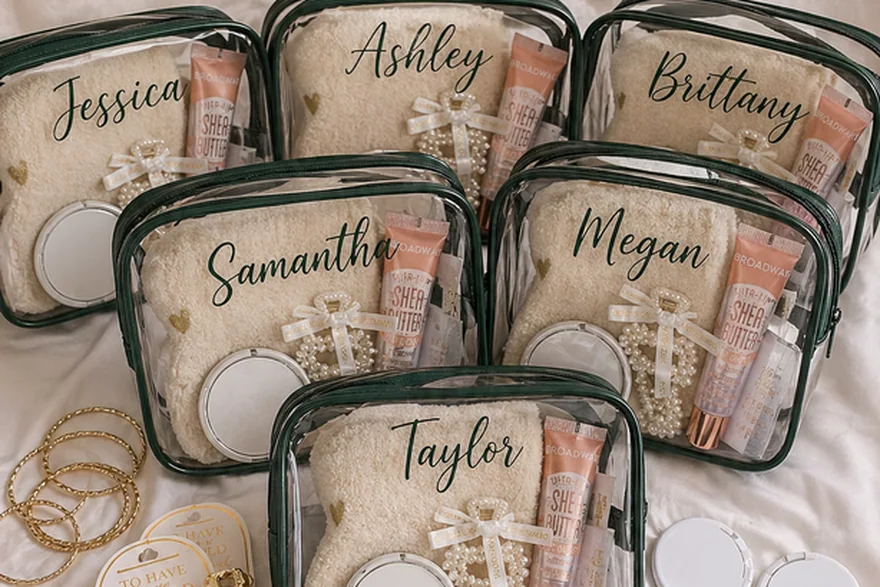
Within the wedding, two audiences behave differently. Bridesmaid bags number six to twelve, carry a higher unit budget, are personalised with a name and a role, and are used in front of a camera on the morning of the wedding. Guest favour bags number 80 to 200, carry a lower unit budget, are usually uniform, and are judged on a table from a metre away and in photographs taken under flash. One bag rarely satisfies both.
The format itself is well established. The phrase make up bags for women draws around 80,000 monthly searches and custom makeup bag draws 5,400 to 6,600 monthly searches, so the category is one guests already recognise and use. Typical unit price bands run $0.45 to $12.00 on Alibaba as of 2026.10, and typical marketplace minimums run 100 to 1,000 pieces, which is why a bespoke 120-piece wedding sits oddly against standard marketplace listings.
Seasonality is the last structural factor. In the northern hemisphere the wedding season clusters between May and October, which means sampling and bulk windows for a June wedding collide with the same production calendar as every other June wedding, and with the Chinese New Year shutdown that falls in January or February earlier in the same year. A buyer who understands that collision plans the sample request in the quiet months rather than in the rush.
Names, dates and decoration methods for small runs
Personalisation is the reason a wedding favour bag is worth specifying at all. Four data fields are available on most methods: the recipient name, the role in the wedding party, the date, and a monogram or short phrase. Names and roles suit the bridesmaid tier. Dates and a short phrase suit the guest tier, where a single line reading the couple's names and the date turns a generic pouch into a keepsake. The method chosen determines what the script looks like and how long sampling takes.
| Decoration method | Smallest practical run | How it photographs | Handling durability | Added sampling time |
|---|---|---|---|---|
| Embroidery | 6-12 pieces | Raised, catches flash, reads as quality | Excellent; stiffens the panel | Adds roughly 2-4 working days |
| Heat-transfer vinyl | 1 piece | Crisp edge, good for hand-lettered script | Fair; can lift with heat or creasing | Within the standard 6-10 working days |
| Screen print | 25+ pieces per artwork | Flat and graphic, good for a date line | Good; cracks along a hard fold | Within the standard window |
| Digital printing | 1 piece | Full colour, suited to a venue sketch | Good on polyester; test on coating | Within the standard window |
| Debossed PU patch | 25+ pieces | Quiet, tonal, reads as expensive | Excellent; ages with the bag | 12-15 working days, complex |
| Woven label | 500 pieces per design | Small, visible only on close inspection | Excellent | Within the standard window |
Variable data has one hard rule: the name list must be final at sample approval. A file revised after bulk start cannot be corrected, because the panels are already cut, printed or hooped. Buyers should confirm spellings, accents and role titles in writing, including whether the list reads Bridesmaid, Bride Tribe, Maid of Honour or Mother of the Bride, and should ask for the exact character set the decoration equipment supports before approving artwork.
Colour matching is the second specification decision. A dyed polyester shell matches a palette reference closely with a lab dip and usually one correction round, while embroidery thread is matched from a physical thread chart rather than from a screen. Where the bag will be carried against a dress, colour fastness matters as much as the match itself, and ISO 105 sets out the test methods for colour fastness to rubbing, washing and light. Buyers can review the scope at ISO 105 colour fastness. Finished-textile certification is a separate and useful document to hold alongside it, and the finished-article scope of OEKO-TEX Standard 100 covers the print paste and the thread as well as the cloth.
Combining two methods usually produces the best result for the money: a woven label or small embroidered monogram on the exterior, and a full-colour interior print visible only when the bag is opened. The exterior stays restrained enough for a guest to reuse, and the interior carries the date and the sentiment. Budget then splits roughly a third to the exterior mark and two thirds to the interior print, rather than the whole amount to one large exterior logo.
- Confirm the final name list, including accents and role titles, before sample approval rather than after.
- Match thread and fabric to physical swatches, never to a screen, and view both under daylight and under flash.
- Specify colour fastness to rubbing where the bag will be carried against a pale dress.
- Keep the exterior mark small so guests reuse the bag; put the sentiment and the date on the lining.
- Ask which character set the decoration equipment supports before approving a script typeface.
Presentation, packaging and how the table photographs
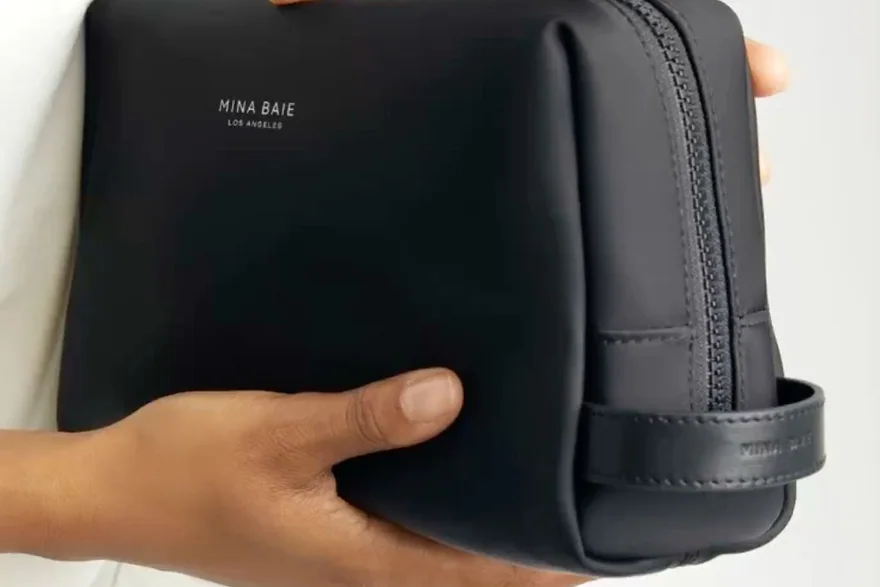
A favour bag is judged twice: once on the table from a standing height, and once in photographs that will outlast the day. Those two judgements favour different choices. On the table, structure and colour blocking carry the arrangement, so a bag with a flat base that stands upright outperforms a soft pouch that slumps. In photographs, surface finish matters: a matte shell reads well under flash, while a high-gloss PU can produce a blown highlight that hides the decoration entirely.
| Presentation option | Handling time per unit at destination | Result on the table | Effect on freight volume | Suits |
|---|---|---|---|---|
| Individually sleeved only | 10-20 seconds | Flat, needs arranging | Lowest | Large guest lists above 150 |
| Tissue wrap and hangtag | 30-45 seconds | Soft, photograph-ready | Low | Guest favours of 80-150 |
| Rigid gift box | 60-90 seconds | Formal, stacks well | High; box volume dominates | Bridesmaid proposals |
| Cotton drawstring dust bag | 20-30 seconds | Textured, reusable | Medium | Bridesmaid tier of 6-12 |
| Filled and sealed at origin | None | Full shape, consistent | Medium; weight rises | Destination weddings |
Filling changes the silhouette more than any other choice. A bag filled to roughly 60 to 70 per cent of its volume holds its shape and looks intentional; a bag filled to 30 per cent looks under-packed, and one filled to 100 per cent bulges at the zipper line and photographs badly. Acid-free tissue or a light insert holds the shape without adding weight, and a small card standing inside the bag gives the arrangement height on a flat table.
The colour story should be capped at three colours: one ground, one print colour and one metal or thread accent. More than that and the table reads as busy in group photographs. Hardware tone matters here too: a brushed or antique brass puller photographs warmly against a cream or blush palette, while a bright nickel puller can read cold and slightly clinical under flash. Buyers should ask for the hardware tone to be approved on the sample rather than chosen from a catalogue image.
A place card and a thank-you note are the two printed elements that turn a favour bag into something considered rather than stock. A small folded card standing inside the bag gives the arrangement height on a flat table and carries the couple's note; a hangtag tied at the puller carries the same message when the bag is hung or photographed from above. Both should be printed on a stock that matches the invitation suite, because a mismatch is visible in a close-up photograph even when nobody at the table comments on it.
Venue timing is the last logistics item and the one most often improvised. Filled bags should reach the venue the day before the wedding rather than on the morning of it, and the delivery should be named to a person rather than to an address. A carton handed to a venue office on a Friday for a Saturday wedding has a reliable habit of being found the following Monday, which is a logistics failure with no remedy available.
Packing for freight is the last presentation decision. Soft pouches can be flat-packed, which cuts carton volume, but they arrive with fold lines that need a day to relax. Structured cases cannot be flat-packed and should be nested to protect the base. Whichever route is chosen, buyers should specify individual sleeving and a stated carton count, because a carton packed loose will scuff the panels of any bag that has a coated or printed surface.
Ordering timeline, spares and the surplus question
The timeline is planned backwards from the wedding date, with more buffer than a commercial buyer would normally accept. Sampling takes 6-10 working days, or 12-15 working days for complex constructions such as a debossed patch or a lined structured case. Bulk production then runs 35-50 days after sample approval. Add ocean transit, clearance, and the week or two a planner needs to unpack, fill and arrange before the day itself.
As an illustrative planning timeline derived from stated assumptions, and not a measured result: for a wedding on 14 June, goods should be in hand by roughly 24 May. An illustrative 25-35 days of ocean transit and clearance puts the ship date around 19-29 April. Counting back 35-50 days of bulk production puts the bulk start around 1-14 March, and counting back sampling plus artwork approval puts the first sample request in the second half of January, deliberately ahead of the Chinese New Year period.
| Milestone | Illustrative weeks before the wedding | What is fixed at this point | Risk if missed |
|---|---|---|---|
| Palette and style shortlist | 22 - 26 | Fabric, ground colour, size | Colourway unavailable in season |
| First sample request | 18 - 22 | Decoration method chosen | Complex methods push sampling to 15 days |
| Sample approval in writing | 15 - 18 | Name list and date line final | No correction path after bulk start |
| Bulk production window | 35 - 50 days after approval | Artwork frozen | Revision costs a full re-run |
| Transit and clearance | 4 - 5 | Delivery address confirmed | No time to unpack and fill |
| Fill, arrange, deliver to venue | 1 - 2 | Filling plan and table layout | Volunteer packing on the morning |
Spares are not optional on a one-date deliverable. An illustrative planning allowance of 6 to 10 per cent above the confirmed guest count covers units damaged in transit, guests added in the final week, and the one or two bags a couple will want to keep. On a 120-guest wedding that is an additional 8 to 12 units. Because the order already sits at the 500-piece minimum per style and colourway, those extra units are usually the cheapest insurance in the whole plan.
The units above the guest count need a destination decided in advance. Planners and boutiques running several weddings a season can hold one colourway across events and draw down the balance. A couple ordering a single event can treat the surplus as anniversary and Christmas gifting for two or three years, or as stock for a small resale line. What should be avoided is deciding after delivery, because that is when cartons end up in a garage rather than in a cupboard.
A commercial buyer who runs short can reorder in 35 to 50 days. A wedding buyer who runs short cannot. That is the single difference that justifies ordering the surplus and paying for the faster sampling window on a complex construction.
Storage protects the surplus and the spares. Cartons should be kept sealed, dry and out of direct sunlight, and structured cases should not have weight stacked on them for months, because a compressed base will not recover on the day. Coated fabrics and printed panels are best stored at moderate temperature; a loft or a garage that swings hot in summer is the wrong place for a bag with a PU coating or a heat-transfer decoration.
The B2B Customisation View
Before a single metre of fabric is cut, the briefing stage settles the silhouette, the lining, the closure and the branding method for makeup bags and toiletry bags.
Standard terms: 500 pieces minimum per style and colourway, 6–10 working days for sampling (12–15 for complex builds), 35–50 days bulk production, AQL 2.5 inspection under ISO 2859-1, FOB Xiamen, T/T 30 deposit / 70 balance.
The commercial arrangement is straightforward: one sourcing partner, one technical pack, one inspection standard, one consolidated shipment.
Which Brand Types Benefit Most
Wedding favour programmes attract a different buyer mix from retail or corporate channels, and the ones who get the best results plan the colourway across more than one date. Five buyer types use this format most.
- Couples and families planning one date with no second run to correct a mistake. These buyers have the least tolerance for error and the least experience with lead times, so they benefit most from a written milestone plan and from accepting a proven construction rather than developing a new one against an immovable date. The surplus question should be answered before the purchase order, not after delivery.
- Wedding planners running six to twenty weddings a season. Planners are the natural fit for a held colourway: one shell colour, one size, and decoration that varies by event. That structure turns the 500-piece minimum from an obstacle into a season-long stock position and lets each wedding buy only what it needs from an already-paid-for run.
- Bridal boutiques and ateliers. These buyers already hold a palette and a client list, and use favour bags as an extension of the dress and accessories story. Colour matching to a physical swatch and hardware tone approval matter more here than in any other channel, because the bag sits next to the dress in the same photographs.
- E-commerce sellers of wedding and bridal party accessories. These sellers need packaging that survives parcel transit and looks ready to gift on arrival, so presentation tiers and carton counts drive the specification. A bag that arrives creased generates a return regardless of how it was made.
- Destination-wedding and hospitality buyers. Resorts and villa operators running wedding packages need a consistent favour across many events and many couples, so durability, storage stability in a warm climate and a neutral design that suits any palette are the deciding factors.
Frequently Asked Questions
What is the smallest quantity for personalised bridesmaid bags?
The minimum that applies is 500 pieces per style and colourway, so a six-piece bridesmaid set is ordered as part of a larger run rather than on its own. Within that run, embroidery and heat transfer both handle variable names, and the practical lower limit is set by the artwork setup rather than by the equipment. Bridesmaid sets usually ride inside a larger guest-favour order in the same colourway.
How far before the wedding should favour bags be ordered?
As an illustrative planning timeline derived from stated assumptions, the first sample request should go in 18 to 22 weeks before the date. That allows 6-10 working days for sampling, or 12-15 for complex constructions, 35-50 days for bulk after approval, an illustrative 25-35 days for transit and clearance, and one to two weeks to unpack, fill and deliver. Earlier is better when the date falls in peak season.
Can the wedding date be printed on every bag?
Yes, and it is the single detail that turns a generic pouch into a keepsake. A date line works in screen print, digital print or heat transfer on a flat panel, and in embroidery on a canvas or 600D shell. Buyers should decide the date format in writing before artwork approval, since 14.06.2027, 14 June 2027 and a Roman numeral rendering are three different artworks.
Which decoration method photographs best under flash?
Embroidery photographs best because it is raised and catches light from any angle, and it also reads as quality at close range. Heat transfer suits a hand-lettered script where a fine edge is wanted. High-gloss PU shells are the risk: a specular highlight can erase a flat print in a photograph, so a matte or semi-matte ground is the safer choice for a bag that will be photographed all day.
Can a favour bag be matched to a particular dress colour?
A dyed polyester shell matches a reference closely with a lab dip and usually one correction round, and embroidery thread is matched from a physical thread chart. Buyers should approve a physical swatch rather than a screen image and view it in daylight and under flash. Where the bag is carried against a pale dress, ask for colour fastness to rubbing to be tested to the ISO 105 methods.
Will the bag transfer colour onto a dress?
That risk is a specification question, not a matter of luck. Colour fastness to rubbing is covered by the ISO 105 test methods, and a buyer can ask for the result on the exact shell and print combination being ordered. Dark grounds, deep reds and metallics carry more risk than pale ones, and a printed panel usually transfers less than a saturated dyed ground with no after-treatment.
How many spare bags should be ordered for a 120-guest wedding?
An illustrative planning allowance of 6 to 10 per cent above the confirmed guest count, so 8 to 12 extra units on a 120-guest list. That covers transit damage, guests added in the final week and the couple's own keepsakes. Because the order already sits at the 500-piece minimum per style and colourway, the additional units are usually the cheapest insurance available.
What happens to the units above the guest count?
Decide before ordering. Planners and boutiques can hold one colourway across several weddings in a season and draw the balance down event by event. A single-event couple can treat the surplus as anniversary and Christmas gifting for two to three years, or as stock for a small resale line. Leaving the decision until after delivery is how cartons end up forgotten in storage.
Can two weddings share one production run?
Yes, and it is the most common way to make the numbers work. Two events share the shell, the size and the ground colour, then vary the decoration: different names, dates and thread colours on the same base goods. That keeps one colourway at or above the 500-piece minimum while each wedding receives a bag that is specific to it.
How should bags be packed so they do not arrive creased?
Specify individual sleeving, a stated carton count and, for structured cases, nesting to protect the base. Soft pouches can be flat-packed to cut freight volume but will arrive with fold lines that need a day or two to relax under light filling. A carton packed loose will scuff any coated or printed panel, which is the most common complaint on delivery.
What fits inside a favour-sized cosmetic bag?
A pouch of roughly 20 x 12 x 7 cm holds a travel-size toiletry set, a sheet mask, a lip balm, a small mirror and a card without looking under-filled. Filling to about 60 to 70 per cent of volume gives the best silhouette; more than that bulges the zipper line. A light tissue insert holds the shape and adds almost no weight to the parcel.
Is a zipper or a drawstring better for a guest favour?
A zipper closure reads as a bag that will be reused, keeps contents secure in transit and suits a flat panel for printing. A drawstring reads softer and more casual, costs less and packs flatter, but it does not protect contents once the bag is thrown into a suitcase. For a guest favour intended to be taken home and used again, a zipper is the safer choice.
Should guest bags and bridesmaid bags be the same style?
Same colourway, different specification. Sharing the shell colour keeps the whole wedding inside one minimum and makes the table look coherent. Within that, bridesmaid bags can take a larger size, a better lining, a personalised name and a gift-box presentation, while guest bags take the smaller size and a uniform date line. The photographs read as one family of objects rather than two unrelated gifts.
Do wedding favour bags need REACH or CPSIA documentation?
A bag placed on the EU market as an article carries REACH obligations for substances of very high concern, so a written declaration covering shell, lining, coating and ink is the right document to hold. Buyers can check the current obligation at ECHA's REACH guidance. The CPSIA limits are written for children's products, so a general-use favour sits outside that scope, though some buyers request a declaration anyway. OEKO-TEX Standard 100 is the finished-textile label most recipients recognise.
How long does a personalised favour bag take from artwork to delivery?
Sampling is 6-10 working days, or 12-15 working days for complex constructions such as a debossed patch or a structured lined case. Bulk production is 35-50 days after sample approval. On top of that sits transit, clearance and the unpacking and filling time. Buyers should treat the artwork approval date, not the enquiry date, as the true start of the clock.
People Also Ask
What do you put in a bridesmaid cosmetic bag?
Contents that will be used on the morning of the wedding: a lip colour for touch-ups, a setting mist or blot sheets, a small mirror, a hair tie and a travel-size pain reliever. A personalised name or role on the exterior makes the bag the keepsake, so the contents can stay modest. Fill to about two thirds of the volume so the bag holds its shape in photographs.
How many favour bags do you need per guest?
One per guest, plus an illustrative planning allowance of 6 to 10 per cent for damage, late additions and keepsakes. Couples are usually counted as one unit rather than two, and children are either counted separately or given a different item. Because the minimum is 500 pieces per style and colourway, the surplus is usually already inside the order rather than an extra cost.
Are personalised cosmetic bags worth it as wedding favours?
They are worth it when the bag is reusable, because the personalisation only pays off if the guest keeps it. That means a small exterior mark rather than a large one, a zipper rather than a drawstring, and a neutral ground colour. A bag with a large printed logo or a very specific date treatment tends to be left on the table.
When should wedding favours be ordered?
Earlier than most couples expect. Working backwards from the date: 6-10 working days for sampling, 35-50 days for bulk after approval, an illustrative 25-35 days for transit and clearance, and one to two weeks to unpack and fill. That puts the first sample request roughly 18 to 22 weeks before the wedding, and earlier still if the date falls in peak season.
Request a Sample or a Written Quotation
Send the silhouette, dimensions, material preference and logo artwork, and the programme team will return a written quotation with MOQ, sampling window, bulk lead time and inspection standard.
Email: [email protected] · WhatsApp: +86 177 5002 0688