10 Types of Makeup Bags: From Pouches to Rolling Cases
Executive Summary
There are ten makeup bag types that cover the whole category, and they are separated by what each one protects rather than by what each is called. Slim flat pouches, boxed bags and brush rolls protect individual items and travel inside something else. Hanging organisers and clear quart bags protect access and screening compliance. Train cases, modular palette cases and rolling cases protect the contents against impact, and that protection is what the buyer is paying for.
Capacity is the practical discriminator. Nominal volumes run from about 0.6 litres for a 22 x 14 cm slim pouch to roughly 30 litres for a 45 x 35 x 25 cm rolling case, and the price moves with volume and with impact protection rather than with fabric. Every type runs on the same programme figures: 500 pieces per style and colourway, 6 to 10 working days for sampling, and 35 to 50 days for bulk production after approval. Buyers should also note that the same sewn pouch can be sold under several category names, so the specification, not the label, decides whether the product protects anything.
What Makes a Bag a Makeup Bag Rather Than Something Else
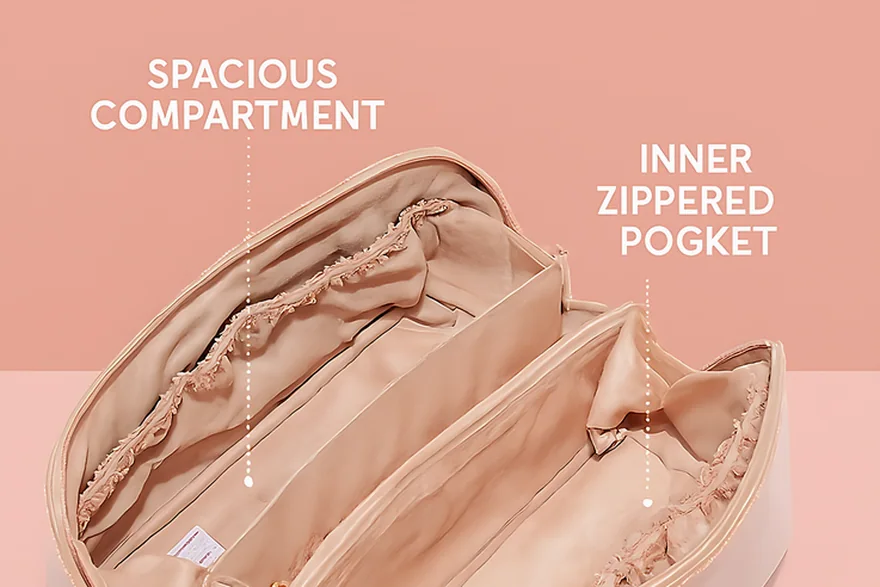
A makeup bag is defined by its contents rather than by its construction. It is a bag bought to carry colour cosmetics: lipstick, compacts, palettes, brushes and the small tools that go with them. That definition separates it from a toiletry bag, which is built around liquids and therefore around waterproof linings, and from a vanity case, which is defined by structure rather than by contents. In practice the same sewn pouch can be sold as any of the three, which is why the specification has to state the intended contents.
The contents dictate three design decisions. Brushes need to be held individually and kept away from the zip, which points to loops and a lid panel. Pressed powders and palettes need a flat, rigid base, because a cracked palette is the single most common damage claim in this category. Liquids, even in small quantities, need a lining that can be wiped, because a foundation pump will eventually leak.
From there the ten types split along one axis: how much impact protection the contents need. A lipstick in a handbag needs none. A glass foundation bottle in a checked suitcase needs a lot. That axis, rather than size or price, is the honest way to read the list that follows, and it explains why two bags of identical volume can sit at opposite ends of the price band. It also explains why the same brand can sensibly sell a pouch and a case at the same time: they are not substitutes, they are answers to different packing problems.
- A makeup bag is defined by contents: colour cosmetics, palettes and brushes
- Brushes need loops and a lid panel; palettes need a flat rigid base
- The ten types split by impact protection, not by size or price
- State the intended contents on the brief, because the term alone does not
Price follows the same axis. Across the typical unit price band of $0.45 to $12.00, the flat pouch sits at the bottom because it protects nothing, and the rolling case sits at the top because it protects everything. Buyers comparing two quotations should therefore ask what protection each construction actually delivers, rather than comparing fabric weights alone, because the fabric is rarely where the difference is.
One further distinction matters for listings. Makeup bag language implies portability: the shopper expects to carry it in a handbag or a suitcase. A bag that needs two hands to move has crossed into case territory even if it is sold under a bag name. That boundary sits around 30 cm wide and around 8 litres of nominal volume, and it is the point at which a handle becomes expected rather than optional.
Understanding that boundary helps a buyer avoid the most common specification error in the category: ordering a large bag with a small-bag construction. A 30 cm pouch in 300D polyester with no base board will slump the moment it is filled, and the slump is visible in product photography long before it is visible in a return. Above 26 cm wide or 5 litres, a base board and 420D or heavier shell should be treated as standard.
The Ten Types, With Dimensions and What Each Protects
The ten types below are ordered by nominal volume, from smallest to largest. Volumes are nominal in the sense that they are calculated from external dimensions; usable capacity is typically 15 to 25 per cent lower once lining, seam allowances and internal fittings are counted. Buyers should treat these figures as a planning tool for comparing types rather than as a packing guarantee.
| Type | External size | Nominal volume | What it protects | Best channel |
|---|---|---|---|---|
| Slim flat pouch | 22 x 14 x 2 cm | 0.6 L | Surface finish of individual items against keys and coins | Gift with purchase, handbag accessory |
| Clear quart bag | 20 x 15 x 7 cm | 1.5 L | Screening compliance and leak containment | Travel retail, airport |
| Structured makeup clutch | 27 x 19 x 7 cm | 2.8 L | Pressed powders against crushing in a handbag | Fashion accessory, gifting |
| Hanging organiser | 24 x 18 x 8 cm closed | 3.0 L | Access and order; contents stay visible when hung | Travel retail, e-commerce |
| Boxed standing bag | 24 x 16 x 10 cm | 3.2 L | Bottles upright; base board prevents slump | Beauty specialty retail |
| Dome bag | 25 x 15 x 14 cm | 3.6 L | Bristle shape and bulky items against compression | Boutique, lifestyle |
| Brush roll | 24 x 12 cm rolled | 1.2 L rolled | Brush heads and ferrules against bending | Professional, prosumer |
| Train case | 28 x 20 x 18 cm | 8.5 L | Glass bottles against impact; rigid walls and tray | Department store, gift |
| Modular palette case | 32 x 24 x 22 cm | 14 L | Large palettes in adjustable dividers | Professional, salon |
| Rolling makeup case | 45 x 35 x 25 cm | 30 L | A full kit against transit impact | Professional, backstage |
Three of the ten are frequently confused, and the confusion costs money. A boxed standing bag and a structured clutch are close in volume but different in purpose: the boxed bag has a deep gusset and holds bottles upright, while the clutch is shallow and flat by design, intended for a handbag rather than for a suitcase. A dome bag and a boxed bag are also close in volume, but the dome has a curved top panel that absorbs compression from above, which suits brushes and bulky sponges.
The brush roll is the odd one out in the list, because its nominal volume is meaningless. What matters is loop count and loop width: 8 to 16 loops at 12 to 20 mm, sized to the brush handles the brand actually sells. A roll with loops too narrow for a kabuki handle is returned as unfit for purpose, and the return costs more than the bag.
The clear quart bag has a different kind of specification problem. Its value is regulatory rather than structural: it exists so that liquids can be presented at a security checkpoint without being unpacked. That means the dimensions and the capacity are the product, and a buyer should check the current liquids rule before finalising artwork rather than assuming a size that was correct in a previous season.
At the top of the list, the modular palette case and the rolling case are professional tools rather than consumer accessories. Both carry adjustable dividers or removable trays, both are bought by people who compare them against luggage or tool cases, and both are sold on demonstrated capacity rather than on colour. Photography for these two should show them loaded and open.
Construction differs across the list in predictable ways. The slim pouch is two panels and a zip. The boxed bag adds a gusset and a base board. The dome adds a curved top panel and a longer zip. The train case adds wall stiffeners, a handle and a tray. The rolling case adds a frame, a wheel set and a telescopic handle. Each addition is a cost step and a defect opportunity, which is why the list should be read as a cost ladder as much as a size ladder.
Capacity Planning: What Actually Fits Inside Each Type
Nominal volume is a poor guide to what a shopper can pack, because cosmetics are awkward shapes. A 3.2 litre boxed bag will hold a surprising amount of flat items and very few bottles. The table below sets out a practical planning basis, using the dimensions of the most commonly carried items so a buyer can sanity-check a specification before a sample is made.
| Item carried | Units that fit | Volume consumed | Packing note |
|---|---|---|---|
| Lipstick, 7.5 x 2 cm | 8-10 in a slim pouch | About 0.02 L each | Loose items scuff; a slip pocket keeps them separated |
| Compact, 10 x 10 x 1.5 cm | 3-4 in a boxed bag | About 0.15 L each | Stack flat against the base, never on edge |
| Eyeshadow palette, 15 x 10 x 1.5 cm | 2-3 in a clutch | About 0.22 L each | Needs a flat base wider than 15 cm or the corners crush |
| Foundation bottle, 100 ml | 3-4 in a boxed bag | About 0.15 L each | Must stand upright, so depth above 10 cm is required |
| Makeup brush, 18 cm handle | 8-16 in a brush roll | About 0.03 L each | Loops of 12-20 mm; bristles need a lid panel |
| Setting spray, 200 ml | 1-2 in a train case | About 0.25 L each | Glass or heavy plastic needs a rigid wall, not a pouch |
| Sponge or puff, 6 cm | 4-6 in a dome bag | About 0.11 L each | Compressible, but recovers poorly if crushed for days |
| Full brush set plus palettes | One kit in a modular case | 10-14 L in total | Adjustable dividers prevent palette corners taking load |
Applying that table to a real specification is straightforward. A shopper carrying two palettes, a compact, four lipsticks and three brushes needs roughly 1.1 litres of item volume, which means a nominal capacity of 1.5 to 2.0 litres once packing inefficiency is counted. A 0.6 litre slim pouch will not do it and a 3.2 litre boxed bag will waste shelf and freight on empty space.
Packing inefficiency is the number buyers forget. Items of mixed shape leave 20 to 35 per cent of a bag unusable, and the figure is worse for rigid items in a soft bag. A buyer should multiply the item volume by roughly 1.4 to size a soft bag and by roughly 1.2 to size a structured case, because a rigid interior wastes less space.
Weight is the second half of the calculation. A boxed bag filled with four 100 ml bottles and a palette weighs roughly 900 g to 1.2 kg, which is more than most handbag straps are comfortable with. That is the real reason the category divides into handbag-scale bags and suitcase-scale cases, and it is why a bag above about 1.5 kg loaded needs a handle rather than a wristlet.
For e-commerce sellers the packing table has a second use. Publishing the item count a bag holds, rather than just its dimensions, reduces size-related returns more effectively than a dimension chart, because shoppers think in items rather than in centimetres. A bullet that states holds two palettes and a ten-piece brush set converts better and returns less.
- Multiply item volume by 1.4 for a soft bag, 1.2 for a structured case
- Above 1.5 kg loaded, a handle is expected rather than a wristlet
- Palettes need a flat base wider than 15 cm, or the corners crush
- Publish item counts, not just dimensions, to cut size-related returns
Stress Points, Protection Claims and How They Are Verified
Protection claims are where this category most often overpromises. A bag described as protective may simply be padded, and padding without structure does not stop a palette cracking. The distinction matters because the failure appears after sale, in a review, rather than in an inspection report. Buyers should therefore specify protection as a tested behaviour: what load, applied where, with what acceptable outcome.
| Stress point | Load applied | Acceptable outcome | How it is verified |
|---|---|---|---|
| Base seam of a boxed bag | 1.5 kg static for 24 hours | No distortion over 3 mm | Measure the base before and after the load |
| Zip on a dome bag | 500 open and close cycles | No tape separation or puller failure | Cycle test on the pre-production sample |
| Hook on a hanging organiser | 3-5 kg static for 30 minutes | No hook deformation or panel tear | Hang loaded from a door or rail |
| Handle on a train case | 3 kg lifted 20 times | No stitch elongation at the roots | Bar-tack the roots and inspect after the lift cycle |
| Wheel set on a rolling case | 15 kg rolled across a seam 50 times | Wheels stay seated; handle does not rattle | Transit test before the first bulk shipment |
| Lining of any bag | 10 ml of foundation oil for 24 hours | No strike-through to the shell | Spot test with the actual formula |
Zip specification deserves separate attention because it is the most common defect in the category. Gauge and tape type should be stated using the vocabulary in ASTM D2053, so that a quotation for a #5 zip means the same thing to both sides. A #3 coil suits a slim pouch; a #5 suits a boxed or dome bag; a U-zip on a train case needs #5 or #8 with two pullers.
Compliance should be settled per type rather than per order. A clear quart bag marketed for air travel is sold against the TSA liquids rule, which governs container size and total volume rather than bag material. A makeup bag marketed to children in the United States falls under the Consumer Product Safety Improvement Act, which adds lead and phthalate testing on coated materials.
Inspection closes the loop. Each style and colourway is sampled as its own lot at AQL 2.5 under ISO 2859-1, so a five-type order generates five inspection lots. The plan should add the type-specific checks listed above, because a folded bag in a carton will not reveal a base seam that distorts under load or a hook that pulls out of an unreinforced panel.
Sampling and bulk timing then follow the same split as the rest of the category. Slim pouches, clutches, boxed bags, dome bags and brush rolls sit in the 6 to 10 working day sampling window. Hanging organisers, train cases, modular cases and rolling cases need 12 to 15 working days, because each requires a hardware trial, a load test or tooling before a representative sample exists. Bulk runs 35 to 50 days after approval.
A protection claim should always be written as a behaviour rather than an adjective. Padded describes a material; survives a 1.5 kg static base load for 24 hours describes a result, and only the second can be checked on a sample before bulk is approved.
The B2B Customisation View
For buyers building a range of cosmetic bags, the specification sheet doubles as the costing sheet, which is why it is worth getting right in week one.
Programme data for this category: minimum order quantity 500 pieces per style and colourway, sampling in 6–10 working days (12–15 working days for complex constructions), bulk production 35–50 days after sample approval, final random inspection at AQL 2.5 under ISO 2859-1, FOB Xiamen, T/T 30/70.
Because the entity is a sourcing and programme-management company, the buyer deals with one accountable counterpart for specification, sampling, inspection and consolidation.
Which Brand Types Benefit Most
Which of the ten types suits which brand depends on what the brand sells alongside the bag. A colour cosmetics brand whose products include pressed palettes should specify around the palette, because a cracked palette generates a complaint about the product rather than about the bag. A brush brand should start with the roll and add a bag later, because the roll is the format that actually protects the product the brand is known for. A skincare-led brand moving into colour should start with the boxed bag, which holds bottles upright and tolerates a leak. A brand selling liquid foundation in glass should treat a laminated lining as non-negotiable across every type it buys, because a single strike-through stains the shell permanently and generates a review about the bag rather than about the product.
- Start-up brands: one slim pouch and one boxed bag in a single colourway, which commits 1,000 pieces at the 500-piece minimum per style and colourway and covers the two most common use cases.
- Established brands: add one structured type for brand storytelling and keep the pouch types for volume, sharing a shell so colour matching stays controllable across the range.
- Retailers and private-label teams: build the range on the capacity table rather than on the size ladder, so each price point corresponds to a stated item count the shopper can verify.
- E-commerce sellers: publish item counts and loaded weights; the two types that photograph best are the boxed bag and the hanging organiser, because both show their contents.
- Professional and salon buyers: modular palette cases and rolling cases are bought on demonstrated capacity, so the specification should state divider count and load rating rather than colour options, and the imagery should show the case loaded rather than closed.
- Travel and duty-free operators: the hanging organiser and the clear quart bag are the two types that solve a travel problem rather than a storage one, so they convert best when the copy states what the shopper avoids unpacking.
Frequently Asked Questions
How many makeup products fit inside a 24 x 16 x 10 cm boxed bag?
Roughly two palettes, three to four compacts, eight to ten lipsticks and three brushes, which is about 1.1 litres of item volume against a nominal 3.2 litre capacity. The gap is packing inefficiency: mixed shapes leave 20 to 35 per cent of a soft bag unusable, so multiply item volume by 1.4 when sizing a soft bag.
Does a clear makeup bag automatically satisfy the liquids rule at security?
No. The rule governs the containers inside the bag as well as the bag itself, so a clear bag holding oversized bottles will still be stopped. A buyer should check the current liquids rule before finalising artwork and should state container size on the packaging rather than implying the bag alone confers compliance. State container limits on the packaging as well.
How many brush slots should a makeup brush roll actually have?
Between eight and sixteen, sized 12 to 20 mm wide to suit the handles the brand sells. The critical detail is not the count but the fit: loops too narrow for a kabuki or powder brush handle will be returned as unfit for purpose. Loops should be stitched to a reinforced panel, not to the lining.
What load should the hook on a hanging makeup organiser carry?
Three to five kilograms static for thirty minutes, which is a realistic figure for a four-compartment organiser loaded with full-size bottles. The hook should be specified by load rating rather than by appearance, and the panel behind it reinforced, because a hook pulled through an unreinforced back panel is the most common failure in this format.
At what capacity does a makeup bag need a frame or stiffener?
Above about 5 litres nominal volume, or above 26 cm in width, a base board and 420D or heavier shell should be treated as standard. Below that, a soft bag holds its shape well enough. Without stiffening, a large pouch slumps when filled, and the slump shows in product photography well before it shows in a return.
How is zipper durability tested on a makeup bag before bulk approval?
By cycling the zip on the pre-production sample, typically 500 open and close cycles, then inspecting for tape separation, puller failure and stitch elongation at the ends. Gauge should be named using ASTM D2053 vocabulary so a quotation for a #5 zip means the same thing to both sides. Record the result on the sample approval sheet.
What is the minimum order for a rolling makeup case?
The standard minimum is 500 pieces per style and colourway, but the effective minimum is higher in practice because a rolling case carries wheel-set and handle tooling that only amortises sensibly over larger volumes. Buyers should ask whether tooling is quoted separately, and should plan the rolling case as an annual commitment rather than a reorder item.
Why does a modular palette case weigh so much when it is empty?
Because the dividers, the frame and the shell are all doing structural work. A 32 x 24 x 22 cm modular case typically carries wall stiffeners, a rigid base and two to four adjustable dividers, which can take the empty weight past 1.2 kg before a single palette is loaded. That weight is the cost of protecting rigid contents.
How long does sampling take for a rolling makeup case?
Twelve to fifteen working days, against six to ten for a pouch, because the wheel set, the telescopic handle and the frame all have to be trialled before a representative sample can be assembled. Bulk production then runs 35 to 50 days after sample approval, so a rolling case programme needs roughly two months more lead time than a pouch.
What shell weight suits a train case holding glass bottles?
At least 600D polyester or 420D nylon with a laminated lining, plus wall stiffeners of 2.0 to 2.5 mm and a 3 mm base board. Glass concentrates load at a single point, so bottle sleeves should be stitched to the base panel rather than to a side wall, and the case should be checked for base bow after a 24-hour load trial.
Can a brush roll and a boxed bag share the same shell material?
Yes, and doing so simplifies colour matching and reduces fabric waste across a range. The caveat is abrasion: a brush roll is rolled and unrolled repeatedly, so a shell that is adequate on a boxed bag may wear at the fold line on a roll. A 420D nylon or a canvas handles the rolling better than a printed polyester.
What inspection level applies to a mixed order of pouches and rolling cases?
AQL 2.5 under ISO 2859-1, applied per style and colourway, so a mixed order generates one inspection lot per style even when everything ships in one container. Rolling cases should additionally be rolled across a seam during inspection, because a wheel that unseats under load is invisible in a carton but expensive once shipped. A single inspection visit can still cover every lot.
What compliance documents apply to makeup bags sold in the United States?
Where a bag is marketed to children, the Consumer Product Safety Improvement Act applies, which adds lead and phthalate limits on coated and printed materials. For general-purpose bags the practical requirement is accurate fibre content and country-of-origin labelling. A clear bag marketed for air travel should reference the current liquids rule. Documentation should name the specific fabric order.
What compliance documents apply to makeup bags sold in the European Union?
REACH covers chemical substances in articles, so coated shells, prints and hardware finishes need to be covered by the supplier declaration. A recycled-content claim requires traceable documentation under the Global Recycled Standard, and any next-to-skin claim is stronger with OEKO-TEX Standard 100 documentation for the specific fabric order. Certificates should reference the specific fabric order.
What are the payment and shipment terms for a ten-style makeup bag range?
Shipment is FOB Xiamen and payment is T/T 30 deposit with 70 against bill of lading. A ten-style range can consolidate into one container, which spreads freight, but each style is inspected as its own lot and carton marking should separate the types so heavy structured cartons are not stacked above light pouch cartons. Separate carton marks prevent crushing in transit.
People Also Ask
What is the best type of makeup bag for travel?
A hanging organiser for access, because everything stays visible when it is hung on a door or rail. A boxed bag at 24 x 16 x 10 cm is the better choice if the priority is keeping bottles upright in a suitcase. For air travel with liquids, add a clear quart bag so screening does not require unpacking the whole kit.
How big should a makeup bag be?
Size it from the contents rather than from the category. Two palettes, a compact, four lipsticks and three brushes come to roughly 1.1 litres of item volume, so a nominal capacity of 1.5 to 2.0 litres is the right target. For a soft bag, multiply the item volume by about 1.4 to allow for packing inefficiency. Round up rather than down when choosing between two sizes.
Are rolling makeup cases worth the higher unit cost?
For a professional carrying a full kit, yes: 30 litres of nominal capacity with a wheel set and a frame protects palettes and glass in ways no pouch can. For consumer use, rarely, because the empty weight and the bulk make it impractical. The format sells to people comparing it against luggage rather than against pouches. The empty weight alone is usually over 1.2 kg.
What is the difference between a train case and a rolling case?
A train case, typically 28 x 20 x 18 cm and around 8.5 litres, is carried by a top handle and holds a lift-out tray. A rolling case, around 45 x 35 x 25 cm and 30 litres, adds a frame, a wheel set and a telescopic handle for a full kit. Both protect against impact; only one is designed to be rolled.
Request a Sample or a Written Quotation
Send the silhouette, dimensions, material preference and logo artwork, and the programme team will return a written quotation with MOQ, sampling window, bulk lead time and inspection standard.
Email: [email protected] · WhatsApp: +86 177 5002 0688