Cosmetic Bags for Beauty Bloggers: Content Creation Kits
Executive Summary
Cosmetic bags for beauty bloggers should be specified as content creation kits rather than as retail pouches, because the bag reaches a camera long before it reaches a shelf. A creator kit has to photograph cleanly under ring light and phone LED, hold a curated selection without bulging at the seams, and carry branding that stays legible at thumbnail size. The practical answer is a matte or brushed shell in a mid-tone shade, a semi-structured body that keeps its silhouette in a flat lay, and a zip line that opens flat for an unboxing reveal.
Programme mechanics follow the same rules as any made-to-order bag run. Brand owners work to a minimum of 500 pieces per style and colourway, allow 6-10 working days for sampling or 12-15 working days for complex constructions, and plan 35-50 days for bulk after sample approval. Inspection runs to AQL 2.5 under ISO 2859-1, shipments move FOB Xiamen, and payment is T/T with 30 deposit and 70 against bill of lading.
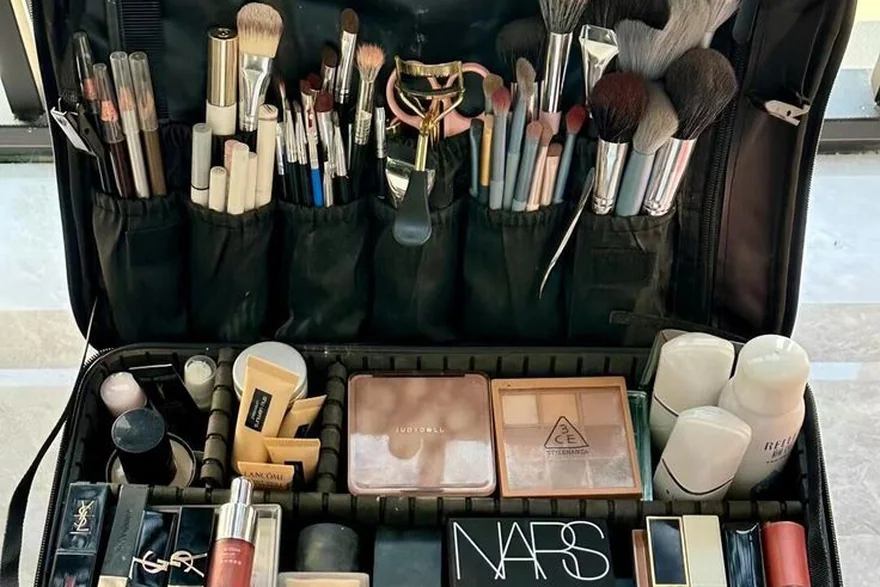
What a content creation kit is in the beauty blogger economy
A content creation kit is a branded cosmetic bag or pouch assembled with a curated selection of product and sent to a beauty blogger so that the contents can be photographed, filmed and reviewed. It differs from a mailer because the bag is part of the content rather than only the container: it appears in the unboxing frame, in the flat lay that follows, and often in posts published months later. It differs from a retail SKU because its first job is visual performance rather than shelf margin, although the same body frequently becomes a sellable pouch once the campaign has run its course.
Three functions sit inside one item. The first is transit protection: a kit crossing a parcel network needs a body stiff enough that a glass dropper or a pressed compact does not crack against a corner. The second is the frame itself, since the bag is the background of the first five seconds of video, which is the portion that decides whether a viewer stays at all. The third is reuse, meaning a pouch that remains on the creator's desk or inside a handbag keeps generating impressions after the gifted moment has passed.
Reuse is the function most often lost during specification. A bag covered in an oversized campaign logo, printed in a shade that clashes with most interiors, or sized so that it fits nothing else gets photographed once and then stored. A 22-24 cm pouch in a neutral mid-tone, carrying a restrained mark of 25-40 mm and a wipeable lining, gets used, and every one of those uses is another frame the brand did not pay for. That is why the kit brief should be written around the second month of the bag's life, not the first minute.
- It is not a shipping mailer: corrugated or padded outer packaging still does the structural work in transit.
- It is not a rigid gift box: a box photographs a lid, while a bag photographs a reveal.
- It is not automatically a retail SKU, although most of the bodies used in creator kits also appear in a brand's own store at some later point.
- It is not a one-off print job: a creator programme reorders, so the specification has to be documented well enough to repeat exactly.
Camera-first surface and colour specification
Ring light and phone LED expose surface decisions that a shopper would never notice. A gloss PU coating returns a hard specular highlight that shows the light source itself as a white blob, which reads as cheap on video and forces the creator to angle the bag away from the light. A matte TPU laminate or a brushed canvas diffuses the same light and gives the camera a continuous tone to work with. Colour behaves the same way: a saturated red or a deep navy shifts noticeably between a 5,000 K ring light and daylight near 6,500 K, while a mid-tone grey, taupe or dusty pink holds its position across both.
Weight and hand also read on camera. A shell that collapses when the bag is set down produces creases that catch light, whereas a 3-4 mm moulded EVA body or a semi-structured build with 2 mm EVA between shell and lining keeps a silhouette through an entire shoot. The trade-off is mass: a moulded 26 cm case weighs 350-500 g against 180-260 g for a soft 24 cm pouch, and that difference matters when hundreds of kits are posted at parcel rates.
| Surface option | Typical build | Behaviour under lighting | Where it performs |
|---|---|---|---|
| Matte TPU laminate | 0.35-0.45 mm film over 300D polyester | Soft falloff, no hot spot, low fingerprint marking | Flat lays, close-up product shots, tutorial b-roll |
| Gloss PU coated 600D | 0.6-0.8 mm coating at 230-260 g/m² | Hard specular highlight that mirrors the light source | Low-light lifestyle frames only; risky for hero shots |
| Brushed 16 oz cotton canvas | 430-480 g/m², natural or piece-dyed | Fully diffuse, matte, hides handling marks | Warm lifestyle content and sustainability-led campaigns |
| Moulded EVA shell | 3-4 mm wall, 55-65 Shore A | Holds silhouette, slight sheen on curved faces | Structured vanity cases, hero kits, video reveals |
| Dull-finish recycled rPET | 600D at 210-240 g/m², GRS-documented yarn | Matte with slight texture, consistent tone | Recycled-content stories and retailer ESG ranges |
Logo legibility has a hard threshold. At the 30-40 cm distance a creator holds a phone, a mark needs a cap height of 6-8 mm and a stroke width of at least 1.2 mm to resolve on a 1080p frame; below that it turns to mush once the video is compressed. Tonal embroidery, meaning a thread one shade away from the shell, reads well in person and disappears on video, so a campaign that lives on video should specify a contrast print or a matte heat transfer instead.
Colour fastness belongs in the brief rather than in a complaint later. Shades used across a campaign that also appears in retail need fastness to light and to rubbing checked before bulk, because a bag that crocks onto a creator's clothing generates precisely the wrong kind of content. Buyers reference AATCC test methods for rubbing and light fastness, and OEKO-TEX Standard 100 where the pouch fabric sits against skin or holds product that does.
- Specify matte or brushed surfaces for any bag that will act as the background of a reveal.
- Hold logo cap height at 6-8 mm and stroke width at 1.2 mm minimum for video legibility.
- Choose mid-tone shades rather than saturated ones when content will be shot under mixed lighting.
- Add 2 mm EVA or a 3-4 mm moulded shell wherever the bag has to hold a silhouette on camera.
- Document Pantone and fabric lot references so that a reorder matches the original shoot.
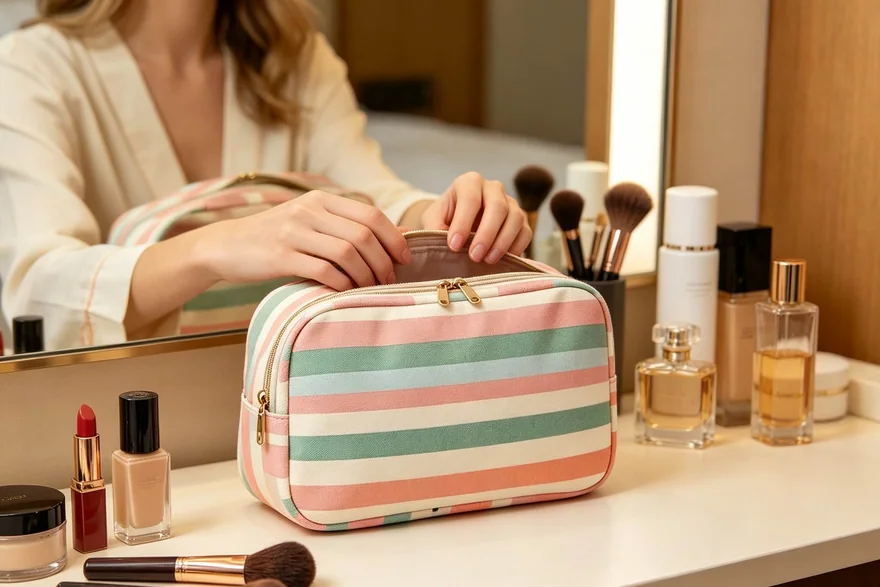
Kit architecture for seeding, mid-tier and hero sends
Creator lists are tiered, and the bag should follow the tier rather than the other way around. A nano-influencer send of 300 recipients cannot carry a structured vanity case costing several dollars a unit, while a hero send to 20 macro creators can and should, because the production value of the frame is the point of the exercise. The usual structure is one design family — the same fabric, hardware and print language — executed at two or three sizes, so the campaign looks coherent while unit cost tracks the value of the recipient.
| Send tier | Recipient count | Bag format and size | Usable volume | Typical fill |
|---|---|---|---|---|
| Seeding send | 150-400 creators | Flat zip pouch 22 x 14 x 6 cm | 1.2-1.6 L | 4-6 travel or sample sizes plus a printed card |
| Mid-tier review kit | 40-120 creators | Semi-structured pouch 24 x 16 x 9 cm | 2.4-3.0 L | 6-9 items, one full size, printed insert |
| Hero kit | 10-30 creators | Structured vanity case 26 x 18 x 12 cm | 4.0-5.5 L | Full-size range, brush roll or mirror insert |
| Event press-day pouch | 60-200 guests | Slim clutch 25 x 17 x 4 cm | 1.0-1.4 L | 2-3 items, handed out and carried |
| Affiliate restock send | 30-80 creators | Seeding body with a second print colour | 1.2-1.6 L | Top-up items only, no new bag design |
Volume drives freight, and freight is where a cheap bag becomes an expensive programme. A 24 x 16 x 9 cm soft pouch packs 60-80 pieces into a 60 x 40 x 40 cm export carton, while the same footprint in a structured case holds 24-30. Against a 500-piece minimum that is the difference between roughly seven cartons and eighteen, which changes both the freight quote and the receiving workload at the fulfilment warehouse. Buyers who plan carton pack-out before they plan artwork avoid the common error of designing a bag that is inexpensive to make and costly to ship.
Inside the bag, the choice sits between elastic loops, slip pockets and a removable divider. Elastic loops at 12-18 mm width hold dropper bottles and lipstick upright for a top-down shot but reduce flexible capacity; a 210D-lined mesh slip pocket costs less and lets items lie flat for a flat lay; a 2 mm EVA divider wrapped in lining stops a structured case collapsing inward when it is opened on camera. Most mid-tier kits use one divider plus four to six loops and nothing more, because a busy interior reads as clutter in a still frame.
Hardware deserves a line in the brief as well. A number 5 coil zip with a 25-30 mm puller opens smoothly one-handed, which matters when a creator is filming with the other hand, and a matte puller finish avoids a bright highlight at the very point of the reveal. A 12-15 mm webbing wrist loop gives the camera something to hold and gives the recipient a reason to carry the bag out of the house, and a zip garage at the top corner stops a puller catching on clothing during a try-on shot.
- Match bag cost to recipient value: soft pouch for seeding, structured case for hero sends.
- Keep one design language across tiers so the campaign reads as a single family.
- Check carton pack-out before artwork, since a bulky case can double landed freight.
- Limit interior organisation to one divider and four to six loops for clean frames.
- Order a second colourway of the same body for restock sends rather than commissioning a new design.
Running a creator kit programme on a content calendar
A creator kit is a dated deliverable, which makes the calendar the controlling document rather than the design. The bag has to arrive at the fulfilment warehouse with enough slack for kit assembly, address collation and a send-out window that creators actually honour. Posting windows cluster around product launch dates, holiday moments and retailer exclusives, and a kit that lands two weeks late misses the window entirely, which is the most expensive failure mode in this category because the goods are already paid for.
| Milestone | Timing before posting window | What is decided |
|---|---|---|
| Brief and size lock | 75-90 days | Body style, dimensions, fill list, recipient tiers |
| Artwork and colourway approval | 65-80 days | Logo placement, Pantone reference, print method |
| Sampling | 6-10 working days, 12-15 if complex | Prototype built and photographed for creator preview |
| Sample approval or revision | 10-15 days | Fit check against the real fill, print position signed off |
| Bulk production | 35-50 days after approval | Fabric, hardware and print run confirmed |
| Inspection | 3-5 days | AQL 2.5 under ISO 2859-1, carton count verified |
| Freight and customs | 25-40 days sea, 5-8 days air | Booked to the fulfilment warehouse, not the brand office |
| Kit assembly and send-out | 7-14 days | Fill packed, address labels applied, tracking uploaded |
Order quantity is where a creator programme meets the same rule as any other made-to-order bag run: 500 pieces per style and colourway. A seeding send of 300 recipients therefore usually sits inside a 500-piece run, with the remaining 200 held for restock, a retail listing and the following send. Splitting across three colourways means 1,500 pieces in total, which is the most common shape of a first campaign from a brand that wants to see which shade gets posted most often.
Repeatability is the discipline that separates a campaign from a one-off. Keep the tech pack, the Pantone reference, the fabric lot and the print screen on file, because a shade drift of even five per cent between two runs makes side-by-side creator content look like two different products. Sampling takes 6-10 working days, or 12-15 working days for complex constructions, and bulk runs 35-50 days after sample approval. Inspection is carried out to AQL 2.5 under ISO 2859-1, and each shipment closes FOB Xiamen against T/T terms of 30 deposit and 70 against bill of lading.
Budgeting is easier once the bag is treated as a media line rather than as packaging. A mid-tier pouch at 2.50-5.00 dollars across a send of 200 creators costs less than a single paid post from a mid-sized account, and the leftover stock converts directly into retail inventory or gift-with-purchase. The comparison that fails is the one against a printed mailer, because a mailer is discarded at the door while a bag keeps working for as long as the recipient keeps using it.
QUANZHOU JUNYUAN BAGS coordinates bag programmes of this kind, holding the specification, sampling and inspection schedule together while the brand owner manages creator relationships and content. The commercial frame is straightforward: a documented tech pack, an approved sample, a 500-piece minimum per style and colourway, and an inspection report before the goods leave the port. Enquiries for a first campaign brief go to [email protected].
The B2B Customisation View
Teams developing cosmetic pouches, vanity cases and beauty organisers benefit from deciding the closure, the lining and the logo application before the pattern is drafted, because each choice constrains the next.
Standard terms: 500 pieces minimum per style and colourway, 6–10 working days for sampling (12–15 for complex builds), 35–50 days bulk production, AQL 2.5 inspection under ISO 2859-1, FOB Xiamen, T/T 30 deposit / 70 balance.
As a sourcing and programme-management company, QUANZHOU JUNYUAN BAGS holds the specification, the inspection record and the shipment schedule together, which is exactly the coordination work a single-factory relationship rarely covers.
Which Brand Types Benefit Most
Different buyers arrive at creator kits from different directions, and the specification should follow the buyer's constraint. A start-up brand usually has one hero product, a launch date and a list of 100-300 nano creators it already follows; the binding constraint is sequence rather than price, and the right move is a single 500-piece run in one body and two colourways, with the specification frozen tightly enough that a second drop can be reordered unchanged. An established brand has the opposite problem: multiple launches a year, several creator tiers, and a need for the kit to look like the campaign rather than like procurement, which argues for a documented design family with standard hardware and a shared Pantone range.
Retailers and e-commerce sellers use creator kits differently again. A retailer seeding a private-label beauty range wants a bag that can later be sold as a gift-with-purchase at a 19-29 dollar price point, so the body has to be built to retail standards from the start rather than to kit standards. An e-commerce seller may list the empty bag as its own SKU and treat the campaign as the launch marketing for that listing, which makes pack-out and shipping profile part of the product decision. Gift and hospitality buyers, event organisers and conference hosts buy the same bodies for delegate kits, where useful life is one day and the priority shifts from reuse to legibility across a room.
- Start-up brands: one body, two colourways, 500 pieces, specification frozen for reorder.
- Established brands: tiered design family, shared hardware, campaign-specific print.
- Retailers: kit bag built to retail standard so it converts into gift-with-purchase later.
- E-commerce sellers: empty bag listed as its own SKU, with the campaign as launch marketing.
- Gift and event buyers: legibility at distance and one-day durability over long-term reuse.
Frequently Asked Questions
What size cosmetic bag photographs best in a flat lay?
A bag between 22 and 26 cm wide fills a phone frame without cropping when the camera sits 30-40 cm above the surface. Below 20 cm the bag reads as a small object surrounded by empty space; above 28 cm the creator has to pull back far enough that product detail is lost. A 24 x 16 x 9 cm semi-structured pouch is the most reliable starting point for a mid-tier kit.
How many pieces does a beauty blogger kit programme have to start at?
The minimum is 500 pieces per style and colourway. A seeding send to 300 creators therefore fits inside a single run, leaving roughly 200 pieces for restock, retail listing and the next send. Ordering two colourways doubles the total to 1,000, and three colourways takes it to 1,500, which is the usual shape of a first campaign.
Which surface finish should be avoided for unboxing video?
Gloss PU coating is the finish to avoid, because it returns a hard specular highlight that shows the light source as a white blob and forces the creator to angle the bag away from the light. Matte TPU laminate, dull recycled rPET and brushed canvas all diffuse light instead. If a gloss shell is unavoidable for cost reasons, keep it off camera-facing panels.
Can one bag body serve both a seeding send and a retail SKU?
Yes, and doing so is common practice. The same 24 cm pouch can carry a campaign print for a seeding send and a neutral logo for retail, provided the body is specified to retail standards from the start: consistent fabric lot, documented Pantone shade, AQL 2.5 inspection and a care label. The saving is in tooling and sampling rather than in unit cost.
What is the smallest logo that stays legible on a phone camera?
A cap height of 6-8 mm with a stroke width of at least 1.2 mm resolves on a 1080p frame shot from 30-40 cm. Anything smaller degrades once the platform compresses the video. Embroidery in a thread one shade away from the shell looks refined in person and disappears on camera, so video-led campaigns should use a contrast print or matte transfer.
How early should a creator kit be ordered before a launch date?
Work backwards from the posting window and allow 75-90 days in total. Sampling takes 6-10 working days, or 12-15 for complex constructions, sample approval adds 10-15 days, and bulk production runs 35-50 days after approval. Freight adds 25-40 days by sea or 5-8 days by air, and kit assembly takes a further 7-14 days. Add a buffer of 10-15 days for address collation and creator confirmations, which is the step most often forgotten once a launch date is fixed.
Do creator kit bags need a clear liquids compartment?
Only if the kit travels by air to an event or if the fill includes liquids above 100 ml. A clear TPU slip pocket adds roughly 0.40-0.70 dollars to unit cost and is worth it for event kits handed out at press days. For a domestic parcel send of sample-size items, a clear compartment adds cost without adding content value.
What lining colour works best for product photography?
A light neutral lining in the 220-240 g/m² range reflects light back onto the contents and makes product read brighter in a top-down shot. Very dark linings swallow detail, and bright white linings can blow out under ring light. Warm grey, taupe or a pale blush is the safest choice across a range of product shades.
How should colourways be split across a 500-piece minimum?
The minimum applies per style and per colourway, so 500 pieces in one shade is one run while 500 across three shades is 1,500 pieces. A common first campaign splits 300 in a hero shade and 100 each in two alternates, then reads which shade gets posted before committing to a second run. Keep all shades on the same fabric base so a reorder can shift the ratio without a fresh sampling round.
What is the difference between a seeding kit bag and a hero kit bag?
A seeding bag is a flat or semi-structured pouch at 22-24 cm holding four to six sample items; a hero kit bag is a structured vanity case at 26 cm holding a full-size range plus a brush roll or mirror insert. The case costs several times more per unit, weighs 350-500 g against 180-260 g, and is reserved for 10-30 recipients.
Can a creator kit bag include a mirror or brush roll insert?
Yes. A brush roll in 210D lining with 12-18 mm elastic loops adds around 0.60-1.10 dollars, and a 1.5 mm acrylic mirror panel set into a lining slip pocket adds 0.80-1.40 dollars plus weight. Both push sampling toward the 12-15 working day range because the assembly is more complex than a plain pouch. Ask for the mirror panel to be edge-bound, since an unbound acrylic edge abrades the lining during transit.
How are creator kit bags packed for parcel send-out?
Bags are bulk-packed flat in export cartons, typically 60-80 soft pouches or 24-30 structured cases per 60 x 40 x 40 cm carton, then filled at the fulfilment warehouse rather than where they are packed in bulk. Cartons ship to the warehouse, not to the brand office, because filling hundreds of kits needs bench space and address data.
Should a creator kit bag carry a date or campaign name?
Avoid dates. A printed campaign name or season dates the bag and shortens its reuse life, which removes the main ongoing benefit of a kit. A restrained permanent mark of 25-40 mm and a neutral shade keeps the pouch in the creator's routine long after the campaign window has closed. If a seasonal message is wanted, print it on the card inside rather than on the bag itself.
Which fabric documentation should a beauty brand request for a kit pouch?
Ask for OEKO-TEX Standard 100 certification on any fabric that sits against skin or holds product, AATCC rubbing and light fastness results on dyed shades, and GRS documentation where recycled yarn is claimed. Keeping these certificates on file also protects the brand if a retailer asks for compliance evidence later. Ask for the certificate number and scope on the document, because a certificate without a scope statement tells a buyer very little.
How is colour consistency kept between two production runs?
Keep the Pantone reference, the fabric lot number and the print screen reference on the tech pack and reissue them with every reorder. A shade drift of even five per cent is visible when two creators post side by side. Sampling before each new bulk run costs 6-10 working days and is the cheapest insurance against a visible mismatch.
What does a creator kit bag typically cost per unit?
Across the category, unit price bands run from roughly 0.45 dollars for a simple flat pouch to around 12.00 dollars for a structured case with hardware and inserts. A mid-tier 24 cm kit pouch with matte laminate, printed logo and lined interior usually lands in the 2.50-5.00 dollar range depending on quantity and finish. Hardware, dividers and inserts move the figure up quickly, so fix the fill before asking for a quotation.
People Also Ask
Are PR kits worth it for small beauty brands?
They are worth it when the brand can seed 100-300 nano creators with one repeatable body rather than 20 creators with a bespoke case. The economics depend on reuse: a neutral pouch that stays in use keeps producing frames after the campaign ends. Against a 500-piece minimum, the per-recipient cost of a soft pouch is modest, and the leftover stock converts to retail or gift-with-purchase.
What should be in a beauty PR package?
A typical package holds four to six sample or travel sizes, one full-size hero item, a printed card with shade names and claims, and a bag that can be reused afterwards. The bag should be specified to the fill: 22 x 14 x 6 cm for sample sizes, 24 x 16 x 9 cm when one full-size item is included, and 26 x 18 x 12 cm for a complete range.
How do you make an unboxing look good on camera?
Use a matte or brushed surface that diffuses ring light, a mid-tone shade that holds under mixed lighting, and a zip line that lets the bag open flat. Keep interior organisation to one divider and four to six loops so the contents read clearly, and specify a light neutral lining that reflects light back onto the product. Set the bag 30-40 cm from the camera so a 22-26 cm body fills the frame without cropping.
Do influencers keep the bags they receive?
They tend to keep neutral, well-sized pouches and store loud or impractical ones. A restrained mark of 25-40 mm, a mid-tone shade and a wipeable lining all increase the chance the bag stays in daily use, which is what converts a one-off unboxing into ongoing organic visibility for the brand. Size is the strongest single factor: a 22-24 cm pouch fits inside a handbag, while a 30 cm case usually does not.
Request a Sample or a Written Quotation
Send the silhouette, dimensions, material preference and logo artwork, and the programme team will return a written quotation with MOQ, sampling window, bulk lead time and inspection standard.
Email: [email protected] · WhatsApp: +86 177 5002 0688