Cosmetic Bags for Minimalists: Capsule Beauty Packing
Executive Summary
Minimalist cosmetic bag selection is a question of matching the bag to a fixed capsule rather than to a full collection: a capsule of 8-14 products needs a shell of roughly 20 x 12 x 8 cm with one main compartment, a light wipe-clean lining and a single zip, not a multi-tier organiser with six pockets. The workable answer for most capsule kits is a slim, semi-structured pouch in a neutral tone with a 180-degree zip opening, an interior pale enough that every item stays visible at a glance, and enough body to keep its shape when carried half empty, because a capsule bag runs at 40-60 per cent fill in daily use.
Programme mechanics follow the same rules as any made-to-order bag run. Brand owners work to a minimum of 500 pieces per style and colourway, allow 6-10 working days for sampling or 12-15 working days for complex constructions, and plan 35-50 days for bulk production after sample approval. Inspection runs to AQL 2.5 under ISO 2859-1, shipment moves FOB Xiamen, and payment is T/T with 30 deposit and 70 against bill of lading.
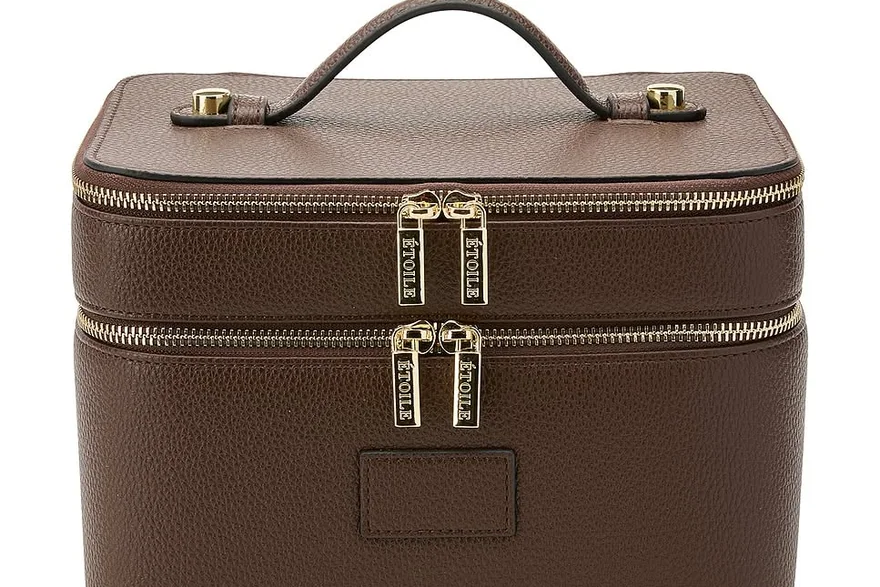
What capsule beauty packing demands of a cosmetic bag
Capsule beauty packing is the practice of committing to a fixed, small set of products, usually 8 to 14 items covering base, colour, tools and skin care, and carrying only that set for a season or a trip. The cosmetic bag inside that system is not storage in the ordinary sense; it is a constraint device. Its job is to hold exactly the agreed set, to refuse the extra items that drift in, and to make every product visible in a single motion. A bag cut to accommodate twice the capsule invites the capsule to grow, and growth is precisely the failure the method exists to prevent.
Three failure modes repeat in capsule programmes. Volume mismatch comes first: a shell cut for 2.8 litres holding a 1.2-litre kit lets items slide, and sliding is what cracks pressed powder and loosens compact hinges. Compartment excess comes second, because six pockets spread across a 20 cm base push each pocket below 3 cm of usable width, so a standard lipstick tube or a mascara wand no longer sits square. Lining darkness comes third, since a black interior opened under a bathroom light loses small items to shadow even when the bag is only half full.
The practical target is therefore a shell sized to roughly 1.3 to 1.6 times the packed volume of the capsule, one main compartment, one slip pocket no wider than half the base, and a lining in a light neutral such as bone, sand or pale grey. Empty weight for a bag in this class usually lands between 180 and 260 g depending on whether a thin foam laminate sits behind the shell. Because fill rate in daily use sits at 40-60 per cent, semi-structured bodies outperform both floppy pouches and rigid framed cases.
- Set the half-full bag on a bench and push the sidewall: collapse beyond 40 per cent of height means the body needs a 1.5-2 mm foam laminate or a 320 g/m² shell.
- Open the bag flat and time how long it takes to locate one named item; more than three seconds means the lining tone or pocket count is wrong.
- Load the capsule, close the zip and shake gently for five seconds; any audible movement means packed volume is below 55 per cent of the shell.
Size to 1.3-1.6 times packed volume, not to the largest item. A capsule bag that fits perfectly when new is already too small once a seasonal swap adds one product.
Sizing the shell to a capsule count
Capsule sizes cluster into four bands, and each band maps to a different body form. Working from item count rather than from a generic small-medium-large scale keeps the specification honest, because the count is the one number a brand owner can actually hold fixed across a season. The table below sets out the band, the packed volume it produces, the internal footprint that suits it, the loaded weight a buyer should expect and the body form that carries it best.
| Capsule size (items) | Packed volume (L) | Internal footprint (cm) | Loaded weight (kg) | Recommended body form |
|---|---|---|---|---|
| 6-8 (essentials only) | 0.8-1.0 | 18 x 10 x 7 | 0.35-0.45 | Flat zip pouch, no gusset |
| 9-12 (standard capsule) | 1.2-1.6 | 20 x 12 x 8 | 0.55-0.75 | Slim box pouch, 2 cm gusset |
| 13-16 (extended capsule) | 1.8-2.2 | 23 x 13 x 9 | 0.85-1.05 | Structured dome, 3 cm gusset |
| 17-20 (capsule plus tools) | 2.4-2.9 | 26 x 15 x 10 | 1.15-1.45 | Small train case, framed base |
Carton planning follows from the footprint. A 20 x 12 x 8 cm box pouch nests to roughly 3 cm when empty, so forty units stack to about 120 cm and a standard export carton takes two stacks side by side rather than one deep stack. Nesting deeper than eight units compresses the gusset seam and leaves a crease that does not come out, so carton counts should be set by nesting height with a divider every eight. This matters more for capsule bags than for larger cases, because the whole proposition is a clean silhouette, and a creased panel reads as a defect even when the bag is functionally sound.
Two corrections matter when reading the table. Loaded weight assumes a typical mix of plastic and glass primary packaging; a capsule built around glass dropper bottles and a mirror compact will run 20-30 per cent heavier, which argues for the next footprint up rather than for a stronger zip. Internal footprint is measured seam to seam, so the external cut must add 1.5-2 cm in each direction for seam allowance and laminate thickness. A buyer specifying 20 x 12 x 8 cm internally should expect an external shell near 23 x 15 x 10 cm once a 2 cm gusset is folded in.
Height deserves separate attention. Capsule kits rarely stand items upright; a foundation bottle at 14 cm tall laid on its side fits a 20 cm bag comfortably, but a 16 cm pump bottle does not, and forcing it in distorts the gusset permanently. Where the capsule contains anything above 15 cm, the specification should move to the extended band even if the item count says otherwise. This is the single most common reason a capsule bag returns from sampling looking correct but failing in use. Bags in this class are also frequently carried inside a handbag rather than inside a suitcase, which caps the useful external footprint near 26 cm regardless of how many items the capsule holds.
- Measure the tallest item in the capsule first, then choose the band by height, then confirm the band by count.
- Add 1.5-2 cm per dimension from internal to external before writing the tech pack.
- Allow 0.2 L of headroom above packed volume for a seasonal swap or one gifted item.
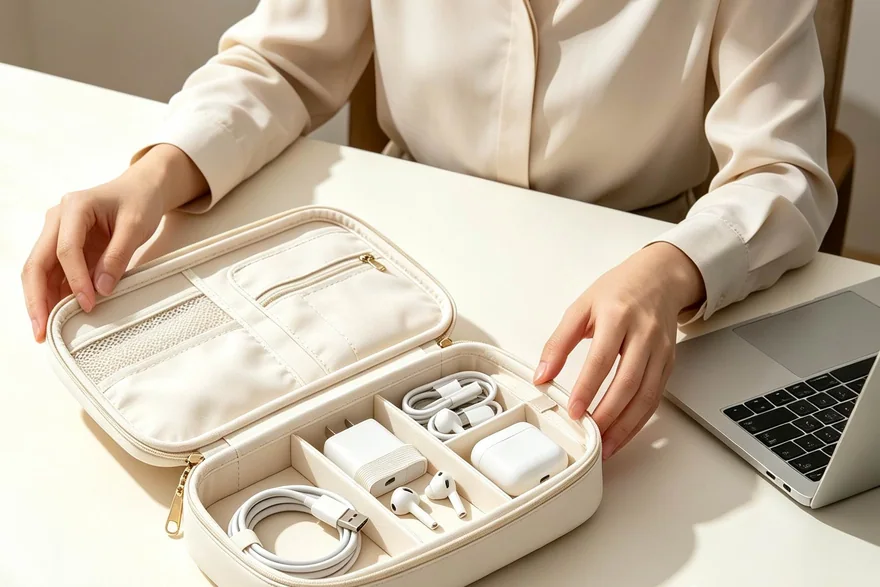
Materials and closures for a reduced kit
Minimalist briefs fail on material more often than on size, because restraint in the silhouette is easy to specify and restraint in the hand-feel is not. A shell that is too light collapses; a shell that is too heavy turns a 220 g pouch into a 400 g pouch and quietly defeats the point. The specification below keeps the bill of materials short and each component accountable to a measurable value.
- Shell: 300D rPET at 240-320 g/m² with a documented recycled claim, or 420D nylon ripstop where abrasion resistance outranks recycled content.
- Lining: 150D polyester in bone, sand or pale grey with a wipe-clean finish and no print that reduces contrast against product packaging.
- Structure: 1.5-2 mm foam laminate behind the shell, or a 320 g/m² self-supporting face fabric; no wire frame, no baseboard.
- Closure: #3 nylon coil zip, 180-degree opening, single puller weighing 4-6 g so the slider does not drag the shell out of shape.
- Pocket: one slip pocket, maximum half the base width, 6-7 cm deep so a mascara wand stands clear of the zip line.
- Hardware: total metal or plastic component count under five pieces; a wrist strap D-ring only where the brief calls for one.
Recycled content is where documentation has to be arranged early. A 300D rPET face fabric carrying a recycled claim needs chain-of-custody paperwork in place before bulk cutting, and buyers can check the scope of that paperwork against the Global Recycled Standard. Where the capsule line also touches skin, the shell and lining should be certified to the OEKO-TEX Standard 100 limit values, and the certificate should name the fabric supplier rather than the finished bag, since that is how the certificate is issued.
The zip is the component most often under-specified in a minimalist bag. Nylon coil in a #3 gauge gives a flatter tape than metal and lets the bag open to 180 degrees without a corner box, which is what makes a one-compartment interior usable. Terminology for tape, slider, puller and stop should be written using the definitions in ASTM D2053 so that a sample rejection cites a shared vocabulary rather than an adjective. Puller weight matters more than buyers expect: above 8 g the puller swings and creases the shell at the zip end during handling.
A pale lining brings one extra obligation. Light shades show dye transfer from dark product packaging and from denim, so the lining should be tested for colour fastness to rubbing and to perspiration using the ISO 105 series and, for a bag sold into North America, the AATCC grey-scale methods listed by AATCC. A target of grade 4 or better on dry and wet rubbing is realistic for a 150D polyester lining and should be written into the tech pack rather than assumed.
Branding, colourways and run mechanics
Branding on a minimalist bag is a negotiation with the brief itself. The buyer wants the mark present; the aesthetic wants it nearly absent. Deciding that in advance, in terms of visual weight and durability, prevents the common outcome where a screen print approved on a 15 cm monitor reads as loud on a finished 20 cm shell.
| Branding method | Visual weight on a neutral shell | Cycles before visible fade | Fit for a minimalist brief |
|---|---|---|---|
| Blind deboss (no foil) | None in flat light, reads in raking light | 15,000+ | Strongest fit: identity without contrast |
| Tonal embroidery | Low, one to two shades off shell | 12,000 | Good where a tactile mark is wanted |
| Laser-etched metal puller | Very low, hidden in hardware | 8,000 | Best for hardware-only identity |
| Single-colour screen print | Medium, hard edge against fabric | 5,000 | Acceptable on canvas, weaker on rPET |
| Woven label, 12 mm | Low, confined to one seam | 20,000 | Good for interior or side-seam placement |
Colourway strategy interacts directly with the minimum. The programme minimum is 500 pieces per style and colourway, so a launch in three colours is three separate 500-piece commitments unless the run is consolidated. For capsule lines the usual resolution is one body in two colourways at 500 each, with the third colour held for a reorder once the first drop has sold. Sampling runs 6-10 working days for a straightforward box pouch, extending to 12-15 working days where a deboss tool or a custom puller mould is involved, and bulk production runs 35-50 days after sample approval.
- Freeze the tech pack before the first sample: capsule bags have few components, so any late change moves the whole specification.
- Order the deboss tool at sample stage if the mark is blind, since tool lead time otherwise lands inside the bulk window.
- Approve one golden sample per colourway and keep it under the same lighting used for bulk inspection.
- Plan the reorder colourway as a repeat, not a development, so the second drop reorders unchanged.
Reorder discipline is where capsule programmes either compound or stall. Because the format has few components and a tight silhouette, the cheapest second run is one that reorders a frozen specification: same shell, same laminate, same zip, new colourway only. Any change to shell weight or laminate thickness restarts the sample cycle, since both alter the silhouette the proposition depends on. Buyers who intend to run capsule bags as a recurring line should therefore treat the first 500-piece order as a specification exercise as much as a sales one, and should sign off a golden sample per colourway with the tolerance values written rather than implied.
Inspection closes the loop. A 500-piece capsule bag run inspected to AQL 2.5 under the procedures in ISO 2859-1 draws a sample of 50 pieces with an accept number of 3 and a reject number of 4 for major defects. Because capsule bags are judged on silhouette as much as on stitching, the defect list should include shape collapse, zip wave and lining contrast, not only broken stitches. Shipment moves FOB Xiamen and payment is T/T with 30 deposit and 70 against bill of lading.
The B2B Customisation View
A realistic cosmetic bags schedule assumes one round of sample revision; planning for a perfect first sample is the most common cause of a slipped launch.
Fixed commercial parameters: 500 pieces per style and colourway minimum, first sample in 6–10 working days (12–15 for complex or hardware-intensive constructions), bulk 35–50 days after approval, AQL 2.5 inspection under ISO 2859-1, FOB Xiamen, T/T 30/70.
A sourcing-partner structure also protects the buyer when volumes grow, because capacity for cosmetic bags can be spread across SGS-verified production lines without changing the specification.
Which Brand Types Benefit Most
Start-up brands benefit most from capsule bags because the format converts a small product range into a complete-feeling offer. A brand with four to six SKUs can put the whole line into a 20 x 12 x 8 cm pouch and sell it as a system rather than as samples, and the 500-piece minimum per style and colourway is low enough that a first drop need not be split across three bodies. The constraint to respect is sequencing: the bag has to be approved before the kit photography, so sampling should start at least 8 weeks ahead of the launch date, allowing 6-10 working days for the sample and 35-50 days for bulk.
Established brands use capsule bags differently, typically as a travel or refill companion sold alongside a full range rather than as the range itself. Their priority is family discipline: the capsule pouch has to use the same hardware finish, the same lining tone and the same Pantone range as the main line, which argues for documenting a standard component set once and reusing it. Retailers and e-commerce sellers favour the format for gifting, where a slim pouch reads as considered rather than cheap and ships in a mailer at a lower dimensional weight than a framed case.
Gift and hospitality buyers come at it from the amenity side: a capsule pouch filled with three or four travel sizes works as a welcome gift, a loyalty tier or a purchase-with-purchase, and the neutral shell accepts a blind deboss that keeps the property name present without shouting. Across all four buyer types the specification converges on the same three decisions: footprint chosen by capsule count, one compartment with one slip pocket, and a pale lining that makes a small kit easy to read. QUANZHOU JUNYUAN BAGS coordinates programmes of this kind, and enquiries go to [email protected].
Frequently Asked Questions
What internal volume suits a 12-item capsule beauty kit?
A 12-item capsule packs to roughly 1.2-1.6 litres, so the shell should be specified at 1.3-1.6 times that figure, meaning about 1.8-2.3 litres of internal volume. In practice that is a 20 x 12 x 8 cm internal footprint with a 2 cm gusset. Going larger lets items slide and raises the risk of cracked powder; going smaller forces the gusset and distorts the silhouette within weeks.
How many pockets should a minimalist cosmetic bag have?
One main compartment plus a single slip pocket is the working answer. Across a 20 cm base, six pockets leave each under 3 cm wide, which is narrower than a lipstick tube or a mascara wand. The slip pocket should be no wider than half the base and 6-7 cm deep. More pockets fragment a capsule and make the bag harder to read, which defeats the method.
Which shell fabric weight works for a slim capsule pouch?
Between 240 and 320 g/m² in a 300D rPET or 420D nylon ripstop. Below 240 g/m² the sidewall collapses past 40 per cent of its height when the bag is half full, which is the everyday fill rate for a capsule kit. Above 320 g/m² the empty weight climbs past 260 g and the bag stops feeling like a minimalist item even though it looks like one.
Why does a dark lining cause problems in a small cosmetic bag?
A black or charcoal interior absorbs the light available in a bathroom or a hotel room, so small items fall into shadow and take more than three seconds to locate. Capsule packing depends on seeing the whole set at once. A bone, sand or pale grey lining at 150D keeps contrast high against product packaging and is easier to wipe clean of foundation and powder residue.
What zip size gives a 180-degree opening on a slim pouch?
A #3 nylon coil zip is the usual choice. The coil tape is flatter than a metal chain, so the bag opens fully flat without needing a corner box, and the single compartment becomes genuinely usable. The puller should weigh 4-6 g; heavier pullers swing during handling and crease the shell at the zip end. Zip terminology should follow ASTM D2053 in the tech pack.
How does the minimum apply across colourways of one minimalist bag?
The minimum is 500 pieces per style and colourway, so a three-colour launch is three separate 500-piece commitments rather than 500 split three ways. The common resolution is one body in two colourways at 500 each, with the third colour held for a reorder. Reorders of an unchanged specification are cheaper in time than new colour development. Consolidating a launch into fewer bodies with more variety in the trim is usually the cheaper route than three full colourway commitments.
Which colourways perform best in capsule beauty programmes?
Neutral mid-tones dominate: bone, sand, warm grey, oatmeal and soft taupe. They hide handling marks better than white, they accept a blind deboss without contrast problems, and they photograph consistently under mixed lighting. Deep tones are used for a second colourway but show powder dust more readily, so the lining in those bags should stay light regardless of the shell shade.
How long does sampling take for a flat zip pouch with a debossed logo?
Allow 12-15 working days where a deboss tool or a custom puller has to be made, and 6-10 working days for the same pouch with stock hardware. The tool is the variable, not the sewing. Buyers who need the bag for kit photography should start sampling at least eight weeks before the launch date so the bulk window is not compressed.
What is the bulk production window for 2,000 slim cosmetic pouches?
Bulk runs 35-50 days after sample approval, and 2,000 pieces spread across four colourways of 500 sits inside that window without special scheduling. The window widens toward 50 days where a deboss tool was cut late or where the lining requires a certified fabric with its own mill lead time. Freight planning should start once the golden sample is signed.
How is colour fastness checked on a neutral-toned shell?
Colour fastness to rubbing and to perspiration is tested using the ISO 105 series, with AATCC grey-scale methods used for bags sold into North America. A 150D polyester lining should reach grade 4 or better on dry and wet rubbing. The requirement belongs in the tech pack, because a pale shell shows dye transfer from denim and from dark product packaging more visibly than a dark one.
Does a recycled rPET shell need documentation for a capsule line?
Yes. A recycled content claim needs chain-of-custody paperwork in place before bulk cutting, and buyers should check its scope against the Global Recycled Standard. The transaction certificate names the fabric supplier rather than the finished bag, so the document has to be requested from the fabric source early. Delayed paperwork is a frequent cause of a hold at the packing stage.
What does AQL 2.5 mean for a 500-piece minimalist bag order?
Under ISO 2859-1 at AQL 2.5, a 500-piece lot draws a sample of 50 pieces, with 3 major defects accepted and 4 rejected. Because capsule bags are judged on silhouette, the defect list should cover shape collapse, zip wave and lining contrast alongside broken stitches. Without those entries, a bag that passes inspection can still look wrong on shelf. A rejected lot is reworked and re-inspected, and responsibility for that cost should be agreed in the purchase order before production begins.
How should capsule bags be packed for shipment to keep their shape?
Pack flat, nested no more than six deep, with a tissue or polybag separator and a corrugated divider between layers. Semi-structured bodies with a 1.5-2 mm foam laminate recover well, but permanent creasing can occur if cartons are over-filled to hit a target cube. Carton counts should be set by the nesting height rather than by a round number. Cartons should stay dry in transit, since a compressed semi-structured panel that gets wet creases permanently.
Can a minimalist bag hold shape without internal framing?
Yes, provided the face fabric is at least 320 g/m² or carries a 1.5-2 mm foam laminate. Framing adds 80-120 g and a hard baseboard that fights the brief. The test is simple: load the bag to 40 per cent fill, stand it and push the sidewall. If the collapse exceeds 40 per cent of height, increase the laminate thickness before adding structure.
What lining colour keeps a small capsule kit easiest to read?
Bone or warm sand at 150D with a wipe-clean finish. Both give high contrast against black, white and metallised packaging, and both tolerate foundation marks better than optic white. Pale grey is the third option and reads slightly cooler under LED lighting, which matters where the bag is sold online and photographed under studio light. Where the shell is dark, a light lining is not a preference but a requirement, because it is the only way contents stay legible in low light.
How is FOB Xiamen pricing structured for a slim pouch programme?
FOB Xiamen pricing covers the goods and their delivery onto the vessel at Xiamen, with freight, insurance, duty and onward carriage carried by the buyer. Payment is T/T with 30 deposit and 70 against bill of lading. For capsule bags the main price drivers are fabric weight, laminate thickness, zip gauge and whether a deboss tool or custom puller is amortised into the run.
People Also Ask
What size makeup bag do minimalists actually need?
Most capsule kits of 9-12 items need a bag around 20 x 12 x 8 cm internally, or 1.2-1.6 litres of packed volume plus headroom. The correct method is to measure the tallest item first, choose the size band by height, then confirm it by item count. Anything above 15 cm tall pushes the kit into the extended band regardless of count. A capsule bag is carried half empty most days, so shape retention matters more than raw capacity.
Are minimalist cosmetic bags cheaper to produce?
Component count is lower, which helps, but the savings are often absorbed by better materials. A semi-structured shell at 320 g/m² with a foam laminate costs more per metre than a floppy 190T lining-grade polyester. The realistic saving comes from fewer pockets, one zip rather than three, and hardware count under five pieces, not from a cheaper face fabric. Fitting is also slower at first, since a tighter silhouette leaves less room for sewing tolerance.
Can one bag work for both a capsule kit and travel?
Yes for trips of two to five days, where the capsule and the travel kit are the same set. Beyond a week, tools and skin care usually expand the set past 14 items and the 20 cm footprint no longer closes comfortably. A 23 x 13 x 9 cm structured dome covers both cases and is the safer single-bag answer. Beyond that point the two sets diverge, and a second, larger bag is the honest answer.
How many makeup items belong in a capsule kit?
Between 8 and 14 is the range that works with a slim pouch. Below 8 the kit stops covering a full face; above 14 the bag needs a gusset deep enough that it stops being a capsule item. The count should be fixed before the bag is specified, because the bag is sized to the count and not the other way round. Fix the count in writing before the tech pack, then size the bag to it rather than adapting later.
Request a Sample or a Written Quotation
Send the silhouette, dimensions, material preference and logo artwork, and the programme team will return a written quotation with MOQ, sampling window, bulk lead time and inspection standard.
Email: [email protected] · WhatsApp: +86 177 5002 0688