Eyelash & Eyebrow Tool Cases: Delicate Item Protection
Executive Summary
An eyelash and eyebrow tool case is a structured container that keeps an eyelash curler, tweezers, brow scissors and brushes from being crushed, blunted or contaminated in transit. The design problem is not volume but shape: a curler has a curved jaw that loses its arc under point load, and tweezers and scissors have tips that blunt against each other. Tray geometry and rigid shell construction decide whether the tools arrive usable.
Protection splits into three specifications worth writing separately: crush resistance of the shell, tip management for pointed tools, and separation between tools so residue is not transferred. A curler needs a relieved pocket that carries load on its handles, tweezers need an individual sleeve or slot, and blades need a guard. Because the tray is a moulded part, the tool set has to be measured and frozen before tooling, and holding pocket dimensions constant across a range lets one tray serve several kits. Minimum order is 500 pieces per style and colourway, sampling 6-10 working days, and inspection at AQL 2.5 under ISO 2859-1 should include placing the real tool set into every cavity.
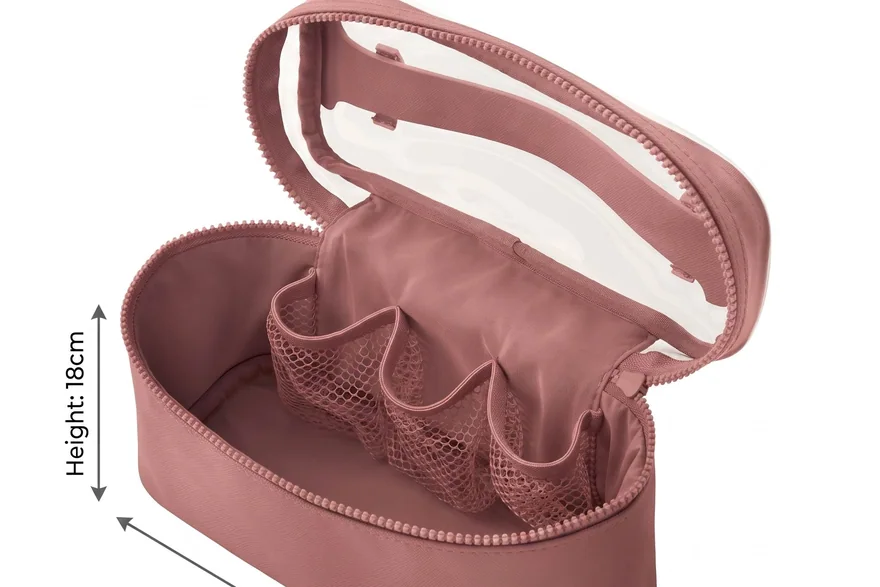
What a lash and brow tool case has to protect
An eyelash and eyebrow tool case carries a set of small, precise, mostly metal implements that are expensive to replace, unpleasant to damage and genuinely degraded by being thrown together in a pouch. The list typically includes an eyelash curler, at least one pair of tweezers, brow scissors, a spoolie or lash comb, and often a dermaplaning or brow razor and a small pot of lash adhesive. What makes these awkward to store is not their size but the combination of a curved clamping jaw, several fine points and one or two sharp edges.
Damage modes are specific and predictable. A curler that is pressed on the outside of its curved jaw loses the arc that makes it work, and misaligned jaws give an uneven curl that the user notices immediately. Tweezers that rattle against scissors blunt at the tip, and a tweezer tip that no longer closes flush cannot grip a fine hair - the tool is finished, at any price. Brow scissors pick up nicks on the blade edge from the same contact. None of this is visible on a product listing, which is why it generates returns out of proportion to the value of the item.
- Eyelash curler: 100-115 mm long, head 35-45 mm wide, jaw opening 20-25 mm, 60-90 g.
- Slant or point tweezers: 90-120 mm, tip meeting gap under 1 mm when closed.
- Brow scissors: 90-110 mm with a 25-35 mm blade, sometimes with rounded safety tips.
- Spoolie and lash comb: 90-120 mm, flexible bristles that take a permanent set if bent.
- Brow razor or dermaplaning tool: 120-150 mm with a guarded replaceable blade.
Two more constraints shape the design. The first is residue: lash adhesive, brow pomade, pigment and skin oils are on these tools when they are put away, so a case that lets them touch also lets them exchange residue. The second is regulatory: a metal implement with a fine point is a sharp object, and where a case is sold with a tool inside, the packaging has to manage the point rather than leave it exposed at the opening of a sleeve.
Crush protection for curved and pointed tools
Crush protection is a shell problem before it is a tray problem. A soft pouch with a die-cut foam insert will survive normal handling and will fail in a suitcase under a 10 kg load, because the load path goes straight through the foam into whatever is inside. A structured case distributes that load around the cavity: a moulded EVA shell with a wall thickness of 4-6 mm, or a rigid PP or ABS shell with a positive lid stop, carries the external load on the shell rather than on the contents.
The second half of crush protection is cavity geometry, and this is where curved tools need specific treatment. An eyelash curler is not a rectangle: it has a curved upper jaw, a pivot, two handle loops and a rubber pad that must not be compressed permanently. A cavity that grips the tool by its handles and leaves relieved space around the jaw head is the correct shape. A cavity that grips the head, which is what a simple rectangular slot does, applies load exactly where the tool is least able to take it.
| Tool | Load-sensitive feature | Failure under point load | Protective cavity geometry |
|---|---|---|---|
| Eyelash curler | Curved jaw arc and the rubber pad | Arc flattens, pad takes a permanent compression set | Relieved pocket around the head, grip on the handle loops |
| Slant tweezers | Tip alignment and meeting gap | Tips splay; the tool no longer grips a fine hair | Individual slot with a closed end, tip seated in a relieved well |
| Brow scissors | Blade edge and pivot tension | Edge nicks; pivot loosens and the blades rake | Flat slot with a blade guard, pivot supported on both faces |
| Spoolie or lash comb | Bristle set | Bristles take a permanent bend | Shallow open channel, no lid contact on the bristle field |
| Brow razor | Guarded blade edge | Guard deforms and the blade is exposed | Full-length sleeve or a clipped holder with a fixed guard |
Clearance matters in both directions. Too much clearance and the tool moves, which is how tips and edges get damaged by impact rather than by pressure; too little and the tool is under constant compression, which is how a curler pad loses its resilience. A clearance of 1.5-3 mm around the rigid parts of a tool, with the lid providing a positive stop rather than a compressive squeeze, is the usual target. Where the shell is moulded EVA, the lid should meet the tray edge so that the two halves share the load through the tray walls.
Buyers should also decide whether the case is meant to be packed inside another bag. A tool case that lives in a bathroom drawer only has to survive being knocked off a shelf; one that travels inside a suitcase has to survive a sustained external load, and that is the case that needs a rigid shell rather than a moulded EVA one. The same decision drives the lid: a case that will be stacked needs a positive stop, so the load is taken by the shell walls rather than by whatever is inside.
Inspection should reflect this. Crush resistance is not something an inspector can judge by eye on a finished case, so the practical approach is to define the check on the cavity: a go/no-go gauge or the actual tool set placed into every cavity, with no rocking and no compression of the pad. Written into the inspection plan at AQL 2.5 under ISO 2859-1, that converts an opinion into a countable defect.
Tip guards, sleeves and edge management
Pointed and edged tools need their own protection beyond a cavity, because a slot protects a tip from pressure but not from contact with the case wall or with a neighbouring tool. Tip guards fall into four practical families. A moulded or extruded sleeve slides over the point and is the most reliable. A cap or boot of silicone or TPU presses onto the tip. A fold-over flap of coated fabric or webbing straps over the business end. A relieved well in the tray keeps the tip clear of everything without covering it.
Each has a cost and a failure mode worth knowing. Sleeves are cheap and effective but get lost, and a lost sleeve means the protection is gone for the rest of the product's life. Silicone caps stay attached better and can be tethered, but they add a moulded part and their own colour-matching problem. Fold-over flaps cost little and never get lost, but they only work while the flap is closed, and users leave them open. Relieved wells are permanent and invisible, and they fail only when the tool is put back the wrong way round.
| Guard type | How it works | Lost-in-use risk | Added cost per unit |
|---|---|---|---|
| Sliding sleeve | Rigid or semi-rigid tube over the point | High; the sleeve is a separate part | $0.06-$0.18 |
| Silicone or TPU cap | Press-fit boot over the tip, can be tethered | Medium; tethering removes most of it | $0.12-$0.30 |
| Fold-over flap | Coated fabric or webbing strap folded over the tips | None, but useless when left open | $0.08-$0.20 |
| Relieved tip well | Tray geometry keeps the point clear of all surfaces | None; permanent | No added part; tooling only |
| Blade sheath | Full-length cover over a razor or scissor blade | Low; usually clipped in place | $0.15-$0.35 |
Edge management for scissors and razors is a related but separate problem. A scissor blade does not blunt from blunt force, it picks up edge damage from lateral contact, so the guard has to prevent side-to-side movement rather than resist downward pressure. A slot that supports the blade on both faces, with the pivot end stopped, does this without any added part. For a brow razor or dermaplaning tool with a replaceable blade, the case should hold the tool in its guarded position and should never place the lid in contact with the blade edge.
The choice between a permanent feature and an added part is worth making deliberately. A relieved tip well costs tooling but no unit cost and cannot be lost, while a silicone cap costs unit cost and can be lost unless it is tethered. For a low-price kit the well is the better answer; for a premium kit, a tethered cap reads as a quality feature and is worth the extra part.
There is a safety dimension that belongs in the specification rather than the marketing. A case that lets a tweezer point or a scissor tip project through a soft wall, or that presents a sharp point at the mouth of a sleeve when the tool is withdrawn, is a handling hazard for the user and a packaging problem for the retailer. Metal implements in skin contact are also subject to substance restrictions under EU REACH where they are supplied with the case, so a nickel-release specification should be written for any plated tool included in a kit.
Tray geometry and contamination transfer between tools
Every lash and brow tool goes into its case carrying something. Lash adhesive leaves a film on curler jaws and on applicator tips. Brow pomade and pigment coat tweezer tips and spoolie bristles. Skin oils are on every handle. In a shared cavity, all of that transfers: pigment onto a pale curler pad, adhesive onto a spoolie, and everything onto the case lining. The user then meets the residue on the next use, on a tool that was cleaned before it was put away.
Separation is the design answer, and it has a hierarchy. Individual cavities for each tool are the baseline; tool-to-tool contact should be impossible when the lid is closed. Beyond that, the order of tools matters: the curler, which carries the most adhesive, should not sit adjacent to the spoolie, whose bristles are the hardest thing in the kit to clean. Adhesive-containing items should be in a compartment that can be wiped, and ideally one that is separated from fabric-lined areas entirely.
| Tray layout | Tool separation | Cleaning access | Best suited to |
|---|---|---|---|
| Die-cut foam slots in a moulded EVA shell | One slot per tool, 4-6 mm walls between | Wipe the foam; residue absorbs into cut cells | Standard kits; the default at mid price |
| Moulded PP tray inside a fabric or EVA shell | Individual moulded channels with positive stops | Tray lifts out and rinses; best cleaning of the four | Travel kits and professional use |
| Elastic loops on a flat panel | Loops separate shafts but not tips or heads | Wipe only; loops collect residue at the stitch | Slim folio cases where depth is limited |
| Silicone or TPU moulded mat | Individual shaped wells, flexible walls | Rinses and inverts; non-absorbing | Washable ranges and humid bathrooms |
| Single open cavity with a divider flap | One divider; heads and tips still meet | Wipe only; corners retain residue | Budget cases and promotional kits |
Ordering the layout around cleaning, rather than around size, also helps. The tools that arrive dirtiest should sit nearest the opening of the tray so they can be lifted out first, and the compartment that takes adhesive should be the one that can be wiped without disturbing anything else. A tray that can be removed entirely is worth the extra tooling wherever the kit is used daily.
Lining and interior colour interact with contamination in a way that drives returns. A pale interior shows every mark of adhesive and pigment, and customers read staining as a defect even when the case has done its job. A mid-tone interior in a low-absorbency material - coated polyester, moulded PP or silicone - hides residue and wipes clean, which is the combination that performs best in service. Any fabric lining in contact with adhesive will hold it permanently and should be avoided in the curler compartment.
Ventilation deserves a brief mention because these cases are kept in bathrooms. A moulded EVA shell with fabric lining holds moisture after the case is wiped; a moulded PP tray with drain slots at the cavity floor lets water escape and dry. Where the kit includes a lash adhesive that is sensitive to humidity, a ventilated tray plus a separate sealed compartment for the adhesive is a better arrangement than ventilating the whole case. Component certification for fabric and foam parts under OEKO-TEX Standard 100 covers the textile elements of the case.
The B2B Customisation View
Range planning for makeup bags and toiletry bags works best when the hero style and the gift-with-purchase style are engineered together, sharing linings and hardware to protect the budget.
Planning figures used across the programme: MOQ 500 pieces per style and colourway, 6–10 working days sampling (12–15 when moulding or multi-layer lamination is required), 35–50 days bulk lead time, AQL 2.5 to ISO 2859-1, FOB Xiamen, T/T 30/70.
The value of a programme-coordination model is continuity: QUANZHOU JUNYUAN BAGS keeps the approved reference sample, the shade standard and the AQL record for every repeat order.
Which Brand Types Benefit Most
Start-up brands use a lash and brow tool case to sell a kit rather than a commodity accessory: a curler, tweezers and scissors presented in a shaped case reads as a product, whereas the same three tools in a polybag read as a parts list, and the 500-piece minimum per style and colourway is realistic for a first kit drop. Established brands benefit from cavity standardisation - holding curler pocket, tweezer slot and blade channel dimensions constant across a range lets one tray tool serve several kits. Retailers and private-label buyers should specify the tip-guard approach explicitly, because the guard is the difference between a kit that arrives usable and one that arrives with blunt tweezers, and it is invisible in a listing photograph. E-commerce sellers should insist on a mid-tone, low-absorbency interior, since adhesive staining on a pale lining is one of the most photographed complaints in this category. Professional, salon and beauty-box buyers should favour moulded PP trays that lift out, because a tray that can be rinsed is the only interior that survives daily use with adhesive and pigment on the tools. Cavity tooling is the planning decision here as well: a shaped tray is cut for a specific tool set, so the tools have to be measured and frozen before the tool is cut, and a later change of curler supplier forces a retooling unless the pocket dimensions were held generously. Buyers should also decide whether tools ship fitted in the case or packed separately, because a fitted set changes the packed profile and the carton count and raises the risk of tip damage if the case flexes in transit.
- Start-up brands: a shaped case turns three loose tools into a sellable kit.
- Established brands: standardise cavity dimensions so one tray serves a range.
- Retailers and private label: specify the tip guard, since it is invisible in photography.
- E-commerce sellers: mid-tone low-absorbency interiors avoid staining complaints.
- Salon and beauty-box buyers: lift-out PP trays are the only interiors that survive adhesive.
Frequently Asked Questions
What wall thickness does a lash tool case need for crush protection?
A moulded EVA shell of 4-6 mm wall, or a rigid PP or ABS shell with a positive lid stop, carries external load on the shell rather than the contents. A soft pouch with a foam insert handles normal handling but fails under suitcase loads, because the load path passes straight through the foam into the tool.
Why does an eyelash curler need a relieved pocket rather than a slot?
The curler's working feature is the arc of its curved jaw and the resilience of its rubber pad. A simple rectangular slot grips the head, which is exactly where the tool cannot take load: the arc flattens and the pad takes a permanent compression set. The cavity should grip the handle loops.
How much clearance should a tweezer slot have?
Around 1.5-3 mm on the rigid parts of the tool, with a relieved well at the tip end. Too much clearance lets the tweezers move and impact the case wall, which splays the tips; too little keeps them under compression. The lid should provide a stop, not a squeeze.
Which tip guard is most reliable for tweezers?
A relieved tip well in the tray is the most reliable because it is permanent and cannot be lost. Where a physical guard is wanted, a tethered silicone cap beats a sliding sleeve, which is the part most often lost in use. Fold-over flaps work only while the user closes them.
How should brow scissors be held in a case?
In a slot that supports the blade on both faces with the pivot end stopped. Scissor edges are damaged by lateral contact rather than by downward pressure, so the guard has to prevent side-to-side movement. A blade sheath is worth adding where the scissors travel loose.
Can a brow razor be stored in the same case as tweezers?
Yes, if the razor is held in its guarded position in a full-length sleeve or clipped holder and the lid never contacts the blade edge. The razor should not share a cavity with anything else, because a deformed guard exposes the blade and creates a handling hazard.
How does a case stop residue transferring between tools?
By giving every tool its own cavity with 4-6 mm walls between them, and by ordering the layout so the adhesive-carrying curler is not adjacent to the spoolie, whose bristles are the hardest item to clean. Shared cavities let pigment, adhesive and skin oils move between tools on every trip.
What interior material resists adhesive staining best?
Moulded PP or silicone, both non-absorbing and wipeable. Coated polyester is the next best. Fabric lining in the curler compartment should be avoided entirely, because lash adhesive soaks in and cannot be removed. A mid-tone colour hides what wiping misses.
Should a lash tool case be ventilated?
Partly. A moulded tray with drain slots at the cavity floor lets water escape after wiping, which suits a bathroom environment. The lash adhesive compartment should stay sealed and dry, so the better arrangement is a ventilated tool tray plus a separate closed compartment for adhesive.
What interior colour shows the least staining?
A mid-tone. Very pale interiors show every mark of adhesive and pigment, and customers read staining as a defect even when the case performed correctly. Very dark interiors hide residue but also hide when cleaning is needed. Mid-tone low-absorbency is the practical choice.
What minimum order applies to a shaped lash and brow tool case?
The programme minimum is 500 pieces per style and colourway. A shaped cavity requires tooling, so the tool set should be measured and the cavity drawing frozen before the tool is cut. Existing tray tooling can often be re-coloured without a new tool, which is the cheapest route to a second kit.
How long does sampling take for a tool case with a new tray?
Standard sampling is 6-10 working days. A new moulded tray, a hinged lid or an over-moulded tip-guard feature moves the programme into the 12-15 working day bracket. Buyers can shorten the schedule by supplying the actual tool set, so the cavity can be fitted to real parts rather than to a drawing.
How is cavity fit inspected at AQL 2.5?
By placing the real tool set into every cavity and checking for rocking, compression of the curler pad and tip contact with the tray wall. Written into the plan under ISO 2859-1 at AQL 2.5, that turns an opinion into a countable defect, which is what makes an AQL level actionable.
Does a case sold with metal tools need compliance documentation?
Where plated metal implements are included, nickel release is restricted under EU REACH for items in prolonged skin contact, so a plating specification should be written into the kit. Fabric and foam components of the case itself can be covered by OEKO-TEX Standard 100 certification for their part.
Can a lash tool case be designed for a replaceable tool set?
Yes, and it is worth doing: holding the curler pocket and tweezer slot dimensions constant lets a later tool revision drop into the existing tray. The alternative is a tray that fits only one generation of tools, which forces a retooling the first time the brand changes its curler supplier.
What causes tweezer tips to arrive blunt in a new kit?
Contact with a neighbouring tool or with the case wall during transit. A slot protects against pressure but not against impact, so the fix is either an individual closed-end slot with a relieved tip well, or a physical guard on the tip. Shared cavities are the most common cause.
People Also Ask
How do you store eyelash curlers and tweezers safely?
In a case with an individual cavity for each tool, so tips and edges cannot contact one another. The curler should sit with its jaw head relieved and its handles held, and tweezers should have a closed-end slot or a tip guard. A shared pouch is what blunts tips.
Why do tweezers stop gripping fine hairs?
Almost always because the tips have splayed. Tip alignment depends on a meeting gap under 1 mm, and contact with another tool or with a case wall during transit is enough to open it. Once splayed, tweezers cannot be adjusted back reliably, so storage protection is the practical fix.
Can an eyelash curler be squashed permanently?
Yes. Point load on the curved jaw flattens the arc, and the rubber pad takes a compression set that does not recover. A curler stored where something presses on the head rather than the handles will give an uneven curl afterwards, which is why the cavity shape matters.
What should be inside a brow tool kit case?
A curler pocket with a relieved head, an individual tweezer slot with a tip well, a flat scissor channel with a blade guard, a shallow channel for a spoolie, and a sleeve or clip for any razor. Adhesive belongs in a separate closed compartment that can be wiped.
Are hard cases better than soft pouches for brow tools?
For pointed and edged tools, yes. A rigid or moulded shell carries external load on itself, while a soft pouch transmits that load into the tools. Soft folio cases with elastic loops work for shafts but leave tips and heads exposed, which is where the damage happens.
Request a Sample or a Written Quotation
Send the silhouette, dimensions, material preference and logo artwork, and the programme team will return a written quotation with MOQ, sampling window, bulk lead time and inspection standard.
Email: [email protected] · WhatsApp: +86 177 5002 0688