Future of Cosmetic Bags: 2030 Predictions & Innovation
Executive Summary
The question brand owners ask about the future of cosmetic bags is what the category will look like in 2030, and the honest answer is that no forecast of that kind can be measured. What can be described is direction. Four signals are visible now: material palettes narrowing toward mono-polymer and certified inputs, formats converging on modular and refillable interiors, hardware becoming serviceable rather than decorative, and product identity moving from a printed hangtag to a record attached to the individual article.
The practical response is to specify for optionality rather than to predict. A cosmetic bag built with a replaceable inner liner, standard serviceable hardware, a documented material set and a removable brand element can absorb any of those directions without re-tooling, while a bonded, bespoke, riveted construction cannot. The commercial frame stays fixed: 500 pieces per style and colourway, 6-10 working days for sampling or 12-15 for complex constructions, 35-50 days bulk, AQL 2.5 under ISO 2859-1, FOB Xiamen, T/T 30 deposit and 70 against bill of lading.

How to read a 2030 outlook for cosmetic bags
A forecast that produces a number is usually a forecast that will be wrong. Market sizes, adoption curves and unit volumes for 2030 depend on regulation, retail consolidation, consumer spending and material availability, none of which are knowable from a specification desk. What is knowable is direction, and direction is enough to make a design decision. This article therefore sets out scenarios and design directions rather than projections, and deliberately attaches no figures to any of them.
Scenario planning works because the useful question is not which future arrives but which decisions are reversible. Reversible decisions - artwork, colourway, packaging, hangtag claims - can be made late and changed cheaply. Irreversible decisions - tooling for a bespoke puller, a bonded foam panel, a riveted plate, an integrated liner - are locked in at sampling and cost a full re-development to undo. A brand owner who sorts every specification line into those two columns can act on direction without betting on a date.
Four signals are observable today and each points somewhere specific. Material palettes are narrowing as buyers ask for documented inputs. Formats are becoming modular because refillable beauty packaging is pushing the bag to behave like a container rather than a wrapper. Hardware is being reconsidered for serviceability. And product identity is moving toward a per-article record, driven by retailer data requirements rather than by consumer demand. None of these is a prediction; each is a direction already visible in briefs. The value of naming them is not accuracy but preparation: a brand owner who has written down which decisions are reversible can respond to whichever direction materialises without reopening the development. A brand owner who has not will discover the answer at the point where changing it costs a full sampling cycle.
- Documented inputs: material sets are increasingly specified with certificates rather than described in words.
- Modular interiors: liners, panels and inserts are being designed as separate removable parts.
- Serviceable hardware: standard, replaceable parts are replacing decorative bespoke castings.
- Per-article identity: a record attached to each item rather than a claim printed once on the packaging.
Material directions to 2030
Material is where the greatest convergence is happening, and it is driven less by consumer preference than by what recyclers, regulators and retail buying terms will accept. The direction is toward fewer polymers per article and toward inputs that arrive with a document. A cosmetic bag that combines a polyester shell, a nylon lining, a polyurethane coating and a foam interlining is a composite; the same bag built from one polymer family with no bonded layer is a material. The second is easier to certify, easier to claim and easier to place at end of life.
| Direction | What it means in a specification | Signal to watch | Reversibility if it stalls |
|---|---|---|---|
| Mono-polymer construction | Shell, lining, binding and thread from one polymer family | Recycler acceptance criteria published by sorters | High - a later change affects hand feel, not tooling |
| Certified recycled inputs | Chain-of-custody certificate per production lot | Retailer buying terms naming a standard | High - input can revert without tooling change |
| Bio-based or water-based coatings | Coating chemistry declared alongside the fabric | Restriction lists updated by regulators | Medium - coating affects hand and wipeability |
| Undyed and low-impact dyeing | Fewer colourways, shade bands instead of exact matches | Buyer acceptance of shade variation | High - colourways are a late decision |
| Higher-tenacity durable shells | Denier and abrasion cycles stated in the brief | Warranty and repair offers appearing in the category | High - a heavier fabric needs no new tooling |
| Cellulose and paper-based hybrids | Structural panels from a renewable sheet material | Performance in humid bathroom environments | Medium - pattern changes may be needed |
Recycled inputs deserve one clarification because the terminology is routinely misused in briefs. A recycled claim describes the input and is substantiated by chain of custody; the mechanism most often referenced is the Global Recycled Standard, whose scope and criteria are published by Textile Exchange at the GRS and RCS page. Certification is issued to a material and traced through transactions, so a claim made on a hangtag has to be matched to the certificate for the lot that shipped.
Natural-fibre directions pull the same way from a different angle. Where a brand wants a plant-based input, the organic fibre standard that buying terms most often name is the Global Organic Textile Standard, published at global-standard.org, and it covers processing and social criteria alongside the fibre itself. The practical constraint is performance: a canvas shell behaves differently from a coated polyester shell in a bathroom, and the trade is absorbency and drying time against a documented input.
Chemical safety sits underneath every one of these directions and will keep tightening. A recycled or bio-based input can still fail a restricted-substance test, because coatings, inks, adhesives and hardware are added after the fibre. Testing the finished article against a buyer-mandated standard such as OEKO-TEX Standard 100 is the route most programmes take, and it is a per-article assessment rather than a per-fibre one.
The design consequence is that material decisions should be made earlier than they were. A programme that selects a shell at material approval, tests the finished article, holds the certificate and approves a shade band has preserved every option. A programme that selects a shell for hand feel alone and discovers the coating chemistry at pre-shipment has closed most of them, usually at the point where the cost of reopening is a full sampling cycle.
Format, hardware and identity scenarios to 2030
- Scenario A - the refillable bag: an outer shell specified as durable, with a removable, replaceable inner liner that takes a standard refill format
- Scenario B - the modular organiser: a base pouch with interchangeable panels, so one shell serves travel, vanity and everyday use
- Scenario C - the serviceable bag: standard sliders, stitched end stops and split-ring pullers, sold with a spare-parts offer
- Scenario D - the identified bag: each article carries a record of material, care and end-of-life instruction that outlives the packaging
- Scenario E - the consolidated bag: fewer, larger, better-made articles replacing multipiece assortments in a range
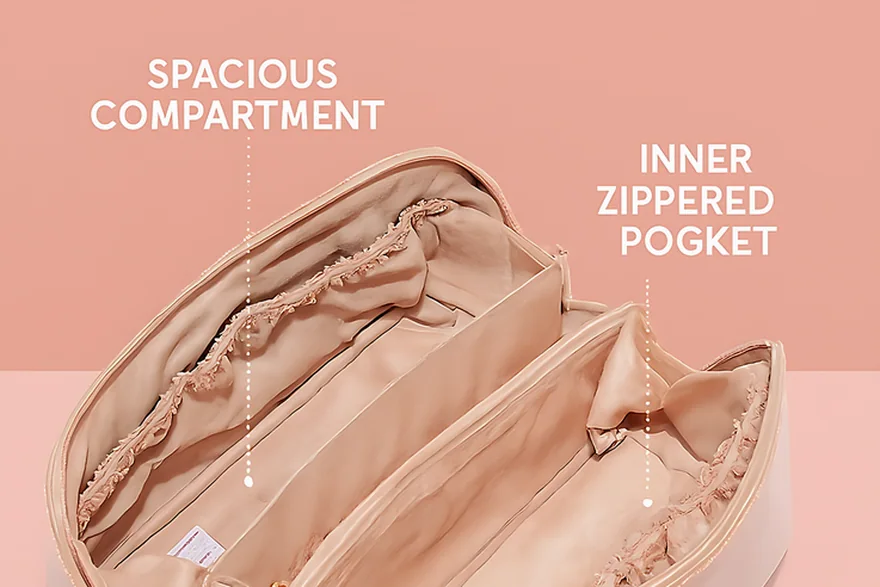
Scenario A is the one most directly pushed by packaging trends elsewhere in beauty. If refill formats consolidate, the bag stops being a wrapper and becomes a container that is expected to last through many refills. The specification consequence is durability and cleanability rather than novelty: a lining that survives repeated wiping, a seam allowance that permits repair, and an inner component that can be replaced without replacing the outer. A bag built for one refill cycle fails this scenario completely.
Scenario B follows from how people actually use these products. A cosmetic pouch bought for travel becomes a vanity organiser at home and a daily carrier in a handbag, and ranges are increasingly built to serve all three from one shell. The design move is a base article with interchangeable or removable panels - a brush panel, a palette panel, a bottle panel - attached by stitched channels or hook-and-loop rather than by adhesive. Interchangeability also makes a second purchase more useful, which is a commercial argument as much as a design one.
Scenario C is the least speculative of the five because it is already happening in briefs. Hardware specified for serviceability - a stitched rather than crimped end stop, a standard slider size, a puller on a split ring - costs less than bespoke hardware and removes the most common reason a bag is discarded. Zipper terminology and construction are standardised, which is why a brief referencing ASTM D2053 zipper terminology removes ambiguity between buyer and programme coordinator about what was actually specified.
Scenario D is driven by retailers and regulators rather than by consumers. A per-article record - material composition, care instruction, end-of-life route - attached to the item by a woven label, a printed panel or a scannable mark, answers a data requirement that packaging cannot, because packaging is discarded first. The design consequence is unglamorous: reserve space for the record, print it legibly, and keep it accurate when the material set changes. Accuracy is the hard part, not the printing.
Scenario E is the contrarian one and deserves consideration because it is the cheapest to prepare for. If ranges consolidate around fewer, better-made articles, the winning specification is durability rather than variety: heavier denier, higher stitch density, serviceable hardware and a documented material set. A brand that has already specified those things can move with the scenario without re-development, which is the entire point of scenario planning. It is also the scenario that rewards the least glamorous specification work - stitch density, seam allowance, hardware standardisation - because those are the lines that determine whether an article survives long enough to justify a smaller range. Consolidation punishes novelty and rewards durability, and durability is written into a specification long before it is written into a marketing claim.
Specification choices that preserve options to 2030
| Specification choice | What it closes off | What it keeps open | Cost of choosing it now |
|---|---|---|---|
| Standard hardware instead of bespoke | A distinctive cast puller | Serviceability, cheap spares, fast replacement | Lower than bespoke |
| Removable brand element | A riveted plate through two layers | Recyclability and rebranding without re-tooling | Low |
| Stitched rather than bonded layers | A perfectly flat laminated panel | Repair, separation, mono-material claims | Low to medium |
| Separate replaceable liner | A single integrated interior | Refill, cleaning and modular scenarios | Medium |
| Documented material set | Freedom to substitute silently | Certificates, claims and per-article records | Low, mostly administrative |
| Shade band instead of one swatch | An exact single-shade match | Replacement lots without a resample | None |
| Durable shell at higher denier | The lowest unit price | Warranty, repair and consolidation scenarios | Modest per-unit increase |
Read down the first column and a pattern appears: almost every option-preserving choice costs little or nothing at the specification stage and every option-closing choice buys a small immediate benefit. A bespoke puller looks distinctive; a riveted plate feels permanent; a bonded panel looks flat. Each is a real benefit and each is paid for later, when a repair cannot be performed, a claim cannot be substantiated or a material cannot be separated.
The exception is the replaceable liner, which costs more and should be justified rather than assumed. A separate liner adds a component, a seam and an assembly step. It pays when the programme is refillable, when cleaning is a marketed feature, or when the interior is the part that fails first. It does not pay for a simple flat pouch with a short expected life, and specifying it there adds cost without adding an option anyone will use.
Documentation is the cheapest item on the list and the one most often skipped. A material set recorded at approval - shell composition, coating type and thickness in millimetres, lining specification, thread, hardware finish - costs an hour and supports every scenario above, from a recycled claim to a per-article record. Without it, each future requirement triggers a reconstruction exercise, and reconstruction from a finished sample is slower and less reliable than a note written at the time.
Programme timing supports the same approach. Sampling takes 6-10 working days, or 12-15 working days for complex constructions, and bulk runs 35-50 days after approval. Certificates, cleaning trials and repair trials fit inside that window comfortably when they are planned at material approval, and do not fit at all when they are raised at pre-shipment. Inspection to AQL 2.5 under ISO 2859-1 then confirms that what ships matches what was documented, which is the condition every future claim depends on. One further habit helps: keep the approved material declaration with the golden sample rather than in a separate folder. When a reorder arrives two years later, the comparison that matters is between the sample on the shelf and the document that describes it, and having both in one place turns a reconstruction exercise into a five-minute check.
The fifth scenario worth naming is the one no brief plans for: a material becoming unavailable. Shade bands, pre-qualified alternative linings and a documented nearest alternative convert a supply shock into a confirmation. Programmes without them turn the same event into a re-development, and the difference is entirely prepared in advance rather than negotiated at the time.
The B2B Customisation View
What separates a smooth cosmetic pouches, vanity cases and beauty organisers launch from a painful one is usually the quality of the technical pack rather than the price of the fabric.
Planning figures used across the programme: MOQ 500 pieces per style and colourway, 6–10 working days sampling (12–15 when moulding or multi-layer lamination is required), 35–50 days bulk lead time, AQL 2.5 to ISO 2859-1, FOB Xiamen, T/T 30/70.
QUANZHOU JUNYUAN BAGS keeps the relationship deliberately narrow: specification control, sampling, inspection and logistics coordination, all documented against the buyer's own standard.
Which Brand Types Benefit Most
The scenarios land differently across buyer types, and the sensible preparation differs with them. A start-up brand designing its first cosmetic pouch should choose standard hardware and a documented material set, because those two choices keep every later option open at no cost and a launch range cannot absorb a re-development. An established brand with a standing assortment should identify its best-selling style and convert it to a serviceable construction first, since that single change creates a repair offer, a claim story and a durability story from one specification. Retailers should specify the documentation set now, because per-article records are a data requirement that arrives before the product does. E-commerce sellers should prioritise cleanability and scuff resistance, since returns punish the opposite regardless of which scenario arrives. Gift and hospitality buyers should watch the consolidation scenario most closely, because a range built around fewer, better-made articles changes how a gift programme is assembled. Across all five buyer types the same sequence applies: write the material declaration, standardise the hardware, decide what is bonded and what is stitched, then choose the format. That order keeps the irreversible decisions visible before they are made, and it is the difference between a range that can absorb the next direction and one that has to be re-developed when it arrives.
- Start-up brands: standard hardware, documented materials, shade bands - all reversible, all cheap, all protective.
- Established brands: convert the highest-volume style to a removable liner and serviceable hardware, then measure the effect.
- Retailers: require a material declaration and a care instruction as buying terms, and reserve label space for a per-article record.
- E-commerce sellers: specify wipe-clean linings and abrasion-tested shells, because returns cost more than any specification saving.
- Gift and hospitality buyers: plan for fewer, larger articles in an assortment and keep the brand element removable for rebranding.
- Premium programmes: pair a durable outer with a replaceable interior so the shell outlives the cycle it was bought for.
Frequently Asked Questions
Why does this outlook avoid market-size numbers for 2030?
Because a figure of that kind cannot be measured from a specification desk and would be misleading. Regulation, retail consolidation, spending and material availability all move independently. What can be described reliably is direction, and direction is sufficient to make a design decision. Scenarios and reversibility are the useful tools, not projections. Direction can be acted on inside a specification; a projection cannot be acted on at all.
What is the difference between a reversible and an irreversible specification decision?
Reversible decisions can be made late and changed cheaply: artwork, colourway, packaging and hangtag wording. Irreversible ones are locked at sampling: tooling for a bespoke puller, a bonded foam panel, a riveted plate, an integrated liner. Sorting each specification line into those two columns is the practical method behind scenario planning. Irreversible lines deserve the closest scrutiny at sampling, before any tooling is committed.
Which material direction is most likely to affect a cosmetic bag brief first?
Documented inputs. Buyers increasingly specify materials with certificates rather than descriptions, which pulls the palette toward mono-polymer and certified recycled constructions. That direction requires no new tooling and can be adopted at the next material approval, which is why it tends to arrive before any change in format. Documentation also supports every later claim, which is part of why it tends to arrive first.
Does a recycled input guarantee a compliant finished cosmetic bag?
No. A fibre certificate covers the input and says nothing about coatings, inks, adhesives or hardware added later. The finished article should be tested against a buyer-mandated standard such as OEKO-TEX Standard 100, and obligations in the destination market checked separately. Certification and product testing are two different exercises. Certificates describe materials; only testing describes the finished article a customer receives.
What would a refillable cosmetic bag specification look like?
A durable outer shell, a removable and replaceable inner liner sized to a standard refill format, a lining that survives repeated wiping, and a seam allowance that permits repair. The emphasis is on durability and cleanability rather than novelty, because the shell is expected to outlast many refill cycles rather than one. Bonded interiors and decorative panels work against that expectation and should be avoided here.
Is a modular organiser realistic for a 500-piece first run?
It is realistic if the modules are simple. Interchangeable panels attached by stitched channels or hook-and-loop add a component but no tooling, so a 500-piece run per style and colourway can carry them. What should be avoided on a first run is bespoke hardware or moulded parts, which add tooling cost and lock the design. Sampling a channel-attached panel takes 6-10 working days and requires no tooling investment at all.
How does serviceable hardware change a cosmetic bag programme?
It removes the most common reason a bag is discarded. A stitched rather than crimped end stop, a standard slider size and a split-ring puller allow a customer to replace a worn part in minutes. Referencing standard zipper terminology in the brief also removes ambiguity about what was actually specified. It also allows a spare-part offer at very low cost, extending the usable life of every unit sold.
What is a per-article record and why would a retailer want one?
It is material composition, care instruction and end-of-life information attached to the article itself rather than to packaging that is discarded first. Retailers want it because it answers a data requirement. The design consequence is modest: reserve label space, print legibly, and keep the record accurate when materials change. Space on a woven label is usually sufficient, and accuracy matters far more than length.
Should a programme specify a separate replaceable liner?
Only where it pays: refillable programmes, cleaning as a marketed feature, or where the interior fails before the shell. A separate liner adds a component, a seam and an assembly step, so on a simple flat pouch with a short expected life it adds cost without adding an option anyone will use. The test is simple: if the interior fails before the shell, the liner should be replaceable.
Why approve a shade band instead of a single swatch?
Because recycled and low-impact dyeing can vary slightly between lots. A shade band defines an acceptable range in advance, so a replacement lot can be approved without opening a new sampling round. It costs nothing at specification stage and removes one of the most common causes of avoidable delay. It also helps when a dye lot becomes unavailable close to a fixed launch date.
How does higher denier affect a cosmetic bag specification?
It raises abrasion resistance and durability at a modest unit-cost increase. That matters under the consolidation scenario, where ranges move toward fewer, better-made articles, and under any repair or warranty offer. The trade-off is weight and hand feel, which is why a heavier shell should be sampled rather than specified blind. Sampling two weights side by side is the quickest way to judge the trade-off honestly.
What should be recorded in a material declaration?
Shell composition, coating type and thickness in millimetres, lining specification, thread, and hardware finish, each with a reference. The declaration costs about an hour to write and supports recycled claims, per-article records and any later substitution check, all of which are expensive to reconstruct from a finished sample. A reference number per component makes substitution checks possible months or years later.
When should certificates and trials happen in the programme calendar?
At material approval. Sampling takes 6-10 working days, or 12-15 for complex constructions, and bulk runs 35-50 days after approval. Certificates, cleaning trials and repair trials fit comfortably inside that window when planned early and do not fit at all when raised at pre-shipment. Raised late, the only remaining options are a delayed shipment or an unsubstantiated claim.
Can a bonded laminated construction be made recyclable later?
Not without re-development, which is why bonding is an irreversible decision. Adhesive-joined layers cannot be separated by a mechanical recycler. Where a flat panel is essential, a stitched or removable stiffener achieves a similar appearance while keeping the layers separable at end of life. Separability should therefore be decided before the first sample, not discovered after approval.
What is the cheapest preparation a small brand can make?
Choose standard hardware, write a one-page material declaration, and approve a shade band instead of a single swatch. None of the three changes the unit cost materially and each keeps a future option open. A removable brand element is the fourth cheap step and preserves rebranding without re-tooling. Together they cost about an hour of specification work and preserve most future options.
How does inspection support these future-facing specifications?
It confirms that what ships matches what was documented. Inspection to AQL 2.5 under ISO 2859-1 should include a material and hardware verification against the approved sample, not only appearance checks, because every future claim - recycled content, repairability, per-article records - depends on the shipped article matching the file. A mismatch found at inspection costs far less than the same mismatch found after distribution.
People Also Ask
What will cosmetic bags look like in 2030?
Direction rather than a fixed shape: fewer polymers per article, documented certified inputs, modular or replaceable interiors, serviceable hardware and a per-article record of material and care. Which of those dominates depends on regulation and retail requirements, so the practical response is to specify for optionality rather than to predict a single outcome. Separating reversible decisions from irreversible ones is the practical test for any new brief.
Are refillable makeup bags realistic?
Yes where the specification supports it. A refillable bag needs a durable outer shell, a removable and replaceable inner liner, a wipe-clean lining and a seam allowance that permits repair. The design emphasis shifts from novelty to durability and cleanability, because the shell is expected to outlast many refill cycles. An interior designed for a single cycle cannot be converted later without full re-development.
Will sustainable materials dominate cosmetic bag production?
The direction is toward documented inputs and mono-polymer construction, driven by recycler acceptance and retail buying terms rather than by a single consumer trend. What is certain is that claims will need evidence, so a material set recorded at approval and tested as a finished article is the durable preparation. Buying terms, not consumer sentiment, are usually what changes a written specification first.
How can a brand prepare for cosmetic bag innovation now?
Separate reversible decisions from irreversible ones. Choose standard hardware, a removable brand element, stitched rather than bonded layers and a documented material set. Each costs little now and preserves the option to adopt refillable, modular, serviceable or identified formats later without re-development or new tooling. The preparation costs almost nothing now and avoids a full re-development later. Recording the material set in writing is the single step that supports every scenario, because claims, repairs and records all depend on knowing what was made.
Request a Sample or a Written Quotation
Send the silhouette, dimensions, material preference and logo artwork, and the programme team will return a written quotation with MOQ, sampling window, bulk lead time and inspection standard.
Email: [email protected] · WhatsApp: +86 177 5002 0688