Lined vs Unlined Cosmetic Bags: Why Lining Matters for Brands
Executive Summary
Lined cosmetic bags are better for almost every branded programme. A lining of 190T polyester taffeta or 210D nylon adds roughly $0.18 to $0.55 per unit, hides seam allowances and interfacing, gives a wipe-clean surface, and stops a leaking foundation or serum from soaking into the shell. Unlined bags are correct in two narrow cases: a natural-fibre pouch sold on an unbleached, raw aesthetic, and a dust bag or inner sleeve that will never see liquid.
The commercial case is about returns and repeat orders rather than about materials. A powder or oil spill on an unlined cotton pouch usually stains permanently, and that generates the review that a wipe-clean PEVA or TPU-laminated lining would have prevented. Minimum order is 500 pieces per style and colourway, sampling takes 6 to 10 working days, and bulk takes 35 to 50 days, with final inspection at AQL 2.5 under ISO 2859-1. A lining also adds 18 to 26 grams and cuts carton count by roughly a fifth, which is the trade-off to price in. The exceptions are narrow: dust bags, inner sleeves and raw-cotton pouches sold on an unbleached aesthetic. Everywhere else the lining pays for itself.
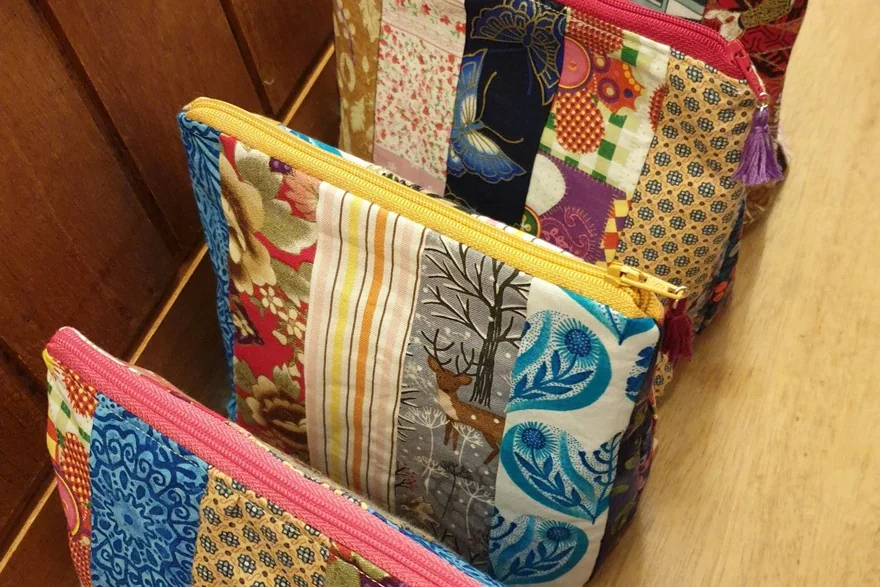
What a Lining Actually Does in a Cosmetic Bag
A lining is the second fabric layer set inside the shell, sewn as a separate bag and joined at the mouth and at the zip. It performs four jobs at once. It conceals seam allowances, interfacing and the back of any embroidery or heat-transfer branding. It provides a cleanable surface, because cosmetics are oily and pigmented and most shell fabrics are not. It adds body, so a bag stands rather than slumps. And it carries the care label and any brand label away from the printed outer face.
The word is used loosely in the trade, and the looseness costs money. A true lining is a floating inner bag, attached at the mouth and free at the base, so the shell and the lining move independently and a spill in the lining does not telegraph through to the shell. A bonded or laminated inner face, where a film is heat-pressed onto the back of the shell fabric, is cheaper and flatter but bonds the two layers together, so the bag loses the slouch that many brands want and the film eventually delaminates at fold points.
- True lining: separate inner bag, attached at the mouth, free at the base, moves independently
- Laminated inner face: film pressed onto the shell, cheaper and flatter, risks delamination at folds
- Lining hides seam allowances, the back of embroidery and any interfacing
- Lining is the surface that meets spills, so it is the surface that gets reviewed
Compliance follows the lining, because it is the layer in contact with the contents. Where a retailer asks for evidence, the usual request is OEKO-TEX Standard 100 certification on the lining fabric, and colour fastness of a dyed lining is assessed under the ISO 105 colour fastness series. An unlined bag removes one fabric from that testing scope but concentrates the risk in the shell. The two also behave differently in a retail setting: a lined bag holds its shape on a shelf and looks finished when a customer opens it, while an unlined bag slumps and shows its interior seams, which is why unlined pouches are usually photographed stuffed with tissue rather than open.
Lining Materials and Weights Compared
Lining choice is a balance of weight, cleanability and cost. Light linings keep the bag soft and cheap but show wear at the corners; heavy linings add structure and hide more but raise cost and packed bulk. Most cosmetic bag programmes sit between 55 and 110 grams per square metre, and the single most common mistake is specifying a lining heavier than the shell, which makes the bag turn inside out at the mouth.
| Lining material | Typical weight or gauge | Added unit cost | Cleanability | Best use |
|---|---|---|---|---|
| 190T polyester taffeta | 55-65 g/m2 | $0.18-$0.32 | Wipe, moderate staining | General purpose, highest volume |
| 210D nylon | 70-90 g/m2 | $0.28-$0.48 | Wipe, good | Mid and premium bags |
| RPET taffeta | 60-75 g/m2 | $0.30-$0.55 | Wipe, moderate | Recycled-content claims |
| PEVA film lining | 0.10-0.18 mm | $0.25-$0.60 | Wipe clean, best | Liquid contents, travel |
| TPU laminate | 0.12-0.20 mm | $0.45-$0.85 | Wipe clean, best | Premium, clear or wipe-clean |
| Brushed tricot | 90-110 g/m2 | $0.35-$0.65 | Poor, traps powder | Eyewear-style soft pouches |
Colour is a decision that gets made too late. A dark lining hides make-up residue and is the default for retail; a light lining photographs better in a listing because the interior reads as clean and spacious, and it is increasingly requested for premium ranges. The compromise many brands use is a mid-tone lining, usually a warm grey or taupe at around Pantone 424 C, which reads light in a photograph while still hiding residue between uses. Where a brand wants a contrast lining, a mid-tone shell against a lighter lining reads as deliberate, while a near-match shade reads as a dye-lot error.
Cleanability can be tested cheaply at sampling and it is worth doing. A standard in-house gate is to place 5 ml of liquid foundation and 5 ml of a tinted serum on the lining, leave for 10 minutes, then wipe with a damp cloth and score the residue after 24 hours. A 210D nylon or a PEVA film will usually clear completely; a brushed tricot will not. That single test explains most of the difference in long-term review scores between lining choices.
The lining also carries two practical details that buyers routinely forget to specify. The first is the attachment at the mouth: the lining can be caught in the same seam as the shell and the zip tape, which is the cheapest method and leaves the lining fixed; or it can be slip-stitched to the zip tape afterwards, which costs about $0.06 to $0.14 more but lets the lining be replaced and stops the mouth from rolling. The second is the floating base: leaving the lining base unattached lets the lining be pulled out for cleaning, which is a genuine selling point on a travel bag and costs nothing to specify.
Recycled content is now routinely requested and it comes with documentation. An RPET lining carries traceability paperwork under the Global Recycled Standard, and buyers should ask for the transaction certificate at the fabric stage rather than at the bag stage, because the certificate follows the roll not the finished product. Claims on a hangtag should match the percentage on the certificate exactly.
Unlined Constructions and Where They Are Correct
Removing the lining saves more than the fabric. It saves a full second bag's worth of cutting and sewing, removes the operation of joining lining to shell at the mouth, and lets the pouch nest flatter, so an unlined flat pouch can pack 10 to 20 percent more pieces per carton than the same pouch lined. On a low-unit-price gift pouch at a typical band of $0.45 to $12.00 per unit, that combination is decisive.
| Seam finish for unlined bags | Construction | Added unit cost | Durability | Appearance |
|---|---|---|---|---|
| Turned and topstitched | Raw edge folded twice, one row | $0.04-$0.10 | Good | Clean, casual |
| Bound with self-fabric bias | Bias strip wraps the raw edge | $0.15-$0.30 | Very good | Premium, soft |
| Bound with contrast tape | 20 mm polyester tape | $0.12-$0.26 | Very good | Sporty, branded |
| Overlocked | Three or four thread overlock | $0.03-$0.08 | Fair | Interior only |
| French seam | Raw edge fully enclosed | $0.18-$0.35 | Excellent | Luxury, sheer fabrics |
The problem with an unlined bag is the seam allowance. Every internal seam shows its raw edge, and on a cotton or canvas shell that edge frays after a few washes, which is the second most common complaint on unlined pouches after staining. A bound seam solves it at $0.12 to $0.30 and is the single best-value upgrade a buyer can make to an unlined specification. An overlocked edge is cheaper and adequate where the interior is not visible in use.
Weight is a second factor that favours going unlined, and it matters in air freight. A lining of 190T taffeta at about 60 g/m2 adds roughly 18 to 26 g to a 24 x 16 cm pouch depending on the cut, which is 12 to 18 percent of the finished weight of a light bag. Across a 10,000-piece air shipment that is 180 to 260 kg of chargeable weight. Where a programme is sea-freighted the weight is irrelevant and only the volume counts, so the calculation should be run against the actual mode rather than assumed. An unlined bag also compresses better in a vacuum pack, which recovers a further 8 to 12 percent of carton volume where the retail presentation allows it.
Two product types are genuinely better unlined. The first is the natural or unbleached cotton pouch sold on a raw aesthetic, where a lining would contradict the positioning and where the buyer has accepted that the bag is not wipe-clean. The second is the dust bag or inner sleeve supplied inside a larger item, which never meets liquid and where flatness and low cost are the whole point. Everything else should be lined.
Interfacing is the third option and it is often the right one. A fusible or sewn-in interfacing of 80 to 120 g/m2 gives shape and hides the back of embroidery without adding a second fabric layer, and it costs about $0.06 to $0.18. It does not provide a cleanable surface, so it does not replace a lining where liquids are involved, but for a structured pouch with no liquid contents it delivers most of the shape benefit at a third of the cost.
Costing, Testing and How to Specify the Lining Line
| Decision factor | Lined | Unlined | Interfaced only |
|---|---|---|---|
| Added unit cost | $0.18-$0.85 | $0.00 plus seam finish | $0.06-$0.18 |
| Spill cleanability | Good to excellent | Poor, stains soak in | Poor |
| Hides embroidery backing | Yes | No | Partly |
| Stands when empty | Yes | No | Yes |
| Pieces per export carton | 24-40 | 30-60 | 28-48 |
| Fabrics in compliance scope | Shell plus lining | Shell only | Shell plus interfacing |
Four defects account for most lining-related rejections. A lining that is too long makes the bag sit proud at the mouth, which reads as poor finishing and is fixed by cutting the lining 3 to 5 mm shorter than the shell. A twisted lining happens when it is joined at the mouth without alignment notches. Corner bunching comes from a lining cut with the same base gusset as the shell rather than 2 to 3 mm smaller. And delamination affects laminated linings first at the fold line of a gusset, typically within six months of use.
- State whether the bag is lined, unlined or interfaced, and do not leave the field blank on the brief.
- Name the lining material, the weight in grams per square metre or the film gauge in millimetres.
- State the lining colour as a Pantone reference and say whether it is dyed to match or contrast.
- State the seam finish, particularly for unlined bags where the raw edge is visible.
- State any functional finish required, such as waterproofing, anti-microbial treatment or wipe-clean film.
- State the documentation required: OEKO-TEX Standard 100, recycled-content certificate or REACH report.
Compliance scope widens with a lining because there is one more dyed fabric in the product. Restricted substances are assessed under EU REACH for the European market, and buyers should commission testing against the destination market named in the brief rather than accepting a generic report. Where a programme sells into both markets, the stricter of the two should be the design standard rather than running two specifications.
A simple decision rule covers most briefs. If the bag will hold liquids, powders or anything oil-based, line it, and use a film lining if wipe-clean is a claim in the copy. If the bag is a dust bag, an inner sleeve or a gift insert, leave it unlined and spend the money on the seam finish instead. If the bag holds dry items and needs to stand up, use interfacing at 80 to 120 g/m2 and skip the lining. Running that rule before the brief is written usually saves one sampling round, because the lining decision changes the pattern, the seam allowance and the mouth construction together.
Timing is unaffected by the lining choice for standard fabrics: 6 to 10 working days for sampling and 35 to 50 days for bulk at 500 pieces per style and colourway. A custom-dyed lining in a non-stock colour adds fabric lead time before cutting and can push sampling toward the 12 to 15 working day figure. Final random inspection runs at AQL 2.5 under ISO 2859-1, and lining defects such as twisting or an unsecured corner are normally classified as cosmetic rather than functional.
Ask for a cut-away sample alongside the finished bag. A cut-away shows the lining attachment, the seam finish and the interfacing in one piece, and it is the fastest way to compare two quotations that look identical on paper.
The B2B Customisation View
A realistic cosmetic bags schedule assumes one round of sample revision; planning for a perfect first sample is the most common cause of a slipped launch.
Fixed commercial parameters: 500 pieces per style and colourway minimum, first sample in 6–10 working days (12–15 for complex or hardware-intensive constructions), bulk 35–50 days after approval, AQL 2.5 inspection under ISO 2859-1, FOB Xiamen, T/T 30/70.
A sourcing-partner structure also protects the buyer when volumes grow, because capacity for cosmetic bags can be spread across SGS-verified production lines without changing the specification.
Which Brand Types Benefit Most
Lining decisions divide along channel lines. Start-up brands on a first 500-piece order usually specify a 190T polyester taffeta lining in a mid-tone colour: it is the cheapest option that still reads as finished, it hides the back of a printed logo, and it keeps the unit price inside the band a new brand can sustain. Established brands more often treat the lining as a signature, running one colour across the whole range so that opening any bag in the collection feels familiar, which is a low-cost way to build recognition. The lining is also the cheapest place to put a brand mark: a woven label sewn into the lining seam costs $0.05 to $0.16, does not disturb the printed outer face, and is seen every time the bag is opened, which is a better return than most exterior branding at the same price.
- Retailers and private-label buyers: PEVA or TPU-laminated lining on anything sold as a travel or liquids bag, because wipe-clean is the claim that survives contact with a real suitcase.
- E-commerce sellers: a mid-tone lining photographs best; pure white shows residue after one use and pure black makes the interior look small in a listing image.
- Natural and organic brands: unlined with bound seams is defensible and on-brand, provided the product copy does not imply wipe-clean performance.
- Gift-with-purchase buyers: unlined or interfaced only, to keep the unit cost of a high-volume insert as low as the band allows.
- Hospitality and amenity buyers: PEVA lining, because housekeeping needs to wipe a bag down between guests rather than launder it.
- Professional and salon buyers: 210D nylon in a dark tone, since brushes and pigments leave residue that a light lining shows after a single day.
- Travel-channel buyers: PEVA or TPU with a floating base that can be pulled out and rinsed, which is the feature that survives a real suitcase leak.
Frequently Asked Questions
What does a lining add to the unit cost of a cosmetic bag?
A 190T polyester taffeta lining adds about $0.18 to $0.32 per unit, 210D nylon adds $0.28 to $0.48, and a PEVA or TPU film lining adds $0.25 to $0.85. There is also labour: the lining is cut and sewn as a second bag and joined at the mouth, which is typically a larger share of the added cost than the fabric.
Is an unlined cosmetic bag cheaper to ship?
Usually yes. Removing the lining lets a flat pouch nest flatter and pack 10 to 20 percent more pieces per export carton, typically 30 to 60 pieces against 24 to 40 lined. On a low-unit-price gift pouch that freight difference can exceed the saving on the lining fabric itself. The gain is largest on a flat pouch and smallest on a boxed bag, where the gusset rather than the lining sets packed height, so it should be measured per style rather than assumed.
Which lining fabric is easiest to clean?
A PEVA or TPU film lining at 0.10 to 0.20 mm is effectively wipe-clean and clears a 10-minute foundation spill completely. Among woven options, 210D nylon outperforms polyester taffeta. Brushed tricot is the worst performer and should be avoided wherever powder or liquid cosmetics are carried. Test rather than assume: place 5 ml of liquid foundation on the lining, leave it for 10 minutes, wipe, then score the residue after 24 hours. That single test separates a film lining from a woven taffeta decisively.
Why does the lining of a cosmetic bag bunch at the corners?
Because the lining was cut with the same base gusset as the shell. The lining should be cut 2 to 3 mm smaller at the base so it sits inside the shell rather than competing with it for space. Corner bunching is normally classified as a cosmetic defect at inspection but it reads as poor finishing to a retail buyer.
Should the lining match the shell colour or contrast?
Mid-tone is the practical answer. A dark lining hides make-up residue between uses; a light lining photographs better in a listing. A warm grey or taupe around Pantone 424 C delivers most of the photographic benefit while hiding residue, and works across a whole range. A contrast lining should differ from the shell by at least four Pantone steps, or the difference reads as a dye-lot error rather than as a design decision.
Can a cosmetic bag be lined and still be soft?
Yes, if the lining is lighter than the shell. Specifying a lining heavier than the outer fabric makes the bag invert at the mouth and feel stiff, which is the most common specification error in this area. Keep the lining between 55 and 90 grams per square metre for a soft shell in the 300 to 600 g/m2 range.
What is the difference between a lining and a laminated inner face?
A lining is a separate inner bag, attached at the mouth and free at the base, so the two layers move independently. A laminated inner face is a film heat-pressed onto the back of the shell, which is cheaper and flatter but bonds the layers and tends to delaminate at fold points within about six months. The laminated route is worth choosing when flat packing matters more than softness, and it is common on clear PVC and TPU pouches where a sewn lining would look bulky.
Is an interfacing a substitute for a lining?
Only for shape. An interfacing of 80 to 120 g/m2 costs $0.06 to $0.18 and gives body while hiding the back of embroidery, but it provides no cleanable surface. Where liquids or powders are carried, a lining is still required; interfacing is suited to structured pouches with dry contents. Fusible interfacing is quicker to apply and costs about the same as a sewn-in layer, but it can bubble after washing, so a sewn-in layer is safer on a bag that will be laundered.
How is lining colour fastness tested?
Dyed lining fabric is assessed under the ISO 105 series, with the washing and rubbing fastness tests being the relevant ones for a bag interior that will be wiped repeatedly. A minimum of grade 4 on dry rub and grade 3 to 4 on wet rub is a reasonable buyer-side expectation, and it should be stated on the brief.
Does a lining affect the compliance testing scope?
Yes. A lined bag puts two dyed fabrics in scope rather than one, so both shell and lining need to be covered by the restricted-substance report. The usual evidence requested is OEKO-TEX Standard 100 on both fabrics, with REACH assessed for the European market and CPSIA where the product is a children's item. Ask for one report that lists every material by name and colour, because a report naming only the shell leaves the lining, the thread and the label unassessed.
What seam finish is best for an unlined cosmetic bag?
A bound seam, either self-fabric bias at $0.15 to $0.30 or contrast polyester tape at $0.12 to $0.26, is the best value upgrade. It stops the fraying that follows a few washes and makes the interior look finished. An overlocked edge at $0.03 to $0.08 is cheaper and adequate only where the interior is not visible.
How long should the lining be cut relative to the shell?
About 3 to 5 mm shorter at the mouth, so the lining sits inside the shell and does not roll to the outside when the bag is opened. If the lining is cut to the same length or longer, the bag shows a lining lip at the zip line, which is one of the most visible finishing faults on a pouch.
Can a recycled lining be used and will it be certified?
An RPET taffeta lining of 60 to 75 g/m2 adds about $0.30 to $0.55 per unit and can carry recycled-content documentation under the Global Recycled Standard. Buyers should request the transaction certificate at the fabric stage, because the certificate follows the roll rather than the finished bag, and hangtag claims must match it exactly. The certificate also names the percentage, so a hangtag claiming fully recycled is not defensible against a certificate that says 60 percent, and retailers do check this.
How long does sampling take for a bag with a custom-dyed lining?
Standard stock-colour linings keep sampling at 6 to 10 working days. A custom-dyed lining in a non-stock colour adds fabric lead time before cutting and typically moves sampling to 12 to 15 working days. Bulk stays at 35 to 50 days after sample approval at 500 pieces per style and colourway. Lab-dip approval usually takes 3 to 5 working days before the dye lot is committed, and it is the step most often missed when a programme slips.
Are lining defects treated as functional at final inspection?
Most are cosmetic: twisting, bunching at a corner or a slightly uneven mouth fall under the higher acceptance number at AQL 2.5 in ISO 2859-1. Delamination of a film lining across more than a few centimetres, or a lining detached at the zip, is functional because the bag no longer performs. Naming the threshold in the inspection plan helps: delamination over roughly 20 mm, or a lining detached along more than a third of the mouth, is a reasonable functional trigger.
People Also Ask
Are lined makeup bags worth the extra cost?
For any bag carrying liquids or powders, yes. A lining of $0.18 to $0.55 per unit prevents the permanent stain that generates a negative review, hides the back of branding, and lets the bag stand when empty. The cost is usually recovered through fewer returns and a higher repeat-purchase rate rather than through a higher price. The saving shows up in fewer returns and a higher repeat rate rather than in the unit price, which makes it easier to justify to a finance team than to a design team.
What is the best lining for a makeup bag?
PEVA film at 0.10 to 0.18 mm for wipe-clean performance, or 210D nylon at 70 to 90 g/m2 when a soft woven feel is wanted. Polyester taffeta is the volume default and adequate for dry contents. Avoid brushed tricot, which traps powder and cannot be wiped clean. If the bag is soft and unlined by design, a bound seam is the next best thing, because it at least stops the interior fraying.
How do you clean the inside of a makeup bag?
Empty it, brush out loose powder, then wipe the lining with a mild detergent solution on a soft cloth. PEVA and TPU linings clear completely; a nylon lining usually clears if wiped within a few hours. Unlined cotton and canvas generally cannot be wiped and may stain permanently from oil-based products. Work from the seam outwards and let the lining dry fully before closing the bag, since trapped moisture is what causes odour in a lined pouch.
Why do some cosmetic bags have no lining?
Two reasons: cost and positioning. An unlined flat pouch packs 10 to 20 percent more pieces per carton and skips a full second sewing operation, which matters on a low-price insert. Natural and unbleached brands also choose it deliberately, accepting that the bag will not be wipe-clean. Cost, positioning and packing density: an unlined pouch packs 10 to 20 percent more pieces per carton and skips a full second sewing operation.
Request a Sample or a Written Quotation
Send the silhouette, dimensions, material preference and logo artwork, and the programme team will return a written quotation with MOQ, sampling window, bulk lead time and inspection standard.
Email: [email protected] · WhatsApp: +86 177 5002 0688