Sephora Collection vs Ulta Beauty Cosmetic Bags: Retail Analysis
Executive Summary
Sephora Collection vs Ulta Beauty cosmetic bags is a comparison of two coherent but different pieces of retail own-brand strategy, and the practical answer is that each range is optimised for its host store's shopper mission and margin model rather than competing head-to-head on identical terms. The prestige-chain pattern treats the pouch as a giftable accessory: restrained colourways, structured silhouettes and metal hardware chosen to survive a gift bag. The mass-prestige pattern treats the pouch as a high-frequency convenience and promotion vehicle: brighter colour rotation, softer constructions, sharper price breaks and heavy reliance on gift-with-purchase and holiday sets.
For a brand owner the transferable lesson is sequencing. Ladder position should be decided first, because it dictates colourway count, and colourway count multiplies commitment: a 500-piece minimum per style and colourway means four colourways carry four times the exposure of one. Sampling runs 6-10 working days, or 12-15 working days for complex constructions, leaving room to test a pull, a zipper and a lining before bulk. Bulk runs 35-50 days after sample approval, with inspection to AQL 2.5 under ISO 2859-1, shipment FOB Xiamen and T/T 30 deposit with 70 against bill of lading.
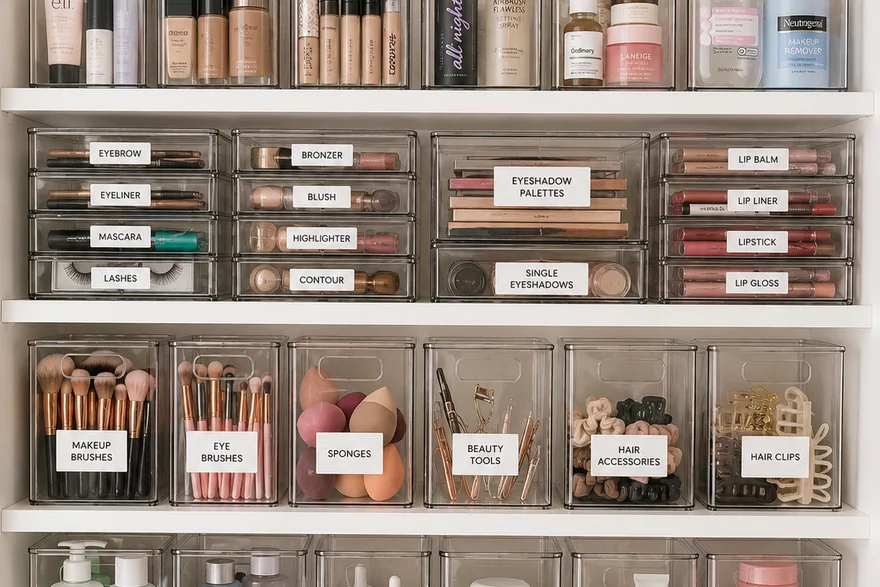
What an own-brand cosmetic bag is actually for in beauty retail
In beauty retail the cosmetic bag is almost never the reason a shopper walks in, which is precisely why the retailer finds it useful. One accessory solves three commercial problems at once. It lifts basket value at the counter without competing with the fragrance or skincare sets displayed around it. It gives the marketing team a high-perceived-value gift-with-purchase vehicle that can be sized to a spend threshold. And it carries the retailer's own name into the customer's bathroom long after the packaging of the products inside it has been discarded. Because almost nobody enters intending to compare cosmetic bags, the shopper holds no reference price in mind, so perceived value is set by touch, closure feel and print sharpness.
The two ranges compared here sit inside different host models. Sephora operates as a selective, prestige-leaning beauty chain, where the accessory has to look credible placed next to premium skincare and fragrance. Ulta Beauty operates a mass-prestige model, combining mass-market and prestige brands under one roof alongside a large loyalty programme, so the accessory range has to work both as an impulse buy and as a promotional mechanic. That difference in host model surfaces in three places a buyer can observe: the width of the price ladder, the number of colourways carried at any one time, and the ratio of permanent line items to seasonal or gift-with-purchase items.
No retailer's internal cost, sell-through, return rate or defect data is visible from outside, and no such claim is made here. What is publicly observable is sufficient to reconstruct the strategy: the printed price, the fibre content and care text on the sewn-in label, the closure type and gauge, the listed dimensions, the colourway count per season, and whether an item appears as a permanent SKU, a holiday set component or a threshold gift. Everything below is drawn from that kind of public shelf observation and is offered as merchandising analysis rather than as inside information.
Sephora, Sephora Collection and Ulta Beauty are third-party retail brands. They are discussed in this article purely as public market comparisons used to illustrate merchandise strategy. They are not suppliers, partners, clients or endorsers of any programme described here, and no claim is made about their internal product data, specifications, costs or sourcing arrangements.
Price ladder, gift-with-purchase and the economics of the pouch
A pouch range is a ladder rather than a list. Each rung exists to make the rung above it look reasonable, and the top rung exists to make the middle rung look like good value. In the prestige-chain version of this ladder the entry rung is deliberately plain: a flat pouch in black or a neutral, minimal branding, light internal structure, because its job is to convert a shopper who came in for a lipstick. In the mass-prestige version the entry rung carries more colour and print, because its job is to compete for attention against impulse-priced accessories near the till. The rungs sit at comparable positions; the visual language at each rung does not.
| Ladder position | Prestige-chain accessory pattern | Mass-prestige-chain accessory pattern | Implication for a buyer's own programme |
|---|---|---|---|
| Entry flat pouch | One or two neutral colourways, light structure, branding by debossed patch or small foil | Wide colour rotation, printed artwork, soft unstructured body | Colourway count is the primary MOQ lever at 500 pcs per style and colourway |
| Mid-size makeup bag | Structured base, wipe-clean lining, metal pull, zipper gauge around #5 | Softer shell, nylon coil zipper, wide gusseted opening | Request wipe-clean cycle test and zipper cycling on production fabric |
| Vanity or train case | Semi-moulded body, interior elastic loops, mirror insert, carry handle | Rare in permanent line, appears mainly in holiday sets | Moulded or structured work extends sampling to 12-15 working days |
| Gift-with-purchase vehicle | Coordinated with holiday sets, sized to a kit, premium-feel hardware | Frequent, tied to loyalty events and basket thresholds | Fix perceived-value target first, then work backwards into the unit cost band |
Gift-with-purchase is where the two models diverge most sharply. A threshold gift is judged in two seconds by somebody who did not choose it, so it has to feel like a real object: a structured base that does not collapse when set down, a metal pull rather than a moulded one, a printed interior lining that signals the piece was designed rather than bought in, and a hangtag that explains what it is. Those four touches consume a small fraction of the unit cost but drive most of the perceived value. The prestige-chain version leans on structure and hardware; the mass-prestige version leans on colour and print, because print reproduces campaign artwork cheaply across many seasonal variants.
The economics are unforgiving. Typical B2B unit price bands for this category run roughly $0.45-$12.00 depending on construction, fabric and hardware, and a threshold gift has to sit where the perceived retail value is a multiple of the landed cost while the promotional margin still survives. That arithmetic, not the sketch, decides the shell fabric, the zipper gauge and whether the lining is printed or plain. A buyer should fix the target landed cost before the first drawing and confirm the FOB Xiamen figure before artwork sign-off, because the two most common ways a gift programme fails are a gift that feels cheap and a gift that quietly costs too much.
- Choose the ladder position before the silhouette: the same pouch at two price points communicates two different things.
- Four perceived-value levers in descending cost efficiency: structured base, metal pull, printed lining, hangtag copy.
- Print-led assortments buy apparent width cheaply; dyed-fabric assortments commit real fabric per colourway.
- Confirm the landed unit cost against the $0.45-$12.00 band before artwork approval rather than after.
A quieter difference sits in replenishment. Prestige-chain accessory lines tend to hold a core of neutral items that stay in the assortment across seasons, with seasonal colour layered on top. Mass-prestige lines rotate faster, because a print-driven pouch behaves like a fashion item with a shorter shelf life. For a private-label buyer this is the most useful distinction: a core-and-layer assortment protects a 500-piece commitment, while a pure rotation assortment exposes it. Testing one neutral core colourway at the minimum, then adding two seasonal colours on reorder, beats launching three unproven colourways at once.
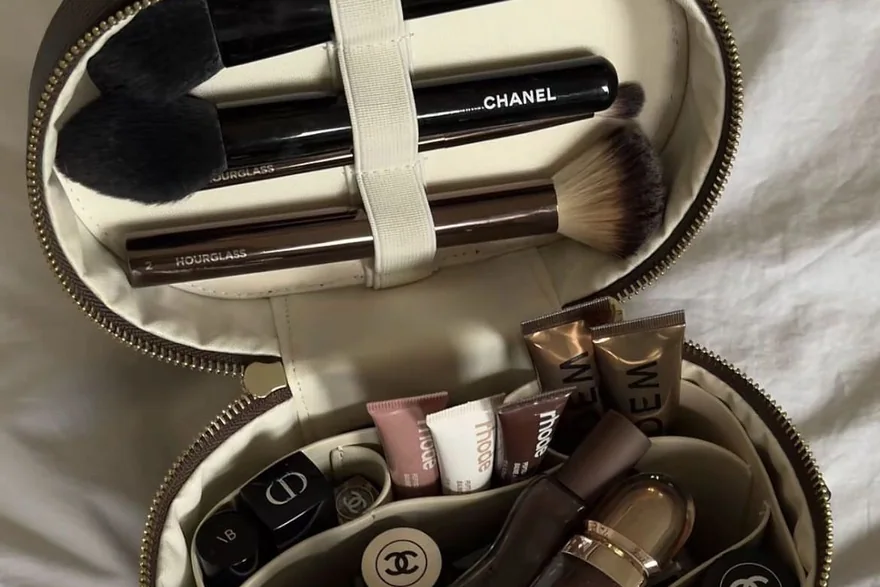
Colourway cadence and the arithmetic of a 500-piece commitment
Colourway is the most expensive design decision in a pouch programme, because the minimum applies per style and per colourway. A 500-piece minimum per style and colourway means a single-colourway test is one commitment, while a four-colourway launch of the same style is four. The style, the pattern, the tooling and the sample iteration are shared; only the fabric lot, the print film or the dye lot is not. That is why print-led assortments can look far wider than they are: one base body carries multiple artworks. Dyed-fabric assortments, by contrast, carry genuine inventory exposure at every additional colourway.
- Colourway count, not style count, is the primary risk multiplier in a pouch programme.
- Plan dye-lot continuity before the second order: a re-run in a different lot can shift shade visibly.
- One proven neutral core plus two seasonal colours on reorder usually outsells three unproven simultaneous launches.
- Keep the shell fabric stable across the programme and put the changeable element in print, trim or hardware.
Cadence follows directly from that arithmetic. A print-driven range can turn over its artwork every season or two, because the base body and pattern are unchanged and only the print film or screen changes. A dyed-fabric range turns over more slowly, because each new colourway is a fresh fabric commitment with its own minimum and its own shade-matching risk. Buyers who want a fast seasonal cadence should therefore place the changeable element in the print, the trim or the hardware and keep the shell fabric stable across the whole programme. That also simplifies testing: one fabric submission covers the range, and only print adhesion needs re-checking per artwork.
Shade continuity is the hidden cost of colourway rotation, particularly in the pinks, nudes and greiges that dominate beauty-adjacent accessories. Dye lots vary, and a re-order six months later can return visibly different from the floor sample. The practical defences are unglamorous but effective. Keep a signed reference swatch cut from the approved sample rather than a digital proof. Specify a shade tolerance in writing instead of relying on a visual match. Require a lab-dip approval before bulk fabric is cut. Where the programme is print-led, note that printed shade drifts with fabric batch as well, so the reference swatch should come from a production piece.
Sampling windows interact with all of this. Standard sampling runs 6-10 working days, which comfortably covers a flat pouch or a simple gusseted makeup bag built from stock fabric and a stock zipper. Complex constructions run 12-15 working days: a moulded EVA vanity case, a train case with an interior mirror and elastic loops, a bag with bonded rather than sewn seams. A buyer planning four colourways of one style should sample all four together rather than sequentially, because a sequential loop through four colourways at 6-10 working days each can consume the better part of two months before bulk even begins its 35-50 day run.
The arithmetic that matters is therefore not the unit price but total committed cash and time to shelf. Five hundred pieces of a single colourway at a mid-band unit cost is a modest test; two thousand pieces across four colourways is a working-capital decision. Add sampling, bulk at 35-50 days and transit, and the calendar from first sketch to floor easily runs three to four months. Buyers who treat the first order as a test of colourway demand reach a profitable second order sooner, because reorder quantities reflect what actually sold.
Translating shelf signals into spec, packaging and compliance decisions
Every cosmetic bag on a retail shelf doubles as a compliance document. The sewn-in label states fibre content and care instructions, the hangtag may state a chemical or safety claim, and country-of-origin marking is a legal requirement rather than a design detail. A buyer copying a retail look should copy the underlying decisions rather than the artwork: whether the shell is a coated polyester that wipes clean, whether the lining is a pale taffeta that makes contents visible, and whether the closure is a nylon coil or a metal zipper. Each of those choices changes the care text and the tests worth requesting.
| Shelf signal a buyer can observe | Spec decision sitting behind it | What to request before bulk starts |
|---|---|---|
| Zipper looks and feels like metal | Metal zipper, gauge around #5, cast or wire pull, self-locking slider | Gauge and terminology confirmed in writing; pull attachment pull-tested on production samples |
| Interior wipes clean without staining | Coated polyester or TPU-laminated shell, 190T-210T lining | Coating adhesion check plus a defined wipe-clean cycle test on bulk fabric |
| Print still sharp after shelf handling | Screen print or heat transfer cured to the stated temperature and dwell time | Colour fastness to rubbing and to cleaning tested on production fabric, not lab submission |
| Pale lining makes contents easy to find | Undyed or light 190T polyester taffeta, roughly 55-70 g/m2 | Shade consistency confirmed against the approved lab dip and reference swatch |
| Hangtag carries a safety or chemistry claim | Claim scope defined before artwork; certificate holder named | Current certificate dated to cover the production window, naming legal entity and product scope |
| Carton opens cleanly at the warehouse | Carton count, polybag thickness and packing method agreed in writing | Packing list and carton count confirmed before the balance payment is released |
Zips are the most frequently returned component on a pouch, partly because gauge is invisible in a shelf photograph. A buyer should specify gauge, tape material, slider type and pull, then confirm terminology with the supplier against a common reference such as the ASTM D2053 standard on zipper terminology, because a phrase like number five metal means different things to different people. The second failure point is pull attachment: a cast pull crimped onto a slider can open under load, so a pull test on production samples is worth considerably more than a photograph.
Colour fastness deserves the same attention, because beauty-adjacent bags meet foundation, lipstick and sunscreen. Rubbing fastness on both print and shell, and cleaning fastness on the whole article, should be tested on production fabric rather than on a laboratory submission. The relevant family of methods is the ISO 105 series on colour fastness, and specific method numbers belong in the written specification so that the laboratory and the buyer are measuring the same thing. Where a hangtag will claim that the article has been tested for harmful substances, that claim has to be backed by a current OEKO-TEX Standard 100 certificate naming the legal entity and product scope.
Packaging is the last place where a retail look is won or lost. Retailers specify carton counts, polybag thickness, barcode placement and whether a hangtag is attached with a plastic swiftach or a sewn loop, and getting these wrong produces a chargeback rather than a design critique. A buyer should confirm carton count and packing method in writing before bulk, since carton count drives both freight cost and warehouse handling cost per unit. Care text, fibre content and origin marking should be proof-read against the destination market's requirements.
Inspection closes the loop. Inspection to AQL 2.5 under ISO 2859-1 is the sampling procedure most buyers settle on for this category: it defines how many pieces are pulled from a lot and how many defects are tolerated before the lot fails. The critical detail is defect classification. A programme should define in advance which defects are critical, such as a broken zipper or a missing lining; which are major; and which are minor cosmetic issues such as print registration shift inside tolerance. Without that written classification, inspector judgement becomes the specification. Payment is then T/T, 30 deposit and 70 against bill of lading, on FOB Xiamen terms.
Sephora, Sephora Collection and Ulta Beauty are third-party retail brands referenced only as public market comparisons. They are not suppliers, partners, clients or endorsers of any programme discussed here, and no internal product data, cost, defect or sell-through figure for those companies is claimed or implied.
The B2B Customisation View
Every programme for cosmetic bags begins with a written brief: target retail price, filling volume, closure type, print method and the compliance market the goods will be sold in.
Commercial parameters stay fixed across the range: MOQ 500 pieces per style and colourway, prototype turnaround 6–10 working days (extended to 12–15 for multi-panel or moulded builds), bulk lead time 35–50 days from approved sample, AQL 2.5 inspection to ISO 2859-1, FOB Xiamen, T/T 30 deposit and 70 against bill of lading.
Working as a sourcing partner rather than a single-line vendor means QUANZHOU JUNYUAN BAGS can move cosmetic bags between construction types — woven, coated, leather-look — without restarting the compliance conversation.
Which Brand Types Benefit Most
Start-up brands are the main beneficiaries of this kind of ladder analysis, because the most common first mistake is launching too wide. A founder working to a 500-piece minimum per style and colourway with a limited launch budget should treat the first order as a single-position test: one silhouette, one or two colourways, placed deliberately at a chosen rung of the ladder. That preserves cash and produces genuine sell-through data. Established brands benefit differently: they usually already hold a ladder position and need the accessory to reinforce it, so consistency across seasons matters more than novelty, and shade continuity between re-orders becomes a specification line rather than a hope. Retailers and importers running their own label should read the two models as a deliberate choice about assortment architecture — a core-and-layer structure with neutral items that stay in the range, or a fast rotation where print carries the change. The two structures carry different working-capital profiles and different markdown risk, and mixing them by accident is what produces a clearance rack. E-commerce sellers sit closer to the mass-prestige pattern, because a pouch sold online competes on photography and review count, so print sharpness, colour accuracy and a lining that photographs well are the transferable lessons. Gift and hospitality buyers — hotel amenity programmes, subscription boxes, corporate gifting — should borrow the gift-with-purchase discipline instead: fix the perceived-value target first, then engineer backwards into the unit cost band, because a gift that feels cheap damages the host brand more than a gift that costs slightly more.
- Start-up brands: one silhouette, one to two colourways, 500 pcs per style and colourway, order one treated as a test.
- Established brands: lock the ladder position, write shade tolerance into the spec, plan re-orders around dye-lot continuity.
- Retailers and importers: choose core-and-layer or fast rotation deliberately, then align carton counts and barcoding to the warehouse.
- E-commerce sellers: optimise for photography — print registration, colour accuracy, a lining that makes contents visible.
- Gift and hospitality buyers: set the perceived-value target first, then engineer backwards into the $0.45-$12.00 unit band.
Frequently Asked Questions
How does a prestige beauty retailer's own-brand cosmetic bag differ from a mass-prestige one?
The difference is less about construction quality than about what the range is being asked to do. A prestige-chain pouch is built to sit credibly beside premium skincare, so it uses restrained colourways, structured bases and metal hardware, and it changes slowly. A mass-prestige pouch is built to work as an impulse buy and a promotional mechanic, so it rotates colour and print quickly, uses softer constructions and hits sharper price breaks. A buyer should choose the job the pouch is meant to do before drawing anything.
Why is colourway count the biggest risk lever in a cosmetic bag programme?
Because the minimum applies per style and per colourway, so every additional colourway is a fresh commitment rather than a variation on an existing one. The pattern, tooling and sample development are shared across colourways; the fabric lot, print film or dye lot is not. Four colourways of one style carry roughly four times the inventory exposure of a single colourway, which is why testing one proven core colour first and adding seasonal colours on reorder is usually the safer path.
What does a 500-piece minimum per style and colourway mean for a first launch?
It means the first order is a test of demand, not a complete assortment. A single-colourway run at the minimum keeps working capital contained and produces real sell-through data, whereas three or four colourways at once turns a test into a bet. The minimum is per style and per colourway, so the same silhouette in two colours is two commitments. Buyers planning wide assortments should phase them: core colour first, seasonal colours on the second order once demand is known.
How long should sampling take for a flat cosmetic pouch compared with a moulded vanity case?
A flat pouch or simple gusseted makeup bag built from stock fabric and a stock zipper normally samples in 6-10 working days. A moulded EVA vanity case, a train case with an interior mirror and elastic loops, or a bag using bonded rather than sewn seams runs 12-15 working days, because tooling, moulding trials and interior fitting add steps. Planning four colourways of one style together rather than sequentially saves weeks before bulk starts its 35-50 day run.
Which zipper details should a cosmetic bag spec sheet actually state?
Gauge, tape material, slider type, pull type and finish, plus the pull attachment method. Gauge is the detail most often omitted and most often disputed, because it is invisible in photographs and the same verbal description covers several different products. Confirming terminology against a published standard removes the ambiguity. The pull attachment deserves a physical test rather than a visual check, since a crimped cast pull can open under load even when the chain itself is sound.
What colour fastness testing matters for a makeup bag that meets foundation and lipstick?
Rubbing fastness on the print and on the shell, and cleaning or laundering fastness on the finished article, are the two that matter most. Both should be run on production fabric rather than on a laboratory submission, because coating batches and print curing conditions differ from the idealised sample. Writing the specific method numbers into the specification matters as much as ordering the test, since a generic colour fastness request can be answered with whichever method the laboratory happens to prefer.
How should a brand decide which rung of the price ladder to launch at?
By deciding what the pouch is meant to do in the basket. An entry pouch converts a shopper who came in for something else and should be plain and low-risk. A mid-size bag is the volume item and carries most of the margin. A vanity case exists mainly to make the mid-size item look like good value, and often sells in small numbers. Choosing the rung first fixes the acceptable unit cost band, which in turn fixes the fabric, hardware and finishing.
Which packaging details most often trigger a retailer rejection on first delivery?
Carton count and packing method, barcode placement and scan quality, hangtag attachment, and labelling content such as fibre content, care symbols and country of origin. None of these are design questions, and none of them are recoverable after the goods land: a mis-specified carton count means re-packing at the destination warehouse, and a wrong origin marking can hold a shipment. Confirming all of them in writing before bulk costs an afternoon and prevents a chargeback.
How is AQL 2.5 under ISO 2859-1 applied to a cosmetic bag shipment?
It defines how many units are randomly pulled from a production lot of a given size, and the number of defective units that can be found before the lot is rejected. The acceptance number scales with lot size, so a 500-piece order and a 5,000-piece order are not inspected identically. The part buyers overlook is defect classification: critical, major and minor categories must be written into the specification in advance, otherwise the inspector's judgement becomes the de facto standard.
When should compliance certificates be requested for a cosmetic bag programme?
Before the balance payment, not after. Certificates are issued for a defined scope, a named legal entity and a validity period, and a closed production lot rarely yields a replacement document. A buyer should check the certificate number, issuing body, holder name, product scope and validity dates, and confirm that the dates cover the production window rather than merely existing. Where recycled content is claimed, the transaction certificate naming the shipped lot is the document that actually matters.
How much calendar time should a buyer allow from first sketch to shelf?
Three to four months is a realistic planning figure. Sampling runs 6-10 working days, or 12-15 working days for complex constructions, and iterations on handle, zipper or lining commonly add a further round. Bulk runs 35-50 days after sample approval, with transit on top. Compressing sampling to save two weeks usually costs more at bulk stage, because changes are cheaper on a sample than on a finished lot.
Which perceived-value details cost the least on a gift-with-purchase pouch?
A structured base that stops the bag collapsing when set down, a metal rather than moulded pull, a printed interior lining, and a hangtag that explains what the item is. Those four touches add very little to unit cost while carrying most of the perceived value, because the recipient judges the object in seconds by touch and weight. Printed lining in particular signals that the piece was designed rather than bought in.
How should a buyer brief a sourcing partner using a competitor's retail pouch as a reference?
Describe the observable attributes rather than naming the retailer as a target to copy. Useful brief content is dimensions in centimetres, shell fabric and weight in g/m2, lining specification, zipper gauge and type, print method, hardware finish and target landed cost. That is enough for a sourcing partner to quote and to build a sample. What is not useful is a request to replicate a specific branded item, and no assumption should be made about the reference product's internal specification or cost.
What payment and shipment terms apply to a first cosmetic bag order?
Standard terms for these programmes are shipment FOB Xiamen with payment by T/T, 30 per cent deposit and 70 per cent against bill of lading. Bulk production runs 35-50 days after sample approval, and inspection is carried out to AQL 2.5 under ISO 2859-1. The deposit triggers fabric and trim procurement, which is why specification changes requested after that point usually carry a cost even before cutting begins.
People Also Ask
Why do cosmetic bags make effective gift-with-purchase items?
They are universally useful, they do not require shade or size matching, and their perceived value can be engineered well above their cost. A structured base, a metal pull and a printed lining make a low-cost pouch feel like a considered gift, which is why the category is used so heavily for spend thresholds and holiday sets. For a brand running its own promotion, the discipline is to fix the perceived-value target first and then engineer backwards into the unit cost band.
How many colourways should a new makeup bag launch include?
One or two is usually right for a first order. Because the minimum applies per style and per colourway, each additional colourway is a separate commitment, and unproven colourways are the most common source of leftover stock. A neutral core colourway tested at the minimum, followed by two seasonal colours on the second order once sell-through data exists, typically produces a better return than three simultaneous unproven launches.
What should a private label cosmetic bag specification include?
Dimensions in centimetres, shell fabric with denier and weight in g/m2, coating type, lining fabric and colour, zipper gauge and type, pull and slider specification, hardware finish, print method and artwork placement, label and hangtag content, carton count and packing method, and the inspection standard. Adding the target landed cost and the destination market helps a sourcing partner quote accurately on the first pass instead of guessing.
Request a Sample or a Written Quotation
Send the silhouette, dimensions, material preference and logo artwork, and the programme team will return a written quotation with MOQ, sampling window, bulk lead time and inspection standard.
Email: [email protected] · WhatsApp: +86 177 5002 0688