Travel Cosmetic Bag Trends 2026: What Buyers Are Looking For
Executive Summary
Buyers specifying travel cosmetic bags for 2026 are converging on four things: a hanging or flat-lay format that opens completely, a clear liquids pouch integrated into the main bag, a recycled or certified shell, and a welded rather than stitched liquids bay. The demand data supports that direction. Toiletry bag recorded about 74,810 weekly Amazon searches in ASINSIGHT data for July 2026, travel bag for toiletries about 110,000 monthly searches, make up bags for women about 80,000 monthly, and custom makeup bag a far narrower 5,400-6,600 monthly.
The commercial implication is that generic travel toiletry demand dwarfs personalised demand, so a 2026 range should win the functional search first and treat personalisation as a variant rather than the whole proposition. Programmes run at 500 pieces per style and colourway, sampling takes 6-10 working days or 12-15 for complex constructions, bulk production runs 35-50 days after approval, inspection is to AQL 2.5 under ISO 2859-1, and shipment is FOB Xiamen on T/T 30 deposit, 70 against bill of lading.
What the 2026 demand signal actually says
Four search figures frame the 2026 brief, and they point in the same direction. Toiletry bag recorded roughly 74,810 weekly Amazon searches in ASINSIGHT data for July 2026. Travel bag for toiletries recorded about 110,000 monthly searches, and make up bags for women about 80,000 monthly. Custom makeup bag sits in a much narrower band at 5,400-6,600 monthly searches. Read together, they say that travel-driven functional demand is an order of magnitude larger than personalisation-driven demand, and that a range built around decoration alone is addressing the smaller of the two markets.
That ranking has a direct consequence for range architecture. The large, generic terms are won by format and function: a bag that hangs, opens flat, survives a leak and passes a security checkpoint. The narrow term, custom makeup bag, is won by personalisation, but it converts on a different page and at a different price. A 2026 programme that puts a monogram on a mediocre shell addresses the 5,400-6,600 monthly searches and ignores the 110,000. One that builds the functional bag first and offers the monogram as a variant addresses both.
Price expectation sets the boundaries of the brief. Typical unit price bands observed on Alibaba in October 2026 run from about $0.45 to $12.00, and typical B2B minimum order quantities on marketplaces sit between 100 and 1,000 pieces. Those two bands tell a buyer where the competition lives: the low end of the price band is a simple sewn pouch sold in marketplace quantities, and the upper end is a constructed bag with hardware, coating and certification sold in programme quantities. The defensible 2026 position is the upper half, because the lower half is contested on price alone.
None of this removes the physical constraints that have governed the category for years. A cabin liquids limit of 100 ml per container inside one transparent resealable bag still shapes what a traveller can carry, and buyers can read the current position in the TSA 3-1-1 liquids rule. What changes year to year is not the constraint but the format response to it, which is why the trends below are described as specifications rather than as styles.
Silhouette and function trends buyers are specifying for 2026
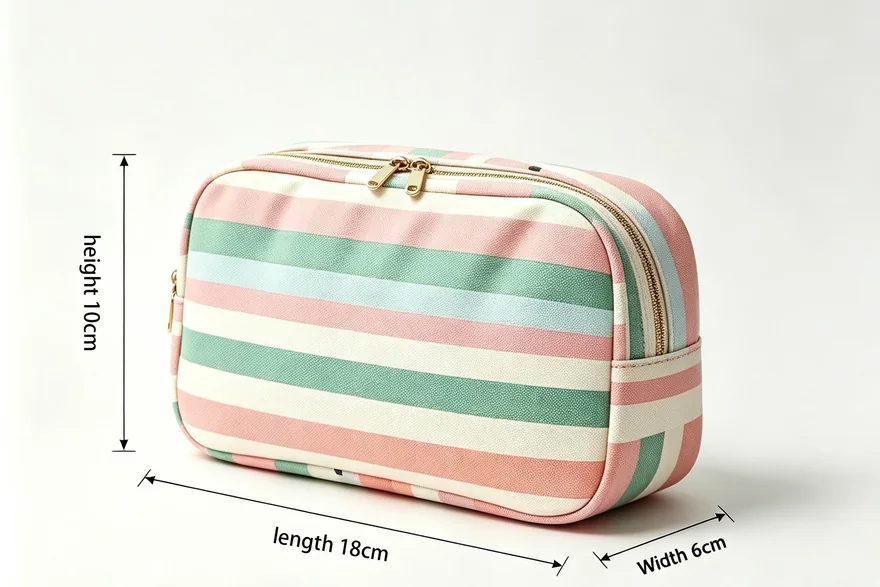
The clearest 2026 trend is that a travel cosmetic bag is expected to open completely. A pouch that must be searched by hand is losing to a case that lays flat or hangs open in one motion, and that expectation has moved down the price bands. A four-panel hanging case closes at 26 x 20 x 10 cm and opens to roughly 78 x 26 cm of visible surface; a flat-lay clamshell at 28 x 22 x 11 cm opens to about 56 x 22 cm. Both beat a 22 x 15 x 7 cm soft pouch on visibility, and visibility is what the review photography in this category rewards.
The second trend is the integrated clear pouch. Rather than a traveller buying a separate quart bag, the 2026 brief increasingly specifies a detachable clear TPU pouch of 20 x 18 x 6 cm that lives in an outer pocket of the main case and lifts out at the checkpoint. That is a small specification change with a large perceived benefit, and it is cheap: the pouch is one welded component at a low unit cost, and it removes the most common complaint in travel toiletry reviews, which is that the customer forgot the quart bag.
| Trend in 2026 briefs | Specification that delivers it | Where it sits in the demand data | Build cost impact |
|---|---|---|---|
| Full-open hanging case | Four panels, swivel hook above 5 kg gate, 26 x 20 x 10 cm closed | Core of the 74,810 weekly toiletry bag searches | Moderate; extra panels and a hook |
| Flat-lay clamshell | Two shells on a bonded spine, 28 x 22 x 11 cm | Long tail of the 110,000 monthly travel bag for toiletries searches | Moderate; one more tooling |
| Integrated clear liquids pouch | Welded TPU pouch, 20 x 18 x 6 cm, detachable on a snap tab | Security-driven search intent across all four terms | Low; a single welded part |
| Modular removable pouches | Three pouches, 0.45-0.9 L, on snap-in anchors | Family and shared-bathroom intent | Higher; three articles in one |
| Brush-specific organiser bay | Vented bay, 15-25 mm elastic loops, mesh lid | Make-up intent behind the 80,000 monthly searches | Low; elastic and mesh only |
| Welded liquids bay, not sewn | 0.30-0.35 mm TPU, radio-frequency welded seams | Leak-driven negative review avoidance | Moderate; welding operation |
Capacity is trending slightly upward and then splitting. The single large cavity is giving way to a 4-6 L bag with defined zones, because a traveller carrying both cosmetics and toiletries now expects them separated. The typical 2026 allocation is a 1.0-1.4 L welded liquids bay, a 1.5-2.0 L dry bay with elastic loops, and a 0.8-1.2 L brush or tool bay with a mesh panel. That allocation fits a 26-28 cm case, and it is what allows one bag to serve a two-night city break and a fortnight abroad without a repack.
Hardware is moving in one direction: lighter and quieter. Metal teeth are losing to #5 nylon coil on the main bay and #3 on interior pockets, because coil is quieter in a shared hotel room at six in the morning and does not corrode under bathroom cleaner. Pulls are getting shorter and moulded in one piece rather than assembled from a cap and a ring. Terminology for these parts is fixed in ASTM D2053 zipper terminology, and referencing it in a 2026 tech pack is now standard practice rather than pedantry.
Personalisation has not disappeared; it has moved. Rather than a large centred monogram, 2026 briefs favour a small mark in a low-flex position: a 6 mm embroidery at the lower left of the front panel, a debossed patch on the gusset, or an engraved zipper pull. That shift reflects the narrower custom makeup bag demand of 5,400-6,600 monthly searches being served as a variant of a functional bag rather than as a separate product, and it also reflects a practical truth: a large mark on an unstructured panel cracks and lifts.
Material, certification and compliance trends in the 2026 brief
Material choice in 2026 is being driven less by hand feel and more by what can be documented. A buyer can no longer launch a travel cosmetic bag into a major marketplace or a chain without an answer on recycled content, restricted substances and coating performance, and the answers have to be evidenced by a certificate rather than asserted in a listing. That has moved certification from a late-stage checkbox to a brief-stage decision.
| Material or certification | Why it appears in 2026 briefs | Standard or test to cite | Effect on unit cost | Buyer note |
|---|---|---|---|---|
| Recycled polyester shell | Recycled-content claims on listing pages | GRS transaction certificate | 5-12% above virgin equivalent | Buy the certificate with the fabric, not after |
| Organic cotton lining or shell | Natural-fibre positioning | GOTS scope certificate | 15-30% above conventional | Pair with a removable liquids pouch |
| Restricted-substance compliance | EU market access and marketplace checks | OEKO-TEX Standard 100 | 1-4% for testing and certification | Cover shell, lining, thread and print |
| EU chemical compliance | Legal requirement for EU sale | REACH SVHC declaration | Negligible if designed in | Confirm plasticisers in coatings |
| TPU replacing PVC | Phthalate risk and odour complaints | ASTM D751 for the coated fabric | 8-15% above PVC | Also removes a child-safety question |
| Welded liquids bay | Leak-related returns | 24-hour water hold at approval | Moderate; welding operation | Specify weld continuity, not just material |
| Coil zipper with garage | Noise, corrosion and fur transfer | ASTM D2053 terminology | Neutral to slightly lower | Two zippers on any divided bag |
Recycled content is the trend most often mishandled. A recycled claim requires a chain of custody, not a fabric that looks the part, and the certificate has to be bought with the fabric rather than applied for afterwards. The recycled claim standard maintained by Textile Exchange sets out how that chain is documented, and buyers should request a transaction certificate covering the specific fabric lot before bulk cutting begins. Without it, the claim cannot be defended on a listing.
Chemical documentation is converging across markets. A bag sold into the European Union has to satisfy EU REACH restrictions, and most buyers add OEKO-TEX Standard 100 certification across shell, lining, thread and print, because a certificate scoped only to the shell is the most common reason a marketplace listing is challenged. Where a natural fibre is used, GOTS is the reference buyers ask for.
On the physical side, coating performance is being specified by test rather than by name. Procedures for coated fabrics, including coating adhesion and hydrostatic resistance, are covered by ASTM D751 coated fabrics, and a 2026 brief that names a hydrostatic head above 600 mm and adhesion above 12 N per 25 mm after five wipe cycles is far easier to enforce than one that asks for a wipe-clean lining. Coated fabrics are also where the PVC-to-TPU substitution is happening, driven by phthalate risk and by odour complaints rather than by marketing.
Weight and fabric construction are moving in a predictable direction: lighter shells with better coatings. A 420D nylon ripstop at 165-190 g/m2 with a 0.30-0.35 mm TPU laminate now outperforms a heavier 600D polyester with a thin PU face on both weight and wipe-down, and it is the most common specification appearing in mid-range 2026 briefs. Heavier shells remain in the brief only where crush protection is the selling point, typically a moulded EVA case at 3-4 mm wall thickness.
How 2026 buying behaviour changes the sourcing calendar
The way buyers place orders is shifting alongside the product. Marketplace behaviour has trained buyers to expect small quantities and short waits, while programme sourcing operates on fabric lots, tooling and production slots. Reconciling those two expectations is the most practical thing a 2026 brief can do, and it starts with being explicit about what a 500-piece minimum per style and colourway buys that a marketplace quantity of 100 to 1,000 pieces does not.
- A 500-piece run per style and colourway buys a dedicated fabric dye lot, a controlled trim package and a pre-production sample retained as the reference for re-order.
- Marketplace quantities in the 100 to 1,000 piece band are usually served from stock fabric and stock hardware, which is why colour and finish options are narrower and repeat orders drift.
- Sampling at 6-10 working days covers a standard sewn construction; 12-15 working days covers complex work such as welded bays, moulded shells or a dual-chamber build.
- Bulk production runs 35-50 days after sample approval, and sea freight with inland delivery adds 25-35 days, so a seasonal launch needs the brief signed 110-140 days ahead.
- Inspection to AQL 2.5 under ISO 2859-1 is sized to the lot, and safety-critical defects such as a broken hook gate or a failed weld are normally zero-acceptance regardless of level.
- Shipment on FOB Xiamen terms with T/T 30 deposit, 70 against bill of lading remains the standard structure, with sampling charges normally credited against the bulk order.
- Freezing the approved references, by supplier code rather than commercial name, turns next year's re-order into a confirmation instead of a second development round.
Certification timing is the change most buyers underestimate in 2026. A recycled-content transaction certificate, an OEKO-TEX certificate and any REACH declaration all have to be in place before the goods ship, and each has a lead time measured in weeks rather than days. Requesting them during bulk production rather than at fabric purchase is the single most common cause of a shipment held at origin, and it is entirely avoidable if the requirement is written into the first brief.
Range planning should follow the demand shape described at the top of this article. Because functional travel demand of roughly 110,000 monthly searches for travel bag for toiletries and 74,810 weekly searches for toiletry bag dominates personalisation demand of 5,400-6,600 monthly searches for custom makeup bag, the 2026 structure that works is one core functional style in two or three colourways, with personalisation offered as a variant on the same shell. That keeps each colourway at 500 pieces, keeps one cutting marker, and still addresses the narrower intent.
Two closing checks belong in every 2026 brief. First, cube and weight the packed bag before quoting freight: a hanging case at 26 x 20 x 10 cm and 480 g packs about 25 units per 60 x 40 x 40 cm carton, so 500 pieces is 20 cartons and roughly 1.92 CBM. Second, define the acceptance test for the feature the product is sold on, whether that is a 24-hour water hold on a welded bay or a 3.2 kg hook load test, because a visual inspection will not find a weld made at the wrong temperature. Specifications and drawings can be sent to [email protected] for a feasibility review before a 2026 slot is booked.
The B2B Customisation View
Before a single metre of fabric is cut, the briefing stage settles the silhouette, the lining, the closure and the branding method for makeup bags and toiletry bags.
Standard terms: 500 pieces minimum per style and colourway, 6–10 working days for sampling (12–15 for complex builds), 35–50 days bulk production, AQL 2.5 inspection under ISO 2859-1, FOB Xiamen, T/T 30 deposit / 70 balance.
The commercial arrangement is straightforward: one sourcing partner, one technical pack, one inspection standard, one consolidated shipment.
Which Brand Types Benefit Most
The 2026 trends reward five buyer profiles differently. Start-up brands benefit most from the shift towards functional differentiation, because a welded liquids bay and an integrated clear pouch can be specified on a first 500-piece buy without the tooling that a moulded case requires. Established brands benefit from the certification trend, since an existing shell and hardware platform can be re-certified once and reused across a season, which spreads a fixed cost over more colourways. Retailers benefit from the modular trend, because removable pouches drive attachment and replacement sales long after the outer case has been bought. E-commerce sellers gain most from the format shift, since a bag that opens fully produces the review photography that converts, and a bag that does not leak produces the review text that ranks. Hospitality and amenity buyers should read the trends selectively: the print and personalisation trends are irrelevant to them, while the welded bay, the coated shell and the documented compliance file are exactly what an amenity programme needs.
- Start-up brands: build the functional bag first and offer the monogram as a 6 mm embroidery variant on the same shell, which keeps one dye lot and one marker.
- Established brands: re-certify an approved platform to GRS, OEKO-TEX and REACH once, then extend it into two or three 500-piece colourways for the season.
- Retailers and chains: stock the core functional style at depth and the personalised variant at shallow depth, since the functional search is roughly twenty times larger.
- E-commerce sellers: lead the listing with format and leak performance, because those are the attributes named in both positive and negative reviews for this category.
- Hospitality and amenity buyers: specify the welded bay and the coated shell rather than the print, because the amenity bag is judged on how it survives a changeover.
Frequently Asked Questions
Which travel cosmetic bag formats are trending for 2026?
Full-open hanging cases at about 26 x 20 x 10 cm closed, flat-lay clamshells at 28 x 22 x 11 cm, and modular cases with removable pouches. All three beat a soft pouch on visibility, which is what review photography rewards. The soft pouch is not disappearing, but it is increasingly sold as part of a set rather than as the main bag.
What does the 74,810 weekly toiletry bag search figure tell a buyer?
That toiletry demand is large, generic and functional. At roughly 74,810 weekly Amazon searches in ASINSIGHT data for July 2026, a single listing competes on format, leak performance and price rather than on decoration. The practical response is to build the functional specification first and to treat monogramming as a variant on the same shell.
How large is the gap between make up bags for women and custom makeup bag demand?
Substantial: about 80,000 monthly searches for make up bags for women against 5,400-6,600 monthly for custom makeup bag. That is roughly a twelve-to-one ratio, so a range built only around personalisation addresses the smaller market and leaves the larger one to competitors. The efficient structure is one core bag with a personalised variant, which serves both intents from one cutting marker and one fabric purchase.
Why is travel bag for toiletries the strongest 2026 keyword signal?
At about 110,000 monthly searches it is the largest of the four figures, and the phrase itself names the use case: travel, not storage. A bag that answers it has to open fully, hold 100 ml containers for a cabin leg, and survive being repacked. Buyers should read it as a demand for function and spec accordingly rather than chase the phrase in copy.
Is the $0.45 to $12.00 unit price band usable for a branded 2026 programme?
The band observed on Alibaba in October 2026 spans a simple sewn pouch at the bottom and a constructed certified bag at the top. A branded programme sits in the upper half, because the lower half is contested on price alone and cannot carry certification costs. Use the band as a sanity check on a quotation, not as a target.
Why do marketplace minimums of 100 to 1,000 pieces differ from a 500-piece colourway programme?
Marketplace quantities are usually served from stock fabric and stock hardware, so the colour and finish options are narrow and repeat orders drift between lots. A 500-piece run per style and colourway buys a dedicated dye lot, a controlled trim package and a retained pre-production sample. The difference is repeatability rather than quantity: a programme re-order matches the approved lot, while a marketplace re-order is whatever stock is available that week.
Which recycled content claim can a buyer actually defend in 2026?
One backed by a transaction certificate for the specific fabric lot, issued under the recycled claim standard maintained by Textile Exchange. A recycled claim needs a documented chain of custody rather than a fabric that looks the part. Request the transaction certificate at fabric purchase, before bulk cutting begins, because a chain of custody cannot be reconstructed retroactively once the lot has been cut and sewn.
Is PVC still acceptable in a 2026 travel cosmetic bag?
Increasingly no. PVC raises a phthalate question under REACH and under child-safety rules, and it is the most common source of odour complaints in a new bag. TPU at 0.30-0.35 mm costs roughly 8-15% more and removes both problems. Where a clear window or a clear liquids pouch is needed, TPU at 0.30-0.35 mm is now the default specification and welds cleanly, which PVC does not.
What clear pouch requirement follows from the liquids rule in 2026?
Containers of 100 ml or less in one transparent resealable bag of about a litre, one per passenger, as set out in the TSA 3-1-1 liquids rule. The 2026 response is a detachable welded TPU pouch of about 20 x 18 x 6 cm stored in an outer pocket of the main case, so the traveller cannot forget it at the checkpoint.
Which closure trend reduces returns in 2026 programmes?
A #5 nylon coil zipper on the main bay with a zipper garage and a one-piece moulded pull, plus a #3 coil on interior pockets. Coil is quieter, resists corrosion from bathroom cleaner and does not snag mesh. Two separate zippers on any divided bag also stop fur and powder travelling between chambers along a shared chain.
How long does a 2026 travel cosmetic bag programme take from brief to delivery?
Plan 110-140 days. Sampling takes 6-10 working days for a standard construction and 12-15 for complex work such as welded bays or moulded shells, bulk production runs 35-50 days after sample approval, and sea freight with inland delivery adds 25-35 days. Certification lead time runs in parallel and should start at fabric purchase, since a recycled-content transaction certificate or an OEKO-TEX certificate takes weeks rather than days.
What inspection level do 2026 buyers specify for travel cosmetic bags?
AQL 2.5 under ISO 2859-1, with the sampling plan sized to the lot rather than to the pallet count. Buyers normally add zero-acceptance for safety-critical and functional defects such as a broken hook gate, a failed weld or a detached pull. Cosmetic classification also matters: on a hanging case, a creased shell is usually treated as major.
How should a buyer split 500 pieces across trend colourways?
It cannot be split below 500 per style and colourway, so two colourways is 1,000 pieces and three is 1,500. Buyers with a 500-unit budget keep one shell colour and vary the trim, print or pull finish, which holds one dye lot and one cutting marker. Reserve separate shell colourways for the second season once volume is proven.
What fabric weights are appearing in 2026 travel cosmetic bag briefs?
Lighter shells with better coatings: 420D nylon ripstop at 165-190 g/m2 with a 0.30-0.35 mm TPU laminate is now the common mid-range specification, and 600D polyester at 210-240 g/m2 with PU remains for value lines. Moulded EVA at 3-4 mm wall thickness appears only where crush protection is the selling point, because it adds roughly 250-350 g to a bag that otherwise weighs 400-650 g empty.
Which personalisation trend is growing for travel cosmetic bags in 2026?
Small marks in low-flex positions rather than large centred ones: a 6 mm embroidery at the lower left of the front panel, a debossed patch on the gusset, or an engraved zipper pull. The shift reflects personalisation being served as a variant of a functional bag, and it avoids the cracking and lifting that a large mark suffers on an unstructured panel.
Does a 2026 trend bag still need a hanging hook?
Yes, unless the bag is a flat-bottom vanity case intended for a private shelf. A hook with a gate strength above 5 kg and a 180-degree swivel, anchored to a 25 mm webbing yoke, remains the defining feature of a travel bag, because most hotel and rental bathrooms offer under 30 cm of dry shelf. Test it at 3.2 kg for 24 hours.
People Also Ask
What is the best travel cosmetic bag format for 2026?
A four-panel hanging case of about 26 x 20 x 10 cm closed, with a welded liquids bay, an integrated clear pouch and a hook rated above 5 kg. It opens fully, which is the single attribute that decides most reviews in this category. A flat-lay clamshell at 28 x 22 x 11 cm is the alternative where a hook cannot be used.
Are clear toiletry bags still required in 2026?
For cabin liquids, yes: containers of 100 ml or less must travel in one transparent resealable bag of about a litre per passenger. The 2026 response is a detachable clear TPU pouch stored inside the main bag rather than a separate purchase, which removes the most common packing complaint in travel toiletry reviews.
What size travel toiletry bag is most popular in 2026?
A 4-6 L bag with defined zones, typically split into a 1.0-1.4 L welded liquids bay, a 1.5-2.0 L dry bay and a 0.8-1.2 L brush bay. That allocation fits a 26-28 cm case and serves both a two-night break and a fortnight abroad. Single large cavities are losing share because contents migrate.
How do I start a private label travel cosmetic bag in 2026?
Write the functional specification first: format, dimensions, welded liquids bay, coating test and hook rating. Confirm certification needs at fabric purchase, since recycled content and restricted-substance certificates take weeks. Then place a 500-piece run per style and colourway, allow 6-10 working days for sampling, and 35-50 days for bulk.
Request a Sample or a Written Quotation
Send the silhouette, dimensions, material preference and logo artwork, and the programme team will return a written quotation with MOQ, sampling window, bulk lead time and inspection standard.
Email: [email protected] · WhatsApp: +86 177 5002 0688