Weekend Trip vs Long Vacation Cosmetic Bags: Capacity Planning
Executive Summary
A weekend trip cosmetic bag and a long-vacation cosmetic bag differ in packed volume, not styling. A two-night kit fits 1.5-2.5 litres with four to six internal slots; a ten-to-fourteen-day kit needs 4-6 litres with eight to twelve slots and a split between a dry makeup section and a wet toiletry section. Buyers can plan from volume per day: 0.25-0.35 litres of packed beauty product per travel day, plus a fixed 1.0-1.4 litre block for liquids, brushes and tools that does not scale with trip length.
That fixed block is why a weekend pouch is not simply a small vacation case. Below 1.2 litres a foundation bottle and a brush roll cannot lie flat; above 6.5 litres the case will not sit beside a liquids bag inside a 40 x 20 x 25 cm personal-item sizer, so it is checked in. A workable range is three tiers sharing one design language: 1.8 litres at 22 x 13 x 8 cm, 3.2 litres at 26 x 16 x 10 cm and 5.5 litres at 30 x 20 x 12 cm. Programme terms stay constant: 500 pieces per style and colourway, 6-10 working day sampling, 35-50 day bulk production.
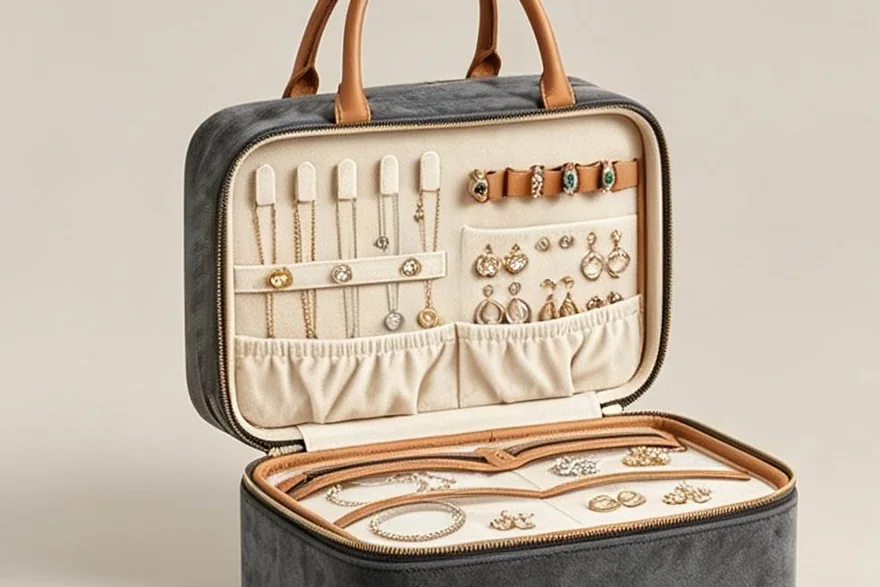
What Capacity Means on a Cosmetic Bag Specification
Capacity on a cosmetic bag specification is quoted in litres, but the figure that decides whether a kit travels is usable volume, not geometric volume. A rectangular pouch measuring 22 x 13 x 8 cm has a geometric volume of 2.29 litres; once seam allowances, a lined interior, a stiffened base panel and the curve of the zipper track are deducted, the packable volume is typically 78-85% of that figure, or roughly 1.8 litres. Buyers who specify in litres without stating a usable-volume factor end up with samples that measure correctly and pack short by a third.
- Quote closed external dimensions in centimetres first and derive litres from them, not the other way round.
- Apply a 0.78-0.85 usable factor to soft pouches and 0.88-0.92 to moulded EVA or ABS cases with flat walls.
- State whether the litre figure includes the liquids block or excludes it; a full quart bag consumes about 40% of a 2.5 litre weekend pouch.
- Measure a brush roll flat and closed, because a nine-slot roll occupies roughly 0.15 litres and 24 x 12 cm of wall area.
- Test with the brand's own product set rather than generic blocks, since a 30 ml glass foundation bottle and a 30 ml plastic tube occupy different footprints.
The liquids block is fixed rather than proportional. Under the TSA 3-1-1 liquids rule each container must hold 100 ml or less and all containers must fit inside a single quart-sized bag, so a traveller on a two-night trip and a traveller on a fourteen-night trip carry the same quart bag. That is the reason capacity planning cannot be a straight line: the liquids, brush and tool block of roughly 1.0-1.4 litres sits inside every kit, and only part of the cosmetic and skincare block scales with trip length.
For a kit that includes colour cosmetics, plan 0.25-0.35 litres of packed product per travel day, then add a fixed 1.0-1.4 litre block for liquids, brushes and tools. A three-night trip lands at 2.2-2.4 litres and a ten-night trip at 3.9-4.9 litres. Below 1.2 litres the kit cannot lie flat; above 6.5 litres it will not share a personal-item sizer with a liquids bag.
The Weekend Band: 1.6 to 2.2 Litres of Usable Volume
The weekend band is the tightest design problem in the category because the fixed block consumes most of the volume. A 1.8 litre pouch has to accept a quart liquids bag, a brush roll and a colour-cosmetic set without the zipper bowing. Built as a flat envelope, the quart bag has to lie across the floor panel with the brush roll on top, which pushes the stack above 8 cm and forces the gusset. A better layout is a 6 cm base gusset with two slip pockets on one wall and one zip pocket on the other, so the tallest single item defines the height rather than the sum of all items.
| Item in a two-night kit | Packed volume (L) | Pack position | Spec consequence |
|---|---|---|---|
| Quart liquids bag, half full | 0.45 | Flat on the base panel | Base gusset at least 6 cm, or the bag stands on edge and eats wall space |
| Nine-slot brush roll, closed | 0.15 | Along one long wall | Needs 24 x 12 cm of unbroken wall with no seam crossing it |
| 30 ml foundation bottle | 0.06 | Upright in a slip pocket | Pocket depth 9-10 cm with an elasticated top edge |
| Twelve-pan eyeshadow palette | 0.08 | Flat against the lining | Needs a flat back panel; a curved barrel shape wastes about 0.03 L |
| Mascara and eyeliner | 0.04 | Slip pocket | Pocket width 4 cm minimum or the two items wedge together |
| Three 30 ml skincare minis | 0.18 | Zip pocket | Zip pocket needs a 180 degree opening to be usable at a basin |
| Hair tie, tweezers, sponge | 0.09 | Mesh drop pocket | Mesh at 120 g/m2 polyester with a bound edge, not a raw cut |
| Total packed | 1.05 | Across seven positions | Leaves about 0.75 L of slack inside a 1.8 L pouch |
That slack is not waste. A soft pouch packed to 100% of usable volume bulges along the zipper line, and a bulged coil zipper is the most common warranty claim in the category because the slider rides off the track under pressure. Leaving 35-40% slack also lets the pouch absorb a souvenir purchase or a second liquids bag on the return leg. Buyers specifying the weekend tier should therefore quote litres as usable volume at a stated fill, for example '1.8 litres usable at 60% fill', and should photograph the approval sample at that fill rather than empty, because an empty pouch hides every fit problem.
A second constraint on the weekend tier is commercial rather than physical. A 1.8 litre pouch sits naturally at an entry price point, and shrinking it further to cut unit cost removes the one feature that sells it, which is that the whole weekend kit fits in one place. Buyers who test a 1.2 litre version against a 1.8 litre version usually find the smaller bag photographs better and reviews worse, because a shopper who cannot fit a brush roll writes about it. The 6 cm base gusset is therefore worth considerably more than the fabric it costs.
- Weekend tier target: 1.6-2.2 litres usable, 22 x 13 x 8 cm closed, 6 cm base gusset.
- Pack the fixed block first: quart liquids bag, brush roll and tool pouch take about 1.1 litres.
- Keep 35-40% slack so the coil zipper track is never loaded in compression.
- State the fill percentage alongside the litre figure on the tech pack and on the product page.
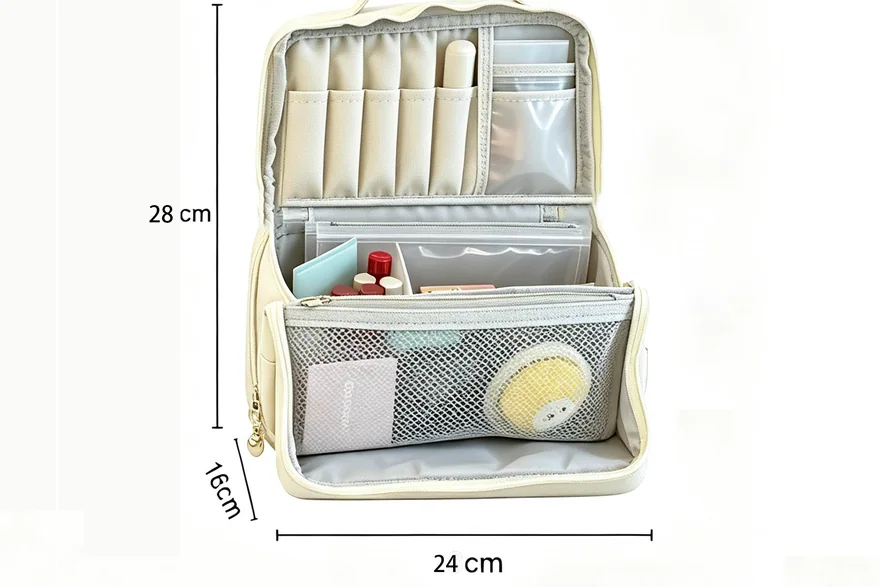
The Long-Vacation Band: 4 to 6 Litres and the Refill Problem
Above about four nights the problem changes from fitting to organising. A long-vacation case rarely fails because products do not fit; it fails because the traveller cannot find anything, or because a leak in one compartment contaminates the whole kit. Capacity therefore grows in two directions at once: litres rise from 2.5 to 4-6, and slot count rises from 4-6 to 8-12. The second number matters more for reviews than the first. A 5 litre case with four slots generates more negative feedback than a 3.5 litre case with ten, because the unpacking experience at a hotel basin is what the traveller actually remembers and writes about.
| Trip length | Packed volume target (L) | Slot count | Construction that suits the band |
|---|---|---|---|
| 1-2 nights | 1.6-2.2 | 4-6 | Single-compartment pouch, PEVA lining, No. 3 coil zipper |
| 3-5 nights | 2.6-3.4 | 6-8 | Two-compartment case with 3 mm foam in the base panel |
| 7 nights | 3.4-4.4 | 8-10 | Two-tier case with a removable 1 L liquids pouch |
| 10-14 nights | 4.4-5.6 | 10-12 | Two-tier case with a wet and dry split and a moulded hook |
| 21 nights or longer | 5.0-6.4 | 10-12 plus one refill pouch | Main case plus a separate 1 L refill pouch sold as a set |
The refill problem is what really separates a vacation case from a weekend pouch. Beyond about ten days the traveller either decants into smaller containers or runs out, so a well-specified long-vacation case includes a documented refill path: a labelled 1 litre pouch that holds the second half of the trip and nests inside the main case when empty. That pouch is also the cheapest upsell in the range, because it can run on the same fabric, zipper tape and puller as the main case and adds roughly $0.60-$1.10 to unit cost at 500 pieces per style and colourway. Buyers should treat it as a separate line on the order rather than a giveaway.
- Liquids: fixed at one quart bag regardless of trip length, because container size is capped, not total volume.
- Brushes: fixed at one roll, because a traveller carries a set rather than a per-day allowance.
- Tools: fixed, since tweezers, a sponge and a hair tie travel once.
- Skincare: scales, at roughly 0.05-0.07 litres per day once minis are used.
- Colour cosmetics: do not scale, because a palette lasts a year rather than a week.
- Sunscreen and aftersun: scale sharply, up to 0.12 litres per day on a beach itinerary.
Weight is the second limit on the long-vacation band. A 5.5 litre case packed to 60% fill weighs 2.5-3.4 kg, and at that weight it is no longer carried by the handle alone but by the handle and the base panel together, which is why a 25 mm webbing handle bar-tacked through a reinforcement patch and a 3 mm foam base panel belong on the specification. Above roughly 6 litres the case also exceeds what a traveller will lift one-handed out of a suitcase, and that practical ceiling sets the top of the band long before any airline rule does. Buyers should state the assumed packed weight on the tech pack, because the handle and base specifications are derived from it rather than from the empty case.
Building One Three-Tier Capacity Ladder for a Single Product Family
A three-tier ladder works commercially when the tiers share a design language and, where possible, shared trims. Repeating a zipper tape colour, a puller shape and a lining colour across all three tiers lets a buyer order 500 pieces per style and colourway on each tier while still consolidating trim purchasing, which is usually where a small programme loses margin. The tiers must also differ visibly in footprint on a shelf: a 22 cm pouch beside a 30 cm case reads as a considered range, whereas a 24 cm pouch beside a 26 cm case reads as a specification mistake that confuses the shopper.
| Tier | Closed dimensions (cm) | Usable volume (L) | Shell fabric | Zipper | Indicative unit band (USD) |
|---|---|---|---|---|---|
| Weekend pouch | 22 x 13 x 8 | 1.8 | 290T polyester or 420D nylon with PEVA lining | No. 3 nylon coil, single pull | $1.20-$2.60 |
| Short-break case | 26 x 16 x 10 | 3.2 | 600D polyester with 0.12 mm PU coating | No. 5 nylon coil, double pull | $2.80-$4.90 |
| Vacation case | 30 x 20 x 12 | 5.5 | 600D Oxford with 3 mm foam, 210D lining | No. 5 reverse coil with storm flap | $4.60-$8.50 |
| Vacation case, hanging | 30 x 20 x 12 closed, 30 x 62 open | 5.1 | 600D Oxford, moulded hook, PEVA wet compartment | No. 5 coil plus No. 3 on the lower tier | $6.40-$11.20 |
Two specification details keep the ladder honest across tiers. The first is zipper length: a No. 5 coil on a 30 x 20 x 12 cm case has to run about 76 cm around three sides plus a 12 cm extension, so tape length belongs on the order at 88 cm with a 2 cm tolerance rather than being left to the sewer. Component terminology is standardised under ASTM D2053, which is worth citing in the tech pack so that slider, puller and top stop mean the same thing on both sides. The second is inspection: the same AQL 2.5 under ISO 2859-1 should be applied to each tier with one defect classification, so capacity claims are checked against a filled gauge rather than by eye.
A 22 x 13 x 8 cm pouch packs roughly 90-110 pieces into a 60 x 40 x 40 cm export carton; a 30 x 20 x 12 cm case packs 30-36. Freight cost per unit therefore roughly triples from tier one to tier three, which is why the small tier usually carries the margin and the large tier carries the shelf presence. A first order of 500 pieces per style and colourway on each tier normally ships on one FOB Xiamen booking inside a 35-50 day bulk window.
- One carton size across the ladder; vary the pack count, not the carton footprint.
- One insert design with a tier letter, so the warehouse needs only one pack-out instruction.
- Decide at sampling whether the tiers sell separately or as a bundled set, because it changes the master carton.
The B2B Customisation View
Development of makeup bags and toiletry bags is a sequence of small approvals, and each approval is cheaper than the rework it prevents.
The numbers a buyer can plan around: 500 pieces minimum per style and colourway, 6–10 working days to a first sample (12–15 where tooling or moulding is involved), 35–50 days to bulk completion, AQL 2.5 under ISO 2859-1 at final inspection, FOB Xiamen terms, T/T 30/70 payment.
As the programme coordinator, QUANZHOU JUNYUAN BAGS owns the sample history, which is what makes a repeat order of makeup bags and toiletry bags look like the original rather than a near-miss.
Which Brand Types Benefit Most
Capacity ladders suit different buyer types for different reasons. A start-up brand launching a travel line usually commits to one tier first, and the 1.8 litre weekend pouch is the least risky choice: it photographs well flat, sits at the bottom of the unit cost band at roughly $1.20-$2.60, and converts as an add-on at checkout. An established brand with an existing assortment adds the 3.2 litre and 5.5 litre tiers to lift basket value without changing the design language, and typically reorders the middle tier most often. A retailer building a seasonal travel fixture needs all three tiers on one planogram, because a ladder gives the fixture a price architecture from entry to premium without opening a second vendor. An e-commerce seller benefits differently: one photography set, one size-page template and one review pool can be extended across three listings, and the inevitable 'which size' question is answered by a capacity table rather than by customer service. A gift or hospitality buyer is the exception and usually wants a single tier in one colourway at a fixed replenishment cadence. The pattern across all of them: a ladder is only worth building when one design language can carry three price points.
- Start-up brands: launch the 1.8 litre tier, prove the fill story with real product, then extend upward.
- Established brands: extend to three tiers to build a price ladder on one shared design language.
- Retailers: stock all three tiers so a fixture carries entry, mid and premium price points from one programme.
- E-commerce sellers: reuse one photography and specification set across three listings and one review pool.
- Gift and hospitality buyers: usually one tier, one colourway, one logo and a fixed annual reorder volume.
- Subscription and kit brands: the middle tier fits a quarterly shipment better than either extreme.
- Private-label programmes: one ladder, one tech pack, three listings, which spreads the sampling cost across the range.
Frequently Asked Questions
What usable volume does a two-night cosmetic kit actually need?
A two-night kit lands at 1.6-2.2 litres of usable volume when it is built from the brand's own product set. The fixed block takes about 1.1 litres: a quart liquids bag at roughly 0.45 litres of packed footprint, a nine-slot brush roll at 0.15 litres and a small tool pocket at 0.2 litres. The variable block adds 0.5-1.1 litres for foundation, concealer, mascara, a palette and three skincare minis. A 22 x 13 x 8 cm pouch at a 0.8 usable factor delivers 1.8 litres and covers the band comfortably; anything below about 1.4 litres forces products to stand upright and the zipper to bow.
How many litres should a seven-night vacation toiletry case hold?
Plan 3.4-4.4 litres of usable volume for a seven-night trip that includes colour cosmetics. Three nights of the kit is fixed block, roughly 1.1-1.3 litres, and four nights of scaling product at 0.25-0.35 litres per day adds the rest. Below 3.4 litres the traveller starts decanting mid-trip; above 4.4 litres the case no longer shares a personal-item sizer with a quart liquids bag. Eight to ten internal slots suit this band better than a single open compartment.
Why can a weekend pouch not simply be a scaled-down vacation case?
Because roughly half of a packed kit does not scale with trip length. The quart liquids bag, the brush roll and the tool pouch travel on a two-night trip and on a fourteen-night trip alike, together about 1.0-1.4 litres. Only skincare and sunscreen scale by day. Scaling a 5.5 litre case down by 60% would leave 2.2 litres, which sounds right, but the fixed 1.2 litre block then fills 55% of the pouch and leaves no room for the palette, so the layout has to be redesigned rather than resized.
What closed dimensions suit a 1.8 litre weekend cosmetic pouch?
22 x 13 x 8 cm is the most workable closed footprint. It gives 2.29 litres geometric and about 1.8 litres usable at a 0.8 factor, and critically it gives a 6 cm base gusset so a quart liquids bag lies flat instead of standing on edge. A 20 x 12 x 7 cm alternative looks tidier on a hook but drops usable volume to roughly 1.35 litres, which is below the practical floor for a brush roll plus a palette.
What dimensions suit a 5.5 litre long-vacation case?
30 x 20 x 12 cm delivers 7.2 litres geometric and about 5.5 litres usable once a 3 mm foam base panel and a lined interior are deducted. That footprint fits across the floor of a 40 x 20 x 25 cm personal-item sizer with a quart liquids bag alongside it. Going to 32 x 22 x 14 cm yields 6.4 litres usable but pushes the packed kit over the personal-item allowance, so the case gets checked in, which is exactly the failure mode a travel case is supposed to prevent.
How much volume does a brush roll add to a capacity plan?
A nine-slot brush roll measured flat and closed occupies about 0.15 litres and needs roughly 24 x 12 cm of unbroken wall area. An eighteen-slot roll roughly doubles both figures to 0.28 litres and 30 x 16 cm. The wall area is usually the binding constraint rather than the volume: if a seam or a zip pocket runs across the middle of that panel, the roll will not lie flat and it ends up rolled loose in the bottom of the case, which is where brush ferrules get bent.
Should a long-vacation case split into two bags or stay as one?
Above 4.5 litres a split usually performs better. One case holding everything becomes heavy at the basin and forces the traveller to unpack wet items next to powder products. A dry makeup section plus a detachable 1 litre wet pouch lets the wet pouch hang in the bathroom while the dry section stays in the luggage, and it gives the brand a second sellable unit at roughly $0.60-$1.10 of added cost.
How does the TSA liquids block change capacity planning for a two-week trip?
It flattens the curve. Because each container is capped at 100 ml and all containers must fit in one quart bag, a two-week traveller cannot simply carry more shampoo; the traveller carries the same quart bag and refills it. Capacity planning therefore adds refill volume rather than liquids volume. Practically, a two-week case needs a labelled decant set or a second dry pouch for refill stock, and the spec should reserve one slot specifically for it.
What usable-volume factor applies to a barrel bag versus a rectangular pouch?
Use 0.78-0.85 for soft rectangular pouches and 0.70-0.78 for barrel or cylindrical bags, because a curved wall cannot be packed tight against flat items such as a palette or a mirror. Moulded EVA and ABS cases with flat internal walls sit highest at 0.88-0.92. Stating the factor on the tech pack prevents the common dispute in which a sample measures to the dimension drawing but the brand's product set will not fit inside it.
How many internal slots justify moving from 2.5 litres to 4 litres?
The move is justified when the slot count passes eight. Below eight slots the extra volume mostly becomes one large void that items slide around in, which reads as poor quality in reviews. Above eight slots the extra volume is actually allocated, so the case unpacks cleanly. A useful test is to fill the sample with the brand's own product set and count how many items sit loose; more than three loose items means the volume went up without the organisation.
Does a hanging compartment change the usable volume of a vacation case?
Yes, by about 0.4 litres on a 5.5 litre case. The hook, the hanging webbing and the reinforced top rail take volume out of the upper tier, so a hanging version of a 30 x 20 x 12 cm case typically delivers 5.1 litres rather than 5.5. The trade is usually worth it for a ten-night trip because unpacked vertical storage at a basin is worth more than 0.4 litres of packed space, but the lower usable figure belongs on the product page.
What fabric weight suits a 5 litre case carrying 2.5 kg of product?
600D polyester or 600D Oxford at roughly 240-280 g/m2 is the usual answer, with a 3 mm foam base panel and a bound internal seam rather than an overlocked one. At 2.5 kg of packed product the failure point is rarely the face fabric; it is the base seam and the handle anchorage. Specifying 210D lining at 70 g/m2 keeps weight down while the shell carries the load, and a 25 mm webbing handle with a bar-tacked X box spreads the anchorage load.
How much does a packed litre of cosmetics weigh?
Roughly 0.45-0.6 kg per litre for a mixed kit of plastic-tube skincare and powder cosmetics, rising to 0.8-1.0 kg per litre when glass bottles, a mirror and metal tools are included. A 1.8 litre weekend pouch typically weighs 0.9-1.3 kg packed and a 5.5 litre vacation case 2.5-3.4 kg packed. That weight drives the handle and hanging-hook ratings far more than the bag's own empty weight does.
What zipper length is needed for a 30 x 20 x 12 cm vacation case?
About 88 cm of No. 5 coil tape with a 2 cm tolerance: roughly 76 cm running around three sides of the case plus a 12 cm extension beyond the top stop. Leaving tape length to the sewer is a common cause of a short extension, which makes the slider catch on the storm flap. The tech pack should also state puller type and top-stop style using standard terminology so the sample matches the drawing.
What minimum applies to a three-tier capacity ladder using shared trims?
The minimum is applied per style and per colourway, so a three-tier ladder is 500 pieces on each tier rather than 500 spread across the ladder. Sharing zipper tape colour, puller shape and lining colour across the tiers helps trim purchasing but does not merge the minimums, because each tier is a distinct style with its own tooling and cutting marker. Sampling runs 6-10 working days per tier, or 12-15 for a hanging construction with a moulded hook.
How should a brand test a capacity claim before release?
Fill the approval sample with the exact product set named on the product page, at the fill percentage stated in the specification, and check three things: the zipper closes without bowing, no item stands proud of the base panel, and the case still fits the intended sizer or luggage footprint. Photograph that filled state for the listing. Then repeat on three production pieces pulled under the agreed AQL 2.5 inspection so the claim is verified against bulk, not against a handmade sample.
People Also Ask
What size cosmetic bag do I need for a weekend trip?
Aim for 1.6-2.2 litres of usable volume, which in closed dimensions is about 22 x 13 x 8 cm with a 6 cm base gusset. That fits a quart liquids bag, a nine-slot brush roll, a palette and three skincare minis with roughly 35-40% slack left so the zipper is not loaded. Anything smaller forces bottles to stand upright; anything larger is wasted weight in a cabin bag.
How do I know if my toiletry bag is too big for a long trip?
It is too big when a packed case will no longer share a personal-item sizer with a quart liquids bag, which for most travellers means above roughly 6.5 litres usable, or when more than three items sit loose inside it. Extra volume without extra slots produces sliding contents rather than extra usefulness, and the weight pushes the kit into checked luggage where leaks cause the most damage.
Is one large toiletry bag better than two small ones?
Above about 4.5 litres, two usually work better. A dry makeup section plus a detachable 1 litre wet pouch lets the wet section hang in the bathroom while the dry section stays packed, keeps powder away from a leaking bottle, and gives the brand a second sellable unit. Below 4.5 litres a single pouch is simpler and cheaper to photograph and ship.
How many toiletries fit in a 3 litre cosmetic bag?
A 3 litre usable bag holds roughly a five-night kit: a quart liquids bag, a nine-slot brush roll, one palette, foundation and concealer, mascara and liner, four or five skincare minis and a small tool set, organised across six to eight slots. That corresponds to a closed footprint of about 26 x 16 x 10 cm and a packed weight of 1.5-1.9 kg.
Request a Sample or a Written Quotation
Send the silhouette, dimensions, material preference and logo artwork, and the programme team will return a written quotation with MOQ, sampling window, bulk lead time and inspection standard.
Email: [email protected] · WhatsApp: +86 177 5002 0688